REVIEW · HAMPI
1 day private tour of Hampi world heritage site in car with professional guide
Book on Viator →Operated by 5 Senses Walks · Bookable on Viator
Hampi can feel like a stone time machine. This private 1-day tour uses a car and a professional guide to help the ruins click into place, from the big ceremonial temples to the power centers of Vijayanagara.
I like two things most: the comfortable car with AC for a long day, and the way the guide brings the sites to life, including named guides like Akhil and Kumar who kept the story clear and engaging. One possible drawback: with 9 hours on the clock, it’s a lot of walking-and-looking, and one day can still leave you wanting more.
In This Review
- Key highlights at a glance
- A 9-Hour Private Car Day Across Hampi’s Biggest Ruins
- Starting at Vijaya Vittala Temple and the Stone Chariot
- King’s Balance: The Legend Behind a Simple Stone Frame
- Virupaksha Temple and the Tower You Can See from Far Away
- Sasivekalu Ganesha: An 8-Foot Single-Block Stop
- Ugra Narsimha and the Serpent Detail Near Badavi Linga
- Royal Enclosures, Queen’s Bath, and the Layout of Power
- Zanana Enclosure and Lotus Mahal: A Different Mood
- Hazara Rama Temple and the Underground Shiva Temple
- Price and Logistics: What You Get for $125 Per Person
- Timing Tips So Your Hampi Day Doesn’t Feel Like a Sprint
- Who This Private Tour Fits Best
- Should You Book This Hampi 1-Day Private Tour?
- FAQ
- How long is the Hampi 1-day private tour?
- What time does the tour start?
- Is pickup included?
- Is this tour private or shared?
- Are admission tickets included?
- What is the price per person?
- Do I get a mobile ticket?
- How far in advance is it commonly booked?
- What is the cancellation policy?
- Is the tour suitable for most travelers?
Key highlights at a glance
- Vijaya Vittala Temple and the stone chariot: the classic Hampi start with serious wow-factor
- King’s Balance: a simple stone frame tied to a famous legend
- Virupaksha Temple: an older temple with a multi-storey tower you can’t miss
- Giant single-block statues: Sasivekalu Ganesha and Ugra Narsimha are big enough to stop traffic
- Royal Enclosures + Queen’s Bath: where you see how the kingdom organized power
- Lotus Mahal in the Zanana Enclosure: the royal women’s spaces, calmer and more graceful
A 9-Hour Private Car Day Across Hampi’s Biggest Ruins

This is a true private setup: only your group rides together, and you’re not stuck waiting for slow walkers from another party. Pickup is offered, and the tour is built around a full day—about 9 hours—so you can hit the key heritage sights without trying to plan a route on the fly.
In my opinion, the biggest value here is not just convenience. It’s that Hampi is scattered. A guide helps you connect the dots between sites so you’re not just looking at temples—you’re understanding why they were important and how they fit into the 16th-century city layout.
AC in the car matters more than you might think. Hampi can be hot and dusty, and the best part of private touring is getting clean breaks between temple clusters instead of turning your day into constant “go, go, go.”
Starting at Vijaya Vittala Temple and the Stone Chariot

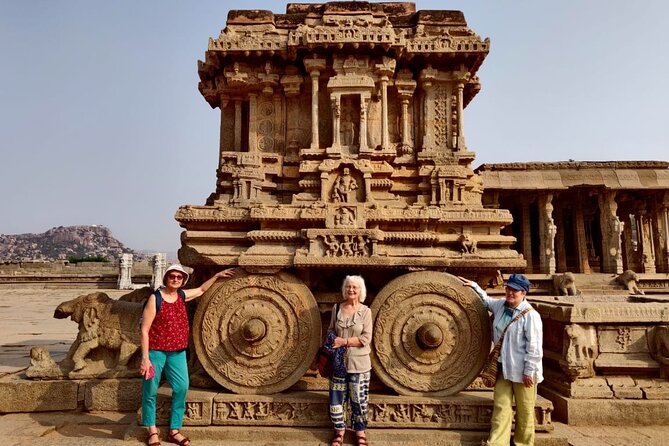
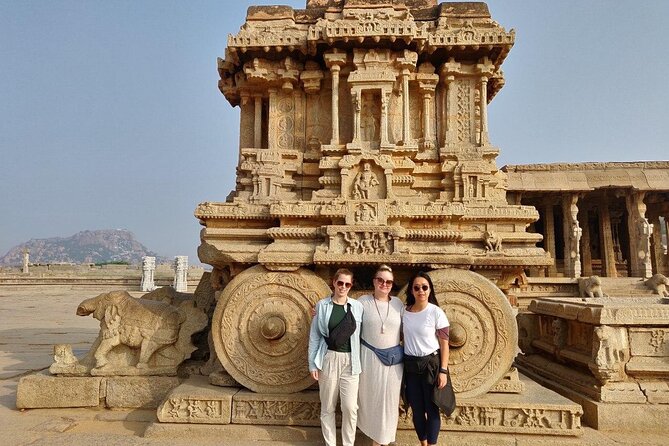
You begin at Vijaya Vittala Temple, often considered the grand centerpiece of Hampi. The temple complex sits on a polyhedron foundation, and that technical detail matters because it hints at the engineering level behind the place. Even if you’re not an architecture person, the site feels intentional—like every block was put there for a reason.
Then you reach the famous stone chariot in front. It’s the kind of monument where your brain goes quiet for a second. It’s not just big; it feels like a sculpture that somehow became part of the temple’s ritual space, not an afterthought.
Time note: you’ll typically spend around 30 minutes here. That’s enough to take photos, look closely at the chariot, and get the main story from your guide. If you love slow photography or want to chase every corner detail, you may wish you had more time—but for a one-day plan, this is a strong start.
Potential drawback: because this is the first major stop, it can set the pace for the rest of the day. If you show up tired, you’ll feel rushed. Plan to start the day feeling fresh.
King’s Balance: The Legend Behind a Simple Stone Frame
Next is King’s Balance, a big stone frame east of Purandara Mantapa. On paper it sounds like a weird detour. In person, it’s more interesting because it’s tied to a legend: the idea that generous kings weighed their goods to confirm fairness.
The structure itself is straightforward—two pillars with a beam placed across. But that’s exactly what makes it work. Your guide’s job here is to connect the physical marker to how the Vijayanagara rulers wanted to be seen, especially around trade and public trust.
Expect about 15 minutes. That short slot is fine because this stop is more about concept than exploring a sprawling complex. You’re there to learn the meaning, glance around, and move on—no long endurance test.
Virupaksha Temple and the Tower You Can See from Far Away
Then you get to Virupaksha Temple, described as the oldest temple in Hampi. It’s from the Hoysala period, and your guide’s explanation helps you understand why that matters: it adds depth beyond the Vijayanagara era you hear about most.
The tower is the star. It rises in eleven storeys to about 165 feet, and you can often spot it even before you’re right next to the complex. That gives you a natural orientation point. When the rest of Hampi feels like scattered ruins, this helps you keep your bearings.
Time note: again, about 30 minutes is typical. That’s enough time to appreciate the vertical scale and walk through the immediate temple areas without needing a half-day detour.
Possible drawback: if you’re sensitive to crowds or you’re photographing at peak time, you may lose a few minutes. The good news is that a pro guide can help you focus on the key views so you don’t burn time waiting for the perfect shot.
Sasivekalu Ganesha: An 8-Foot Single-Block Stop
Now you shift to something very visual and very Hampi. Sasivekalu Ganesha Temple features a huge single-block statue of Lord Ganesha—about 8 feet tall. Single-block carving is one of those things that’s hard to fully grasp until you’re standing near it.
This is one of those stops that feels less like a lecture and more like a direct experience. The statue fills your attention quickly, and the scale does the teaching for you.
Expect around 15 minutes. It’s short, but it breaks up the longer temple complexes so your day stays varied.
Practical tip: keep your camera ready, but also take a moment without shooting. This kind of carving is easiest to understand when you slow down for 30 seconds.
Ugra Narsimha and the Serpent Detail Near Badavi Linga
A few minutes later, you reach Ugra Narsimha, reportedly the biggest idol in Hampi. The statue is about 22 feet high and was carved during Krishnadevaraya’s time. There’s also a serpent with an open hood at the back, which is the kind of small detail that makes the scene feel alive rather than purely monumental.
This stop often lands well with people who enjoy myth and iconography, because the body language of Narsimha reads as power made solid. Your guide’s interpretation helps you see it as part of the site’s religious storytelling, not just a giant sculpture.
Time note: plan on 15 minutes. It’s enough to appreciate the height and the symbolic details without turning it into a full half-hour of stand-staring.
Potential drawback: if you’re spending most of your day under direct sun, this giant statue can still be uncomfortable to look at for long. Go at your own pace, and use shade breaks when you can.
Royal Enclosures, Queen’s Bath, and the Layout of Power
This is where Hampi starts to feel like a functioning city instead of a set of monuments. The Royal Enclosures were the seat of power of the Vijayanagara kingdom. Here you see durbar halls, platforms, tanks, underground chambers, and temples.
The tour begins at Queen’s Bath. Even if you’ve seen baths in other Indian temple complexes, this one stands out because it ties beauty to governance—water, ritual, and the idea of royal life all mixing in one planned space.
Expect about 1 hour for this section. That extra time makes sense: the Royal Enclosure area is more spread out and more concept-heavy. You’ll benefit from the guide’s ability to connect structures so they don’t feel like random ruins.
If you’re a visual learner, focus on how the enclosure groups buildings. It helps you imagine how power moved through the city—who likely visited where, and what spaces felt public versus private.
Optional add-on note: in at least one full-day experience, the plan included time for a boat ride for views of ancient temples near the water. Your exact day may vary, so treat this as a potential highlight to ask about if your schedule allows.
Zanana Enclosure and Lotus Mahal: A Different Mood
Then you step into the Zanana Enclosure, described as the place for royal women. The shift here is subtle but real. The mood tends to feel more residential and reflective compared to the broad power arenas.
The star structure is the Lotus Mahal. It’s a two-storied palace surrounded by a rectangular wall. The name itself gives you a visual hook, and once you’re there, you can see why people remember it: it’s architectural grace inside a rugged ruin landscape.
Time note: about 20 minutes. That works because this area isn’t about maximum number of structures. It’s about the key palace image and the broader idea of how royal life was organized.
Hazara Rama Temple and the Underground Shiva Temple
You’ll also visit Hazara Rama Temple, the only temple in the Royal Enclosure area dedicated to Lord Ram. It’s a shorter stop (around 20 minutes), but it’s important because it shows how devotion and authority were stitched together in the same complex.
Before the day ends, you reach the Underground Shiva Temple. This is the kind of site that’s hard to describe until you’re there, because the experience feels different from open-air temple spaces. You’re dealing with an excavated feel and a more enclosed atmosphere.
Expect around 20 minutes for this closing section, along with time near an excavated water tank and administrative enclosure. That blend makes the ending feel logical: you see not only religious power, but how the kingdom managed water and daily functions.
Practical drawback: underground and shaded areas can feel cooler, but they can also mean uneven footing. Wear shoes that let you move confidently, especially if the ground is dusty or uneven.
Price and Logistics: What You Get for $125 Per Person
At $125 per person for about 9 hours, this is a private day that includes the big-ticket convenience elements: a professional guide and admission tickets for the stops built into the route.
That ticket detail matters for value. When admission is handled for each major stop, you don’t lose time hunting for counters or paying on the spot at multiple places. It also keeps the day smoother, which is the whole point of a private plan.
Also, the tour is designed to work even if you’re traveling with a small group. Group discounts are listed as a feature, and the tour being private means your pacing and photo needs are easier to manage.
One more detail that affects the “day feel”: confirmation is provided at booking, and the tour uses a mobile ticket. That reduces last-minute hassle.
Timing Tips So Your Hampi Day Doesn’t Feel Like a Sprint
You start at 8:00 am, which is smart. Morning light helps with photos, and the heat tends to be less intense earlier in the day. It also gives you a buffer if you linger at the bigger sites like Vijaya Vittala and Virupaksha.
Because the plan hits nine stops, you’ll want to travel light. Bring water, sun protection, and simple snacks. You’ll likely find time for lunch—one full-day experience included a lunch stop at Mango Tree—but don’t count on every day having the exact same spot.
Photo strategy that works: take wide shots first at each main monument, then spend a few minutes on one or two details. For example, at Vijaya Vittala, the stone chariot is the anchor image. At Ugra Narsimha, look for the serpent detail at the back. Doing this keeps you from wandering endlessly and missing your next stop.
Who This Private Tour Fits Best
This tour fits best if you want major Hampi sights in one day without turning the day into planning chaos. It’s ideal for:
- First-timers who want the key monuments and the story behind them
- People who prefer a set route with a professional guide
- Small groups who value comfort, like a car with AC
- Travelers who don’t want to rent vehicles or manage multiple tickets by themselves
If you’re the type who loves spending hours in one temple complex, you might feel that one day is tight. That’s not a deal-breaker—Hampi is simply big. A longer stay can let you return to your favorite site with fresh eyes.
Should You Book This Hampi 1-Day Private Tour?
I’d book it if your goal is clear: see Hampi’s headline temples and royal areas in a single 9-hour day with a guide who can connect the landmarks into one story. For most people, the biggest win is pacing plus understanding—so the ruins don’t blur together.
Skip it (or consider adding time) if you hate time pressure or you want deep, slow exploration of every site. Hampi rewards repeat visits. Still, for a one-day plan, this is a strong way to get the core experience without stress.
FAQ
How long is the Hampi 1-day private tour?
It runs for about 9 hours (approx.), covering multiple major heritage sites.
What time does the tour start?
The start time is 8:00 am.
Is pickup included?
Yes, pickup is offered.
Is this tour private or shared?
This is a private tour/activity. Only your group participates.
Are admission tickets included?
Admission tickets are included for the listed stops on the route.
What is the price per person?
The price is $125.00 per person.
Do I get a mobile ticket?
Yes, the tour includes a mobile ticket.
How far in advance is it commonly booked?
On average, this experience is booked 44 days in advance.
What is the cancellation policy?
You can cancel for free up to 24 hours in advance for a full refund.
Is the tour suitable for most travelers?
The tour indicates that most travelers can participate.