REVIEW · BRISTOL
Bristol Harbourside History Tour
Book on GetYourGuide →Operated by Wrong Turn Tours · Bookable on GetYourGuide
Bristol’s harbour has always had a story to tell. This Bristol Harbourside History Tour takes you along the water in a small group to connect what you see today with the harbour’s 700-year past, from early global trade to ships, industry, and the modern waterfront.
I like that it’s guided by a human (Tim), not an app. And I like the way it mixes big historical turning points with street-level details you can actually notice on a walk.
One heads-up: the meeting spot can be missed if you only skim the directions. If you’re the kind of person who hates wandering in circles, read the meeting-point section carefully and arrive a few minutes early.
What Makes This Tour Worth Your Time
- Tim’s stories are interactive, with questions encouraged throughout the walk
- Small group size (limited to 10) keeps things personal and helps the pace feel relaxed
- You’ll trace the harbour’s arc: medieval beginnings to modern tourist destination
- The tour covers serious themes too, including slavery and the Cabot controversy, without dodging questions
- You end with an easy break at a café by the harbourside (coffee and pastries are not included)
In This Review
- A 90-Minute Bristol Harbourside Walk with Tim
- Finding the Red Buoy Meeting Point (and the Blue Notebook)
- From Medieval Trade to the World’s First Ocean Liner
- Dockyard Life, Ships, Statues, and City Changes You Can See
- When Bigger Ports Took Over: How the Harbour Reinvented Itself
- Questions Welcome: Slavery, Cabot, Banksy, and City Politics
- Practicalities: Flat Walking, Cobblestones, One Road Crossing, and a Rain Plan
- Price and Value: What $16 Buys You in a Small Group
- Should You Book This Tour?
- FAQ
- How long is the Bristol Harbourside History Tour and how much walking is there?
- Where exactly should I meet my guide?
- Will the tour run in bad weather?
- Is the tour wheelchair accessible, and how large is the group?
- Is this a self-guided tour or led by a person?
- How much does the tour cost?
A 90-Minute Bristol Harbourside Walk with Tim
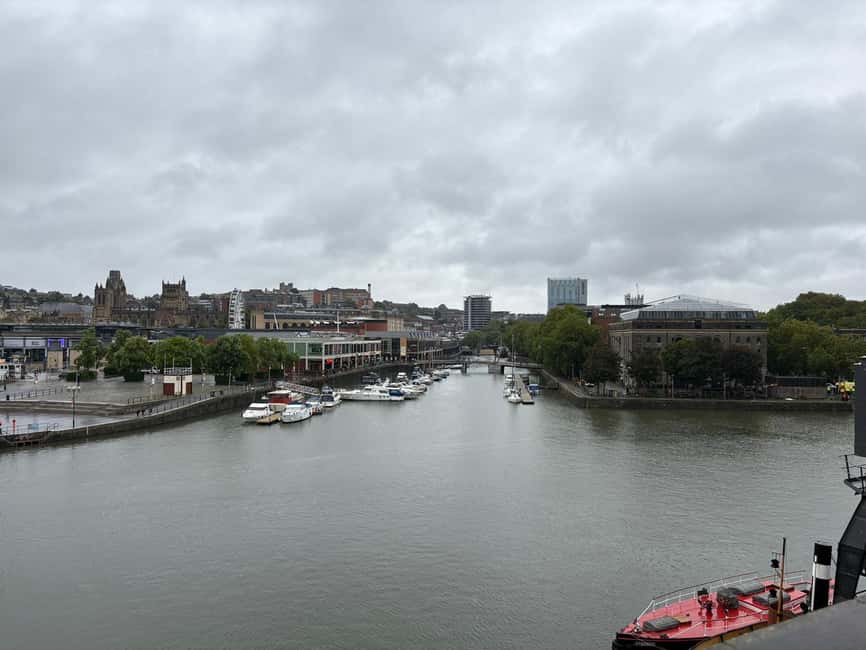
If you want Bristol to make sense quickly, start at the harbour. The city’s story isn’t just in museums; it’s written along the quays, in the shape of the waterfront, and in the ships and statues you spot as you walk. This tour is built for that exact purpose: a focused 90 minutes that links what you’re looking at to what it meant when the harbour was Bristol’s engine for trade and movement.
I like that the tour does more than list dates. It connects cause and effect. The harbour’s early growth helped kick off the scramble to the New World. Later, it played a role in major maritime milestones, including the claim that it built the world’s first ocean liner. Then, as shipping needs changed, the waterfront had to fight to stay relevant while bigger deepwater ports rose in importance.
The vibe is also a practical one. You’re not stuck listening to a monologue while the scenery passes by. The guide encourages questions, and the walk stays at a comfortable pace—so you can actually hear what matters and still look around.
And yes, it’s mostly an easy stroll. The walking distance is just over 1.1 miles (1.8 km), largely flat, which means you can spend your energy on paying attention rather than managing your legs.
Finding the Red Buoy Meeting Point (and the Blue Notebook)
Let’s talk logistics—because one wrong turn can waste 20 minutes of a good tour.
You meet your guide by the red buoy, in front of the floating restaurant Under The Stars. Your guide will be holding a blue notebook. That’s the landmark combo to anchor yourself.
One reason this matters: a few past participants felt the meeting-point instructions could be clearer. So don’t assume. Instead, do what works: get to Under The Stars a few minutes early, find the red buoy, and look for the blue notebook.
If you arrive late, you might end up doing the most common travel move in the world: guessing. This tour is short enough that guessing is risky. You’ll enjoy it more if you start on time with everyone else.
From Medieval Trade to the World’s First Ocean Liner
The core promise here is simple: you’ll see the harbourside you’re already Googling, then you’ll understand it. The harbour has a timeline that stretches back around 700 years, and the guide uses the waterfront as the timeline’s “map.”
Early on, the harbour’s development mattered because Bristol wasn’t just watching global change—it was helping push it. The tour frames how the harbour supported long-distance voyages and how Bristol’s ambitions fed into the scramble to the New World. You’ll also hear about how the harbour grew from a working water system, including the idea that it captured two rivers—a reminder that harbours aren’t only built with stone and docks, but with engineering choices that shape the water itself.
Then comes the moment that gives the tour extra punch: the claim that the harbour built the world’s first ocean liner. Even if you only know the basics of ocean liner history, it’s a big anchor point. It helps you understand that this wasn’t a quiet local port. This was a place making ships for a world that was getting smaller.
This section is where the “why” really lands. You’ll start noticing how the harbour’s layout connects to movement, scale, and the kind of maritime ambition that shaped Bristol’s identity.
Dockyard Life, Ships, Statues, and City Changes You Can See
Here’s the part I’d call street-smart. The tour doesn’t treat the harbourside like a static postcard. It treats it like a changing workplace—then and now.
As you walk, you’ll hear what life was like at the harbour’s peak: the human side of shipping and dock work, where vessels aren’t just objects but tools of livelihoods. You’ll also learn how the harbour’s identity was shaped by what arrived, what was built, and what was demanded by the economy.
The guide also ties in the visible details. Past participants specifically mentioned learning about ships and statues, and how those details connect back to the harbour story. That’s a key difference between a “see it” tour and a “make sense of it” tour. When you connect the physical objects to the bigger story, you walk away with memories that actually stick.
And Bristol doesn’t keep its history only in the distant past. The walk is also built to connect the harbour to modern Bristol culture. Some topics show up as part of the overall city picture, including local art and landmarks that people often recognize, like references to Banksy and the Shawn the Sheep studio. The payoff is that you finish thinking, Oh, so that’s why the waterfront feels like it does.
When Bigger Ports Took Over: How the Harbour Reinvented Itself
Every waterfront faces the same pressure sooner or later: the world’s shipping needs change. Larger ships need deeper access. Trade patterns shift. And the old harbour has to either adapt or fade into background scenery.
This tour explains that tension clearly. You’ll hear about the struggle to keep the harbour intact in the face of modernisation and the march of larger, deepwater ports. That part matters because it helps you understand why the harbour looks the way it does today—not just aesthetically, but politically and economically.
Then you get the other side of the story: how the harbour remodeled itself into a modern destination for tourists and locals alike. In other words, it didn’t simply “survive.” It transformed its purpose, carving out space for recreation, viewing, and local life while still carrying reminders of its working past.
I like how this avoids turning history into a museum-only vibe. It treats the harbour as a living civic problem and solution—something Bristol had to negotiate over time. That’s the kind of context that makes your next walk through the city feel sharper.
Questions Welcome: Slavery, Cabot, Banksy, and City Politics
Some history tours keep things light, safe, and purely celebratory. This one doesn’t. You’ll talk about hard parts of the harbour’s past, including slavery, and you’ll also hear about the Cabot controversy. If you have questions, the guide doesn’t brush them off.
One of the strongest pieces of feedback was that the guide didn’t mind expanding on slavery when it was close to a participant’s concerns. That’s important. It means the tour can handle real discussion rather than forcing you to swallow history as a neat, sanitized timeline.
The tour also connects history to local civic thinking—participants mentioned city politics as part of what the guide addressed. That can sound abstract, but it’s not. When you learn how decisions were made about the harbour, you start understanding why certain changes happened and why other things were fought for.
And yes, it also includes the fun stuff. References to Banksy and the Shawn the Sheep studio aren’t treated like gimmicks. They show how Bristol layers its identity: serious maritime legacy on one side, street art and playful culture on the other. The guide’s job is to stitch it together so your understanding feels whole, not randomly mixed.
If you enjoy tours where you can ask questions without feeling silly, this one fits that style well.
Practicalities: Flat Walking, Cobblestones, One Road Crossing, and a Rain Plan
Let’s keep it practical. The tour is 90 minutes long with a total walking distance of just over 1.1 miles (1.8 km). The route is mostly flat, which makes it approachable for lots of people.
Still, plan for the details that can trip you up:
- There can be cobblestones.
- There’s an occasional road crossing.
- The tour goes ahead rain or shine, so bring appropriate footwear and clothing.
This matters because the best tours are the ones you can enjoy without worrying about slipping, sore feet, or wet discomfort. Wear shoes you can walk in comfortably on uneven surfaces.
Group size is another real-world factor. The tour is limited to 10 participants, so it doesn’t turn into a crowded shuffle. That’s also why questions work. You’re not shouting over a hundred voices to ask one thing.
At the end, there’s a café where you can take in the harbourside with fresh coffee and pastries. This is not included in the price, but it’s a smart finish. You get a natural moment to pause, look back at what you just learned, and decide what to do next.
Price and Value: What $16 Buys You in a Small Group
At $16 per person, this is the kind of price that’s hard to argue with—especially because the tour is led by a live guide, not a phone system. You’re paying for context, pacing, and the ability to ask questions on the spot.
The value also comes from the format. With a small group of up to 10, you’re more likely to get personal attention and answers that match what you care about—whether that’s ship history, Bristol’s political story, or the tougher topics like slavery.
One more factor: the tour is only 1.8 km of mostly flat walking. That means the cost isn’t tied to a huge physical commitment. You can do this on a day when you’ve already been sightseeing and still feel like you added something meaningful.
If you’re the type who hates committing too early, the tour offers a reserve-and-flex option (you can book now and pay later). That kind of flexibility can make a difference when your day plan is still shifting.
Should You Book This Tour?
I’d book it if you want Bristol’s harbourside to make sense fast and you like history with real edges—engineering, global trade, difficult topics, and modern waterfront life all in one walk. It’s also a great fit if you enjoy interacting with a guide and don’t want to be stuck listening at a distance.
Skip it only if you prefer purely visual sightseeing with minimal conversation, or if you strongly dislike walking on cobblestones and uneven pavement. Otherwise, this is a well-priced, human-led way to get beyond surface-level views.
If you’re short on time, this tour is a strong anchor experience. It gives you the background to appreciate what you’ll see after—whether you’re staying in Bristol for one day or a week.
FAQ
How long is the Bristol Harbourside History Tour and how much walking is there?
The tour lasts about 90 minutes and covers just over 1.1 miles (1.8 km) of mostly flat walking.
Where exactly should I meet my guide?
Meet by the red buoy in front of the floating restaurant Under The Stars. Your guide will be holding a blue notebook.
Will the tour run in bad weather?
Yes, it goes ahead rain or shine. Wear suitable footwear and bring weather-appropriate clothing.
Is the tour wheelchair accessible, and how large is the group?
Yes, it is wheelchair accessible. The group is limited to 10 participants.
Is this a self-guided tour or led by a person?
It’s a live, English-speaking tour guide. It’s not an app-based tour.
How much does the tour cost?
The price is $16 per person.