REVIEW · JEJU
Jeju Island UNESCO Heritage Bus Tour
Book on Viator →Operated by Jeju Travel Lucas · Bookable on Viator
Jeju runs best when you plan it. This 2-day Jeju UNESCO tour is a tight, efficient way to hit the island’s major natural sites without renting a car. I like how the stops are grouped by region and geology, so your brain doesn’t feel like it’s doing cartwheels. I also really appreciate that English support is built in through Jeju Travel Lucas, and guides like Andy and Terry come up in a very practical way. The main drawback: the exact vehicle and guide coverage can change with group size.
What I like most is the blend of UNESCO-level geology plus culture stops that make the natural sites feel more meaningful, not just scenic. The tour also uses smart fallbacks when key places get closed, like Manjang Cave during construction. One thing to keep in mind is that you’re on a schedule, so the beaches, caves, and viewpoints can be weather- and tide-dependent.
If your goal is to see a lot on Jeju and you don’t want to stress over routes, this works. If you’re the type who wants total freedom to linger for hours, you may feel a bit rushed.
In This Review
- Key things to know before you go
- Value and what $125 really buys on Jeju
- Two-day flow: how the itinerary hangs together
- Day 1 Stop 1: Saryeoni Forest Path for a calm start
- Day 1 Stop 2: Seongeup Folk Village and the fortress-minded houses
- Day 1 Stop 3: Seopjikoji vs Sangumburi, and why month matters
- Day 1 Stop 4: Seongsan Ilchulbong and the women diver show
- Day 1 Stop 5: Jongdal-ri coast road and hydrangeas in summer
- Day 1 Stop 6: Hamdeok Beach, with Haenyeo Museum as the rainy fallback
- Day 1 Stop 7 (construction swap context): Manjang Cave and the underground wow
- Day 2 Stop 1: Hallasan National Park and the Eoseungsaengak baby volcano
- Day 2 Stop 2: O’sulloc Tea Museum for a slower, calmer break
- Day 2 Stop 3: Sanbangsan Mountain and the Sanbanggulsa cave temple
- Day 2 Stop 4: Yongmeori Coast, volcanic beach, and tide rules
- Day 2 Stop 5: Cheonjeyeon Falls, three drops and the Pond of God
- Day 2 Stop 6: Daepo Haean Jusangjeolli Cliff and UNESCO Geo Park columns
- Day 2 Stop 7: JEJU ART CIRCUS and a rainy-day energy option
- How the guide setup affects what you actually experience
- Practical tips that make the schedule feel easier
- Who this tour suits best
- Should you book Jeju Island UNESCO Bus Tour?
- FAQ
- What is the duration of the Jeju Island UNESCO Bus Tour?
- How much does the tour cost?
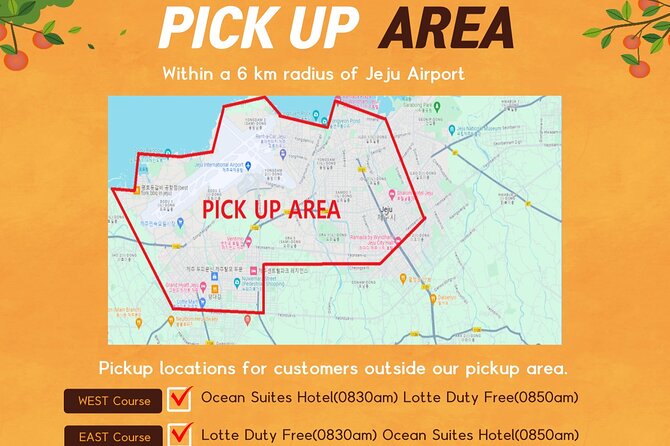
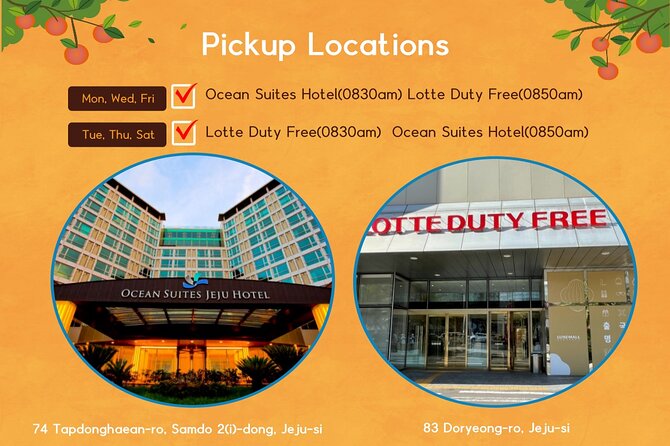
- Does the tour include hotel pickup and drop-off?
- What’s included in the tour price?
- What happens on rainy days?
- Is Manjang Cave included?
- Is a guide always provided in English?
- What is the minimum number of travelers for the tour to operate?
Key things to know before you go
- East and West UNESCO rotation: the tour runs different UNESCO days depending on the weekday, so check your day.
- Weather swaps are real: rain can trigger replacements like Haenyeo Museum or Circus World.
- Manjang Cave is temporarily closed: the plan substitutes Hamdeok Beach during construction.
- Seongsan Ilchulbong is a highlight: you get UNESCO context plus the women diver show.
- Guide support depends on group size: smaller groups may have a driver who speaks English instead of a full guide.
- You’ll cover both coast and crater areas: it’s not only temples and viewpoints.
Value and what $125 really buys on Jeju
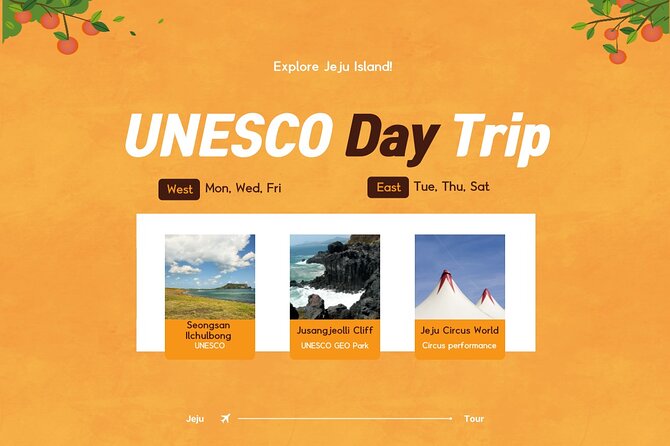
At $125 per person for about two days, this is one of those prices that feels fair once you count what’s included. You’re not just paying for seats on a bus. You’re paying for the workflow: pickup and drop-off inside Jeju City downtown, transportation (van/minibus/bus depending on the group), and English help from the operator team.
Jeju can get expensive fast if you add taxis back-to-back. This tour is built for people who want to avoid that. Even with some admission tickets noted as free, you’re still getting organized time at the big hitters—especially the UNESCO sites and the geology-focused stops that are hard to string together without a plan.
One practical note: outside Jeju City downtown, pickup and drop-off requires an extra 80,000 KRW one way. If you’re staying farther out, do the math early so you don’t get surprised.
Two-day flow: how the itinerary hangs together
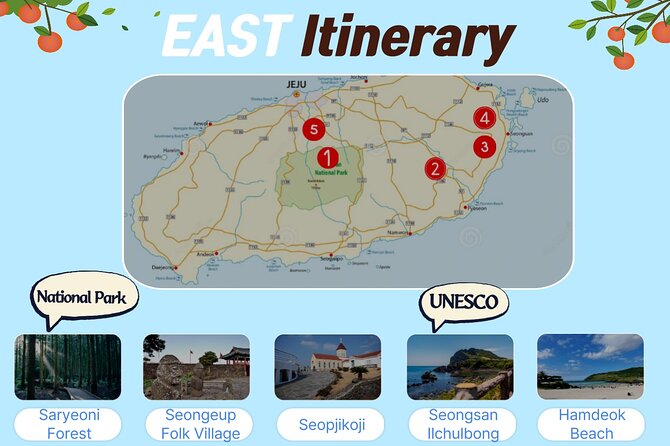
This isn’t just a random list of places. The order makes sense: day 1 leans into the eastern UNESCO core, then day 2 expands into more volcanic, coastal, and waterfall scenery in the southern/central stretch. You also get cultural context baked in with stops like Seongeup Folk Village and the Haenyeo Museum.
Day 1 is the geology-and-coast push, with:
- forest and folk village time
- Seopjikoji or Sangumburi (season-dependent)
- Seongsan Ilchulbong (UNESCO, plus the women diver show)
- coastline viewpoints
- Manjang Cave substitute if needed
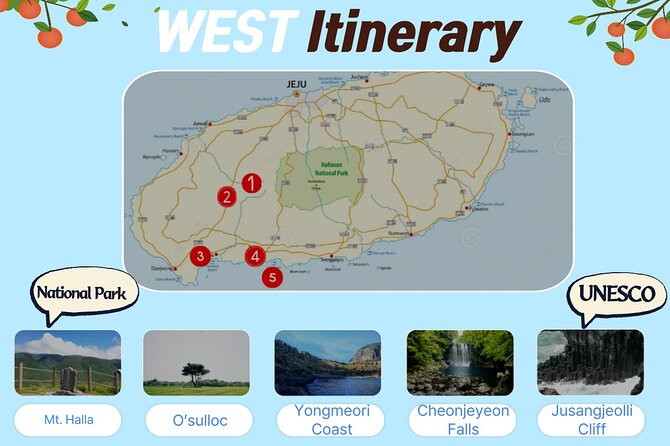
Day 2 is the crater-and-waterfalls push, with:
- Hallasan National Park (or a rainy-day swap)
- Osulloc tea area
- Sanbangsan cave/temple stop
- Yongmeori Coast (or another swap)
- Cheonjeyeon Falls
- Jusangjeolli columns (UNESCO Geo Park)
- and an art circus performance option, especially for rainy weather
Day 1 Stop 1: Saryeoni Forest Path for a calm start

You begin with Saryeoni Forest Path, a protected trail that people talk about as one of Jeju’s top lesser-known spots. The big value here is pacing. You’re not jumping straight into rocks and sea cliffs. You get a reset in a real forest walk style setting.
The time is about 50 minutes, and admission is free. Wear shoes you don’t mind getting dusty. This is the type of stop where you’ll do best if you keep your expectations simple: quiet, shaded paths, and a break before the more intense sightseeing.
Day 1 Stop 2: Seongeup Folk Village and the fortress-minded houses
Next is Seongeup Folk Village, which preserves how things were built and lived. The standout detail is the stone piles designed to help protect rooftops from wind, plus the overall defensive logic tied to historical threats—homes and structures meant to withstand invasion risk.
You’re in the area for about 50 minutes, and admission is free. This stop works well because it adds a human layer to Jeju. You’re learning how people adapted to wind, weather, and the island’s conditions—not just photographing rocks.
Day 1 Stop 3: Seopjikoji vs Sangumburi, and why month matters
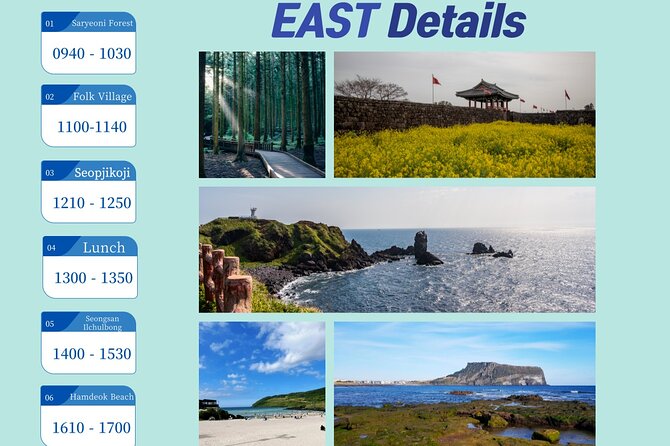
Then you hit Seopjikoji on this route, described as especially great in April when canola flowers bloom. There’s a practical twist: the tour notes that Seopjikoji can be replaced with Sangumburi in October.
If you’re traveling in October to December, Sangumburi tends to shine because the ridges can turn gold, and the scenery is tied to seasonal grasses. The tour suggests October specifically instead of Seopjikoji, which is a helpful heads-up if you want peak color rather than “anytime views.”
Expect about 40 minutes here. Admission is free. If you’re hoping to do serious hiking, this is more of a viewpoint-and-walk stop than a long trail.
Day 1 Stop 4: Seongsan Ilchulbong and the women diver show
This is one of the most iconic stops on Jeju. Seongsan Ilchulbong (Sunrise Peak) is a UNESCO heritage site built from hydrovolcanic eruption origins, with a preserved crater bowl and inner structures shaped by sea cliffs.
You get about 1 hour 20 minutes, and admission is included. The real added value, compared with many “just show up and pose” stops, is the note about a women diver show included with this UNESCO visit.
I like this stop because it gives you something more than a single photograph angle. You can understand what you’re looking at: a tuff cone and crater form that’s basically a geology lesson you can walk around.
Day 1 Stop 5: Jongdal-ri coast road and hydrangeas in summer
Next comes Jongdal-ri, including coastal passing views and a segment of Jongdalri Shore Road. The tour specifically calls out hydrangeas in summer, plus a coastline drive with points like Hado Beach and Saehwa Beach.
Time is about 40 minutes, and admission is free. This stop is a good one to treat as scenery + a quick refresh, not a long destination. If you’re sensitive to heat or strong sun, plan to use the short timing well—water, shade when you can, and keep moving.
Day 1 Stop 6: Hamdeok Beach, with Haenyeo Museum as the rainy fallback
Then you get to Hamdeok Beach. The tour mentions that on rainy days it can be replaced by visiting the Haenyeo Museum.
You also get a key logistics detail here: Manjang Cave is currently closed due to anti-falling construction, and it’s scheduled to reopen in August 2025. During this construction period, Manjang Cave is substituted with Hamdeok Beach.
This matters because Manjang Cave is one of those “only in Jeju” experiences people plan around. If your trip falls during construction, you’ll be glad the tour has a ready swap rather than leaving you disappointed. Expect about 1 hour and admission is free at these points.
Day 1 Stop 7 (construction swap context): Manjang Cave and the underground wow
Normally, this part of the day is where you’d visit Manjanggul Lava Tube, described as the world’s largest known lava tube and famous for a “Stone Turtle” shape. The tour notes it feels like stepping into an underground place, which is exactly the kind of sensory experience that makes Jeju feel different from mainland Korea.
But right now, construction closures change the plan. If you’re traveling before August 2025, assume the lava tube may be out of the picture and lean into the substitute sites the tour provides.
Also note: the tour mentions the cave is sometimes closed on the first Wednesday of every month, which can trigger an alternative path with the Haenyeo Museum as well.
Day 2 Stop 1: Hallasan National Park and the Eoseungsaengak baby volcano
Day 2 starts at Hallasan National Park. You’ll visit [Eoseungsaengak], described as an oreum (a baby volcano) called out by the tour.
The time here is about 1 hour, and admission is included. If it’s rainy, Hallasan can be replaced by Circus World. This is a very Jeju move: you’re chasing weather-proof plans because island weather can flip fast.
A small practical tip: if the weather is questionable, bring a light layer. Rain can mean slippery walkways even if the actual stops are short.
Day 2 Stop 2: O’sulloc Tea Museum for a slower, calmer break
Next is O’sulloc Tea Museum, Korea’s first tea museum (opened in 2001). The tour notes Osulloc Tea Stone next to the museum with various tea experience and cultural activity programs.
Time is about 1 hour, and admission is free. This stop gives you a break from volcanic formations and ocean viewing. It also adds contrast: Jeju isn’t only rocks and waves; it’s agriculture and culture too.
Day 2 Stop 3: Sanbangsan Mountain and the Sanbanggulsa cave temple
Then you’re at Sanbangsan, a 395-meter dome-shaped volcano. The tour’s detail you’ll care about: there’s a natural stone cave in the mountain called Sanbanggulsa Temple, with a Buddha statue, plus a legend about water drops as tears from a goddess.
Time is 30 minutes, and admission is included. This is one of those “short stop, memorable feature” moments. If you like places where nature and worship spaces overlap, this one fits.
Wear shoes with grip. Cave environments can be cool and damp.
Day 2 Stop 4: Yongmeori Coast, volcanic beach, and tide rules
After that comes Yongmeori Coast, a volcanic beach made by ash from explosions when hot magma met cold seawater. The name means dragon’s head, and the view is tied to the narrow path down to the beach plus a sandstone cliff.
Time is about 1 hour, admission is included. The big consideration: entrance may not be permitted during rising tides or bad weather. The tour also says that if Yongmeori Coast is closed, Mt. Songaksan becomes the alternative.
This stop is worth it when conditions cooperate, but it’s also a reminder that Jeju’s coast runs on tides. If you hate uncertainty, this is the part of the day where you’ll feel it.
Day 2 Stop 5: Cheonjeyeon Falls, three drops and the Pond of God
Next is Cheonjeyeon Falls, called The Pond of God. The tour breaks it into three sections, with a structure of waterfall levels and a cave feeding the first drop into a pool, then cascading into two more falls.
Time is about 40 minutes, and admission is included. I like how this one is easy to understand as you walk. You can follow the flow: cave to pool to waterfall steps.
Bring a poncho if rain is possible. Wet rocks are part of the deal.
Day 2 Stop 6: Daepo Haean Jusangjeolli Cliff and UNESCO Geo Park columns
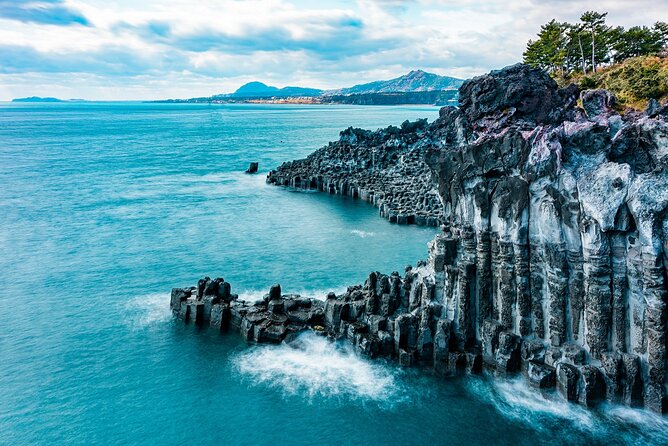
Now you hit the standout geology feature: Daepo Haean Jusangjeolli Cliff, designated as UNESCO Geo Park. The tour notes columnar joints with black hexagon pillars that look like a folding screen, right where waves crash.
Time is 50 minutes, and admission is included. This stop is often the one people remember because it’s visually dramatic without requiring big physical effort.
If the ocean is rough, don’t stand too close to the edge where signs tell you not to. It’s tempting, but safety wins.
Day 2 Stop 7: JEJU ART CIRCUS and a rainy-day energy option
Finally, the tour includes JEJU ART CIRCUS (Jeju Art Circus). The tour describes a circus performance using Chinese-technique style plus elements tied to Arirang, and it also mentions a popular motorcycle show.
Admission is free, and the tour notes that on rainy days Hallasan is replaced by Circus World. This makes the circus a practical plan-B that also turns the day into something fun instead of just “indoors time.”
If you’re traveling with kids or anyone who gets bored sitting around waiting for weather to improve, this can be a smart choice.
How the guide setup affects what you actually experience
This tour is run by Jeju Travel Lucas, and the tour structure changes based on group size.
- With minimum 13 travelers, it proceeds with the standard plan.
- Up to 4 individuals can join at the same price as a regular taxi with an advanced English-speaking driver.
- Groups of 5 to 10 get an English-speaking guide (described as a minivan setup).
- 10+ people can get a van or larger vehicle, with an English-speaking guide, up to 35 travelers.
This is why some people feel they got a guide, while others feel they mainly had a driver who handled logistics. If you care a lot about narrated interpretation at every stop, your best odds are in the group-size bands that include a professional English-speaking guide, not just a driver.
One name that’s especially tied to positive experiences in the provided info is Andy. Another commonly mentioned is Terry, and there are also references to Mr. Lee and Mr. Kim in high marks. That’s not just trivia; it tells you the operator invests in English capability, not only transport.
Practical tips that make the schedule feel easier
1) Plan for weather and closures. Manjang Cave is closed during construction until August 2025, and coastal spots like Yongmeori can close due to tides or bad weather. Don’t build your hopes around one single viewpoint being available every day.
2) Pack for quick transitions. This is a “move, stop, learn, move” style day. Light rain gear, water, and comfortable shoes will save you more time than anything fancy.
3) Take notes on what fits your taste. If you love geology, prioritize Seongsan Ilchulbong and Jusangjeolli columns. If you want culture context, make sure you don’t rush Seongeup Folk Village or Haenyeo Museum on rainy days.
4) Be ready for short timed stops. Many stops are around 30–50 minutes. That doesn’t mean you can’t enjoy them. It means you should choose your viewing points fast and keep moving.
Who this tour suits best
This Jeju UNESCO bus tour fits best if you:
- want to cover a lot across a short trip
- don’t want to rent a car or plan routes between distant sites
- like guided context, especially for UNESCO sites and geology
- travel in a group or are comfortable joining a set itinerary
It’s also a good option for people who want the east-side highlights (Seongsan Ilchulbong and the surrounding UNESCO area) plus the southern coastal geology and waterfalls on day 2.
If you’re a “slow traveler” who needs long free time at each location, you might find the stop lengths frustrating. The tour is designed for efficiency, not wandering.
Should you book Jeju Island UNESCO Bus Tour?
I’d book it if your priority is getting the core Jeju natural highlights efficiently with transportation and English help handled for you. The value shows up in the way the days are structured around UNESCO geology and in how the tour adapts to real-life issues like rain and construction.
I would hesitate only if:
- you’re traveling during periods when you really, truly need Manjang Cave (because the plan is substitute-based until August 2025)
- you want maximum flexibility to linger at each stop
- your group expectations require a full professional guide at every single stop (because the guide setup depends on group size)
If that matches you, this is a solid way to see Jeju without turning your vacation into a logistics project.
FAQ
What is the duration of the Jeju Island UNESCO Bus Tour?
The tour runs for 2 days (approximately).
How much does the tour cost?
The price is $125 per person.
Does the tour include hotel pickup and drop-off?
Yes, hotel pickup and drop-off are included within Jeju City downtown area only. Pickup/drop-off outside that area costs an extra 80,000 KRW one way.
What’s included in the tour price?
Included are transportation, driver/professional English tour guide, and hotel pickup and drop-off in Jeju City downtown. Some attraction admissions are listed as included and others are listed as free.
What happens on rainy days?
The itinerary includes multiple rainy-day swaps, such as Haenyeo Museum instead of certain outdoor stops and Circus World as an alternative when Hallasan is affected. There are also tide or weather-related alternatives for some coastal stops.
Is Manjang Cave included?
The tour notes Manjang Cave is currently closed due to anti-falling construction and scheduled to reopen in August 2025. During the closure period it’s substituted with Hamdeok Beach.
Is a guide always provided in English?
English support depends on your group size. The tour provides an English-speaking guide for some group sizes, while smaller groups (up to 4) may travel with a regular taxi driver who has advanced English skills.
What is the minimum number of travelers for the tour to operate?
The tour requires a minimum of 13 travelers. If the minimum isn’t met, you may be offered an alternative date/experience or a full refund.