REVIEW · HALIFAX
Half-Day Historical Tour of Halifax
Book on Viator →Operated by Halifax Titanic Historical Tours · Bookable on Viator
Halifax has a way of grabbing you fast. This 6-hour history-and-harbour tour runs deep without feeling like a lecture. I love that the group stays small, so your guide can actually answer questions and slow down when something matters.
I especially like how the tour jumps between big turning points and human stories, from Acadians and deportation to the people connected to Titanic and the Halifax Explosion. The mix of driving views plus short walks keeps it moving.
One drawback to think about: with a tight cruise schedule, you may not see every stop. If your ship has a short port call, plan your timing carefully and build in buffer for getting back.
In This Review
- Key things I’d circle before you go
- A half-day that covers serious ground in Halifax
- Pickup, vehicle comfort, and how the day actually feels
- Pier 21 and the Gateway to Canada: start where the stories land
- The Halifax Farmers Market: 1750 roots to modern waterfront life
- Dartmouth’s quiet power: founders, art, shipping legends
- Georges Island and the Acadians: forts, tunnels, and folklore
- HMCS Sackville, the Maritime Museum, and why the harbour matters
- Halifax’s church skyline and civic buildings: beauty with scars
- Cemeteries on the route: where Halifax keeps receipts
- Halifax Citadel and the Noon Gun: the tradition you can feel
- The Halifax Explosion memorial trail: Mont Blanc in steel and stone
- Point Pleasant Park and university-era Halifax: life between the wars
- Fisherman’s Cove and Evan’s Seafood: the payoff after the facts
- Price and value: what $131.43 buys you
- When this tour is the best match (and when to be careful)
- Should you book this Halifax Historical Tour?
- FAQ
- FAQ
- How long is the Half-Day Historical Tour of Halifax?
- What’s the group size?
- Is pickup available?
- Where does the tour start?
- Is lunch included?
- Is bottled water and WiFi provided?
- Are admission tickets included?
- What should I do if the weather is bad?
- Can I drive and park near the meeting point?
- What language is the tour in?
Key things I’d circle before you go

- Small group (max 10) with a guide who tells the stories and can flex with the day
- Pickup and drop-off from downtown hotels and cruise areas, so you’re not wrestling transit
- Georges Island history with forts, tunnels, Acadian holding grounds, and lighthouse lore
- Halifax Explosion and Mont Blanc memorial stops, including a bell tower and physical relics
- Cemeteries tied to major events, from early Halifax graves to Titanic victims
- Fisherman’s Cove for the fun, colorful payoff and photo-friendly waterfront vibes
A half-day that covers serious ground in Halifax
This is listed as a half-day, but it’s built like a best-of program. Expect about 6 hours, which means you’ll cover a lot of Halifax’s downtown landmarks, plus Dartmouth and Fisherman’s Cove, using mostly driving time with several short stops.
That structure is the point. Halifax is spread along the harbour, and a lot of the most important sites are outdoors or in places you wouldn’t casually route yourself. This tour helps you see the whole map in one shot—then leaves you with clear targets for what to explore later on your own.
You can also read our reviews of more tours and experiences in Halifax.

Pickup, vehicle comfort, and how the day actually feels

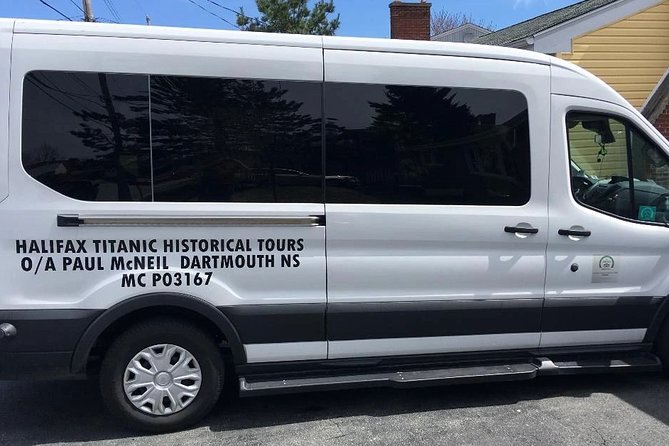
The tour runs with a comfortable, high-roof 15-passenger van (Ford Transit 350 XLT). You get bottled water and WiFi on board, plus air conditioning—handy because Halifax weather loves changing its mind.
You’ll have a practical meeting point: 1041 Marginal Rd, near the harbour (and if you’re driving to Pier 22, the parking is described as secure and priced for all-day use). If you’re on a cruise or arriving by the port route, you meet at Pier 22 Parking Lot.
Most days, the experience feels smooth because you’re not managing transportation between neighbourhoods. In a small group (minimum 4, maximum 10), that also means you’re less likely to get stuck waiting for a dozen people with different walking speeds.
Pier 21 and the Gateway to Canada: start where the stories land
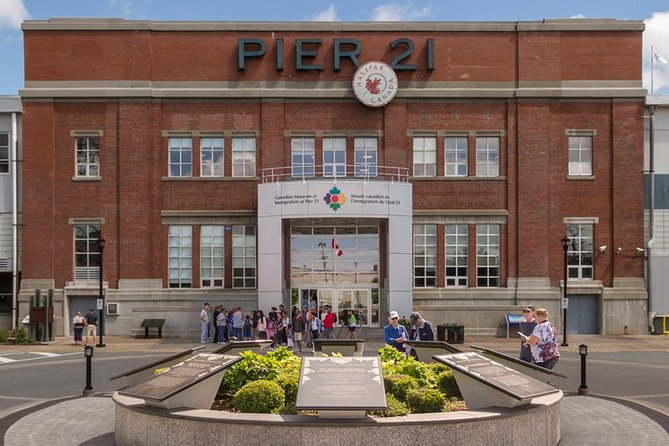
The day kicks off with Pier 21, described as the Gateway to Canada. This is a smart opening because it gives you a human “why” before you hit the landmark “what.”
From there, you’ll start seeing Halifax as more than a postcard harbour. The route connects immigration, shipping, and military power—ideas that show up again and again across the rest of the tour.
The Halifax Farmers Market: 1750 roots to modern waterfront life

You’ll stop at the Halifax Farmers Market, and the history here is the surprise. The market was created by Royal Proclamation in June 1750, a year after Halifax’s founding, and it originally operated as a mix of produce and livestock space—not just flowers and local jam.
You also learn how the site evolved when Halifax incorporated in 1848. The location shifted through the years, and in 2010 the market moved to the Seaport area, now known as the Halifax Seaport Farmers’ Market, described as the longest continuously running market in North America with over 250 vendors.
Practical tip: if you want snacks later, this stop is a good moment to grab something light. If you’re saving your appetite for lunch, you’ll still enjoy watching how the market anchors the waterfront.
Dartmouth’s quiet power: founders, art, shipping legends
The tour leans into founders and creators, and it does it in ways that feel personal rather than textbook.
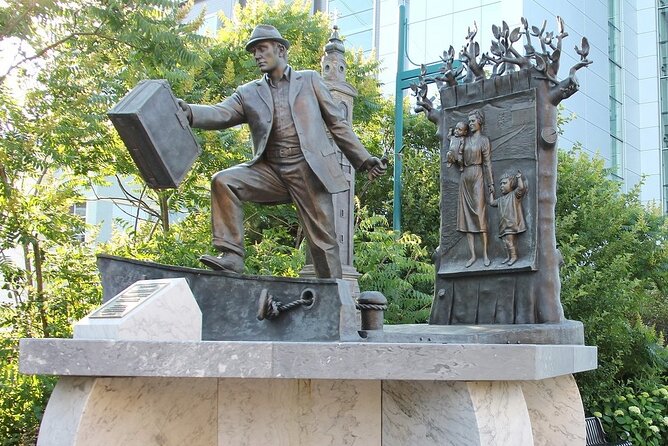
You’ll hear about Armando Barbon, an Italian immigrant who came to Canada in 1951. His artwork (with the story of family separation and reunion) is presented as a gift to Canada, which makes the stop more than a “look, a sculpture” moment. It’s the kind of detail that helps Halifax feel lived-in.
You’ll also hear about Sir Samuel Cunard, born in Halifax and linked to the Cunard Line, plus Alexander Keith and Keith’s Nova Scotia Brewery—said to have opened nearly 200 years ago. The tour frames these as shipping-era wealth and craft culture in the same breath, which is exactly how Halifax’s identity developed.
Georges Island and the Acadians: forts, tunnels, and folklore
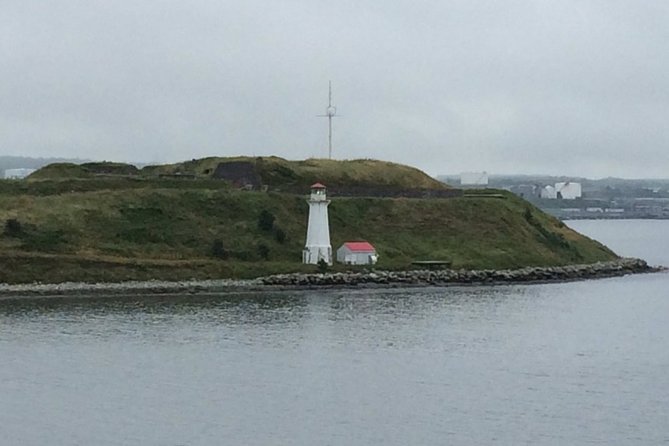
Georges Island is one of the most historically loaded stops on the route. The explanation you’ll get focuses on the island’s strategic location in the middle of Halifax Harbour, which helped it become a centerpiece of British seaward defenses across the 18th and 19th centuries.
You’ll also hear about Fort Charlotte, seaward-facing batteries, and an underground tunnel complex. Add in the note about one of Canada’s early fully automated lighthouses, and you start to understand how much engineering lived on this one piece of land.
The most sobering part is the Acadian connection: between 1755 and 1763, during Le Grand Dérangement (The Great Upheaval), Georges Island became a holding area for large numbers of Acadians. That’s followed by how the island’s tunnels and hidden spaces fed local folklore over generations.
This is a “pay attention” stop. If you like history that comes with real consequences, you’ll probably want a slower walk and a few extra minutes to look at the harbour views between the facts.
HMCS Sackville, the Maritime Museum, and why the harbour matters
You’ll visit HMCS Sackville, described as the only one of 269 Allied corvettes from WWII that remains in service as Canada’s Naval Memorial. The stop also connects to how many corvettes were built in Canada, tying national industry to global events.
There’s also a strong recommendation built into the tour plan: the Maritime Museum of the Atlantic. It’s positioned as the kind of place you’ll get more from either before or after this tour, because it covers convoys, sailing eras, steam age, and major exhibits linked to Titanic and the Halifax Explosion.
If you only have time for one extra add-on, aim for the museum if you want the deeper artifacts and visuals. If you already love walking among memorials and structures, HMCS Sackville and the outdoor stops may feel like enough.
Halifax’s church skyline and civic buildings: beauty with scars

This part of the route gives Halifax its architecture identity. You’ll hear about:
- The iconic Round Church (Saint George’s), built in 1800, made to fit the growing Little Dutch Church community, designed in a Palladian style.
- Saint Mary’s Cathedral Basilica, a National Historic Site with Gothic Revival design.
- Halifax City Hall (1887–1890) as a National Historic Site.
- Province House (opened 1819), Canada’s oldest legislative building and home to Canada’s first elected House of Assembly.
- Government House, described as the oldest official residence in Canada and the long-time home of the sovereign’s representative in Nova Scotia.
- Historic Properties, a National Historic Site featuring restored waterfront warehouse blocks with Victorian-Italianate façades.
Here’s what I like about this sequence: it’s not just “pretty buildings.” The tour ties each place to governance, faith communities, and the city’s evolution after major shocks.
You’ll also hear about relics tied to the 1917 Halifax Explosion, like the Ghost Window and wood embedded in interior walls at the oldest cathedral building in Halifax (as described in the route notes).
Cemeteries on the route: where Halifax keeps receipts
If you don’t like somber stops, this may be the toughest part of the day. But it’s also one of the most meaningful segments, because Halifax treats memory as a public practice.
You’ll see or hear about multiple cemeteries, including:
- Camp Hill Cemetery, replacing the Old Burying Ground in 1844, with notable interments listed like Viola Desmond, Alexander Keith, Joseph Howe, and Titanic survivor Miss Hilda Mary Slayter.
- Old Burying Ground, with more than 1,200 head-and-foot stones and a stone-walled green space setting.
- Fort Massey Cemetery, tied to British and Canadian soldiers and maintained by Veteran’s Affairs Canada.
- Holy Cross Cemetery, with 25,000 people buried since 1843, including Irish-descent notables like Sir John Sparrow Thompson. The route also includes Our Lady of Sorrows Chapel and the note about 1,800 people building it in a single day.
- Mount Olivet Cemetery, described as the Forgotten Titanic Cemetery, including markers for Roman Catholic Titanic victims.
- Fairview Lawn Cemetery, where 121 Titanic victims are interred (and more Halifax Explosion-related markers are mentioned in the route notes).
The tour’s tone matters here. In practice, it’s handled with sensitivity so it doesn’t feel exploitative. If you want to learn how disasters change a city’s identity, these stops do that quickly and honestly.
Halifax Citadel and the Noon Gun: the tradition you can feel
The highlight in downtown for many people is Halifax Citadel National Historic Site, also called Fort George. You’ll time the stop around the Noon Gun, a tradition described as happening since 1856, and a Changing of the Guards element associated with the 78th Highlanders.
You’ll also learn why the location mattered: the present Citadel completed in 1856 is the fourth fort system on Citadel Hill, and the star shape and defensive ditch explain how the site was designed so no enemy could approach easily. Even if you don’t love forts, it helps you understand the harbour’s “security-first” era.
If you’re a photographer, bring your patience. This is a “be there when it matters” stop.
The Halifax Explosion memorial trail: Mont Blanc in steel and stone
This is the emotional core of the tour. You’ll hear how the Halifax Explosion on December 6, 1917 killed 1900–2000 people, wounded another 9000, and left 25,000 homeless—described as the largest man-made explosion until the atom bomb.
The route includes the Halifax Explosion Memorial Bell Tower on Fort Needham, which overlooks the devastation area. The tower’s original bells are described as connected to Barbara Orr, who lost her entire family in the explosion.
Then you connect the story to physical remnants of the day. The tour includes:
- A note about hydrostone being used in reconstruction planning to reduce fire danger, with details like hydraulic pressing and production in Eastern Passage.
- A stop where a cannon thrown about three miles to Albro Lake in Dartmouth is mentioned as later recovered.
- The Mont Blanc Anchor Site, where you’ll see an anchor shaft from SS Mont Blanc said to have flown about 2.3 miles after the explosion.
This is one of the best “why this matters” parts of Halifax. You’re not just told tragedy happened. You’re shown how the city rebuilt using specific materials and how the blast scattered pieces into the landscape.
Point Pleasant Park and university-era Halifax: life between the wars
After the heavy stops, the tour shifts pace. You’ll pass Point Pleasant Park, described as a historic 75-hectare wooded park with easy winding trails and preserved ruins of early fortifications. It’s also described as having multiple wheelchair-accessible trails.
You’ll also hear about education and civic time:
- Dalhousie University, founded in 1818 with the intent of a non-denominational college.
- King’s College, established in 1789, described as the oldest chartered university in Canada and the first English-speaking university in the Commonwealth outside the UK.
- Sir Sandford Fleming Park (The Dingle), tied to Standard Time Zones and with the Dingle Tower dedicated in 1912 for representative government.
If you’re wondering why Halifax felt so “organized” in its institutions, these stops give the cause-and-effect. It’s a city shaped by shipping deadlines, military structures, and then governance and learning.
Fisherman’s Cove and Evan’s Seafood: the payoff after the facts
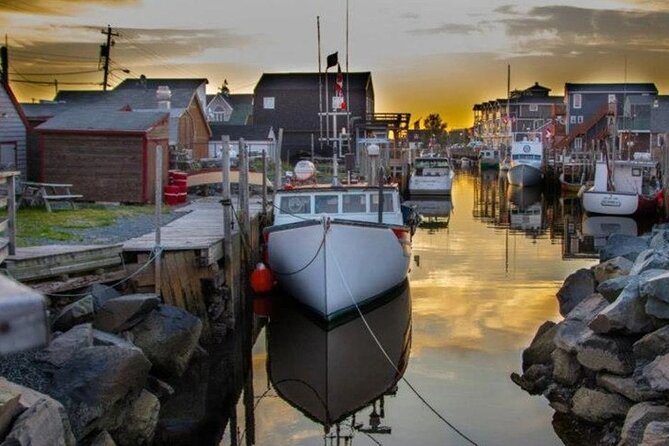
The day ends with lighter energy. Fisherman’s Cove is described as a restored 200-year-old working fishing village with lots of photo opportunities. It’s the kind of stop where you can finally exhale, take a few pictures, and see Halifax’s coastal personality.
Lunch is optional (not included). If you choose it, the route includes Evan’s Seafood, described as fresh Nova Scotia seafood with an amazing view of Halifax. They mention orders are phoned ahead to speed things up, and gluten-free options are noted in the lunch description.
I’d treat lunch here as a bonus, not a requirement. If you’re tired from the memorial and cemetery stops, you might prefer grabbing something quick and stretching your legs around the cove.
Price and value: what $131.43 buys you
At $131.43 per person for about 6 hours, this tour is priced more like an education-forward experience than a “quick sightseeing” bus ride. You’re paying for small-group time, transport between distant stops, and a guide who connects locations instead of listing them.
Two things make the value feel real:
- You don’t have to plan routes across Dartmouth, the waterfront, and the memorial sites.
- The storytelling is structured, so your stops come with meaning—especially around the Halifax Explosion, Mont Blanc, and the Titanic-related cemetery markers.
Your cost stays lower than “book everything separately” days because transportation and guided context are built in. If you love history and want it placed in context quickly, the price starts to make sense fast.
When this tour is the best match (and when to be careful)
This tour is a strong fit if:
- You want a guided run through Halifax’s biggest chapters without car rental.
- You like photography and landmark viewpoints, especially along the harbour.
- You’re okay with a few emotionally heavy stops if you’re there to learn, not just to sightsee.
Be extra careful if:
- Your cruise port call is tight. One of the practical risks is losing time if the ship needs you back early. Build in buffer, and don’t assume you’ll finish every optional corner.
Also bring rain gear if the weather turns. The route involves short walks, and Halifax loves to test footwear.
Should you book this Halifax Historical Tour?
If you want a guided day that treats Halifax as both a working harbour city and a place where major events still show up in buildings, bells, cemeteries, and relics, I’d book it. The small group size, pickup convenience, and the way the route connects Pier 21 to Georges Island to the Halifax Explosion Memorial Bell Tower make this more than a checklist tour.
Skip it only if you hate somber history or your schedule is so tight that you can’t absorb a few delays. Otherwise, this is one of the more efficient ways to get your bearings fast—and understand why Halifax looks the way it does today.
FAQ
FAQ
How long is the Half-Day Historical Tour of Halifax?
It runs for approximately 6 hours.
What’s the group size?
The tour has a minimum of 4 guests and a maximum of 10 guests.
Is pickup available?
Yes. Guests can be picked up at any listed downtown hotel. Cruise and driving guests can meet at Pier 22 Parking Lot at 1041 Marginal Road.
Where does the tour start?
The meeting point is 1041 Marginal Rd, Halifax, NS B3H 4P7, Canada.
Is lunch included?
No. Lunch is not included, though there is a seafood stop at Evan’s Seafood where you can order.
Is bottled water and WiFi provided?
Yes. Bottled water and WiFi on board are included.
Are admission tickets included?
Some stops list admission ticket not included, such as Halifax Citadel. Other stops are listed as free.
What should I do if the weather is bad?
The experience requires good weather. If it’s canceled due to poor weather, you’ll be offered a different date or a full refund.
Can I drive and park near the meeting point?
Yes. Parking at Pier 22 is described as secure, with a $10 CAD all-day fee.
What language is the tour in?
The tour is offered in English.