REVIEW · HURGHADA
Luxor’s Ancient Wonders:Day Expedition from Hurghada (Group Tour)
Book on Viator →Operated by Eyes of Egypt · Bookable on Viator
Luxor hits fast, even from Hurghada. This group day trip strings together four of Egypt’s biggest-name sites—Hatshepsut, the Valley of the Kings, Colossi of Memnon, and Karnak—so you get serious ancient Egypt in a single long day. I like the practical setup: hotel pickup/drop-off plus air-conditioned transport, and I also like that the itinerary is time-planned so you’re not just driving and hoping. One thing to keep in mind: you’ll spend a lot of the day on the road (about 4 hours each way), so it’s not a slow, leisurely outing.
If you’re going to Luxor for the first time and want the highlights, this is a solid way to do it. I’m especially fond of the Hatshepsut stop—this is a queen’s temple that really shows why her reign mattered—and Karnak’s scale is the kind of sight that makes you forget you’re on a schedule. The only real drawback is that it’s a group tour with limited time at each stop, so if you want lingering, detailed tomb-hunting, you may feel a bit rushed.
In This Review
- Key Things To Know Before You Go
- Price and Value for a 12–13 Hour Luxor Day
- Getting From Hurghada to Luxor (And Why Timing Feels Long)
- Temple of Hatshepsut at Deir el-Bahari: Where the Architecture Tells the Story
- Valley of the Kings: Tomb Culture, Names You’ve Heard, Colors You Can Still See
- Colossi of Memnon: A Short Stop That Still Hits
- Karnak Temple: The Big One, Dedicated to Amon-Ra and Family
- Lunch in Luxor: A Welcome Reset on a Long Day
- The Group Tour Reality: What You Gain, What You Trade
- Who This Trip Fits Best (And Who Should Think Twice)
- Should You Book Luxor’s Ancient Wonders From Hurghada?
- FAQ
- FAQ
- How long is the Luxor day expedition from Hurghada?
- What stops are included during the day?
- Are entrance tickets included?
- Is hotel pickup and drop-off included?
- What food is included?
- What tour options can I choose from?
- How does cancellation work?
Key Things To Know Before You Go
- A single-day highlights route: Hatshepsut, Valley of the Kings, Colossi of Memnon, Karnak—planned to fit 12 to 13 hours.
- Guides matter here: the Golden and Diamond options include an expert guide, and a great guide can make the story click (one standout name I heard was Mimo).
- Entrance ticket coverage depends on your option: Diamond includes entrance tickets; other options may differ.
- Short visits, big payoffs: expect about 1 hour at Hatshepsut, 1.5 hours at the Valley of the Kings, and 1.5 hours at Karnak.
- Group size stays reasonable: maximum 30 travelers, so it’s not a cattle-car situation.
- Lunch is included: you’ll have a restaurant meal in Luxor, which helps on a day this long.
Price and Value for a 12–13 Hour Luxor Day
This trip is priced at $55 per person, and that matters because Luxor is far enough from Hurghada that you’re paying for more than sightseeing—you’re paying for the full day logistics. The value improves further because pickup and drop-off are included, along with comfortable air-conditioned transport and lunch in Luxor.
You’ll also want to think in terms of what’s included at each “tour option” level. The Silver option is built around shared transfer and lunch. The Golden option adds an expert guide on top of the transfer and lunch. The Diamond option is the most complete—transfer, guide, lunch, and entrance tickets.
If you’re the kind of person who enjoys history but doesn’t want to play archaeologist for a day, I’d lean toward Golden or Diamond. A good guide doesn’t just give facts; they help you read what you’re seeing, like how Karnak’s layout connects to the gods it was built for, or why Hatshepsut’s architecture sends a message about power and legitimacy.
You can also read our reviews of more tours and experiences in Hurghada.


Getting From Hurghada to Luxor (And Why Timing Feels Long)
You start in Hurghada, with pickup timing based on meeting at the start point. The schedule gives you a clear sense of the day’s rhythm: about 4 hours to get to Luxor, then another 4 hours back. Between those drives, you’ll visit the main sites and stop for lunch.
That means this trip is best for people who can handle a “big day” without needing extra breaks. If you’re picky about pace, be honest with yourself: you’ll be trading free time for a packed route. On the bright side, the driving is handled for you by a licensed driver familiar with the route, in a newer model, air-conditioned vehicle—so at least you’re not sorting transportation on your own.
A practical tip: plan your energy for the long haul. Bring water, a hat, and sun protection. You’ll be outside at sites, and the day’s length means you’ll feel the heat and walking more than you might expect.
Temple of Hatshepsut at Deir el-Bahari: Where the Architecture Tells the Story
Your first major site after the drive is Temple of Hatshepsut at Deir el-Bahari. This is one of those places where you quickly understand why certain rulers are remembered. The temple is dedicated to Queen Hatshepsut, and it’s described as a turning point in Ancient Egyptian architecture—so you’re not just looking at old stones. You’re seeing how style, planning, and symbolism were used to communicate authority.
You’ll have about 1 hour here, which is enough time to walk the main areas and get oriented, especially with an expert guide on the Golden or Diamond options. Without a guide, you can still enjoy it—you’ll see the scale, the dramatic setting, and the craftsmanship—but a guide can help you connect the temple design to the queen’s message.
What I like about this stop is that it sets the tone for the rest of the day. After Hatshepsut, the Valley of the Kings feels like a continuation of the same obsession: building worlds for eternity. It’s a quick jump from politics and architecture to burial culture, and it works.
Valley of the Kings: Tomb Culture, Names You’ve Heard, Colors You Can Still See
Next up is the Valley of the Kings. This is the burial valley where Egypt’s elite were laid to rest, including famous names like Tutmosis I, Tutmosis III, Tut-Ankh-Amon, Ramssess VI, Mrenptah, and Amonhotep II. Even if you don’t memorize those names, the point lands fast: this is where rulers were meant to move into the afterlife.
You’ll spend about 1 hour 30 minutes here, and entrance is listed as included at this stop. The schedule also notes that the colors inside the tombs are well preserved. That’s important because tombs can be impressive without being readable; here, the preserved color makes the interior feel more alive and less like an empty shell.
A reality check: one of the limits of a group day is that tombs are time-sensitive. You might not get to do everything you want in a “choose-your-own-adventure” way. So go in knowing you’re doing a highlights pass. Pick a tomb focus—either the ones that match the famous names or the interiors that have the best preservation—and let that be your win for the day.
Also, be ready for the mood shift. Valley of the Kings sites can feel cooler and dimmer compared to the bright daylight outside. That’s normal—just keep an eye on comfortable footwear and watch your step.
Colossi of Memnon: A Short Stop That Still Hits
Then comes Colossi of Memnon, a shorter visit of about 30 minutes. These are the remains of the mortuary temple of Amenhotep III—and even as fragments, they carry weight. Think of it as a pause between major story sites. You’ll get your photo moment, but there’s also enough information tied to the location to make it more than a quick stop.
Because the time here is brief, you’ll want to arrive ready to look up and around. It’s easy to treat this like a photo backdrop. Try instead to connect what you’re seeing to what it used to be: part of a larger mortuary complex tied to Amenhotep III’s legacy.
If you’re someone who likes your “short stops” to feel meaningful, this one does the job. It keeps the itinerary moving without skipping this iconic Luxor detail.
Karnak Temple: The Big One, Dedicated to Amon-Ra and Family
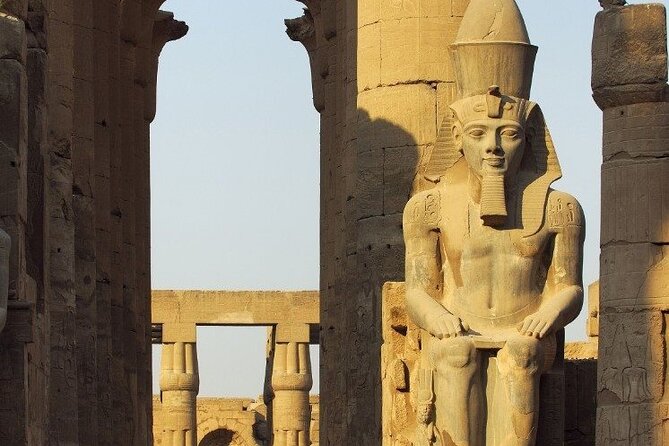
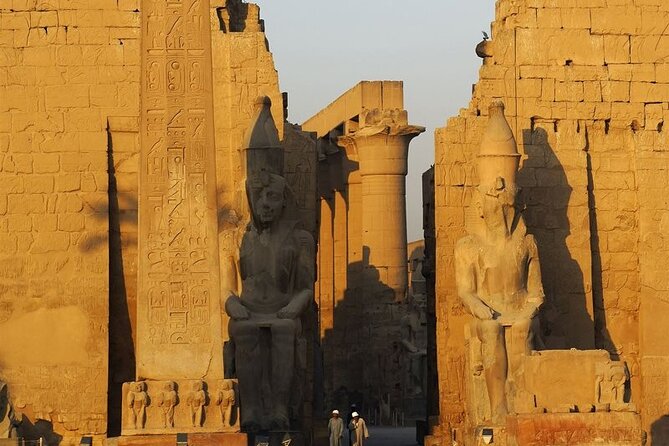
Your final major stop is Karnak Temple, scheduled for about 1 hour 30 minutes. This is the biggest temple on the list, dedicated to Amon Ra and his wife Mut and their son Khonsu. Construction is noted as starting around 2000 B.C., which helps you grasp the scale of long-term building—this isn’t one project. It’s a long religious and political statement stretching across generations.
This is where a guide can make a noticeable difference. With an expert guide, you’ll understand the temple’s purpose, why certain areas matter, and how the sections relate to one another. Even without that, you’ll still feel the size and the sense of a complex built to awe visitors and worshippers.
What I’d watch for here is “visual overwhelm.” When you arrive, take a minute to orient yourself. Look for the major axes and the parts of the layout that match your guide’s explanation (if you chose Golden or Diamond). Then you can enjoy the details without getting lost in the sheer amount of stone.
By the time you’re done at Karnak, your brain will be full. That’s okay. The ride back to Hurghada will give you space to let it all settle.
Lunch in Luxor: A Welcome Reset on a Long Day
Lunch is included in all the tour packages listed, with the meal at a restaurant in Luxor. For a trip that runs 12 to 13 hours, this is more than a checkbox. It keeps you from spending your limited time searching for food after a full morning of sites.
Because the tour focuses on major monuments, the lunch is best seen as a fuel stop, not the highlight of the day. If you’re sensitive to timing, eat like you have a plan: quick, steady, then you’re ready to keep moving.
One note from what I’ve learned from real-world experience with long Egypt day programs: if you’re considering adding extra optional activities later, don’t build your schedule too tight. A packed monument day can throw off plans like sunset timing, even when everything looks doable on paper.
The Group Tour Reality: What You Gain, What You Trade
This is a shared group tour with a maximum of 30 travelers. That size is helpful. You’ll have people around, you can compare notes, and it usually stays manageable. But it also means you won’t get total freedom of pace. Stops are set: about 1 hour at Hatshepsut, 1 hour 30 minutes at the Valley of the Kings, 30 minutes at Colossi, and 1 hour 30 minutes at Karnak.
Here’s what you gain: structure. The driver and schedule keep the day efficient, and the order matters. You move through Luxor’s key story sites rather than bouncing randomly.
Here’s what you trade: extra time. If you’re the type who likes to linger in quiet corners or if you want to study carvings without interruptions, you may wish for more hours. That’s not a flaw—it’s just the nature of fitting four major highlights into one day.
Who This Trip Fits Best (And Who Should Think Twice)
This tour is a good fit if you:
- Are staying in Hurghada and want a one-day Luxor hit without arranging private transport
- Want the classic Luxor lineup in one organized schedule
- Like having history explained during the stops (especially if you choose Golden or Diamond)
- Prefer a group setting with a cap of 30 travelers
It may not be ideal if you:
- Want a slower pace or lots of spare time for wandering
- Have a hard time with long road days (about 8 hours driving total)
- Plan to stack another big activity the same day after returning to Hurghada
Should You Book Luxor’s Ancient Wonders From Hurghada?
If you’re a first-timer to Luxor and you want the essentials—Hatshepsut, Valley of the Kings, Colossi of Memnon, and Karnak—this is one of the most practical ways to do it from Hurghada. The $55 price point makes sense for a full day with pickup, A/C transport, lunch, and site entries depending on the option you select.
I’d book it if you can handle a long day and you’re comfortable with “highlights, not everything.” If you want the story behind what you’re seeing, I’d strongly consider Golden or Diamond for the expert guide and smoother ticket coverage.
If you’re chasing deep, unhurried exploration or you’re planning multiple major add-ons the same day, you might be happier with a longer stay in Luxor instead. For many people, though, this day trip is the smartest way to turn time into memories.
FAQ
FAQ
How long is the Luxor day expedition from Hurghada?
The trip runs about 12 to 13 hours total.
What stops are included during the day?
You visit Temple of Hatshepsut, the Valley of the Kings, the Colossi of Memnon, and Temple of Karnak.
Are entrance tickets included?
Entrance ticket inclusion depends on your selected option. The Diamond package includes entrance tickets, while other options may include certain admissions based on the tour details.
Is hotel pickup and drop-off included?
Yes. Hotel pickup and drop-off in Hurghada are included.
What food is included?
A lunch at a restaurant in Luxor is included in the tour options listed.
What tour options can I choose from?
There are three options: Silver (shared transfer and lunch), Golden (shared transfer, expert guide, and lunch), and Diamond (transfer, guide, lunch, and entrance tickets).
How does cancellation work?
You can cancel for a full refund up to 24 hours before the experience’s start time.