REVIEW · SANTIAGO DE COMPOSTELA
Santiago de Compostela: Urban and Heritage Tour
Book on GetYourGuide →Operated by Ars et Urbs Santiago · Bookable on GetYourGuide
Santiago teaches fast if you know where to look. This tour turns the streets of Santiago de Compostela into a readable map of heritage and urban change, using stone marks, inscriptions, and building layouts as your clues. I especially like how it connects monuments to the people and institutions that shaped daily life, and I like the guide’s skill at answering questions without rushing. The only real drawback: because it’s about interpretation, it moves at a thinking pace, so if you only want photos and quick hits, you may want a different style of walk.
You start with the city’s modern “green lung” on the Alameda, then shift into the medieval quarter where eras overlap in surprising ways. The group is kept small (10 max), it runs in Spanish and English, and it’s wheelchair accessible, which makes it easier to actually follow along. One more plus: the Pazo de Fonseca stop can include time for temporary exhibitions, so you’re not just passing by.
In This Review
- Key highlights worth your time
- Why interpret Santiago’s streets instead of just touring them
- Alameda: your first lesson in 19th-century urban life
- Rúa do Franco and the medieval quarter’s “property marks”
- A quick timing note
- Platerías and the Romanesque façade as a “sculptural puzzle”
- Pazo de Fonseca: the University origins stop you should not rush
- Praza del Obradoiro: four landmarks that finally talk to each other
- Cathedral of Santiago: a short visit with the right framing
- San Martín Pinario: from monastic space to cultural reuse
- Praza de Cervantes: a brief landing spot with useful context
- The guide factor: bilingual, small group, and Vanessa’s sharp Q&A
- Price and what $8 buys in real value
- Who should book this, and who might want a different style
- Should you book this Santiago de Compostela urban heritage tour?
- FAQ
- Where does the tour start?
- How long is the tour?
- What language is the tour offered in?
- How big is the group?
- Is this tour wheelchair accessible?
- What’s included in the guided experience?
- Does the tour include temporary exhibitions at the Pazo de Fonseca?
- Where does the tour finish?
- Is there free cancellation?
Key highlights worth your time
- You read Santiago like a historical document, not a postcard.
- Stone clues matter: shields, inscriptions, and emblems linked to specific institutions.
- You’ll learn the city’s “temporal layers” by watching how neighborhoods evolved.
- Rúa do Vilar-style details like roof peepholes help you picture older life.
- Plaza del Obradoiro is explained with context, so the four major buildings make sense together.
- A real guide back-and-forth: one guide (Vanessa) is singled out for friendly help and smart history-of-art context.
Why interpret Santiago’s streets instead of just touring them
Santiago de Compostela can feel overwhelming at first: grand façades, narrow lanes, and constant reminders that this is a pilgrimage city with deep roots. What makes this tour different is the method. You don’t just look. You interpret.
You’ll be taught how to read a city by its layout and its symbols. That means you’ll notice things like property marks carved into stone—then connect them to who owned or controlled spaces. You’ll also pay attention to silences: gaps between buildings, street widths, and the way public and private areas sit next to each other. It’s a practical way to understand why Santiago looks the way it does today.
I like that the focus stays on urbanism as much as art. A cathedral is important, sure, but the tour keeps reminding you that the surrounding homes, institutions, and streets are part of the same story.
Alameda: your first lesson in 19th-century urban life
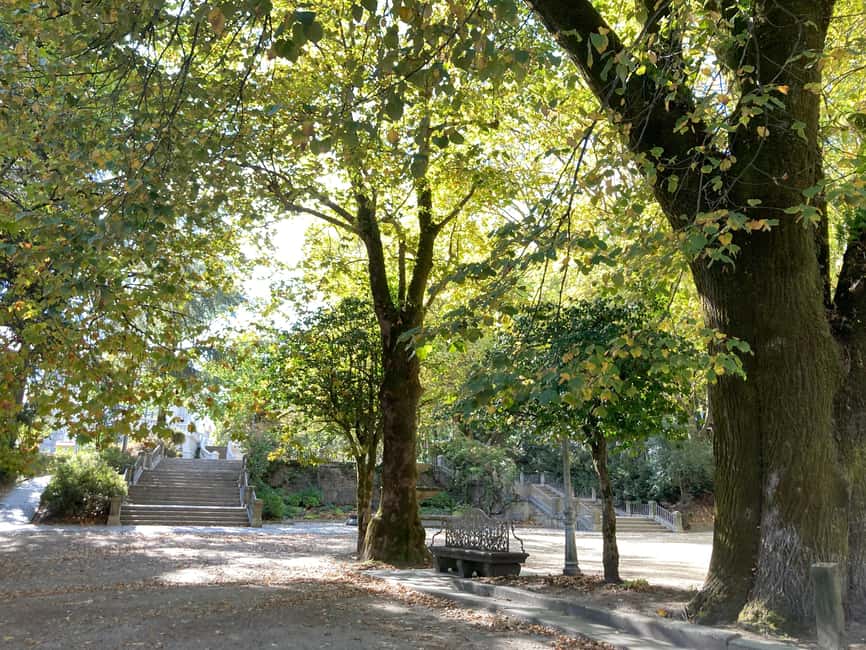
The tour kicks off at As dúas Marías, then you move into the central walk on the Alameda for about 20 minutes. The Alameda is more than a pleasant park path. It’s a witness to how Santiago modernized in the 19th century.
Here’s what you learn to look for: the idea of a public leisure typology—spaces planned for citizens to stroll, gather, and breathe—then how that same space stayed in use well into the 20th century as the city kept changing.
This is a smart warm-up stop. It sets a baseline, so when you step into the medieval quarter later, you can actually feel the shift in time. If your brain is already tired from travel, the Alameda also offers an easy on-ramp: less stair-climbing energy, more street-level perspective.
Rúa do Franco and the medieval quarter’s “property marks”
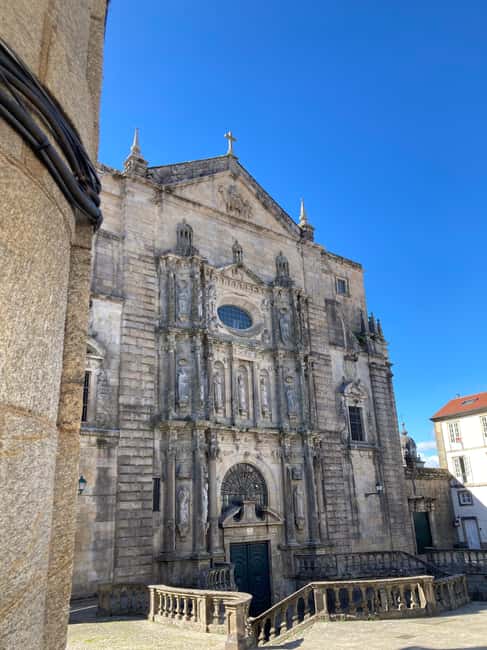
From the Alameda, the tour heads into the historic quarter, starting with Rúa do Franco (about 15 minutes). This is where Santiago’s medieval origin gets more interesting than you might expect, because the buildings you see aren’t all from one era. You’ll notice a “surprising mix” of houses from different times sitting side by side.
In streets like Rúa do Vilar (you’ll be walking in that zone), your guide points out odd details you’d miss on your own. Two examples that really change how you see the street:
- Roof peepholes, which help you imagine older property life and how people managed privacy and visibility.
- Property marks—shields, inscriptions, and emblems carved in stone—that reveal ownership or institutional ties.
This isn’t random trivia. The marks link buildings to major players in the city, such as the Cathedral’s Cabildo, the University, the Hospital of the Catholic Monarchs, and the Monastery of San Martín Pinario. Once you learn that, the stone decorations stop being decoration. They become a record of who had influence.
A quick timing note
Because this is interpretation-heavy, the guide will likely pause often to explain what you’re looking at. It’s worth it, but if you’re the type who hates stops and starts, this section may feel like it “takes longer than you planned.”
Platerías and the Romanesque façade as a “sculptural puzzle”
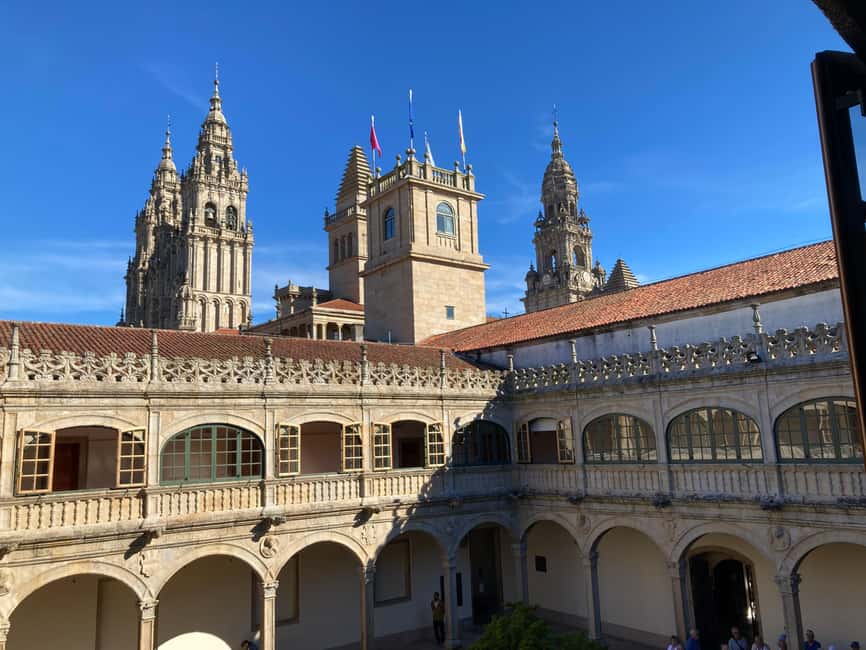
As you continue through the historic center, you’ll reach the south façade of Platerías, described as a 12th-century Romanesque jewel. What makes it especially memorable on this kind of tour is how history affected it.
Instead of a clean, fully intact façade, you’re shown a work that’s been fragmented, disjointed, and shaped by what the city went through. The guide treats it like a puzzle—helping you piece together meaning even when everything isn’t complete.
I like how this prevents the common cathedral-problem: you see big medieval art, but you don’t know what you’re looking at. Here, even broken sections get interpreted. You end up leaving with a better sense of form, style, and what Romanesque storytelling looks like in architecture.
Pazo de Fonseca: the University origins stop you should not rush
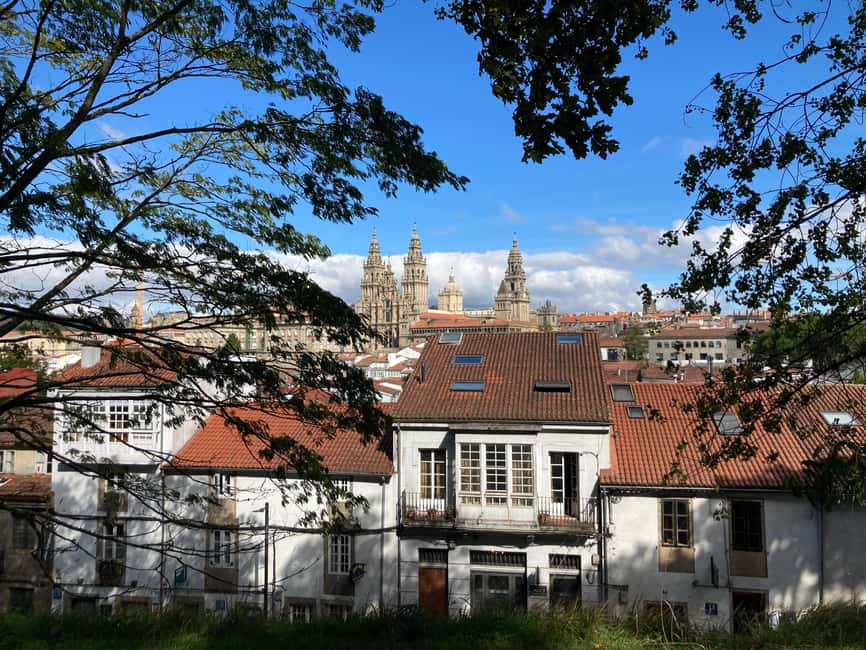
Next comes the Pazo de Fonseca (about 15 minutes). This Renaissance palace connects directly to the origins of the University, so it’s not just an impressive building—it’s a pointer to how education shaped Santiago’s institutional power.
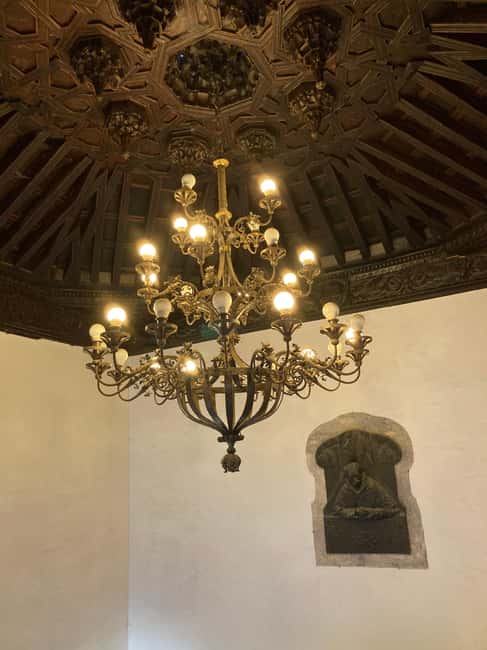
During your visit, you’ll tour the cloister and, if available, you can spend time in the temporary exhibitions in the Artesonado Room and the upper cloister. That matters because it turns the stop from a quick “look at the façade” moment into something you can absorb, especially if the exhibit theme clicks with you.
Practical upside: this is one of the rare stops where “heritage tourism” overlaps with something present-day. Even if you’re not an art museum person, the exhibitions can give context to what the University and its collections mean to the city today.
Praza del Obradoiro: four landmarks that finally talk to each other
The tour’s big set-piece is Praza del Obradoiro, with about 20 minutes here. This is where four emblematic buildings converge, and the guide’s job is to make that cluster readable.
You’ll look at:
- The baroque façade of the Cathedral
- The neoclassical Town Hall, including the sculpture of Santiago Matamoros
- The old Hospital of the Catholic Monarchs
- The University Rectorate, including a Romanesque portal that evokes the Portico of Glory
On your own, these can blend into one dramatic background. With the tour, they become a system: a religious center, a civic authority, a health institution, and an educational institution all sharing the same stage. You get a clearer picture of why Obradoiro is more than a pretty square.
If you time this right (and you follow the guide’s attention cues), you’ll also understand how architectural styles stack across centuries without losing coherence. It’s an urban lesson disguised as a sightseeing stop.
Cathedral of Santiago: a short visit with the right framing
After Obradoiro, you’ll spend about 15 minutes at the Cathedral of Santiago de Compostela. The tour angle here is interpretation, not a long museum-style itinerary.
That framing helps. Even if you already know the cathedral’s significance, the guide’s explanations aim at reading it as part of the city’s “living historical document.” You’re not just absorbing scale; you’re learning how meaning works through façades, symbols, and placement.
One caution: the stop is relatively short. If you love cathedral interiors and want deep time inside, you may need to plan a return on your own afterward. The tour is built for understanding, not for exhausting the building.
San Martín Pinario: from monastic space to cultural reuse
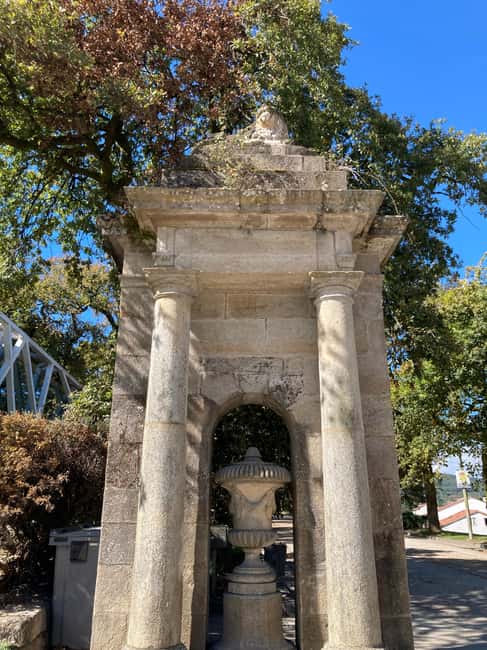
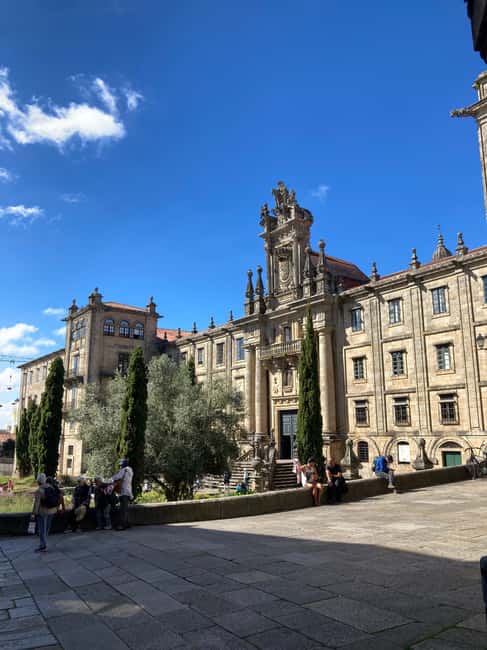
The last featured heritage stop is the Monastery of San Martín Pinario, Espacio Cultural, with about 15 minutes. This is a great capstone because it brings the story forward into the 19th century.
You’ll hear about the disendowment (the 19th-century process that transformed church property and functions) and how monastic spaces were converted into multifunctional buildings. That shift matters because it shows how heritage survives: not always as a museum, and not always in its original form, but as living space that keeps getting repurposed.
The tour ends in front of San Martín Pinario, and that’s a thoughtful finish. You get to close the loop on the theme: cities keep changing, but their identity often stays readable in what remains.
Praza de Cervantes: a brief landing spot with useful context
Before the finish, you’ll visit Praza de Cervantes for about 10 minutes. It’s a shorter segment, but in a tour like this, even “small” stops have a job: help you orient and connect what you saw earlier to what you’ll likely notice next on your own.
Since you finish at Obradoiro’s edge (in front of San Martín Pinario), this layout is useful for planning your next move: you’ll likely be well-positioned for wandering, eating, or checking out nearby spots without backtracking.
The guide factor: bilingual, small group, and Vanessa’s sharp Q&A
This is where the experience often makes or breaks. Here, the setup helps: it’s a small group capped at 10 participants, run in Spanish and English, and bilingual guidance means you can actually follow the explanation rather than catching only fragments.
One review highlights Vanessa for being friendly and for sharing important information about the historic center, plus practical tips on bookstores, the market, and restaurants. Another review praises how the guide’s dedication stretches even when people ask lots of questions.
That’s a big deal with a tour like this. When you’re learning to read symbols and urban layers, curiosity is part of the process. If a guide is strict about time, you lose the chance to understand the detail that matters to you.
A final note: some content may appear in its original language. That’s normal in heritage contexts, and the guide’s bilingual approach should keep you from feeling lost.
Price and what $8 buys in real value
At $8 per person for a 2-hour guided tour, the value is unusually strong. You’re not paying for a “walk and listen” basic route. You’re paying for guided interpretation—heritage and urban history explained through the city’s physical evidence.
What supports the value:
- The small-group limit (you’re not getting lost in a crowd).
- Multiple guided stops across major heritage zones.
- On-site explanations of monuments, street layout, and historical elements.
- Access to the Pazo de Fonseca interior, plus the chance to see temporary exhibitions there (free admission).
Even if you don’t care about every single architectural style, the method—learning how to read Santiago’s stone signs and street patterns—tends to pay off long after the 2 hours end. It changes how you walk the rest of the city.
Who should book this, and who might want a different style
This tour fits best if you:
- Want more than photos and want the city explained in plain terms.
- Like art and architecture, but also care about how institutions shaped daily life.
- Enjoy walking at a thoughtful pace and don’t mind stops for interpretation.
- Prefer a guided experience that helps you make your own sense of what you see.
You might choose something else if you:
- Only want a quick checklist of sights.
- Hate pauses and prefer self-guided wandering without a lesson.
- Want long time inside monuments. This tour is short by design, so think of it as orientation and insight, then build your own deep dives later.
Should you book this Santiago de Compostela urban heritage tour?
If you want a better way to understand Santiago—how it grew, who influenced it, and what the city’s symbols mean—this is an easy yes. The price is low enough that the tour feels like smart orientation, not a big commitment, and the small group plus bilingual guidance makes it feel personal.
Book it if you like history that shows up in the street itself: in carved stone, in building marks, in the way plazas cluster power. Skip it only if you’re strictly in photo mode or want a long, indoor-heavy itinerary. For most people, this is one of the most efficient ways to get your bearings fast and learn how the city tells its story.
FAQ
Where does the tour start?
It starts at As dúas Marías.
How long is the tour?
The duration is 2 hours.
What language is the tour offered in?
The tour is Spanish and English.
How big is the group?
It’s a small group, limited to 10 participants.
Is this tour wheelchair accessible?
Yes, the tour is wheelchair accessible.
What’s included in the guided experience?
You get a guided tour of the historic center with heritage and urban interpretation, on-site explanations about monuments and historical elements, and a visit inside the Pazo de Fonseca (including temporary exhibitions offered there).
Does the tour include temporary exhibitions at the Pazo de Fonseca?
Yes, you can visit temporary exhibitions in the Artesonado Room and possibly the upper cloister, depending on availability. Entry is free for those exhibitions.
Where does the tour finish?
It finishes in front of the Monastery of San Martín Pinario at the end of the route.
Is there free cancellation?
Yes. You can cancel up to 24 hours in advance for a full refund.