REVIEW · CHICAGO
The Devil in the White City: A Haunting History Tour
Book on Viator →Operated by Chicago Hauntings · Bookable on Viator
Chicago gets under your skin fast. This half-day ride ties the 1893 World’s Columbian Exposition to the darker side of Victorian Chicago through the legend of H.H. Holmes. You’ll move between key locations by bus, then step out briefly to connect the dots between spectacle, street life, and crime.
Two things I like a lot: the tour mixes World’s Fair landmarks with H.H. Holmes themed stops, so it isn’t only one or the other, and it’s built for comfort with bus travel plus short walks. One thing to consider is that the pace can feel story-heavy, so if you’re hoping for a strictly architectural deep dive, you may want to go in knowing the spooky thread is a major part of the show.
In This Review
- Key things to know before you go
- A haunted Chicago route that still feels practical
- Prairie Avenue Historic District and Fort Dearborn: the morning of violence
- The unassuming USPS stop and the Murder Castle legend
- Jackson Park’s Japanese Garden: pictures with a creepy edge
- Jackson Park World’s Fairgrounds: where the scale comes through
- Union Stockyard Gate and The Jungle: when the city’s underside gets named
- Museum of Science and Industry: the last remaining 1893 link
- Price and pacing: is $64 good value?
- Who should book this tour
- Small on-the-ground tips that make it easier
- Should you book The Devil in the White City tour?
- FAQ
- Where does the tour start and end?
- What time does the tour run?
- How much does the tour cost?
- Is the tour mostly walking or bus travel?
- Do I need to pay for admission at the stops?
- What happens if weather is bad or I need to cancel?
Key things to know before you go
- 3 hours, half-day timing that fits neatly into a Chicago itinerary
- Bus + short foot segments keeps the walk manageable while you still get close to the sites
- Free admission at each stop (no extra tickets required for the listed locations)
- Guided storytelling centered on H.H. Holmes and 1893 fair history
- Small group size (max 52) for a more conversational feel on the bus
- Mobile ticket so you can show up without hunting for paper
A haunted Chicago route that still feels practical
The Devil in the White City vibe here is real, but the structure is practical. You’ll spend the afternoon crossing several important neighborhoods tied to the 1893 World’s Fair era, and the guide ties each location to either fair life, the city’s big dreams, or the darker rumors that still cling to Chicago.
What makes this tour work is the rhythm. You get bus time for context and transitions, then short stops where the setting actually matters. Even if you’re not chasing every historical detail, you’ll leave with a clearer mental map of where the action happened and why people at the time were both awed and anxious.
The other strong point is how the route includes recognizable Chicago anchors, not just one gimmick stop. You hit a Victorian district, Jackson Park and its Japanese Garden, a key industrial-era location linked to The Jungle, and a museum that connects back to the last surviving 1893 structure on the grounds.
You can also read our reviews of more tours and experiences in Chicago.


Prairie Avenue Historic District and Fort Dearborn: the morning of violence
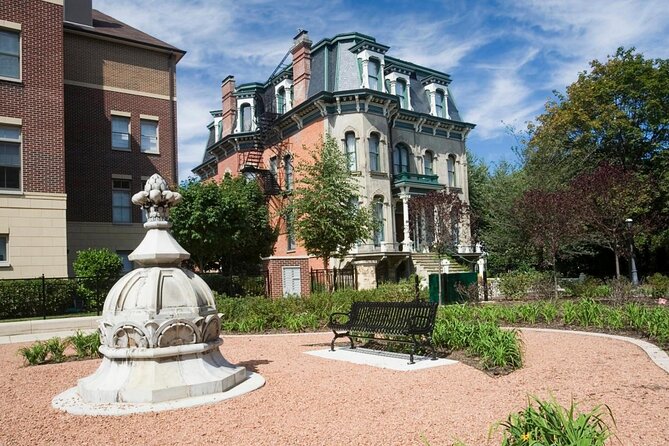
Your first real anchor is the Prairie Avenue Historic District. You spend about 30 minutes here, and it’s not a random scenic stop. This is tied to the Fort Dearborn Massacre site, which helps frame Chicago as a place where danger wasn’t an exception.
Why it matters for this specific tour: it reminds you that the 1893 fair era didn’t arrive in a vacuum. Chicago was already shaped by conflict, change, and the kind of rapid growth that creates both wealth and chaos. When the guide later connects Victorian-era ambition to later horror stories, you’ve already got the groundwork.
Tip for this stop: take a moment to look at scale. Prairie Avenue’s built environment can make the past feel distant, but grounding yourself in place first makes the later “ghost stories” feel less like movie magic and more like rumors with a setting.
The unassuming USPS stop and the Murder Castle legend
Next comes one of the tour’s most intriguing contrasts: the United States Postal Service building. You’ll have about 25 minutes here, and the focus is the legend of the former H.H. Holmes Murder Castle.
This stop is scary in a specific way. You’re not in a dark museum diorama. You’re in something practical and modern, which makes the idea stick harder: the story’s horror is tied to a building that, at least in the legend and its local memory, became part of everyday life rather than something safely locked away in a biography.
If you’re the kind of person who likes a clean timeline, this is also where you may want to slow down and listen for how the guide links Holmes to the Chicago boom. The key is not just the crimes—it’s the environment that made new opportunities (and new predators) feel possible.
One small caution: since this is part of a half-day tour, you’ll want to be ready for the storytelling to move quickly. This stop works best if you’re comfortable taking notes fast or just letting the guide’s narrative do the heavy lifting.
Jackson Park’s Japanese Garden: pictures with a creepy edge
After the Murder Castle connection, the tour shifts to something that looks instantly more peaceful: Jackson Park’s Japanese Garden. It’s only about 15 minutes, but it’s a smart use of time because it gives you a breather and a photo moment while still staying on theme.
Why this stop fits the overall tone: the Japanese Garden signals the World’s Fair era’s love of curated beauty and international display. That makes the contrast with the Holmes story sharper. The fair promised wonder and progress, and the tour’s whole point is how both of those ideas lived side by side.
Practical tip: bring your phone camera ready and plan for quick shots. This isn’t a slow stroll. It’s a short, guided pause where the guide frames what you’re looking at and then moves you on.
Jackson Park World’s Fairgrounds: where the scale comes through
You’ll spend about 30 minutes at Jackson Park itself, the former 1893 World’s Fairgrounds. This is where the tour starts to feel like Chicago history at street scale—bigger than the ghost stories, even when the ghost stories keep talking.
At this point, the tour usually helps you connect three things:
1) what people came to see in 1893,
2) how the fair changed the neighborhood, and
3) why Victorian Chicago became a magnet for tall ambition and odd rumor.
Even if you don’t leave with every architectural detail, you’ll come away understanding why the city’s growth story is inseparable from the era’s mythology. The World’s Fair wasn’t only entertainment. It was a stage where money, fame, and reinvention all collided.
Union Stockyard Gate and The Jungle: when the city’s underside gets named
The route then moves to the Union Stockyard Gate, a short 10-minute stop. This is one of those “quick but important” moments, because it ties directly to Upton Sinclair’s The Jungle.
Here’s why that connection is more than trivia. Sinclair’s work is a reminder that the same Chicago boom that produced global spectacle also produced grinding labor conditions and moral anger. When you pair this stop with the Holmes material, the tour creates a larger picture: crime stories are often fed by the same systems that let workers suffer and let outsiders exploit opportunity.
Because time is tight, treat this as a setting-and-story moment. Don’t expect a long historical walk. Instead, listen for the guide’s link between industry, people, and the kind of society that can hide wrongdoing in plain sight.
Museum of Science and Industry: the last remaining 1893 link
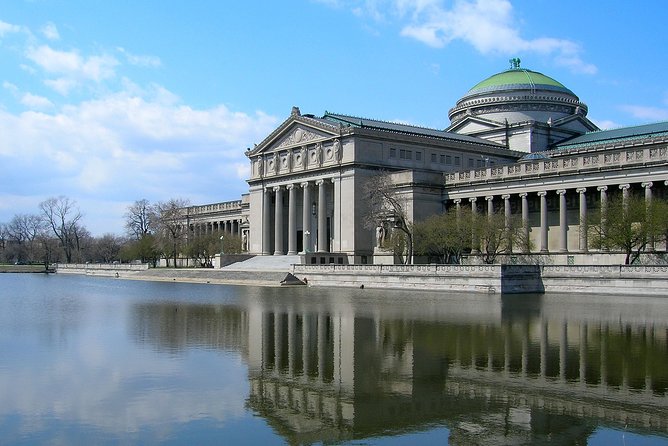
The final stop is about 15 minutes at the Museum of Science and Industry, where the tour focuses on ghost stories tied to the last remaining building from the 1893 World’s Fair.
This is a good ending because it brings the entire afternoon full circle. You began with Chicago’s earlier conflict and then moved through fair optimism, industrial realities, and the Holmes legend. Ending at a site that literally survives from the era gives you a concrete way to hold onto the story in your head after you’ve left the bus.
If you’re into “staying power,” this is the kind of stop that helps. Even without deep museum time, the guide’s framing gives you a sense of continuity: the fair era didn’t vanish. Parts of it are still here, and the myths grew around that leftover reality.
Price and pacing: is $64 good value?
At $64 per person, this is priced like a guided city experience rather than a bargain-only walking tour. For your money, you’re getting:
- about 3 hours of guided time,
- bus travel across multiple sites,
- guided time on foot at several stops,
- and free admission at each listed location.
That combination matters in Chicago. You can’t easily cover these areas quickly on foot without exhausting yourself or spending extra time riding public transit between far-flung stops. The bus keeps the tour moving, and the paid time is mostly inside the guide’s storytelling rather than waiting around.
The pacing question is worth your attention. Some departures may feel more crime-leaning than fair-focused, and there have been complaints that the story topics can take longer than you’d expect or that bus routing can slow things down. My advice: go in expecting a blended mix where the fair is the framework and Holmes is the thread. If that’s what you want, the value feels strong.
Who should book this tour
This tour fits best if you:
- like history that uses a narrative thread (not just dates and plaques),
- want a practical half-day option that covers several neighborhoods,
- enjoy fair-era Chicago but also want the darker legends in the same sweep.
If your ideal day is strictly about architecture, you might want to compare this with a purely architectural route. This one is more about storytelling connections across time than technical building analysis.
If you like your dark history grounded in places you can actually stand in, this works especially well. Chicago can be hard to organize in your head at first. This tour gives you a guided path that turns the city into a story you can remember.
Small on-the-ground tips that make it easier
- Wear comfortable shoes. The walking is not huge, but it adds up across several short stops.
- Bring a light layer. Chicago afternoons can swing, and you’ll be outdoors during multiple segments.
- Plan for quick photos. Some stops are only 10–15 minutes, so treat your phone like a tool, not a souvenir recorder.
- If the theme sounds fun to you, commit to it. The tour works when you’re willing to let the guide’s narrative do the connecting.
Should you book The Devil in the White City tour?
I’d book it if you want a compact Chicago afternoon that links 1893 World’s Fair settings with the lasting legend of H.H. Holmes. The route is thoughtfully spaced, the stops are meaningful, and the mix of bus time plus short walks keeps it doable.
I’d think twice if you’re mainly chasing the fair itself—especially detailed architecture—or if you dislike tours where the story line can occasionally steer the pacing more than you’d like. In that case, you may end up feeling like you spent most of your time on one thread rather than the whole city-of-1893 package.
If you’re on the fence, here’s a simple way to decide: do you want Chicago as a narrative—fair wonder plus criminal rumor—served in a three-hour loop? If yes, this is an easy pick.
FAQ
Where does the tour start and end?
The tour starts at the Congress Plaza Hotel & Convention Center, 520 S Michigan Ave, Chicago, IL 60605, USA, and it ends back at the same meeting point.
What time does the tour run?
The start time is 2:00 pm, and the duration is approximately 3 hours.
How much does the tour cost?
The price is $64.00 per person.
Is the tour mostly walking or bus travel?
It includes travel by bus while sightseeing, plus guided walking time at multiple stops. You’ll get a mix of both rather than a long walking-only tour.
Do I need to pay for admission at the stops?
Admission is listed as free for the Prairie Avenue Historic District, the USPS Murder Castle site location, Jackson Park’s Japanese Garden, Jackson Park, the Union Stockyard Gate, and the Museum of Science and Industry stop.
What happens if weather is bad or I need to cancel?
If the experience is canceled due to poor weather, you’ll be offered a different date or a full refund. You can cancel for a full refund up to 24 hours in advance, and changes within 24 hours of the start time aren’t accepted.