REVIEW · MOSTAR
Mostar War Heritage Walking Tour
Book on Viator →Operated by Fortuna Trade Tours Mostar d.o.o. · Bookable on Viator
War history sits close to the Neretva River. This walking tour turns Mostar landmarks into a clear, human story, with a short film and a guide who explains what you’re seeing. You start in Spanish Square, move through the Old Bridge area, pause at sensitive memorial ground, then wind toward artisan lanes and smaller bridges that most people skip.
I especially like how the guide links architecture to real events, from Ottoman-era construction details to the scars of the 1992–1995 war. I also like the pacing: it’s short (2 to 3 hours), but you get enough time at each stop to absorb both beauty and damage without feeling rushed. One consideration: this route includes war-related personal stories, so it may feel emotionally heavy if you prefer lighter sightseeing.
In This Review
- Key highlights you’ll notice right away
- A war-story walk with a schedule that actually works
- Finding your footing at Španski trg (Spanish Square)
- Stari Most: the construction story behind the famous arch
- Mezarje/Groblje Liska park: history you can’t ignore
- Kujundziluk bazar: where craft is the point
- Carinski Bridge and Kriva Ćuprija: smaller bridges, big meaning
- The short film stop: how context gets stitched together
- Price and what you actually get for about $47.66
- Who this tour fits best (and who might reconsider)
- A quick morning game plan
- Should you book the Mostar War Heritage Walking Tour?
- FAQ
- FAQ
- How long is the Mostar War Heritage Walking Tour?
- What time does the tour start, and where do we meet?
- Is the tour offered in English?
- What’s included in the price?
- What is not included?
- Is this a private tour?
- Can I cancel for a full refund?
Key highlights you’ll notice right away
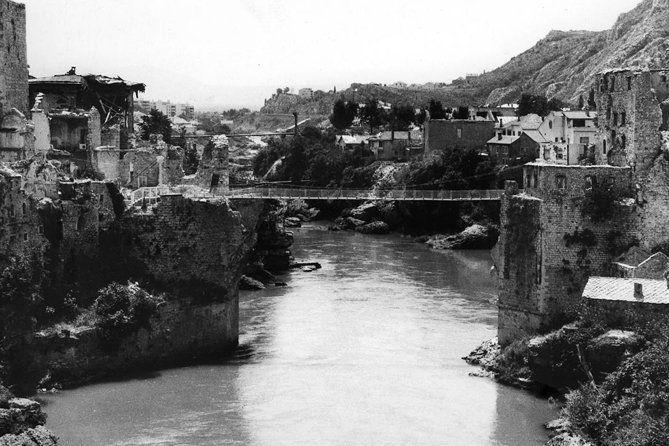
- Old Bridge (Stari Most) facts that go past the postcard like the single-arch design and Hajrudin’s connection to Sinan
- Mezarje/Groblje Liska park as a burial site created when cemeteries weren’t available during the war
- Spanish Square’s name change in 1995 honoring 21 Spanish troops from UNPROFOR
- Kujundziluk craft streets tied to coppersmiths and leather workers, not just shopping
- Crooked Bridge (Kriva Ćuprija) as a quieter “prototype” of Stari Most
- A short history film stop that helps you follow the timeline while you walk
A war-story walk with a schedule that actually works
This is a guided walking tour in Mostar focused on recent history, told on your feet. It runs about 2 to 3 hours, starts at 9:00 am, and loops back to the meeting point. The time structure is built for the main sites: you get short visits at several key locations rather than one long stop where you lose the thread.
The tour is offered in English, and it’s set up as a private tour/activity, meaning only your group goes. That matters more than it sounds. When you’re listening to war stories and sensitive memories, it’s easier to ask questions and keep a respectful pace when the group is small and focused.
You’ll also have an easy, modern touch: the tour uses a mobile ticket, and the meeting point is straightforward. It’s at the Spanish Square skate plaza in Španski trg, Mostar 88000, and the plus code listed is 8RV4+9QM.
You can also read our reviews of more tours and experiences in Mostar.
Finding your footing at Španski trg (Spanish Square)
Mostar’s Spanish Square is both a starting point and a message. Even the name carries history: it was given in 1995 to honor 21 Spanish troops who were killed with UNPROFOR during the last war. So right at the beginning, you’re not just orienting yourself. You’re being reminded that this city’s geography and identity were shaped by conflict.
Dominating the square is the Stara Gimnazija (Old Gymnasium). The construction finished in 1902, and it was among the oldest schools in ex Yugoslavia. For a long time it carried the name of poet Aleksa Šantić. Architecturally, it’s in Moorish Revival (Neo-Moorish) style, and it’s listed as a national monument.
What I like about starting here is that it gives you two lenses at once. You see the city as it was taught and built in calmer times, and you also understand why the square’s later renaming was a kind of public memory. If you pay attention at this stage, the rest of the tour lands harder.
Practical note: even if you’re just arriving, this spot is easy to recognize, which helps you keep your morning calm.
Stari Most: the construction story behind the famous arch
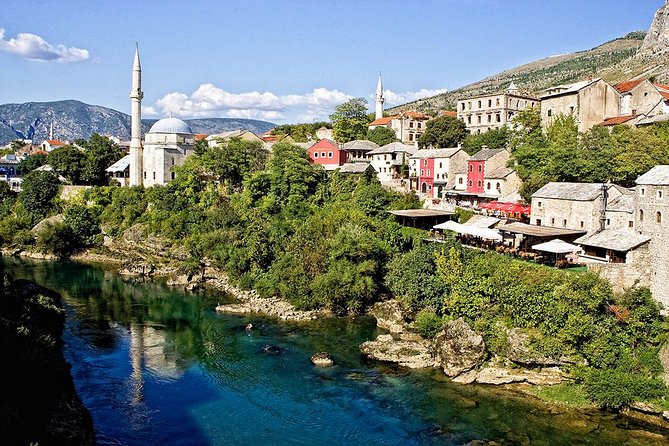
You’ll spend time at Mostar Old Bridge, the monument everyone recognizes and almost no one understands fully.
Here’s the basic arc your guide will walk you through. When the Turks invaded Mostar, there was a wooden bridge where today’s Old Bridge stands. It hung on chains, and you had to cross carefully. Over time it wore out in the 16th century, and the people of Mostar asked authorities in Istanbul to build a new bridge using better materials.
The bridge you see now was designed by Hajrudin, described as a student of Sinan, the great 16th-century Ottoman architect. It was completed and put into service in July or August 1566.
Then come the details that make this place click. The bridge’s span is 28.70 meters, it has one big stone arch, and it’s 4.49 meters wide. From the summer water level, the height is 21 meters. It was built using square stones connected with iron hooks, and the stones were cast in lead.
Why this matters on a war heritage tour: Stari Most isn’t only a symbol. It’s a technical achievement tied to how Mostar connected neighborhoods across the Neretva. Once you understand how it was built, you’re better prepared for why its destruction and reconstruction carried such weight. You’ll walk along the former front line too, but this stop sets the baseline for what the city lost and rebuilt.
You’ll also get a “breather” moment here. The Old Bridge area is where people naturally stop to admire. Your guide uses that pause well, so you’re not standing around in silence.
Mezarje/Groblje Liska park: history you can’t ignore
Next comes a place that feels different in a way you can’t fake. Mezarje/Groblje Liska park is a historic green space in Mostar, originally established in 1954. During the 1992–1995 war, it became a burial site for civilians and soldiers of various nationalities, especially because there weren’t enough cemeteries available.
Even if you’re used to visiting memorials, this stop can hit unexpectedly because it’s a park—an everyday kind of space—repurposed by the emergency reality of war. Your guide’s job here is to keep it human and careful: you’re meant to notice the sensitivity of the location, not treat it like a photo stop.
A short stop here is the right length. You don’t need lots of time to grasp the message, but you do need time to let the setting sink in.
Kujundziluk bazar: where craft is the point
After the memorial stop, you shift back toward the city’s daily fabric in Bazar Kujundziluk. This is the old part of town on the left bank of the Neretva, historically known as Kujundžiluk because of the many coppersmiths (kurz-style “Kujundžije”). There were also tailors, but the best-known artisans were often the tanners, skilled at processing leather.
Now it’s an area of small artisan workshops and handicrafts. The difference between this and a typical “souvenir street” is that the whole area is organized around trades you can still see at work. Even if you’re not buying anything, it gives you a more grounded view of what Mostar was before the fighting, and what people worked on after it ended.
I like this stop because it balances the emotionally heavy pieces of the tour. It also helps you understand that heritage isn’t just monuments. It includes the skills that rebuild a city’s everyday life.
Carinski Bridge and Kriva Ćuprija: smaller bridges, big meaning
Two bridges round out the route in different ways: one is historically “useful,” the other is visually charming and quietly instructive.
First is the Carinski Bridge (Customs Bridge). It spans the Neretva River just north of the famous Old Bridge. It was built during the Austro-Hungarian period and served as a vital crossing point connecting different parts of the city. This stop is a reminder that Mostar’s importance wasn’t only Ottoman-era or wartime. Different empires and systems left their own infrastructure choices behind.
Then you’ll find the Crooked Bridge (Kriva Ćuprija). It’s tucked away in the old quarter and considered a quieter hidden beauty. The story here is simple and satisfying: it’s believed to be a miniature prototype of Stari Most, dating back to the 16th century, with arches over the Radobolja River.
The value of these bridges on this specific tour is that they broaden your sense of what “heritage” means. You don’t only learn about the one icon everyone posts online. You learn how the city’s crossings—big and small—kept communities connected over centuries.
Also, this is where the walk starts to feel more like a path than a checklist. With time and context, you’ll notice you’re moving through neighborhoods rather than hopping between isolated landmarks.
The short film stop: how context gets stitched together
A short film about Mostar’s history is included, and it plays a key role in the experience. On a war heritage walk, you can easily end up with a pile of facts and not much emotional clarity.
The film helps connect the timeline so the stops don’t feel like random scenes. When you later stand near places tied to Ottoman design, Austro-Hungarian crossings, and wartime memory, the city starts to behave like a story with chapters.
If you’re the kind of traveler who loves context—maps, cause-and-effect, and a clear sequence—this film is one of the reasons this tour feels more “understandable” than most short walks.
Price and what you actually get for about $47.66
The price is listed as $47.66 per person. For Mostar, that’s not a “cheap and cheerful” sightseeing fare, but it also isn’t priced like a full-day tour. You’re paying for a professional authorized guide and a route that covers multiple core sites in a structured 2–3 hour window.
Here’s the value logic I’d use to decide:
- You’re getting a guided interpretation, not just walking directions.
- You’re spending time at emotionally and historically important locations, which benefits from someone explaining what you’re seeing.
- Multiple stops here have admission ticket free notes, so the cost isn’t inflated by entry fees at each point.
Tips aren’t included, so budget a little extra if your guide does a great job. But the main point: you’re paying mostly for the human layer—the guide’s ability to make the city legible.
Who this tour fits best (and who might reconsider)
This tour suits you if you want more than photos. If you care about how architecture, memory, and craft connect, you’ll like how the route stays focused.
It’s also a good match if you prefer a smaller group setting. Because it’s private, it’s easier for your guide to keep the conversation moving at a respectful pace, and you get better chances to ask questions.
One consideration: because the tour includes personal war stories from the guide, it can be heavy. Guides such as Elma and Serdin have been praised for being friendly, flexible, and knowledgeable, and some guides also share what they lived through as adolescents. That personal angle can be powerful, but it may not be what you want if you’re trying to keep the day light.
A quick morning game plan
To make the most of the time, I’d treat this like a real walking session, not a casual stroll.
- Wear comfortable shoes for old-town terrain and river-adjacent paths.
- Bring a water bottle and keep your phone charged for photos and the mobile ticket.
- If you’re sensitive to war topics, tell your guide early so they can pace the stories in a way that fits your comfort level.
The schedule is short enough that you won’t be exhausted by hour three, but it’s long enough that good footwear still matters.
Should you book the Mostar War Heritage Walking Tour?
If you’re visiting Mostar and you only do the famous Old Bridge, you’ll miss the deeper point of the city. This tour gives you the bridge and the city around it, but it also explains what those spaces mean—historically, emotionally, and in everyday life.
I recommend booking if you want:
- A clear historical storyline while walking
- War memory handled with care, plus reminders of beauty and rebuilding
- Smaller bridge stops like Carinski Bridge and Kriva Ćuprija, not just the main icon
Skip it only if you strongly prefer purely scenic sightseeing and you know you want to avoid personal war accounts.
FAQ
FAQ
How long is the Mostar War Heritage Walking Tour?
It lasts about 2 to 3 hours.
What time does the tour start, and where do we meet?
The tour starts at 9:00 am. You meet at the Spanish square skate plaza in Španski trg, Mostar 88000 (plus code 8RV4+9QM).
Is the tour offered in English?
Yes, it’s offered in English.
What’s included in the price?
Included is a professional authorized guide and a mobile ticket is used for the experience.
What is not included?
Lunch (optional) and tips are not included.
Is this a private tour?
Yes. It’s listed as a private tour/activity, so only your group participates.
Can I cancel for a full refund?
Yes. You can cancel for a full refund up to 24 hours before the experience’s start time.