REVIEW · NAGOYA
Nagoya: 2026 Hida Takayama Shirakawa-go Light-up Winter Tour
Book on Viator →Operated by Hakuu · Bookable on Viator
Snowlight in Shirakawa-go is hard to forget. This 10-hour Nagoya tour lines up preserved Edo streets in Hida Takayama with a UNESCO visit to Shirakawa-go’s gassho-zukuri farmhouses, then adds a rare winter glow on select dates.
I like the structure: Miyagawa Morning Market gives you an easy start (plus snack hunting), and you still get time to slow down and wander at your own pace at both destinations. I also like that the tour includes an air-conditioned bus and an English tour guide, so you’re not stuck doing everything by guesswork.
One possible drawback: the group can be mixed-language, and a few departures may feel more like transportation with tips than a nonstop guided narration. If you strongly prefer explanations fully in English, it’s worth thinking about that before you book.
In This Review
- Key things that make this tour worth your time
- Price and what you actually get for a $176 day
- The 8:30 pickup and the bus ride out of Nagoya
- Hida Takayama’s Miyagawa Morning Market: food, crafts, and quick local immersion
- Two practical dining options during the morning market window
- The trade-off
- Shirakawa-go: gassho-zukuri houses and the Shiroyama Observation Deck in winter
- What to know before you go
- Winter Illumination: select-date magic on Jan 25 and Feb 1
- A practical tip for the timing mindset
- Rakuto in Shirakawa-go: warming up at a gassho-style café
- The guide and language reality: English may not be the only language
- How to make this work for you
- Weather and road closures: Gujo Hachiman as the backup
- Group size, pacing, and how long you’ll really spend at each place
- Packing tips for a winter day with snow-capped views
- Who should book this day trip, and who should think twice
- Should you book the Nagoya 2026 Hida Takayama Shirakawa-go Winter Illumination tour?
- FAQ
- What time does the tour start, and how long is it?
- Where do I meet the tour in Nagoya?
- Is the guide English-only?
- What’s included in the tour price?
- Is food included?
- Does the Shirakawa-go Winter Illumination happen every day?
- What if Shirakawa-go can’t be reached due to weather or road closures?
- Can I cancel for free?
Key things that make this tour worth your time
- Two UNESCO sights in one day: Hida Takayama atmosphere plus Shirakawa-go’s steep thatched roofs
- Winter Illumination on select evenings (dates like Jan 25 and Feb 1) for a night-sky glow
- Shiroyama Observation Deck views with snow and the Hakusan Mountains in the background
- Real time to explore at both stops, so you can snack, shop, and move at your pace
- Small group size (up to 25), which usually helps with timing and getting off the bus smoothly
Price and what you actually get for a $176 day

At $176 for about 10 hours, you’re paying for three big things: the ride from Nagoya, guided interpretation, and the chance to hit two major rural heritage areas in one shot. That’s the real value here. You’re not just seeing one town and going home.
Your day includes an air-conditioned vehicle, gratuities, and fuel surcharge, and you have an English tour guide. That means you don’t have to juggle extra ticketing or tips on top of the main cost.
What you’re paying for is also the winter timing. Shirakawa-go’s “wow” factor hits harder when the thatched roofs are capped in snow and the village lights up at dusk on a few specific nights.
You can also read our reviews of more tours and experiences in Nagoya.
The 8:30 pickup and the bus ride out of Nagoya
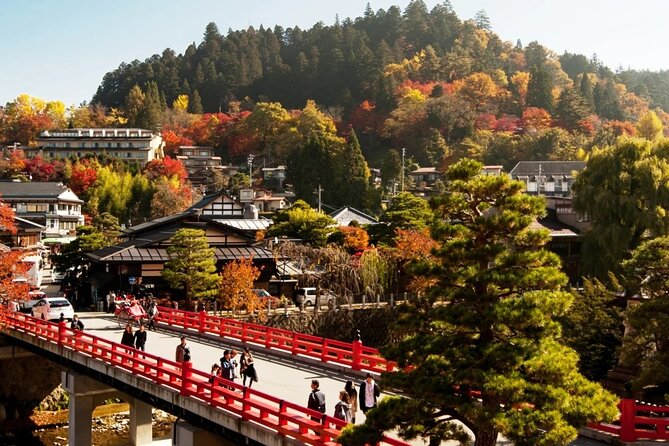
The tour meets at Nagoya Eki Taikodoriguchi, 6 Tsubakicho (Nakamura Ward), with a start time of 8:30 am. The day is designed as a long drive with two set stops, so you’re better off treating this as a scheduled day trip rather than a flexible hop-on/hop-off plan.
The comfort piece matters in winter. You’ll be on an AC bus, and the driver is responsible for the pacing and getting you to both towns on time. That matters because the best photo moments in winter often depend on when you arrive and when you’re back on the road.
The tour ends back at the same meeting point. So you don’t need to think about trains, transfers, or coordinating a return.
Hida Takayama’s Miyagawa Morning Market: food, crafts, and quick local immersion
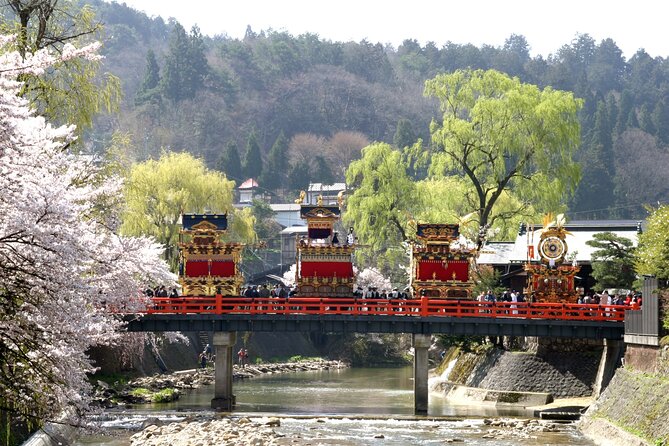
You begin with a bus ride to Hida Takayama, often called Hida’s Little Kyoto. The first scheduled stop is the Hida-Takayama Miyagawa Morning Market, with about 2 hours to explore.
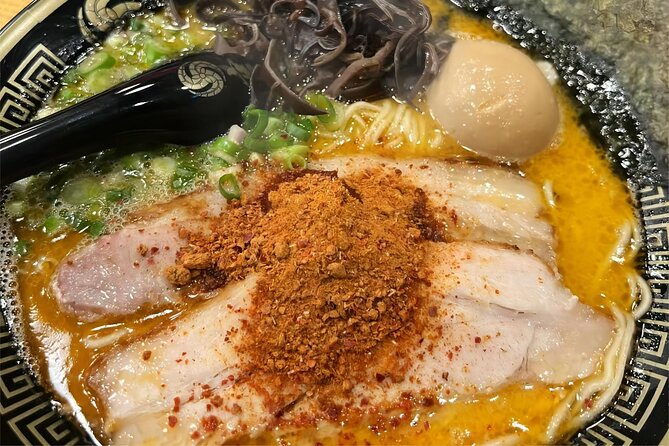
This part works well because it’s not “museum time.” You can browse, snack, and pick up little gifts without feeling rushed. The market atmosphere is where you’ll likely sample the region’s flavors, including things like Hida beef skewers and dango (sweet rice dumplings).
Two practical dining options during the morning market window
If you want to eat something that matches the day’s theme, these are solid starting points (all listed by the tour info):
- Ajizo Heaven (Hida beef-focused) at 4-147 Huali, Takayama City
- Maruaki Hida Takayama Store (known for melt-in-your-mouth Hida beef barbecue) at 6-8-1, Takayama City
Even if you don’t eat at these exact spots, use them as anchors for your hunger. You’ll get the timing right: eat early, then wander Takayama’s Edo-style lanes with food energy still in your body.
The trade-off
This stop gives you freedom, but it’s also where your experience can depend on what you choose to do. There’s no guarantee you’ll get a full, step-by-step walking script through town. If you like your heritage tours to be heavily guided, you may feel the market time is more self-directed than lecture-style.
Shirakawa-go: gassho-zukuri houses and the Shiroyama Observation Deck in winter
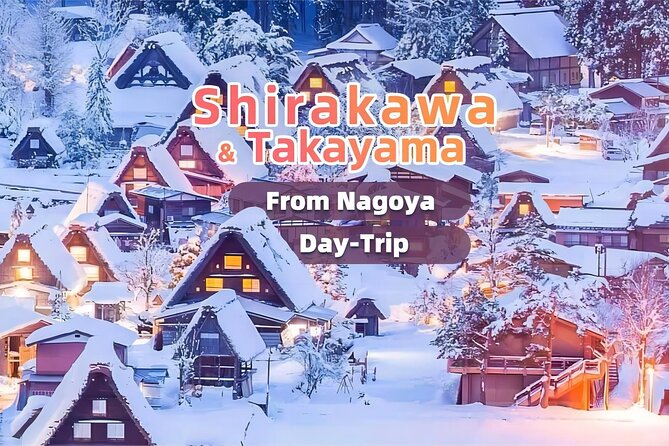
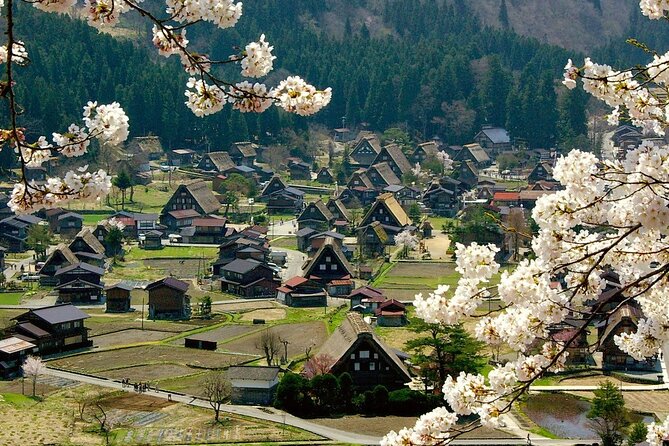
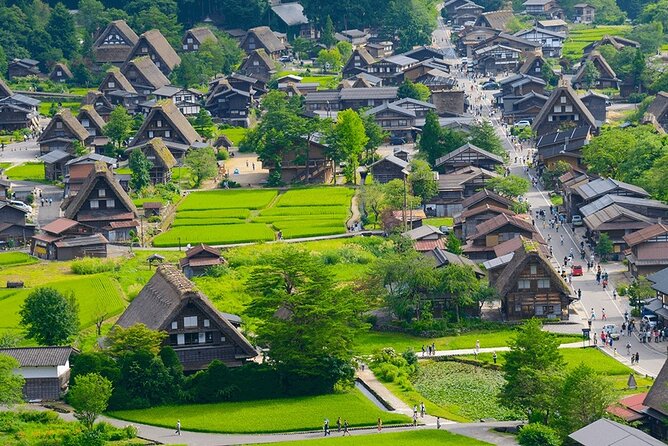
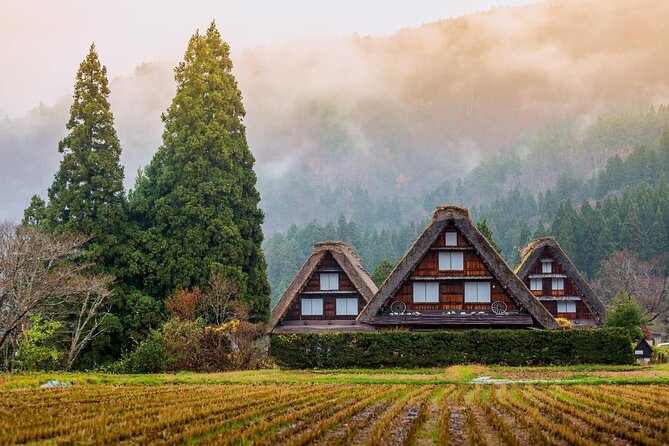
After Takayama, you head to Shirakawa-go, a UNESCO World Heritage Site known for gassho-zukuri farmhouses—those steep thatched roofs built to handle heavy snow.
The key viewpoint on your schedule is the Shiroyama Observation Deck. This is where the scenery clicks into place: snow-covered roofs spread out, and the Hakusan Mountains form a dramatic backdrop when conditions are clear. In winter, that mountain-and-village pairing is why so many people time their day around arrival and dusk.
At this stop you also get additional free time (the tour info lists around 2 hours), so you’re not trapped behind a single route. You can take photos, walk for perspective, and then find a spot to warm up.
What to know before you go
- Winter lighting helps. Darker hours can make the roofs look more sculptural, especially when the village lights turn on.
- The day includes a lot of “go see it, then walk it.” If you want a long guided tour of every side street, you may prefer a more specialized Shirakawa-go walking tour.
Winter Illumination: select-date magic on Jan 25 and Feb 1
This is the “special occasion” part. On select winter dates—the tour info gives examples like Jan 25 and Feb 1—you’ll experience the Shirakawa-go Winter Illumination.
Here’s what makes it different from daytime sightseeing: at dusk, the village shifts from bright, daylight postcard mode to warm, night-sky glow. The thatched roofs look even more iconic because the light softens shapes and highlights snow texture. It’s the kind of moment that feels temporary. When you’re there, you’ll want to watch how the lighting changes as people move and the sky darkens.
A practical tip for the timing mindset
Don’t treat it like a quick add-on. Plan to linger. Even if your schedule allows only a certain amount of time, you’ll get more value by stepping away from the busiest photo spots and letting your eyes adjust to the night contrast.
Rakuto in Shirakawa-go: warming up at a gassho-style café
Before you head deeper into the village experience, your tour includes a stop at Rakuto, described as a charming gassho-style café featured in the manga ONE PIECE.
Why this matters: winter days can turn into cold, fast. A place like Rakuto gives you a chance to refuel without breaking the day’s rhythm. The tour info also highlights red bean porridge and dango, which are perfect winter comfort choices.
This is a good mid-course pause if you’ve been walking Takayama’s market streets and then doing viewpoint photos at Shirakawa-go. Even a short warm-up helps you enjoy the later illumination moment instead of rushing because you feel cold.
The guide and language reality: English may not be the only language
The tour is marketed with an English tour guide, and the guide team is described as covering English, Chinese, and Japanese. That’s great in theory because more people can understand what’s happening.
In practice, a mixed-language group can change the vibe of the experience. Some departures may feel like the explanation time switches between languages. When that happens, English-only guests can miss details right when they’re most useful—like which side to photograph from, or how much time to spend at a deck versus down in the village.
That said, other departures are praised for handling dual-language explanations more evenly, and you may be paired with guides who give clear time management and site advice (names mentioned include Amy, Jin, and Jane). If you’re the kind of person who likes quick pointers—what to eat, where to go first—that can work in your favor.
How to make this work for you
- Listen closely at the bus stops before you exit. That’s when guidance seems to be most helpful.
- If you’re English-first, it still helps to glance at any printed or app-based tips you receive, because explanations may get split across languages.
Weather and road closures: Gujo Hachiman as the backup
Winter comes with a risk: road closures. The tour info is clear about a contingency plan. If access to Shirakawa-go is blocked due to severe weather or road closures, the destination will be replaced with Gujo Hachiman so the tour can continue smoothly.
That’s not a minor detail. Shirakawa-go is the headline stop, especially on Illumination dates. But the backup plan matters because it protects your day from turning into an unhappy sit-in-a-bus scenario.
You’ll still have a rural, historic-feeling day. Just remember that the light-up experience may not happen if you don’t reach Shirakawa-go.
Group size, pacing, and how long you’ll really spend at each place
The tour is capped at a maximum of 25 travelers. That’s a reasonable size for a day trip like this. It’s big enough for a lively group, but small enough that you’re less likely to disappear into a crowd for every photo moment.
Pacing is built around two main site blocks and a morning market window. The key point: you’re getting time to explore rather than a nonstop guided march. Some people love that freedom. Others want more narration and tighter routing.
Also remember: it’s a 10-hour day in winter. You’ll want to stay mindful about restroom breaks, layers, and water. Even short delays can pile up when you’re driving between mountain towns.
Packing tips for a winter day with snow-capped views
Because winter is part of the appeal here, plan for cold and wet. You’ll be around snowy rooftops and likely stand at viewpoints.
Bring:
- Warm layers you can adjust quickly
- A hat or hood for wind exposure
- Gloves you can still use for camera handling
- Shoes with decent traction
The tour info doesn’t list umbrellas or gear, but you can bet you’ll be happier with hands and feet that feel stable. If conditions get icy, traction matters more than fashion.
Who should book this day trip, and who should think twice
This tour makes sense if you want:
- A single-day hit of Hida Takayama plus UNESCO Shirakawa-go
- Winter illumination energy on select nights
- A good mix of guided context (how to see the sites) and free time to explore
It may be less ideal if:
- You require a fully English-only explanation the entire day
- You expect a deep, continuous guided walkthrough of every street segment
- You’re very sensitive to language switching in a mixed group
If you’re flexible and you enjoy wandering, this kind of day trip can be exactly the right blend: guided enough to avoid wasting time, free enough to let the towns feel real.
Should you book the Nagoya 2026 Hida Takayama Shirakawa-go Winter Illumination tour?
If your main goal is winter Shirakawa-go—especially a select-date illumination evening—this is a strong, practical way to do it. The pricing lines up with the hard part: transport from Nagoya and making two UNESCO-level stops work in one day.
I’d book it if you’re happy to trade perfect language continuity for the bigger payoff: snow-roof views, market snacks, and a night-time glow that doesn’t happen every day.
I’d think twice if you want a classroom-style English tour for the whole day. The tour includes an English guide, but the group may involve multiple languages, and the on-site experience can lean more toward “helpful pointers plus free exploration” than “constant narration.”
FAQ
What time does the tour start, and how long is it?
The tour starts at 8:30 am and runs for about 10 hours. It returns back to the same meeting point.
Where do I meet the tour in Nagoya?
You’ll meet at Nagoya Eki Taikodoriguchi, 6 Tsubakicho, Nakamura Ward, Nagoya, Aichi 453-0015, Japan.
Is the guide English-only?
The tour includes an English tour guide, but the guide team is described as capable of explanations in English, Chinese, and Japanese. In a mixed-language group, explanations may be shared across languages.
What’s included in the tour price?
The tour includes an air-conditioned vehicle, gratuities, fuel surcharge, and an English Tour Guide.
Is food included?
No. Food and beverage are not included, so you’ll buy meals and snacks on your own.
Does the Shirakawa-go Winter Illumination happen every day?
It happens on select winter dates. The tour info lists examples such as Jan 25 and Feb 1.
What if Shirakawa-go can’t be reached due to weather or road closures?
If access to Shirakawa-go is blocked, the destination is replaced with Gujo Hachiman.
Can I cancel for free?
Yes. You can cancel for a full refund if you cancel at least 24 hours before the experience start time.