REVIEW · YEREVAN
Yerevan: Garni, Geghard, Symphony of Stones & Lavash Baking
Book on Viator →Operated by ONE WAY TOUR · Bookable on Viator
Mount Ararat shows up early, then the day delivers. This is a focused loop of Armenia’s big story points: UNESCO monuments, a pagan temple at Garni, and the basalt “organ” in Azat Canyon—finished with real lavash baking. One thing to plan around: your Mount Ararat view can turn cloudy, and that changes the feel of the first stop.
I like that the day is built for people who want meaning, not just photos. You get a guide to connect Charents Arch to Geghard’s spear legend, then to Mithra’s sun temple at Garni, and finally to the oddly musical basalt formations at the Symphony of Stones. Still, two paid add-ons are common—Garni and the Symphony of Stones entrances—so it helps to budget a bit extra beyond the tour price.
In This Review
- Key things to know before you go
- First stop: Charents Arch and the Mount Ararat Temple viewpoint
- Geghard Monastery: UNESCO rock-cut calm and the spear legend
- Symphony of Stones in Azat Canyon: the basalt organ effect
- Garni Temple: pagan Armenia, the Mithra connection, and restoration history
- Lavash baking master class: what you’ll actually take home
- Time, transport, and pacing out of Yerevan
- Price and value: $23 plus two entrance fees
- Who this tour suits best
- Should you book this Yerevan day trip?
- FAQ
- What time does the tour start?
- How long is the tour?
- Where does the tour start and end?
- What’s included in the price?
- Are entrance fees included?
- What language is the tour offered in?
- How big is the group?
- What happens if weather is bad?
- Can I cancel for a refund?
Key things to know before you go
- Mount Ararat Temple viewpoint at Charents Arch with the poetry line by Yeghishe Charents carved into the façade
- Geghard Monastery’s rock-cut setting and the spear connection behind its name, Geghardavank
- Symphony of Stones (basalt organ) across the canyon in a UNESCO-protected area
- Garni Temple history in one stop: 1st-century pagan Armenia, earthquake damage, and restoration
- Lavash baking included so you leave with a skill and not just sightseeing
- Small group pacing (max 20) that usually keeps the day smooth and not rushed
First stop: Charents Arch and the Mount Ararat Temple viewpoint
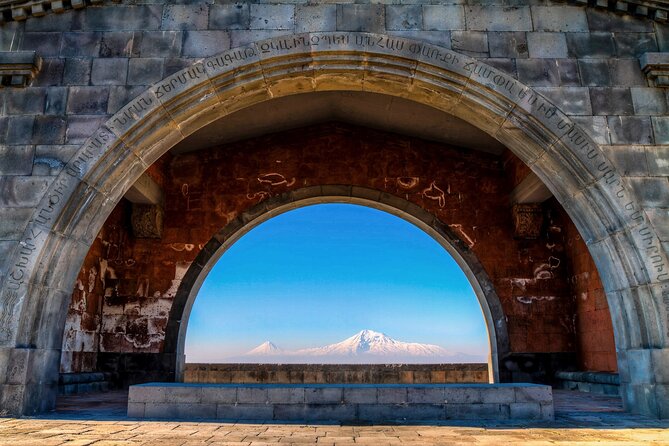
You start at the Komitas Yerevan State Conservatory area (9:00 am), then roll toward the hills outside Yerevan where the view opens fast. Charents Arch is tied to the Mount Ararat Temple, designed by Rafael Israelyan and completed in 1957. The place is famous enough that it has two identities: the official one linked to the temple, and the popular one tied to Armenia’s poet.
The front entrance carries the last line of Yeghishe Charents’s poem in large, visible lettering. It’s a good way to understand Armenia at a glance: the landscape is spiritual here, and art and identity overlap. When the sky is clear, this viewpoint is the day’s “wow” moment—Mount Ararat looks like a natural symbol, not just a distant peak on a map.
The practical catch: Ararat visibility depends on weather. If clouds or fog roll in, you’ll still get the architecture and the story, but the mountain view won’t land the same way. I’d plan your expectations around that—this stop is meaningful even when the mountain plays hide-and-seek.
You can also read our reviews of more tours and experiences in Yerevan.

Geghard Monastery: UNESCO rock-cut calm and the spear legend
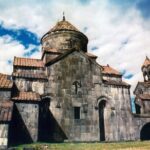
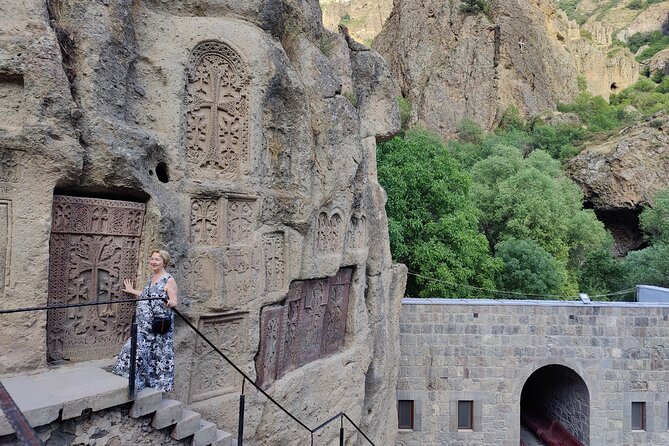
Next comes Geghard Monastery (often called Geghard or Geghardavank), perched in Kotayk Province with parts carved into the cliff. It’s medieval, dramatic, and oddly quiet even when you’re among a group. UNESCO recognition here isn’t just a label—the setting is part of the experience.
What makes Geghard more than scenery is the name. Geghardavank translates to the monastery of the spear. The tradition says the spear that wounded Jesus at the Crucifixion was brought to Armenia by Apostle Jude (also known locally as Thaddeus) and stored among relics. Today, that relic is believed to be in the Echmiadzin treasury.
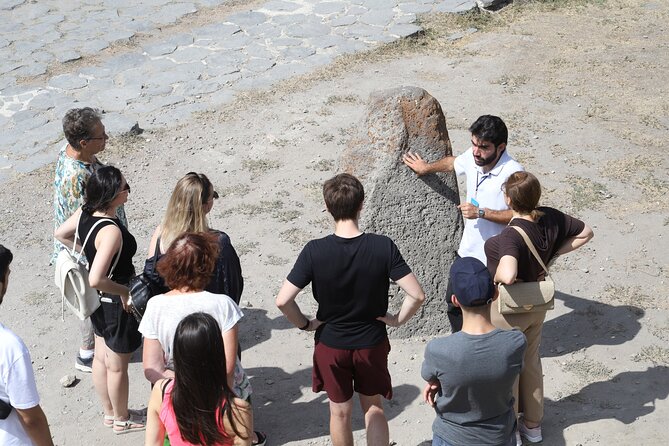
The tempo at this stop works well for most people: you get guided context, then you can slow down and explore at your own pace around the rock-cut spaces. I like that the guide frames what you’re seeing—carved walls aren’t just cool to look at; they fit into the Armenian story of faith, memory, and place.
One more small note that matters: this is listed as a UNESCO site with enhanced protection status. That’s why you’ll often be asked to move carefully and keep the flow polite. It’s worth it, because the monastery is still one of those places where the physical environment feels powerful.
Symphony of Stones in Azat Canyon: the basalt organ effect
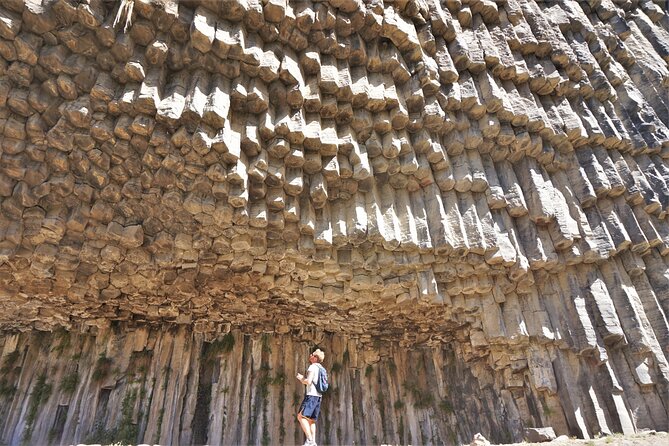
After Geghard, you head to the Symphony of Stones, also part of the UNESCO-protected heritage area. This is where Armenia’s geology starts acting like architecture. The “organ” look comes from naturally formed basalt columns that line up across the canyon with striking symmetry.
The name makes sense once you see it: those hexagonal stones stretch in a way that resembles organ pipes. It’s not a man-made monument in the typical sense—it’s nature with perfect timing. You don’t need to know geology to feel the order in it; your brain just clicks.
Here’s the practical consideration: this stop includes a small entrance fee (300 AMD). It’s not included in the tour price, so it’s one of the few line items you’ll likely pay during the day. Also, weather matters. If conditions are icy, snowy, or bad visibility, the tour may adjust timing or what you can see. That’s not about comfort alone—it can affect how safe and how long you can safely spend in open canyon areas.
Still, if you like unusual forms of UNESCO, this is the highlight that feels different from the rest of the route. Geghard is spiritual and carved by hand; the Symphony is the opposite—formed by the earth, interpreted by humans through a name.
Garni Temple: pagan Armenia, the Mithra connection, and restoration history
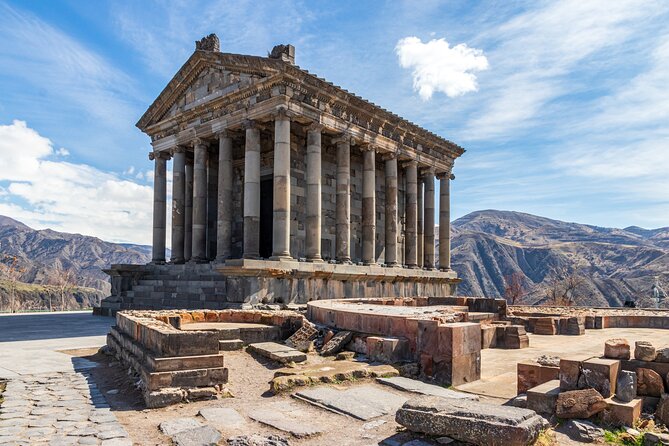
Then you arrive at Garni Temple, a first-century structure that’s the best-known example of preserved pagan architecture in Armenia. It’s dedicated to Mithra, the sun god, and it stands out because it’s said to be the only preserved pagan temple in Armenia and the territory of the former USSR.
Of course, it didn’t survive cleanly. A devastating earthquake hit in 1679, and the temple fell into ruin. Restoration followed later, taking roughly eight years (1968–1975). So when you look at Garni, you’re seeing a blend: ancient intent plus a modern decision to rebuild something meaningful.
This is a great stop for two reasons. First, it gives contrast. Earlier in the day you’re in medieval Christian Armenia; here you’re in pre-Christian Armenia with a different idea of sacred space and symbolism. Second, the guide can connect the dots between temples, relic traditions, and how Armenians preserved identity through centuries of change.
Garni also has an entrance fee (1500 AMD), not included in the base tour price. If you’re budgeting, consider this the “main paid ticket” after the tour itself.
Lavash baking master class: what you’ll actually take home
At the end of the day, you switch from monuments to food. The tour includes a lavash baking master class (40 minutes, and it’s included). You’ll see how Armenian flatbread is prepared and baked in the traditional style.
Lavash matters in Armenia in ways that go beyond taste. It’s practical food culture—bread that fits daily life, celebrations, and travel. Watching the process is one of those travel moments that feels simple but sticks with you, because you can picture the steps at home later.
A quick expectation-setting point: the exact level of hands-on participation can vary. The core promise here is that you’ll observe how lavash is baked and you’ll get the demonstration side of the master class.
If you want a souvenir that isn’t just a magnet, this is a good way to end. It also works as a mental reset after the stone and history stops—your brain gets a break, and then you leave with something warm and memorable.
Time, transport, and pacing out of Yerevan
The whole experience runs about 6 hours, from a 9:00 am start and returning to the meeting point. The group limit is 20 travelers, which is important for a day like this. In smaller groups, you spend more time standing in front of monuments and less time herding people at each stop.
Transport is included, so you’re not solving logistics while you’re sightseeing. You’ll be riding between sites, and that’s exactly where the guide’s stories work best. The drive time becomes part of the learning rhythm—rather than dead time.
I also appreciate that the tour doesn’t pretend you’ll “do everything forever.” It targets a tight geography: Charents Arch, Geghard, the Symphony of Stones, Garni, then lavash. That makes it a smart choice if you have a limited window in Yerevan and want the region’s most important highlights in one go.
Price and value: $23 plus two entrance fees
The tour costs $23.00 per person, which is a genuinely approachable price point for a full half-day circuit that includes guide service and transport. The structure is also mostly included: you get the guide, transportation, and the lavash baking master class.
What’s not included are the two bigger site entrances you’re likely to pay:
- Garni Temple: 1500 AMD
- Symphony of Stones: 300 AMD
Everything else in the core sequence is free of admission on the tour’s side (Charents Arch and Geghard are listed as free). So, in practice, you’re paying a small add-on amount for the two sites that charge.
Why that matters for value: you’re not hit with lots of small fees all day. It’s a predictable, easy-to-plan setup—especially helpful if you’re traveling with a group and want fewer surprises.
If you’re the type who wants a guide to connect the symbolism (poetry, relic tradition, pagan temple history, then basalt geology), this is the kind of price-to-meaning ratio that makes sense.
Who this tour suits best
This tour fits well if you’re:
- Short on time in Yerevan but want more than one historic site
- Interested in how Armenian identity shifts across centuries (Christian, pre-Christian, and folk memory)
- Enjoying guided explanations at a steady pace rather than self-guided wandering
- Traveling solo and like the comfort of a small group day out
It’s less ideal if you need total flexibility to linger for hours at a stop. The route is structured, and you’ll follow the flow. That’s not a flaw—it’s the point—but it’s worth knowing if your travel style is slow and open-ended.
Also, if you’re chasing the perfect Ararat photo, give yourself grace. The tour starts with a viewpoint that depends heavily on weather and sky conditions. You can still enjoy the architecture and stories, but the mountain itself may not always cooperate.
Should you book this Yerevan day trip?
I’d book it if you want an efficient, meaningful introduction to Armenia beyond Yerevan city limits. The combination is strong: Charents Arch for identity and symbolism, Geghard for UNESCO rock-cut spirituality, the Symphony of Stones for something visually unusual, Garni for pre-Christian Armenia and restoration history, then lavash to close the loop.
I wouldn’t book it if your whole goal is a guaranteed Ararat view. Cloudy conditions can change the impact of the first stop. If that’s your top priority, keep an eye on the forecast and be ready to be satisfied with the cultural and historical pieces even when the mountain isn’t clear.
If you do want this kind of highlight-hopping with a guide and a small group, this one is a good bet.
FAQ
What time does the tour start?
The tour starts at 9:00 am.
How long is the tour?
It’s approximately 6 hours.
Where does the tour start and end?
It starts at Komitas Yerevan State Conservatory (1a Sayat-Nova Ave, Yerevan 0001) and ends back at the same meeting point.
What’s included in the price?
The tour includes guide service, transport service, and the lavash baking master class.
Are entrance fees included?
Charents Arch and Geghard are free on this tour. Garni (1500 AMD) and Symphony of Stones (300 AMD) are not included.
What language is the tour offered in?
It’s offered in English.
How big is the group?
The group size is capped at 20 travelers.
What happens if weather is bad?
The experience requires good weather. If it’s canceled due to poor weather, you’ll be offered a different date or a full refund.
Can I cancel for a refund?
Yes. You can cancel up to 24 hours in advance for a full refund.