REVIEW · CORINTH
Ancient Corinth: Self-Guided Audiovisual Tour with 3D Models
Book on Viator →Operated by Culture App · Bookable on Viator
Ancient Corinth feels real again with 3D ruins. This self-guided audiovisual tour turns scattered stone into a walkable story, using 3D reconstructions and 360 visuals to show what Greek, Roman, and Byzantine Corinth may have looked like. I also like the tight pacing of the 15-monument audio narration, which gives you locations and context as you move through the site.
One catch: the experience leans on your phone. If GPS geolocation or the internet connection doesn’t cooperate, the interactive map can feel less helpful, and you may spend more time figuring out where you are. It’s still a great option if you’re comfortable using a phone as your guide.
In This Review
- Key highlights at a glance
- Start at the Archaeological Museum entrance (and get your phone ready)
- Walking the main route: Greek, Roman, and Byzantine Corinth with AR-style 3D
- Getting your bearings: using the GPS map without fighting your phone
- The Bema stop: a pause for Apostle Paul’s defense
- Peirene Fountain: listening to the water and the Nymph’s lament
- Ending at Acrocorinth: the view that ties it together
- Price and value: why $8.13 can still add up (in a good way)
- What to pack and how to plan your timing (so you don’t rush the good parts)
- Who this self-guided tour is best for
- Should you book Ancient Corinth with this audiovisual 3D tour?
- FAQ
- FAQ
- How long is the Ancient Corinth self-guided audiovisual tour?
- Where does the tour start and end?
- Is the entrance ticket included in this booking?
- What do I need to bring?
- Does the tour work without internet?
- What languages are available?
- What does the tour include in terms of content?
- Do I need to grant location permission for the map to work?
- Can I cancel for free?
- What’s the listed opening time window?
Key highlights at a glance
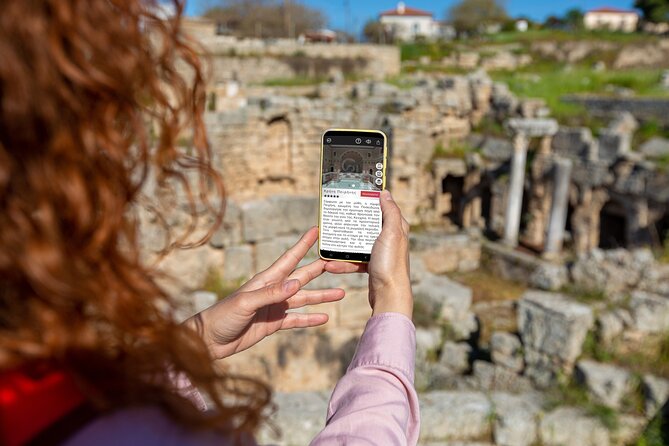
- GPS-based interactive map that tracks your position as you go
- 15 monuments covered in audio, with text info to match what you see
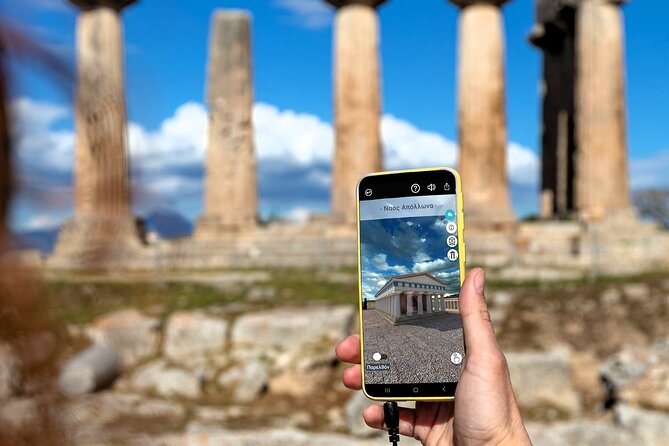
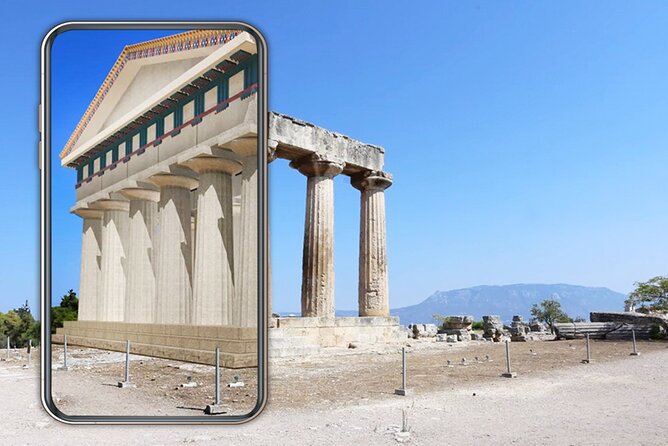
- 3D models and 360° panoramas for 13 monuments to rebuild the ruins in your head
- Immersive videos for 13 monuments that add motion and clearer explanations
- Language options across 9 choices, including English and multiple European languages
Start at the Archaeological Museum entrance (and get your phone ready)
Your walk begins at the Archaeological Museum of Ancient Corinth (Argous 105, Archea Korinthos 200 07). The meeting location matters here because this is a self-guided route. You’ll start at the site entrance and follow the main routes through the ruins, so arriving with your app already set up makes the whole hour much smoother.
Before you step in, do the practical stuff. After booking, you get an email with instructions. The app download is automatic once you open it on your phone and select your language. The tour also requires internet access to function properly, so plan to use either reliable mobile data or Wi‑Fi if you can get it before you start.
Also, bring your own basics. This tour booking includes the app, but not a smartphone or headphones. You’ll want headphones so the narration is clear and you’re not competing with wind, footsteps, and the general outdoor noise level.
Finally, take note of the site hours listed for the tour: 8:00 AM–8:00 PM, Monday through Sunday (as provided). It’s late enough in the day to pair with an easy evening meal, but it also means you’ll want to start early if you want breathing room for the 3D sections.
You can also read our reviews of more tours and experiences in Corinth.



Walking the main route: Greek, Roman, and Byzantine Corinth with AR-style 3D
Once you’re inside, the tour is designed to move you along the site’s main circulation. You’ll see monuments tied to Greek, Roman, and Byzantine periods, with the 3D parts helping you connect the dots between what’s left and what used to be there.
Here’s what you get content-wise:
- Audio and text for 15 monuments
- 3D models and 360° panoramas for 13 monuments
- Immersive videos for 13 monuments
This mix is the real value. If you only had audio, you’d spend more time guessing proportions and placement. If you only had videos, you’d be watching instead of walking. The tour tries to do both at once: you look at a structure, then the phone recreates it or gives you a 360 view so you can understand why a spot matters.
And yes, there’s augmented-reality style presentation mentioned with the 3D representations. In practice, that means your phone becomes the bridge between “what I see” and “what the place was.”
The drawback isn’t the content. It’s that this is not a live guide who can adjust on the fly. If the ruins feel hard to read in the moment, you’ll rely on the map and the monument list. That’s why the next section on orientation is worth your attention.
Getting your bearings: using the GPS map without fighting your phone
You get an interactive map with GPS location tracking. That’s meant to reduce the usual problem at archaeological sites: you stop, look around, and wonder which direction the tour wants you to go next.
But there’s a key tech detail. The app requires permission to enable geolocation during the download process. If you don’t grant that permission when it asks, the GPS feature may not work as intended. So even if you’re excited to start, don’t race past the permission prompts.
If you’ve got location services on already, still check for one thing: did you allow location permission for the tour app itself? If the app isn’t allowed to access location, the map can become more of a generic picture than a helpful tracker.
Practical tip: charge your phone before you start. The GPS and media (3D, 360, videos) can drain battery faster than a normal map app. This isn’t listed as a warning, but it’s a common reality with phone-based tours that use lots of visuals.
The Bema stop: a pause for Apostle Paul’s defense
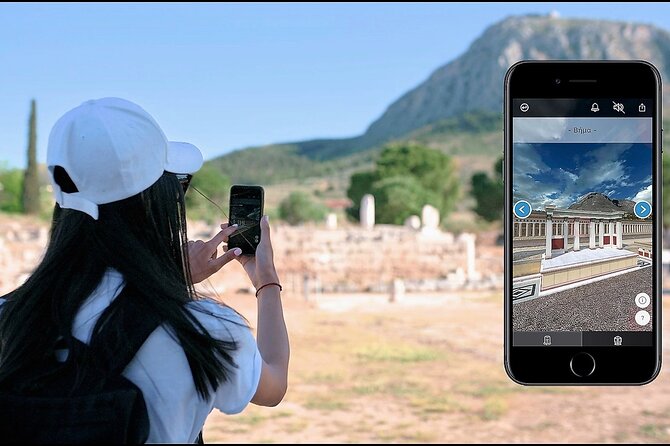
One of the most story-driven moments on the route is the Bema. The tour specifically calls out a spot where the Apostle Paul defended himself about 2,000 years ago.
What I like about this kind of stop is that it forces you to slow down. Ruins can blur together when you’re trying to read stone with no timeline. Here, you’re given a narrative anchor, so the site feels like a place where events happened—not just a museum of broken columns.
You’ll likely spend a bit of time standing and listening, then matching the narration to the physical setting. Since the tour includes audio and text for multiple monuments, you can choose how you want to take it in: quick audio and move on, or audio plus reading when you hit a key point.
A consideration: moments like this can take longer than you expect, especially if you keep toggling between the normal view and the 3D reconstruction. Give yourself some buffer in your hour.
Peirene Fountain: listening to the water and the Nymph’s lament
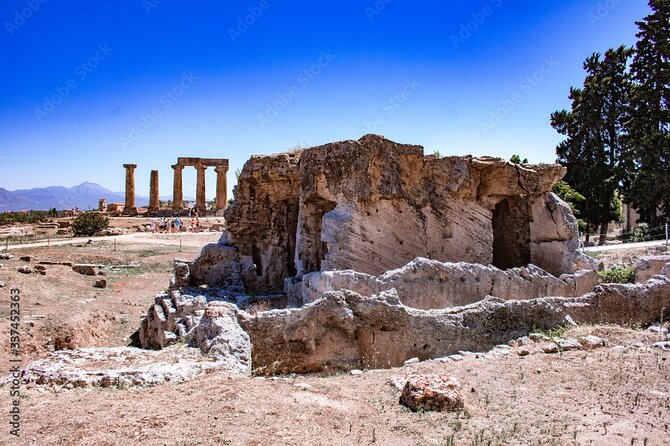
Another highlight is the Peirene Fountain, where the narration focuses on water that still runs. The tour asks a poetic question—do you hear the Nymph’s lament?—and it uses that sound (or the idea of it) as part of the experience.
Even if you don’t treat the myth as literal, this is a smart technique. Sound is a shortcut for imagination. Watching a dry basin forces you to guess. Hearing water while you look at the source helps you picture how the fountain worked as a lived-in part of daily life.
This stop also benefits from the tour’s structure. Because it’s one of the mapped monuments, you can use the phone to connect the current physical remains with what the narration is pointing at.


Ending at Acrocorinth: the view that ties it together
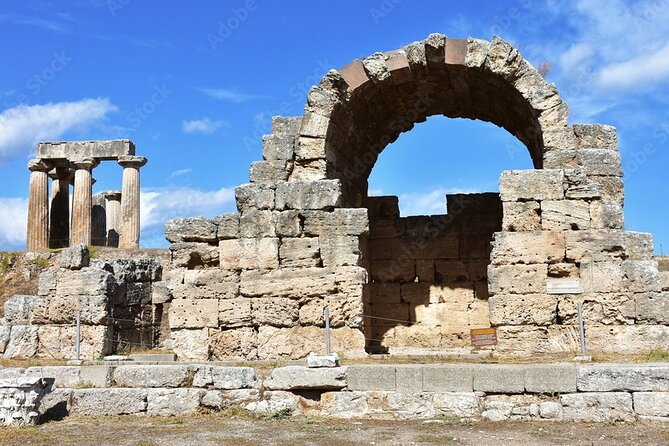
The tour’s final movement is to Acrocorinth rock, with the idea that you’ll take in the scenery and let your gaze wander.
This ending matters because it changes your posture. The archaeological site can be very “head down and read the stones.” Climbing or repositioning yourself for views resets your mental map of the region. You see how the ancient city connects to the surrounding area, which makes earlier stops feel less random.
Your ending point is listed at Οδός Απόλλωνος 825, Archea Korinthos 200 07. The tour also notes that the only exit of the archaeological site is located near the central square, and a 2-minute walk returns you to the meeting point area. So you won’t end up stuck on the far edge wondering how to get back.
Price and value: why $8.13 can still add up (in a good way)
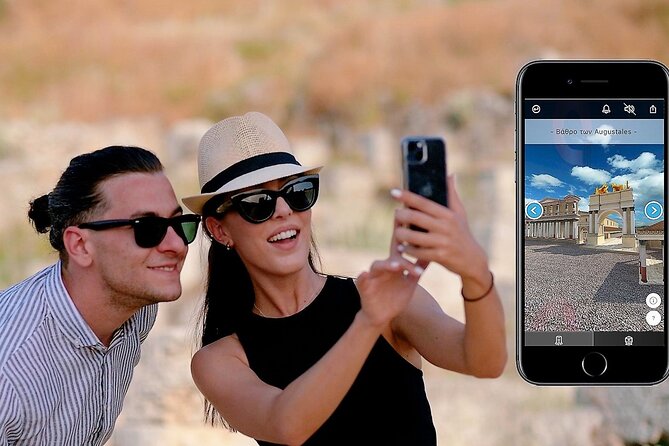
This booking lists a tour price of $8.13 per person. That price is for the self-guided audiovisual experience—the downloadable app and the media inside it—not the archaeological site ticket.
You still need the entrance fee separately: €8 full price, €4 reduced (as provided). So your realistic budget is closer to the app price plus the site admission, plus any day-to-day extras like water.
Is it good value? For me, the strongest case is the amount of included media for the relatively low app cost:
- audio plus text for 15 monuments
- 3D models and 360 panoramas for 13 monuments
- immersive videos for 13 monuments
That’s not just “background information.” You’re paying for a tool that helps you interpret the ruins, not just stand near them.
Who this value makes the most sense for:
- you like independent pacing (stop, rewind, move on)
- you want 3D help rather than relying purely on archaeology “reading”
- you don’t want to pay for a live guide for the whole site
Who might find it less satisfying:
- you hate using your phone to orient
- you don’t want to deal with internet or location permissions
- you’re hoping for a fully guided group experience
What to pack and how to plan your timing (so you don’t rush the good parts)
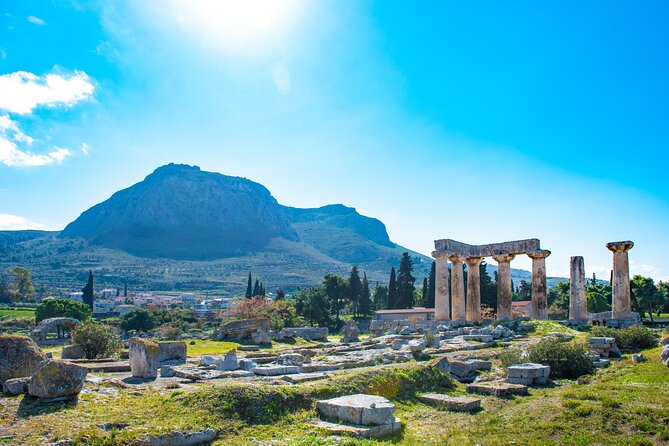
Duration is listed as about 1 hour to 1 hour 30 minutes. That’s usually enough if you treat the 3D segments as optional boosters rather than mandatory every time. If you try to watch every video full length and stop for every 3D overlay, plan toward the longer end.
Here’s a simple way to keep it stress-free:
- Start right at opening if you can, so you’re not skipping content due to crowds or closing time.
- Bring headphones and make sure your phone volume is up.
- Keep one eye on battery life.
- If the GPS map feels off, fall back to the monument flow you’re following in the app and take extra pauses rather than walking fast while unsure.
Also, the tour includes a maximum of 999 travelers. That number is about capacity, not a guarantee of quiet. But it does suggest you’re not joining some micro-crowd where every pause becomes a bottleneck. Still, it’s a popular archaeological site area, so expect some other visitors around.
Who this self-guided tour is best for
This is a strong fit if you want an interpretive guide without committing to a fixed group schedule. The content is built for travelers who appreciate:
- clear story anchors like the Bema and Paul
- myth-and-place tie-ins like Peirene Fountain
- “see it as it was” support using 3D models and 360° panoramas
You’ll also enjoy it more if you’re comfortable with basic phone tech: downloading an app, selecting a language, and granting geolocation permissions when asked.
If you’re traveling with kids, this can work because the multimedia format often holds attention. But you’ll still want to manage the practical side—headphones and battery—so it doesn’t turn into a tech scavenger hunt.
Should you book Ancient Corinth with this audiovisual 3D tour?
I’d book it if you want a self-paced way to make Ancient Corinth readable, and you’re excited by the idea of seeing monuments reconstructed with 3D and supported by narration. At $8.13, it’s a low-cost add-on compared to the value you get from audio, visuals, and a GPS map.
I’d think twice if you’re likely to struggle with phone permissions, weak mobile data, or battery anxiety. The tour does depend on internet access and geolocation, and if those fail, you can end up feeling a step behind where you’re supposed to be.
If you’re on the fence, here’s your decision shortcut: if you’re willing to grant location permission and use headphones, you’ll probably feel guided even when you’re alone.
FAQ
FAQ
How long is the Ancient Corinth self-guided audiovisual tour?
The tour runs about 1 hour to 1 hour 30 minutes.
Where does the tour start and end?
It starts at the Archaeological Museum of Ancient Corinth (Argous 105, Archea Korinthos 200 07) and ends near Οδός Απόλλωνος 825, Archea Korinthos 200 07.
Is the entrance ticket included in this booking?
No. The archaeological site entrance fee is not included. It lists €8 full price and €4 reduced.
What do I need to bring?
You need a smartphone and headphones (not included).
Does the tour work without internet?
No. The tour requires internet access to function properly.
What languages are available?
The tour app is available in English, Greek, Spanish, German, French, Italian, Dutch, and Chinese.
What does the tour include in terms of content?
You get audio narration and text information for 15 monuments, plus 3D models and 360° panoramas for 13 monuments, and immersive videos for 13 monuments.
Do I need to grant location permission for the map to work?
Yes. The app requires permission to enable geolocation during the download process for GPS tracking to work as intended.
Can I cancel for free?
Yes. Free cancellation is available, and you can cancel up to 24 hours in advance for a full refund.
What’s the listed opening time window?
The opening hours are listed as 8:00 AM to 8:00 PM, Monday through Sunday.