REVIEW · CORINTH
Ancient Corinth Self-Guided Tour with 3D & Audio (No Ticket)
Book on GetYourGuide →Operated by Culture App · Bookable on GetYourGuide
Ancient Corinth makes more sense with your phone. This self-guided tour adds 3D reconstructions and expert audio so you can picture what you’re standing near, then move on whenever you want. After downloading, it works offline on site, so you can wander without worrying about data.
I like the way the tour uses 360 panoramic views to help you understand the site from above. I also like the interactive 3D models for the Temple of Apollo and the Bema, because you’re not just reading placards—you’re comparing the real ruins with what used to be there.
One thing to plan for: the entrance ticket is not included, and this is a digital tour that depends on a charged smartphone and downloaded content before you arrive.
In This Review
- Key Highlights Worth Planning Around
- A Smartphone Tour That Actually Guides Your Eyes
- The 360 Panoramas: How You Get Oriented Without Guessing
- Temple of Apollo Through 3D: Seeing Beyond What’s Left
- The Bema and the Buildup of Meaning
- Cultural Routes: Making a Big Site Feel Like a Story
- Price and Value: $8 for the App, Plus the Site Ticket
- Where the Experience Can Fall Short (and How to Reduce the Risk)
- Phone Prep That Makes or Breaks the Day
- Getting There: Simple Access and Parking Nearby
- Who This Tour Fits Best
- Should You Book This Ancient Corinth 3D Audio Tour?
- FAQ
- Do I need an entrance ticket to visit Ancient Corinth?
- Is there a meeting point?
- Can I use the tour offline at the archaeological site?
- What languages are available for the audio narration?
- How long is the tour valid after activation?
- How much storage does the app need on my phone?
- What do I need to bring to use the tour comfortably?
- What happens after I book?
Key Highlights Worth Planning Around

- 360 panoramic views help you orient fast, even if you arrive with no map sense
- 3D models let you interact with the Temple of Apollo and the Bema at your own pace
- Offline audio and text mean you can keep walking without roaming or signal problems
- Cultural routes encourage a travel-over-time-and-space way of seeing the site
- Multiple languages available, with English narration plus options like Italian, French, German, and Chinese
A Smartphone Tour That Actually Guides Your Eyes
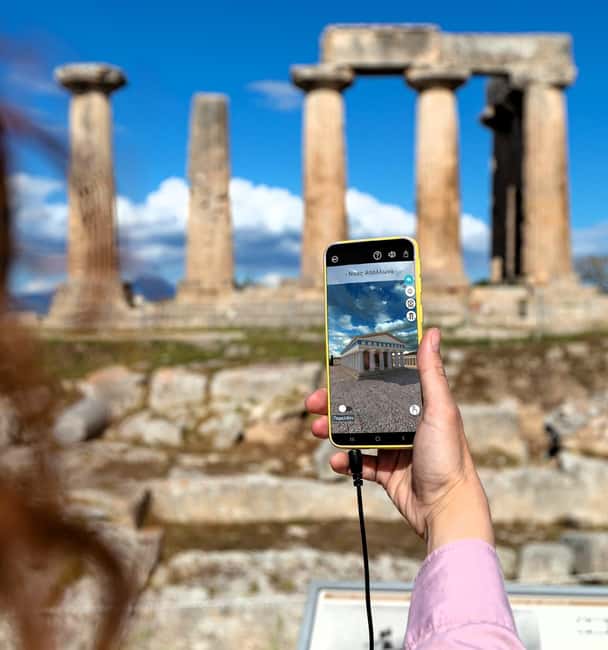
Ancient Corinth can feel like a lot of stone if you’re expecting the site to explain itself. What makes this experience useful is that your phone becomes a lens, not just a screen. You’ll get audio narration plus visuals (including short videos) that help you connect what you’re seeing to what those places meant.
You can also choose your tempo. If you like to read everything, you can slow down. If you prefer quick look, audio, and move on, you can keep it moving. That flexibility matters here because the site is spread out enough that groups can end up feeling rushed.
The “3D + audio” combo is the heart of it. The visuals help you spot the shape and scale of areas that are hard to imagine once the structures are gone. Then the audio gives you the story thread so you don’t just stare at reconstructions without context.
You can also read our reviews of more tours and experiences in Corinth.



The 360 Panoramas: How You Get Oriented Without Guessing

One of the best parts is the chance to see Ancient Corinth from above through 360 panoramic views. Even if you’re standing in front of ruins, it’s easy to lose the larger layout. These panoramas give you a reference point, so when you walk, you’re walking with a mental map already in your head.
This works especially well if you like to understand geography first. You can use the panoramas as a warm-up: get your bearings, then head out to the spots the narration points toward. You can also revisit the panoramas if you feel turned around. That’s a real advantage of a self-guided format: you’re not waiting for someone else’s timing.
Possible drawback: using a smartphone for orientation means you’ll need a stable grip and basic patience while you scroll and listen. If you’re the type who hates anything tech-related at historical sites, this part may slow you down at first—but it also prevents the “where am I supposed to look” frustration.
Temple of Apollo Through 3D: Seeing Beyond What’s Left

The tour’s interactive 3D models are built for two key stops: the Temple of Apollo and the Bema. The Temple of Apollo section is where the format really starts paying off. Instead of only reading what remains, the 3D model helps you imagine the original structure and how it relates to your position.
For me, the value is comparison. You look at the stone in front of you, then you’re shown a reconstruction that helps your brain fill in the gaps. That can turn a quick glance into a “now I get it” moment.
There’s also a comfort factor: you don’t need to find a guide, and you don’t have to crowd around anyone. You can take your time, pause, rewind the audio, and move when you’re ready. If you’re traveling with older legs or short attention spans, this is the kind of control that makes a big difference.
The Bema and the Buildup of Meaning

Next comes the Bema, again supported by an interactive 3D model and narration. Even if you don’t have deep background knowledge, the tour helps you follow the “why this place matters” thread as you walk.
The Bema portion is also a good example of how this tour handles “travel over time and space.” You’re not only seeing ruins as static remains. You’re being guided to connect the layout and the spaces to a sequence of understanding—something traditional walk-and-read tours often struggle to do.
A small consideration: because this is audio-led, you’ll want earphones. Headphones aren’t included, so if you show up without them, you’ll be stuck listening at a distance or skipping audio entirely. The site can be quiet, but it’s still not the same experience.
Cultural Routes: Making a Big Site Feel Like a Story

The tour doesn’t treat Ancient Corinth like a checklist. It frames your visit as cultural routes—learning by moving through the site in a way that’s meant to feel like a journey through time. That matters because the ruins can otherwise blur together, especially when you’re tired or the light changes fast.
You’ll also get a mix of content types: audio narration, text, 3D reconstructions, panoramas, and short videos. That variety helps if you’re the kind of traveler who zones out when everything is just spoken or just read.
One helpful practical detail: the tour is designed to work offline after you download it. So you can keep walking along these routes without the constant fear of losing signal or burning battery on loading screens. Offline also tends to make the experience feel steadier, like you’re following a guide rather than fighting an app.
Price and Value: $8 for the App, Plus the Site Ticket

The tour costs $8 per person and does not include the entrance ticket. At the site, the ticket is 15€ full or 8€ reduced, so you’re paying for the storytelling layer on top of access to the ruins.
Here’s how I think about the value:
- If you want a guided explanation but don’t want a full group tour schedule, the $8 can feel like a low-cost upgrade.
- If you’re already the type who loves reading on-site signs and doesn’t care about reconstructions, you might feel the app is only worth it if the audio adds enough value for you.
- If you like visuals and you’re curious about how places looked, the 3D models give you a reason to pay even before you reach the first major viewpoint.
In plain terms: the app is the product. The archaeology entrance is separate. If you’re fine handling that second purchase, this can be a good-value way to get more from the visit without paying for a live guide.
Where the Experience Can Fall Short (and How to Reduce the Risk)

The overall idea is strong, but a few practical issues show up in real use cases. One big theme is that not every language track hits the same quality bar. For example, the German audio has received criticism for sounding like it was spoken by someone other than a native speaker. If narration quality matters to you, consider sticking with English or another language you trust more.
There’s also a possible multi-person wrinkle: one booking had trouble with transferring the license for a second person, and a second language version used an unexpected voice. If you’re traveling as a pair or group, make sure you understand how activation works on your devices after the provider sends instructions.
Finally, the tour relies on your phone. That’s not a flaw in the concept, but it does mean you should show up prepared: charged battery, earphones, and enough free storage.
Phone Prep That Makes or Breaks the Day

This is the part you should treat like packing shoes. You’ll need to download the tour content on Wi-Fi before your visit, because it’s meant to work offline afterward. You should also plan for about 200MB of storage and make sure your smartphone battery is full.
Supported devices matter too. The tour requires iOS 11.0+ or Android 5.1+. If your phone is older, you’ll want to double-check compatibility before you rely on it.
After booking, you’ll receive an email from the provider with download instructions. Check your spam folder too. That email is your path to getting the content onto your phone, so don’t miss it.
What to bring is also straightforward: comfortable shoes, water, a sun hat, and a fully charged smartphone. Ancient Corinth can mean lots of sun and walking, and the tour’s pace is your choice—so being comfortable keeps the experience fun instead of tiring.
Getting There: Simple Access and Parking Nearby

There’s no meeting point because this is fully self-guided. No pickup or drop-off either. The easiest way to reach the archaeological site is by car or taxi.
The route note that helps most is to take the detour on the Ancient Corinth National Highway Corinth – Patra and follow signs toward Patras (Ancient Corinth node). Parking is available in a parking lot right next to the site, which is exactly what you want for a flexible, phone-led visit.
Who This Tour Fits Best
This is a strong choice if you want:
- A self-paced visit without being tied to other people’s speed
- 3D visual support to make ruins easier to understand
- Offline reliability, so you can wander without signal anxiety
- Multi-language audio and text (English plus Greek, Spanish, Italian, French, German, Dutch, and Chinese)
It may be less ideal if you strongly dislike using a phone outdoors, or if you only want minimal tech and prefer to rely entirely on on-site signs and your own reading pace.
Should You Book This Ancient Corinth 3D Audio Tour?
If you’re visiting Ancient Corinth and you want your time to feel clearer, I think booking makes sense. For the $8 price, you’re buying a guide-like layer: audio narration, 3D reconstructions, and 360 panoramas you can revisit at your own pace. The real value is control—no crowds guiding your shoulders, no rush to finish on someone else’s timetable.
Book it if you’re willing to do two small prep steps: download the content on Wi-Fi and bring earphones with a charged phone. Skip it if you’d rather not rely on your device, or if you’re counting on the German audio being perfectly polished (quality can vary by language track).
FAQ
Do I need an entrance ticket to visit Ancient Corinth?
Yes. The entrance ticket is not included in this tour. You’ll need to purchase it separately at the site or online.
Is there a meeting point?
No. This is a self-guided smartphone tour, so there is no meeting point and no scheduled guide time.
Can I use the tour offline at the archaeological site?
Yes. After you download the content, the app works fully offline, with no internet required on site.
What languages are available for the audio narration?
Audio narration is available in English, Greek, Spanish, Italian, French, German, Dutch, and Chinese.
How long is the tour valid after activation?
It’s valid for 5 days starting from the first activation.
How much storage does the app need on my phone?
Plan for about 200MB of storage space on your device.
What do I need to bring to use the tour comfortably?
Bring comfortable shoes, a sun hat, water, and a charged smartphone. You’ll also need earphones, since headphones are not included.
What happens after I book?
You’ll receive an email from the provider (Culture App) with instructions for downloading the content. Check your spam folder, and download the tour while you’re on Wi-Fi if possible.