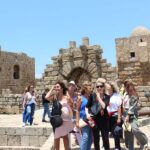
Beirut changes fast, and so will your day. This guided half-day private tour helps you hit the city’s biggest historical and cultural signals in about 5 hours, with a guide to make sense of what you’re seeing and comfortable air-conditioned transport between stops.
I especially like two things: the front-door hotel pickup/drop-off that removes logistics stress, and the way the route strings together different eras and faiths into one easy loop. You’ll see ancient archaeology, Ottoman-era stories, Crusader traces, and modern Beirut city life without needing to plan it yourself.
One thing to consider: this is a “see a lot” schedule. Most stops are short photo-and-walk moments, and only the National Museum has a ticket cost, so budget time and money for that one paid admission.
In This Review
- Key highlights you’ll feel right away
- Why this half-day Beirut tour works when time is tight
- Pickup and private transport: how the day stays comfortable
- National Museum of Beirut: the 2-hour archaeology anchor
- Roman Baths of Berytus: outdoor ruins with real purpose
- Martyr’s Square: Ottomans, World War I, and a city memory
- Mohammad Al-Amin Mosque (the Blue Mosque): big scale, quick look
- Al-Omari Grand Mosque: a timeline you can see in the stones
- Saint George Greek Orthodox Cathedral: old church, old location
- Place de l’Etoile (Nejme Square): parliament, cathedrals, and a clock face
- Beirut Souks: shopping and city energy, guided and practical
- Zaytouna Bay and the Corniche: Lebanon’s seaside mood
- Raouche and the Pigeon Rocks: the iconic finish
- The abandoned Holiday Inn: a war landmark you can’t ignore
- Price and value: is $75 per person worth it?
- Who should book this tour, and who might not love it
- Should you book this guided half-day Beirut tour?
- FAQ
- How long is the Guided Half-Day Private Beirut Historical Tour?
- Is this tour private or shared?
- Does the tour include hotel pickup and drop-off?
- Is transportation included, and is it air-conditioned?
- Are entrance tickets included?
- Is lunch included?
- Do you get a mobile ticket?
- What’s included in the tour price?
- What is the cancellation policy?
Key highlights you’ll feel right away
- Hotel pickup/drop-off keeps the day smooth, especially if you’re staying outside Downtown.
- One compact route covers Martyr’s Square, multiple houses of worship, and the seafront.
- Museum time is real (2 hours), not just a quick peek.
- Most admissions are free, with the National Museum the main exception.
- Roman Berytus Baths plus story stops turn ruins into context you can repeat later.
- Sea views at Raouche finish the tour with a strong sense of place.
Why this half-day Beirut tour works when time is tight
Beirut can be confusing when you’re doing it on your own—roads, traffic, and the sheer amount of history stacked on top of each other. A guided half-day private tour fixes that fast. You get a plan, you get transportation, and you get someone explaining what each place meant at the time.
This tour also has a smart rhythm. It starts with archaeology, moves into downtown power and faith, then shifts to public squares and commerce, and ends with the ocean side of the city. That sequence matters. Beirut doesn’t feel like one theme—it feels like layers. A guide helps you read those layers instead of just collecting photos.
You can also read our reviews of more tours and experiences in Beirut.
Pickup and private transport: how the day stays comfortable
The tour includes hotel pickup & drop-off, plus a comfortable private vehicle with air conditioning. That’s a big deal in Beirut. Even when you keep walking minimal, you still spend time getting between areas. Doing it with a driver means you’re not negotiating routes or trying to time taxis.
It’s also private, so it’s just your group. You won’t be forced into the pace of a big tour bus. If your group wants more time outside the Mohammad Al-Amin Mosque or wants to linger a bit longer by the Roman Baths, you’ll likely have that flexibility.
Plan for a day of movement. The schedule runs about 5 hours, and most stops are around 10 to 15 minutes. The tradeoff is that you get breadth. The upside is you get your bearings fast for the rest of your trip.
National Museum of Beirut: the 2-hour archaeology anchor
The National Museum of Beirut is the one stop where you’ll slow down. It’s the principal archaeology museum in Lebanon and gives you a foundation for the rest of the day. You’re not just looking at a few artifacts; you’re getting an overview of Lebanon’s history through items excavated across the country.
This is the place where the “why Beirut matters” story becomes clearer. Lebanon sits at a cultural crossroads, and you’ll see material evidence of different civilizations overlapping over time. If you’ve ever wondered why Beirut’s downtown feels so layered—religion here, ruins there—this museum helps you understand the physical depth.
Ticket note: museum admission is not included, so expect to pay that day. Everything else in the route is listed as free admission, which makes the museum stand out as the only paid entry.
Practical tip: wear comfortable shoes. Even if you don’t read every label, you’ll want to walk through at your own speed for that 2-hour block.
Roman Baths of Berytus: outdoor ruins with real purpose
Next up are the Roman Baths in downtown—often called the Roman Berytus Baths. These are the largest outdoor Roman baths located in central Beirut. They were discovered in 1968–1969 and then renovated in the mid-1990s, which gives you a site that’s both old and preserved enough to feel visitable.
Here’s the kind of detail that makes ruins click: the Roman Berytus Baths had four major bath complexes, and the first dates back to the early first century under Augustus. Then came disaster. A powerful earthquake in 551 AD destroyed the baths, and that destruction is part of the site’s story.
One of the most interesting modern notes: one bath area is used for artistic performance and concert space. So you’re not just staring at stones—you’re seeing how the city repurposes ancient structures without pretending they’re brand new.
Time on site is about 15 minutes. That’s short, but it’s the right length to absorb the layout and take photos from the open-air setting.
Martyr’s Square: Ottomans, World War I, and a city memory
Martyr’s Square is only a brief stop, but it carries heavy meaning. Historically, the square was known as Al Burj or Place des Cannons. Today it’s named for the executions on May 6, 1916, carried out by the Ottomans of Lebanese nationalists ordered by Jamal Pasha during World War I.
Even if you don’t know the details yet, the guide explanation gives you context for why this square is treated like a landmark of memory. It’s one of those places where the architecture and open space make sense once you know what happened there.
You get about 15 minutes here, so use it for orientation and story. If you’re the type who likes to stand still and let the facts land, this is a good spot to do it—then move on.
Mohammad Al-Amin Mosque (the Blue Mosque): big scale, quick look
Downtown Beirut’s Mohammad Al-Amin Mosque is often called the Blue Mosque. It’s the biggest mosque in Lebanon and dominates the skyline near Martyr’s Square.
A few specifics you can keep in your head while you’re there:
- It opened in 2008
- It has four minarets about 65 meters high
- The mosque features domes with light blue tiles
- There are multiple tall arches, including arches that span a couple of stories
This is a great stop because it balances modern scale with traditional design. It also sets a visual tone for the downtown area, so when you look back at the route later, you’ll remember this mosque as a reference point.
Admission is listed as free, and the stop is about 10 minutes. You’ll be able to see the main exterior and take a solid set of photos, but it’s not enough for deep exploration. If your group wants longer, try focusing on angles that show the domes and minarets rather than trying to cover every doorway.
Al-Omari Grand Mosque: a timeline you can see in the stones
The Al-Omari Mosque has a layered past you can sense right away, even during a quick visit. It was built in 635 AD, in the age of Omar Bin El Khattab. Then came a major shift during the Crusader period, when it was converted into the Church of Saint John in the 12th century.
Later, the Mamluks transformed it back into a grand mosque in 1291. And like so many places in this region, it wasn’t spared by modern conflict. It was damaged during the Lebanese Civil War, and refurbishment was completed in 2004.
You’ll get about 10 minutes at this stop. That’s enough for a guided walkthrough of the timeline and a close look at how the building reflects successive eras.
Admission is free, which helps you keep the day flowing without ticket anxiety.
Saint George Greek Orthodox Cathedral: old church, old location
The Greek Orthodox Cathedral of Saint George is the seat of the Greek Orthodox Metropolitan bishop in Beirut. It’s also described as the oldest church in the city—and one of the oldest in the region.
Even more useful for your understanding: the first Christian temple at this location dates to the mid-sixth century AD. The cathedral is closely associated with Beirut’s famous law school, which adds an academic thread to your history day, not just architecture and conflict.
This is another about 10-minute stop. You’re not lingering here for a long service-style visit. You’re absorbing the fact that this is an ongoing religious site with serious age behind it.
Admission is free.
Place de l’Etoile (Nejme Square): parliament, cathedrals, and a clock face
Next comes a classic Beirut civic scene: Place de l’Etoile, also known as Nejme Square. It’s the central square in the Downtown area and home to the Lebanese Parliament and related buildings. You’ll also find two cathedrals and a museum in the area, plus a ring of cafes and restaurants.
One detail that makes the square easy to remember: a four-faced Rolex clock installed in 1930, and the architecture that helped the square become an icon of Beirut worldwide.
You’ll spend about 15 minutes here. That’s enough to understand how the square functions as a public stage—politics, religion, and daily life all in one view.
Admission is listed as free.
Beirut Souks: shopping and city energy, guided and practical
Beirut Souks are a commercial district with over 200 shops and 25 restaurants and cafes, plus an entertainment center and a cinema complex. It’s one of the city’s biggest shopping and leisure zones, and it’s also useful as a cultural “feel” stop, not just a retail one.
You’ll get around 15 minutes here. So don’t plan on buying everything. Plan on scanning the area, deciding where you want to return later, and maybe grabbing a snack or coffee if your energy needs it.
If you’re the type who wants to see what everyday Beirut feels like, this stop gives you that. Even if you’re not shopping, the souks are a quick window into how people move through the city center.
Admission is free.
Zaytouna Bay and the Corniche: Lebanon’s seaside mood
Then the route shifts to the water, and the mood changes fast. First is Zaytouna Bay, a waterfront promenade with shops and restaurants. The official description calls it Beirut’s finest leisure destination, which is basically a polite way of saying it’s designed for strolling, eating, and looking out at the harbor.
Expect about 10 minutes here, enough time to get oriented and grab a few sea-facing photos.
After that comes the Corniche Beirut along Al Manara Corniche, stretching from Ramlet al Bayda to the Saint George marina. The promenade is lined with palm trees, and you’ll get views out to the Mediterranean Sea. On clear days, you can also see Mount Lebanon on the eastern side, which makes the whole scene feel anchored in geography, not just tourism.
Time here is about 15 minutes. Keep your camera handy, but also take a few moments to just stand and watch. Beirut’s sea moments help you understand why people come back here again and again.
Admission is free.
Raouche and the Pigeon Rocks: the iconic finish
The last major visual stop is Pigeon Rocks in Raouche (also called the Rock of Raouché). These two huge rock formations sit at Beirut’s western-most tip and are one of the city’s most iconic photo scenes.
What makes this stop work is the contrast. You’ve moved from museums and mosques into civic squares and shopping districts. Then suddenly you’re staring at dramatic sea rocks shaped by time, with the water and coastline framing it. It’s the kind of moment that turns your mental map into a real image.
You’ll spend about 15 minutes here, which is enough for photos and a quick walk around viewpoints.
Admission is free.
The abandoned Holiday Inn: a war landmark you can’t ignore
One of the most intense stops on the day is the abandoned Holiday Inn Hotel, included as a war landmark. The hotel was built between 1971 and 1974 during Beirut’s economic boom, when the city was one of the more visited tourist destinations in the Middle East.
It operated until the Lebanese Civil War began in 1975. After that, it became part of the conflict known as the Battle of the Hotels, where more than 25,000 combatants fought for control over luxury hotels, including the Holiday Inn and the famous Phoenicia hotel.
The building remains untouched and abandoned, empty decades after the war. Standing near it gives you a physical reminder that Beirut’s modern identity came through extreme conditions, not just change and redevelopment.
This stop is not there for vibes. It’s there for memory.
Price and value: is $75 per person worth it?
At $75 per person, this tour sits in the “reasonable for a private guide and transport” category, not the “budget shuffle” category. The value comes from the combination:
- Private transportation (with air conditioning)
- Front-door pickup and drop-off
- A professional guide to connect the dots between archaeology, Ottoman-era events, Crusader conversions, and modern Beirut public life
- A route that covers a lot of major locations without you spending the day in navigation stress
Also, you’re not paying admission repeatedly. Most stops are listed as free, except for the National Museum where admission is not included. Lunch isn’t included, so you’ll want to plan for your own meal or snack break, ideally around the Souks or seaside areas.
One note: this is a private tour, so the per-person price can work best if you have a small group. If you’re traveling solo or with just one person, it can still be worth it for the convenience, but compare it to any shared-group alternatives you might find.
Who should book this tour, and who might not love it
This tour is a strong fit if you:
- Have limited time in Beirut and want a fast, guided overview
- Like history that mixes archaeology, religion, and politics
- Want comfortable transport and minimal logistics
- Prefer short, well-placed stops over long museum-style wandering all day
You might want a different style of tour if you:
- Want a very slow pace or deep time in one site (the museum is the exception)
- Hate quick photo stops and prefer fewer locations
- Need a lunch included meal plan (this one lists lunch as not included)
Should you book this guided half-day Beirut tour?
I’d book it if your goal is to get your bearings fast and understand what you’re looking at. The route makes sense for first-time visitors: museum context, downtown meaning, a church-and-mosque reality check, then the sea and the city’s public rhythm.
It’s also a good “connector tour.” After you finish, you’ll know where you want to go back: the Souks for browsing, the Corniche for a longer walk, or the downtown squares for a calmer revisit.
If you can handle a schedule with quick stops and one paid museum admission, this is a smart use of half a day in Beirut.
FAQ
How long is the Guided Half-Day Private Beirut Historical Tour?
It runs for about 5 hours.
Is this tour private or shared?
It’s private. Only your group will participate.
Does the tour include hotel pickup and drop-off?
Yes, it includes front-door hotel pickup and drop-off.
Is transportation included, and is it air-conditioned?
Yes. The tour includes comfortable private transportation with an air-conditioned vehicle.
Are entrance tickets included?
National Museum of Beirut admission is not included. The other listed stops have free admission.
Is lunch included?
No, lunch is not included.
Do you get a mobile ticket?
Yes, you’ll receive a mobile ticket.
What’s included in the tour price?
Hotel pickup & drop-off, comfortable private transportation, professional guides, air-conditioned vehicle, and local authentic experiences.
What is the cancellation policy?
You can cancel for a full refund up to 24 hours in advance. If you cancel less than 24 hours before the start time, the amount paid is not refunded.