REVIEW · PHNOM PENH
Guided Phnom Penh Heritage Tour
Book on Viator →Operated by Phnom Penh Heritage · Bookable on Viator
Phnom Penh history hits differently from a bus window. This guided heritage loop uses a digital tablet plus headphones to tell the story of Cambodia’s French-protectorate-era buildings, Art Deco flourishes, and even the Khmer Rouge years, with short audiovisual stops along the way.
What I really liked is how practical it feels for a short visit: you cover a lot of ground in about 2 hours 30 minutes without needing to navigate traffic or distances yourself. I also love the mix of on-street architecture with “what it was like back then” videos and vintage photos, including a few moments where the guide lets you virtually enter places you can’t normally access.
One thing to keep in mind: several big-name sites are only shown from the outside, and some interiors depend on whether they are open. If you’re hoping for long temple or museum time, plan to do those separately, since parts like Wat Phnom’s hill temple and the National Museum are not included in the tour time.
In This Review
- Key highlights I’d plan around
- The real value: a fast, guided “orientation” tour of Phnom Penh
- Price and logistics: what you pay for (and what you don’t)
- Who this tour fits best
- Stop-by-stop: what you’ll see and why each one matters
- 1) Phnom Penh overview stop: get your bearings fast
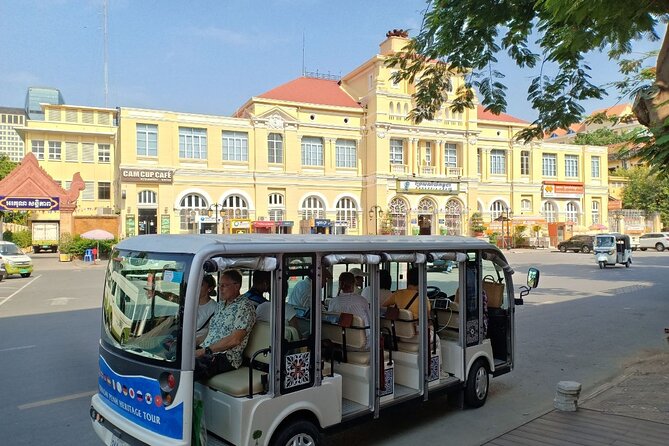
- 2) Cambodia Post Office: French-era grandeur in everyday use
- 3) Palais de la Poste: the old Indochina bank story
- 4) Le Manolis: Phnom Penh’s early hotel vibe
- 5) Commissariat of Phnom Penh Municipal Police: control and authority
- 6) Council for the Development of Cambodia: the governor’s house layer
- 7) Chinese house and Hokkien temple complex: the city’s multi-community fabric
- 8) Naeggas Bridge: the Naga story in stone
- 9) Wat Phnom: the famous hill temple from below
- 10) The country club / current US Embassy area: strong history, photo limits
- 11) National Library: possible inside visit
- 12) Raffles Hotel Le Royal: an early 20th-century landmark
- 13) Railway station: the “home” stop that links Phnom Penh to movement
- 14) Central Market: the everyday life chapter
- 15) No Problem Villa / Hyatt Regency area: a shifting memory of power
- 16) FCC Phnom Penh: a mansion under renovation
- 17) UNESCO Cambodia: a cultural-institution wrap
- 18) Royal Palace: shown with context, not visited
- 19) Street 240 / British Ambassador residence: epilogue and final context
- The tablet + headphones approach: how to use it well
- Time, weather, and pacing: why it can feel perfect or too fast
- What’s not included (so you don’t get surprised)
- The guide factor: meeting Oliver and staying on track
- Should you book the Phnom Penh Heritage Tour?
- FAQ
- FAQ
- How long is the Phnom Penh Heritage Tour?
- What is included in the tour price?
- Are the main palace and museum visits included?
- Can I go inside any buildings on the tour?
- Is private transportation included?
- Where does the tour start and end?
Key highlights I’d plan around
- Tablet audiovisual guidance in 10 languages with headphones, so you can keep moving without missing context
- 19 stops / 22 heritage sites tied to French protectorate history, Art Deco style, and later 20th-century events
- Possible inside access at select buildings if they’re open, including the old bank area, Hokkien temple, and the National Library
- Plenty of photo opportunities from the bus stops, plus quick time on foot at many locations
- Small group (max 10 travelers), which keeps the guide from feeling like background noise
The real value: a fast, guided “orientation” tour of Phnom Penh
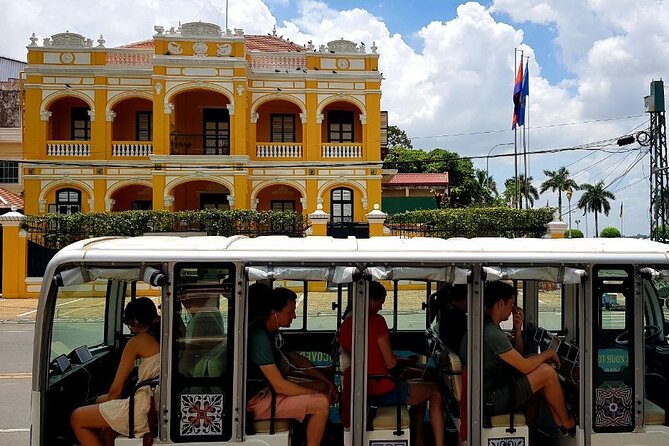
If Phnom Penh is overwhelming when you first arrive, this tour is built for that exact moment. In a couple hours, you get a guided walk-and-ride circuit that explains why certain buildings exist where they do, who used them, and how the city shifted over time—from a fishing village into a capital with French-model planning.
The format matters. You get a tablet and headphones, and each stop is paired with audiovisuals: video explanations, vintage images, and short historical anecdotes. That means you’re not just looking at facades. You’re matching what you see on the street to what it used to be—bank, hotel, police station, governor’s house, school/temple complex, or elite residences.
And because the tour runs with a set route and timing, you don’t waste your limited daylight trying to figure out what’s worth your time. That’s also why it’s a popular “first or early” tour idea: once you know the city’s key threads, everything you do later makes more sense.
You can also read our reviews of more tours and experiences in Phnom Penh.

Price and logistics: what you pay for (and what you don’t)
At $24.36 per person for roughly 2.5 hours, you’re paying for three things: the guide (in-guide person), the tablet with audiovisuals (10 languages), and the time-saving route with multiple heritage stops. Bottled water is included, which matters in Phnom Penh heat.
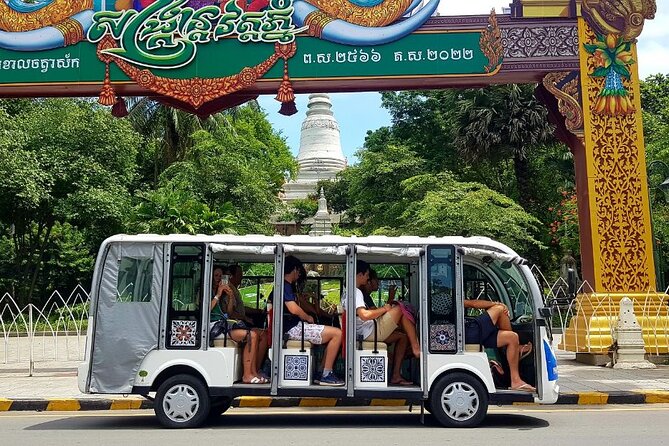
What you’re not paying for is private transportation. The tour clearly includes guided movement between stops (it’s not a pure walking tour), but the listing doesn’t frame it as a private car. So you should assume you’ll be on the standard tour ride with the group.
Also, several admissions are not included. Some entrances and interior visits are either not part of the city loop or depend on being open that day. The tour does offer extra value in other ways—quick photo stops and the tablet’s virtual access to certain buildings—but it’s still a “see-and-learn fast” experience, not a full-day museum plan.
Who this tour fits best
I think this tour is ideal if:
- You have limited time and want a heritage overview you can build on.
- You like history tied to buildings (not just dates).
- You’d rather sit for parts of the route than sweat through long distances.
It’s also a good option if you’re traveling independently and don’t want to assemble a route of 15+ sights on your own. If you’re the type who wants long stays inside palaces, museums, or hilltop temple areas, you’ll still enjoy the exterior context—but you’ll want additional time elsewhere afterward.
Stop-by-stop: what you’ll see and why each one matters
1) Phnom Penh overview stop: get your bearings fast
The tour starts with a broad orientation to Phnom Penh as a rapidly changing capital. You’re essentially being set up to notice the city’s layers: colonial-era planning, elite architecture, and later history that reshaped the country.
This first stop matters because it trains your eyes. After this, the next buildings don’t feel random. You start seeing patterns—types of institutions placed where they were, and how French influence shows up in urban form and design choices.
2) Cambodia Post Office: French-era grandeur in everyday use
At the Cambodia Post Office, you’ll get the story behind one of the city’s most photographed historic buildings. The tour’s audiovisual format helps a lot here: you’re not only admiring architecture, you’re learning why this building represents a certain era of urban modernization.
This is also a nice early “anchor” stop because you’ll likely recognize it later, even if you wander away from the tour route.
3) Palais de la Poste: the old Indochina bank story
Right after, you head to the Palais de la Poste area and the old Indochina Bank context. Expect short, focused audiovisual guidance—enough to connect the building to colonial finance and institutional power without dragging on.
The practical win: you get quick clarity on what you’re seeing, then you move on. You can always choose to return later if something catches your interest.
4) Le Manolis: Phnom Penh’s early hotel vibe
At Le Manolis, the tablet guidance shifts to hospitality—described as the first hotel of Phnom Penh. This stop is valuable if you’re curious about how elite life worked during the early 20th century.
I like these “life-and-luxury” building stories because they balance the heavy parts of history. It also gives you a mental picture of who stayed where, and what “modern city” meant to people at that time.
5) Commissariat of Phnom Penh Municipal Police: control and authority
The tour then takes you to the Commissariat of Phnom Penh Municipal Police, with audiovisuals about the old police station. The theme here is authority—how institutions supported colonial rule and how cities ran.
It’s not just grim. If you pay attention to the role of these buildings, you’ll understand why Phnom Penh’s power structures are written into the city’s layout.
6) Council for the Development of Cambodia: the governor’s house layer
Next up is the Council for the Development of Cambodia, described as tied to an old governor’s house. You get a sense of how colonial governance shaped the “center” of Phnom Penh.
This stop also shows how buildings can keep switching roles across time. You’re seeing the same kinds of grand spaces used for different types of power.
7) Chinese house and Hokkien temple complex: the city’s multi-community fabric
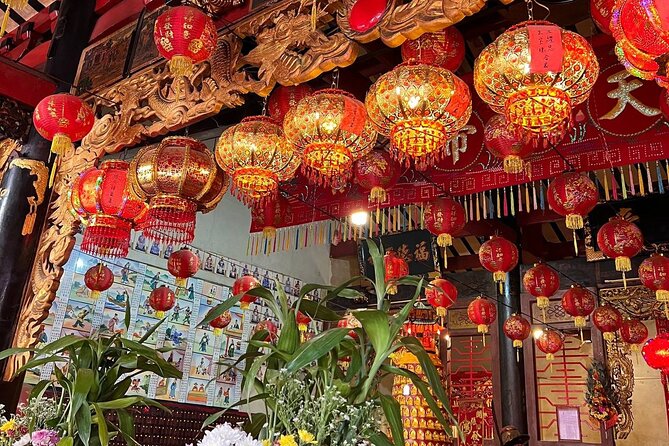
One of the longer segments includes the Chinese house and the Hokkien temple (and it’s described with a couple of temple and school references). Expect guidance in multiple audiovisual parts and enough time to understand that Phnom Penh isn’t only a French story.
If you like architecture tied to community identity, this is one to focus on. You may also get a chance to visit inside the Hokkien temple area if it’s open, but the tour time itself is still short and structured.
8) Naeggas Bridge: the Naga story in stone
At Nagas Bridge, the tablet explains the old naga bridge. This is one of the stops that feels less like a government-institution history lesson and more like mythology and local symbolism showing up in urban design.
Photos are usually easier at this kind of stop because you’re standing for a brief window and the setting is visually clear.
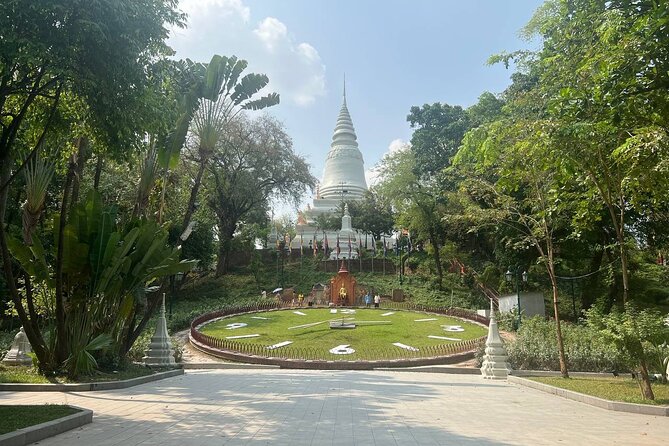
9) Wat Phnom: the famous hill temple from below
At Wat Phnom, you’ll get an audiovisual introduction. You can take pictures, but the visit of the temple on the hill is not included in the city tour.
So if Wat Phnom is high on your list, you’ll need a separate plan to go up for the main temple experience. Think of this stop as your “orientation version,” not the full pilgrimage.
10) The country club / current US Embassy area: strong history, photo limits
Next is the country club area where the current US Embassy is located, with a note that pictures are not allowed here. That’s important because it changes how you experience the stop: you’ll be there for context and viewing the area, not for capturing photos.
The payoff is the historical narrative, which fits the tour’s bigger story about shifting institutions and changing eras of foreign presence.
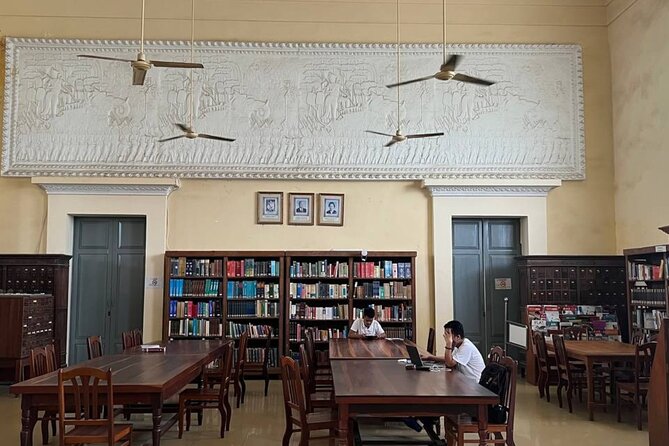
11) National Library: possible inside visit
Then comes the National Library. The tablet gives you the story, and you may have the chance to visit inside if it’s open.
If you can get in, this is the kind of stop that can turn into a satisfying detour. Even if you can’t, you still come away understanding the building’s role.
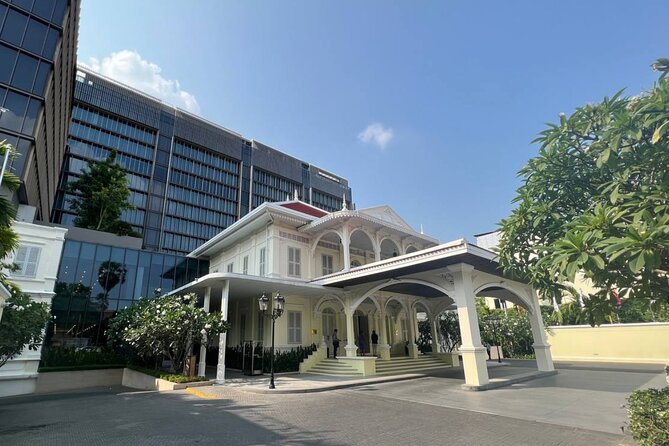
12) Raffles Hotel Le Royal: an early 20th-century landmark
At Raffles Hotel Le Royal, the guidance centers on why it’s considered one of the best hotels in Cambodia. You get a quick slice of elite lifestyle and architectural identity.
In a city where many stories are tied to institutions, hotels and leisure spaces help balance the emotional weight with a different lens.
13) Railway station: the “home” stop that links Phnom Penh to movement
Next you pass through the train station area with the tablet’s audiovisual context. This is a useful connector stop because it tells you Phnom Penh wasn’t just built for prestige—it was also built for connections and movement.
Even a quick station stop can help you imagine how people and goods flowed through the city.
14) Central Market: the everyday life chapter
The route also includes Central Market (listed as a stop with a guided audiovisual). This is the “today meets history” moment. You’ll get context, but you’re also seeing a place where Phnom Penh’s commerce shows up in real time.
The tour time here is short, so it’s more about orientation than shopping therapy.
15) No Problem Villa / Hyatt Regency area: a shifting memory of power
You’ll hear the story around No Problem Villa and also a Hyatt Regency Phnom Penh stop described as tied to the old No Problem Villa. This part of the tour is where the history becomes personally felt.
The tablet guidance is where you get the narrative shape without needing to spend hours reading. It’s a good example of how a short stop can still hit hard if the story is clear.
16) FCC Phnom Penh: a mansion under renovation
The tour includes FCC Phnom Penh, described as an old mansion currently under renovation (noted for 2024/2025). You’ll get the audiovisual explanation, but you may notice parts of the building are covered or altered.
This stop is helpful because it teaches you how heritage survives in real life—sometimes you see the building in transition rather than in perfect postcard condition.
17) UNESCO Cambodia: a cultural-institution wrap
Next is UNESCO Cambodia with audiovisual context about the “UNESCO house.” This gives you a modern institutional layer and the idea that heritage isn’t only preserved in the past—it’s also organized in the present.
It’s a lighter stop that still keeps the narrative thread going.
18) Royal Palace: shown with context, not visited
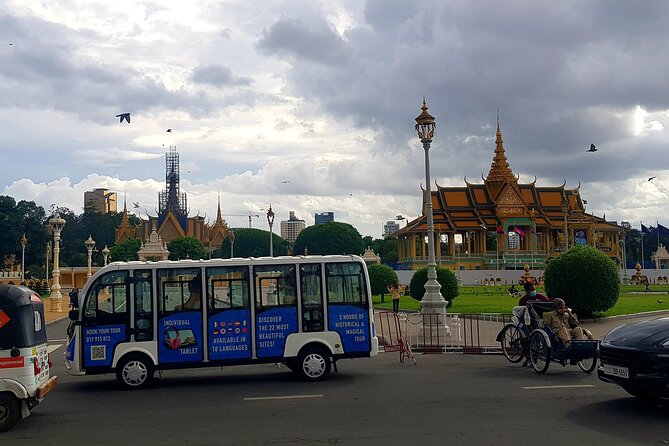
The route includes the Royal Palace area, with an audiovisual introduction, but the palace visit is not included during the city tour. You get context from outside, plus the stop is timed to keep the circuit moving.
If Royal Palace inside access matters to you, you’ll need an additional visit day. Don’t assume this tour replaces it.
19) Street 240 / British Ambassador residence: epilogue and final context
Finally, you end at Oknha Chhun St. (240), near the Royal Palace and Wat Botum Square, with the tablet’s epilogue and a story about the Residence of the British Ambassador to Cambodia. This ending spot closes the loop nicely because Street 240 is treated like a narrative finale—foreign presence, elite residences, and the city’s modern identity.
The tablet + headphones approach: how to use it well
This is one of those tours where your best move is mental, not physical. Keep your tablet screen angled toward the guide cue. Wear the headphones snugly. Each short stop is paired with a story, and missing the audio means you’ll mostly see “buildings on a route” instead of a connected timeline.
The tour also mentions virtual entry into certain buildings that aren’t accessible to the public. That’s a smart way to expand what you can experience without adding long lines or complicated logistics. If you’re the type who likes to compare past and present, this format helps.
Time, weather, and pacing: why it can feel perfect or too fast
You’re on a set schedule and many stops are brief—some are around just a few minutes. That pacing is great for energy and for staying out of the sun. It’s less great if you want to linger and take your time.
And yes, Phnom Penh heat is a factor. This tour is designed so you’re not constantly walking. Still, plan for warm weather by bringing water (you’ll receive bottled water) and wearing sun protection.
If you’re a slow museum-style traveler, treat this as your “first cut.” Then come back on day two for the 2-3 places that really grabbed you.
What’s not included (so you don’t get surprised)
A few stops are explicitly outside the included visit time:
- Wat Phnom hill temple visit is not included
- National Museum visit is not included
- Royal Palace visit is not included
- Some locations have restrictions such as no photos at the country club / US Embassy area
Interior access can be possible only when places are open, including the old bank area, Hokkien temple, the National Library, and the Royal University of Fine Arts.
The way I see it: the tour is still worth it because it sets you up to choose your return visits with better instincts.
The guide factor: meeting Oliver and staying on track
In the real world, the difference between a good tour and a confusing one is the guide’s ability to keep you moving and answer questions. The guide named Oliver is specifically called out for being friendly, knowledgeable, and quick to spot you in busy areas so you don’t lose the group.
That kind of help matters most early on—like when you’re trying to find the start corner or figure out where the bus pickup feels chaotic. It also helps if you want recommendations on what to see longer later.
Should you book the Phnom Penh Heritage Tour?
Book it if you want a fast, well-guided heritage orientation with a tablet-and-headphone format that explains what you’re seeing. At this price level, you’re paying for structure, context, and time saved—plus a small group size that keeps the experience from feeling like a stampede.
Skip it (or plan it differently) if your priority is long, in-depth museum time or full palace/temple visits. This tour is designed to point you toward those experiences, not replace them.
FAQ
FAQ
How long is the Phnom Penh Heritage Tour?
It runs about 2 hours 30 minutes (approx.).
What is included in the tour price?
You get bottled water, an in-guide person, and a tablet with an audiovisual guide with 10 languages. Mobile ticket is used.
Are the main palace and museum visits included?
No. The Royal Palace visit and the National Museum visit are not included in the city tour.
Can I go inside any buildings on the tour?
You may be able to visit inside some places if they are open, including the old bank area, the Hokkien temple, the National Library, and the Royal University of Fine Arts.
Is private transportation included?
Private transportation is not included.
Where does the tour start and end?
It starts at Corner Street 102 & Street 13, Phnom Penh, Cambodia, and ends on Oknha Chhun St. (240), near the Royal Palace and Wat Botum Square.