REVIEW · ATHENS
Blue Lake, Sanctuary of Hera, Mycenae, Ancient Corinth, Canal
Book on Viator →Operated by Ancient Greece Tours & Transfers · Bookable on Viator
A day that starts on a canal and ends in swim-warm water. You’ll see major Bronze Age ruins and the kind of shoreline break Athens rarely offers. This is also a private door-to-door trip, so you’re not fighting buses or schedules.
What I like most is the way the day balances big-ticket sights with breathing room. Two personal highlights for me are the Cyclopean Walls at Mycenae and the relaxed finale at the Sanctuary of Hera at Perachora, where the Blue Lake swim turns “history day” into “vacation day.” It’s a long route, though, and some museum and site entries are extra once you’re there.
In This Review
- Key Points Before You Go
- A Reset Day Trip: Corinth, Mycenae, and a Real Swim Break
- Price and Logistics: What You’re Paying For (and What’s Extra)
- Door-to-Door Comfort With a Driver Who Sets the Stage
- Corinth Canal and the Ancient Diolkos: Engineering as Ancient Geography
- Mycenae’s Grave Circles, Cyclopean Walls, and the Royal Palace Complex
- The Myth of Agamemnon Gets Real at Mycenae’s Free Highlights
- Treasury of Atreus and Clytemnestra’s Tomb: When “Tholos” Becomes Visual
- Museum Time at Ancient Mycenae: Gold, Masks, Jewelry, and More
- Acrocorinth (Akrokorinthos): Fortress Walls and the Best Big-View Break
- Upper Peirene Fountain and Geraneia Views: Short Stops That Matter
- Ancient Corinth: Apollo, the Agora, Paul’s Bema, and St. Paul’s Church Mosaic
- Heraion in Perachora and the Blue Lake Swim: The Day’s Real Payoff
- Timing, Pace, and How to Get the Most From a Long Day
- Should You Book This Private Athens Tour to Corinth, Mycenae, and the Blue Lake?
- FAQ
- Is this tour private?
- How long is the tour?
- Do I pay admission fees for the sites?
- Is pickup from Athens hotels included?
- Is a licensed tour guide included inside the sites?
- What language is the tour in?
- What is the cancellation policy?
Key Points Before You Go
- Private pickup and drop-off from your Athens hotel keeps the day calm and efficient
- Corinth Canal plus Ancient Diolkos shows how Mediterranean trade moved before modern engineering
- Mycenae’s palace complex and the Treasury of Atreus give you famous sites without feeling like a sprint
- Acrocorinth’s fortress views make the landscape feel huge, even when you’re just taking short walks
- Perachora’s Sanctuary of Hera + Blue Lake swim is the payoff moment you’ll remember
A Reset Day Trip: Corinth, Mycenae, and a Real Swim Break
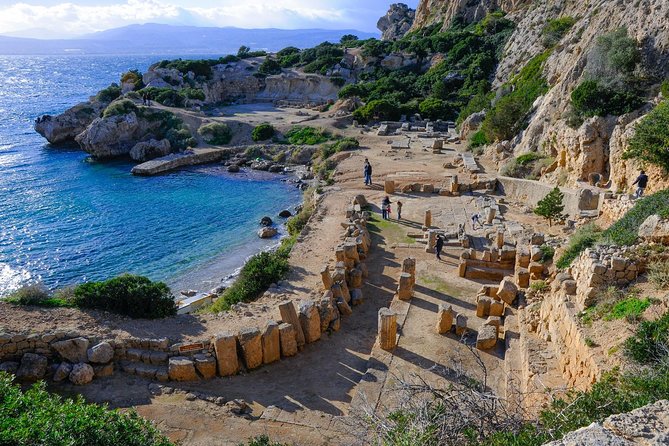
If Athens is your base, it can also start to feel like a lot of stone, traffic, and crowds. This tour is built for a clean change of pace. You start with one of Greece’s most striking engineering stories at the Corinth Canal, then work your way through the legends and archaeology of Mycenae and ancient Corinth. The day ends with something physical and refreshing: time at Hera’s sanctuary in Perachora, plus a swim in the Blue Lake.
The “reset” part is not just the geography. It’s also how the day is paced. You’ll get focused stops that actually match what most people want: major ruins, a museum or two where details matter, and a finale that doesn’t feel like more sightseeing.
You can also read our reviews of more tours and experiences in Athens.

Price and Logistics: What You’re Paying For (and What’s Extra)
At $337.15 per person for a fully private experience, you’re paying for two things that are hard to replicate on your own: convenience and transport.
You’re picked up and dropped back at your Athens hotel (or Airbnb entrance), and you ride in a private luxury vehicle with WiFi, bottled water, and refreshing wipes, plus small comfort touches like handmade Greek biscuits. This matters on a 9-hour day because the drive is long enough that “I’ll just do it myself” can turn into “why am I tired already?”
Here’s the trade-off: the price does not include entrance fees to sites and museums. It also doesn’t include a licensed guide who walks you inside every site (though an add-on licensed guide can be arranged). Your driver can explain a lot on the road, but you’ll still want to budget for ticketed entries once you arrive.
Door-to-Door Comfort With a Driver Who Sets the Stage
One of the best surprises here is how much the driver contributes even when they can’t accompany you inside every ticketed area. Drivers such as Yannis (and others like Panos) are often singled out for in-depth context and a calm, caring approach.
You’ll get history and practical tips during the drive so that when you step into places like Mycenae or Ancient Corinth, you’re not staring at walls and guessing. This is especially valuable for Mycenae, where names like Lion Gate or Treasury of Atreus are famous, but the layout can feel confusing without context.
Also, this is a true private arrangement—your group only. That means you can move at the pace that works for you, and your day doesn’t get dragged down by strangers who are late or overly slow.
Corinth Canal and the Ancient Diolkos: Engineering as Ancient Geography
The first stop is the Corinth Canal, a 19th-century engineering project that reshaped sea routes in a way that still feels dramatic when you’re standing near it. It’s not just a pretty view. It’s a reminder that trade and travel always come down to whoever can move goods faster.
Then you’ll visit Ancient Diolkos, a paved trackway used to haul boats across the Isthmus of Corinth. The point here is that you’re not only seeing a modern canal. You’re seeing the earlier version of the same problem-solving. It’s a clever “how the Mediterranean worked” lesson in stone and slope.
The Diolkos portion is listed with free admission and about 45 minutes, which is a good amount of time. You’re there long enough to understand what it was, and not so long that you start wishing for the next stop.
Mycenae’s Grave Circles, Cyclopean Walls, and the Royal Palace Complex
Then you’re in Mycenae, and it’s the kind of site that makes your eyes do double duty: you’re looking at archaeology, but you’re also imagining the power behind it.
Start with the Grave Circles A and B, the royal cemeteries outside the Bronze Age citadel walls. They’re short stops, but they set the emotional tone of the place. These weren’t burial “afterthoughts.” They were statements.
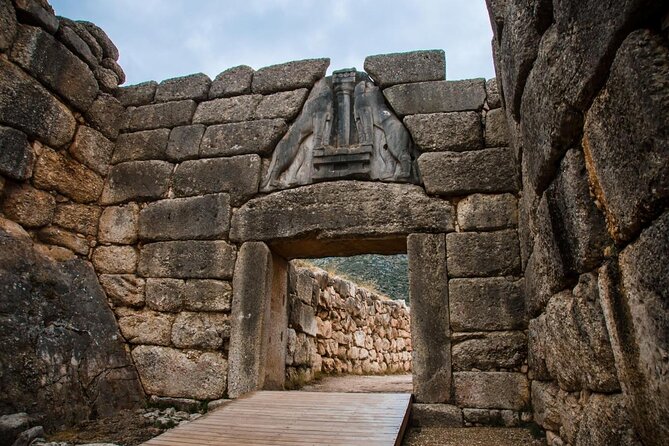
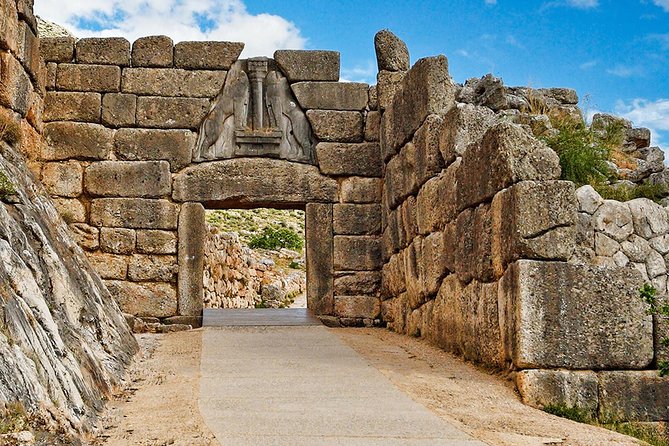
Next come the Cyclopean Walls—those huge limestone boulders that feel almost impossible until you see the scale for yourself. The name matters, but the real experience is visual. You get a sense of how much muscle it would have taken to build something like that without modern equipment.
You’ll also pass the Royal Palace areas: domestic apartments, a Throne Room Suite, a Grand Staircase, and spaces tied to palace officials. The palace complex can feel like a lot to take in quickly, so don’t worry if it’s not all sinking in at once. The key is to focus on structure and purpose. Mycenae is about authority: who lived, who administered, and how power was staged.
You’ll have about 30 minutes at this citadel-style highlight section. If you love architecture and building methods, you’ll enjoy it even in a shorter time. If you prefer slow museum-grade viewing, keep an eye on your ticketed time needs and plan to spend longer where you’re most drawn.



The Myth of Agamemnon Gets Real at Mycenae’s Free Highlights
After the palace and walls, you continue with additional Mycenae time (about 1 hour 30 minutes with free admission for this segment). This is where you can reconnect what you learned from the drive with what you’re seeing on the ground.
This is the part of the day where the site starts to feel more personal. You’ll likely see the Lion Gate area as a prominent landmark (the Lion Gate stop is also separately listed with a shorter time window and tickets not included). In Bronze Age sites, gates and entrances tend to be the most direct way to understand flow—where people arrived, who had access, and how the site defended itself.
If you want an easy way to make the ruins feel less like a checklist: pick one theme for your own mini “tour within the tour.” For example, you can focus on entrances and circulation, or you can focus on defense and walls. With Mycenae, one theme at a time works best.
Treasury of Atreus and Clytemnestra’s Tomb: When “Tholos” Becomes Visual
The Citadel and Treasury of Atreus segment is where Mycenae becomes extra memorable fast.
The Treasury of Atreus is a large tholos, often described as beehive-shaped. The structure is famous for a reason: even without being an expert, you’ll recognize the ambition in its design and scale. Then there’s the Tomb of Clytemnestra, also a tholos-type tomb dating to around 1250 BC, named for the legendary Clytemnestra.
You’ll have about 15 minutes here, and tickets are listed as not included for these stops. In a short window, you’re not meant to memorize every curve—you’re meant to see it clearly, then move on.
My practical advice: arrive with your expectations set for a quick architectural moment. This is ideal if you enjoy photos, geometry, and “how did they pull this off” thinking more than slow guided storytelling.
Museum Time at Ancient Mycenae: Gold, Masks, Jewelry, and More
After the outdoor masterpieces, you’ll have time at the Archaeological Museum of Ancient Mycenae (about 30 minutes, with admission not included).
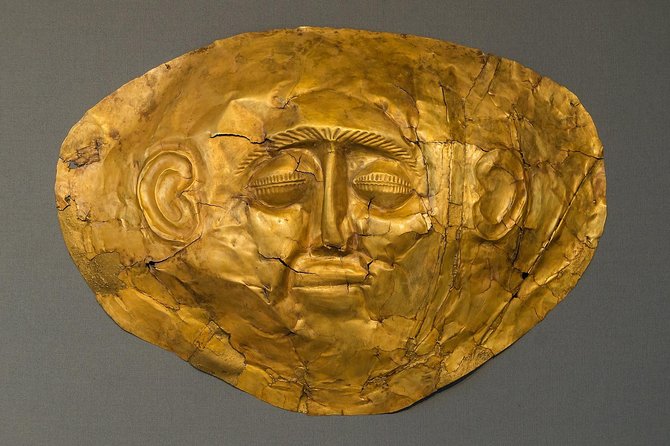
This is the part that helps you connect the site to the people. Outside, you see walls, gates, and tomb architecture. Inside, you see what those burials might have meant. The museum’s standout items are the gold grave goods, burial masks, jewelry, weapons, worship idols, and frescoes.
If you’re the type who wants one place to “really look” rather than walk around, this museum is your best bet. It’s also a nice contrast to the fortress feel of the citadel areas.
Acrocorinth (Akrokorinthos): Fortress Walls and the Best Big-View Break
Next you head to Acrocorinth, the acropolis area of ancient Corinth on a monolithic rock overlooking the region. The best reason to come here isn’t a single temple or tower. It’s the viewpoint and how the site dominates the terrain. You get a real sense of control over routes and movement.
You’ll see the layered defensive systems—a system of circuit walls reinforced by towers—and you can trace how the space was meant to withstand attack. There are also traces of the Temple of Aphrodite on one of the picks of the mountain, plus the Frankish Tower at the southwest edge of the rock. Remains here include churches, mosques, houses, and water structures like fountains and cisterns.
This segment is about 1 hour and listed as free admission. Even with it being free, it still counts as a serious stop. You’ll likely get the “why this matters” moment the minute you look out over the Corinthian gulf and the Peloponnese coast.
If you dislike steep climbs, note that your exact walking level isn’t detailed in the information you have. So plan for some uneven ground and stairs. The good news is the time allocation feels designed for a manageable visit.
Upper Peirene Fountain and Geraneia Views: Short Stops That Matter
Two shorter breaks help round out Acrocorinth.
Upper Peirene Fountain is a quick look at Peirene Spring inside the encircling walls (about 15 minutes, with admission not included). Even when it’s not the star, water sources often tell you how a fortress sustained itself.
Then Geraneia is all about the views—about 15 minutes, free admission. This is where you slow down for a minute, take photos, and let the day’s distances make sense.
These short stops are useful because the overall day is packed. A 10–15 minute viewpoint break keeps you from feeling like you’re always moving.
Ancient Corinth: Apollo, the Agora, Paul’s Bema, and St. Paul’s Church Mosaic
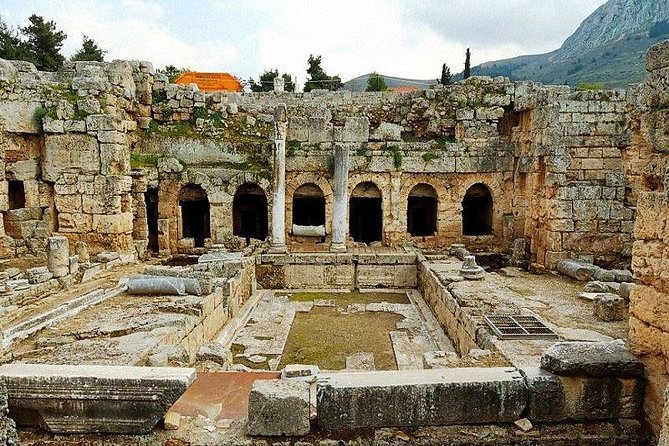
Ancient Corinth is a big site and you’ll feel it immediately. You’ll start with things like Hadgimoustafa spring, a fountain built during the Ottoman empire. It’s a quick reminder that the layers of Corinth don’t stop at antiquity.
Then comes the Ancient Corinth Archaeological Museum and the major outdoor highlights.
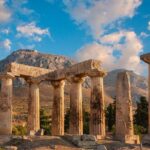
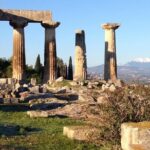
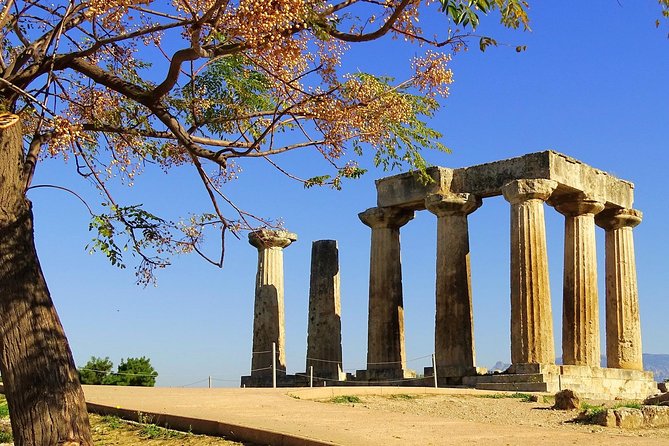
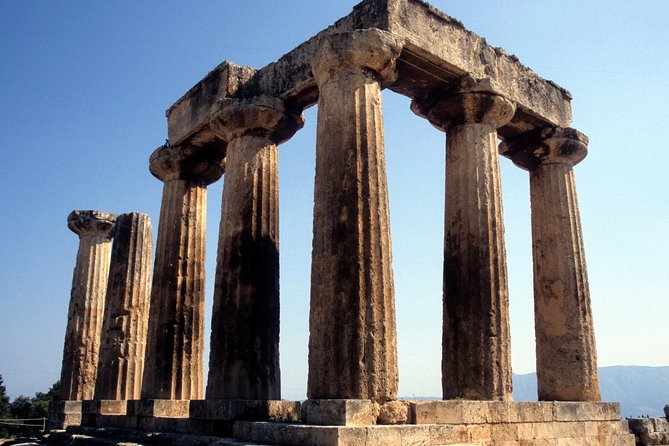
The Temple of Apollo is one of the earlier Doric temples in the Peloponnese and Greek mainland, and the information specifically calls out monolithic columns, which are rare. This is one of those moments where the columns do more than look historic—they give you a sense of scale and proportion.
In the Agora, you’ll see the rectangular layout of central shops, smaller temples, altar areas, and the famous Bema podium. This is where Apostle Paul addressed the Corinthians in 52 AD. That connection is a big part of why many people find Ancient Corinth more than just ruins. It becomes a place where a known story happened.
You’ll also see Roman buildings, plus the theatre and Odeon/Asklepieion. The Lechaion road points toward the port of Lechaion, tying the archaeological site back to movement and trade. And at St. Paul’s church, there’s a mosaic mural depicting Paul’s vision as he traveled to Damascus.
You’ll have about 3 hours here, with admission not included. This is plenty if you’re staying focused. If you’re easily overwhelmed by large sites, consider using a simple rule: spend most of your energy on Apollo, the Agora/Bema area, and the church mosaic. Those are the anchors that make the rest click.
You’ll also have time for lunch. There’s a recommendation for an authentic village-style lunch on a terrace with views over the archaeological area and the Temple of Apollo. That’s a rare combo: food plus a serious scene outside your plate.
After lunch, you can stroll through village shops for handmade souvenirs.
Heraion in Perachora and the Blue Lake Swim: The Day’s Real Payoff
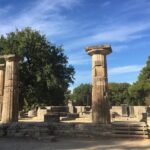
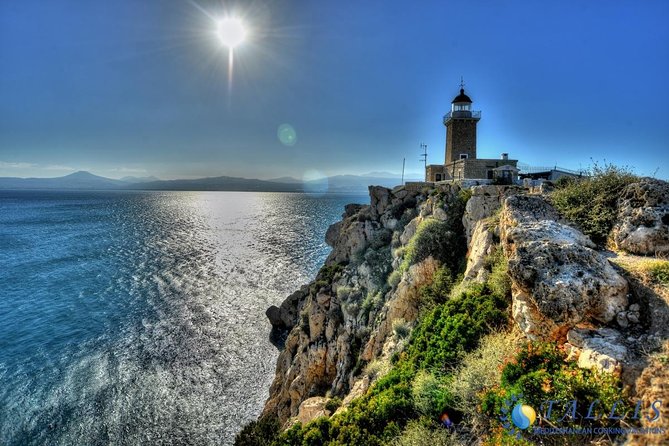
The final highlight is Heraion (Sanctuary of Hera) in Perachora, with the Malagavi Lighthouse mentioned as part of the area. This is where the day changes tone again.
You’ll get time at Heraion / Blue Lake, with about 1 hour allocated for the swim. Entrance is not included for this segment. But the value is clear: you’re leaving the ruins behind and cooling off in a place built for a break.
This is the moment that makes the whole day feel worth it, especially after Mycenae’s long stretches of stone and museum viewing. Plan on wearing something you can swim in if you’re comfortable doing so. Greece in the sun can be deceptive. Water time is a smart decision, even if you don’t end up swimming the whole hour.
Timing, Pace, and How to Get the Most From a Long Day
This tour is built to fit a lot into a single day. That’s good, as long as you approach it with the right expectations.
- You’re moving between major archaeological zones, so you’ll have fewer “deep dive” stops and more “see what you came for” moments.
- You’ll also get shorter viewpoint breaks like Geraneia, which help you reset without losing momentum.
- Your driver’s context during transit helps you process what you’re seeing when you step out of the car.
One more practical note: entrance fees and some site admissions aren’t included, and the time at each stop can feel brief. If you have a museum obsession, the museum segments (Mycenae museum and Ancient Corinth museum) are where you’ll want to spend your attention.
If you travel with kids or you’re doing this as a first-time archaeology outing, the structure works well. The day naturally alternates between walking, photos, and a proper swim at the end.
Should You Book This Private Athens Tour to Corinth, Mycenae, and the Blue Lake?
I’d book it if you want a high-value, low-stress way to hit several of the Peloponnese’s headline archaeological sites in one day, with the comfort of private transport and a relaxing swim finish. The combination is the selling point: Corinth Canal + Mycenae’s monuments + Acrocorinth views + Ancient Corinth’s Agora/Bema + Heraion Blue Lake.
I’d think twice if your idea of a great day is slow museum time and minimal driving. This is not that. It’s a packed day with ticketed sites where you’ll need to budget entrance fees and accept that you’re seeing key highlights rather than reading every label in every room.
If you want an organized, driver-led Athens escape that ends with water and sun, this is a strong choice.
FAQ
Is this tour private?
Yes. It’s a private tour/activity, and only your group participates.
How long is the tour?
The duration is approximately 9 hours.
Do I pay admission fees for the sites?
Entrance fees to the sites are not included. Some segments are listed as free, but many museum and archaeological admissions are not included.
Is pickup from Athens hotels included?
Yes. Pickup and drop-off from your hotel in Athens are included, and the driver meets you at the lobby (or coordinates with you for an Airbnb entrance).
Is a licensed tour guide included inside the sites?
A licensed tour guide to accompany you into sites and museums is not included, but it can be arranged as an additional cost on request.
What language is the tour in?
The experience is offered in English.
What is the cancellation policy?
You can cancel for a full refund up to 24 hours in advance of the experience start time. If you cancel less than 24 hours before, the amount paid is not refunded.