REVIEW · PHILADELPHIA
Revolution and the Founders: History Tour of Philadelphia
Book on Viator →Operated by Grim Philly Twilight Tours · Bookable on Viator
Old City turns into 1776 on foot. This Revolution and the Founders walking tour threads together Philadelphia’s key moments with stops you can’t miss, from the Liberty Bell to Independence Hall and the founder-era places around Franklin Court. It’s built for your schedule too, with morning or afternoon options, and a group pacing that keeps things moving.
I love two things most: first, you’re led by someone with a history degree, and the guides bring stories to life in a way that makes the details stick. Second, you get a tightly focused route that hits a lot of major landmarks in about two hours, so you leave with direction for the rest of your Philadelphia day.
One possible drawback: this is an outdoor walking tour, so weather can matter, and major interiors are not a given at every stop. If it’s crowded or closed, your tour may adjust quickly—still worth it, but plan mentally for a mix of exterior views and short indoor pit-stops.
In This Review
- Key takeaways
- Price and timing: what $29 buys in Philadelphia’s Old City
- Where you meet and how the tour starts strong
- Stop 1: Liberty Bell—what you see, and what you can add
- Independence Hall: timed entry passes and the East Wing pit-stop
- Washington and Adams at the first President’s House
- Congress Hall: where early government functioned in person
- Franklin Court and the “hang together” connection
- The American Revolution’s “first Pentagon” location
- Benjamin Franklin Post Office & Museum: colonial mail, plus an odd flag detail
- Carpenters’ Hall: the First Continental Congress and secret talks
- First Bank and Second Bank: Hamilton vs Jackson on one route
- Franklin’s circles: American Philosophical Society and the Library Company
- Dolley Todd House: seeing the middle-class side of 18th-century Philadelphia
- What the walking format gets right (and what to prepare for)
- Guides, storytelling style, and why names matter
- Value check: does $29 make sense after the whole walk?
- Who should book this tour—and who might prefer something else
- Should you book Revolution and the Founders: History Tour of Philadelphia?
- FAQ
- How long is the Revolution and the Founders: History Tour of Philadelphia?
- How much does the tour cost?
- Is the tour offered in English?
- Do I get a mobile ticket?
- Which major sites will you see?
- Is Independence Hall interior access included?
- Can you go inside the Liberty Bell Pavilion?
- Does the tour run rain or shine?
- Where is the meeting point and where does the tour end?
- Are children and service animals allowed?
Key takeaways
- History-degree guides who can answer real questions and keep the route organized
- Liberty Bell and Independence Hall as the headline sites, with free timed entry passes for Independence Hall
- Franklin Court and founder-era institutions in a single, efficient walk
- A lot of ground in two hours, with a pace designed to fit a free rest-of-day afterward
- Rain or shine operation, plus a plan if poor weather cancels the outing
- Small group cap (up to 24) so you’re not lost in a crowd of strangers
Price and timing: what $29 buys in Philadelphia’s Old City
At $29 per person for about two hours, this is priced like a smart add-on to your first-time Philly plans. You’re paying for a guided route that saves you time and helps you understand what you’re looking at, rather than just collecting photos.
The tour also runs every morning and every afternoon, and it uses a mobile ticket. That matters because Philadelphia’s Independence-area logistics can be fussy, and having the tour handle key timing pieces keeps the day from turning into guesswork.
Group size is capped at 24 travelers, which usually means you can actually hear what the guide is saying and keep up without it feeling like a moving train. It’s a walking tour, so it’s best if you’re comfortable on city sidewalks for the full route.
You can also read our reviews of more tours and experiences in Philadelphia.

Where you meet and how the tour starts strong
You’ll meet at Grim Philly Twilight Tours, 523 Market St and the experience ends at the Merchant Exchange Building, 143 S 3rd St. The ending point is right in the area tied to historic civic life, and it’s close enough that you can continue exploring without feeling stranded across town.
Right at the start, there’s a revolution history introduction and orientation. This is more than a warm-up. It gives you a framework for why these buildings matter, so the stops don’t feel random. With a little context up front, even a quick exterior look starts to make sense.
Stop 1: Liberty Bell—what you see, and what you can add
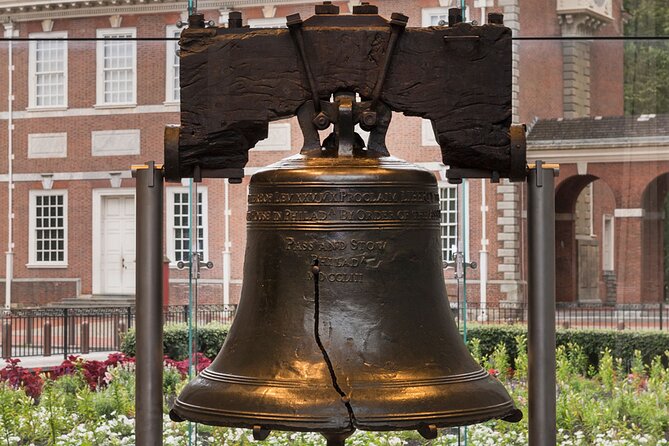
The Liberty Bell is the kind of symbol that draws a line of people almost year-round. Here, the focus is on understanding the bell as an icon—what it represented, how it was made, and why it became shorthand for American liberty.
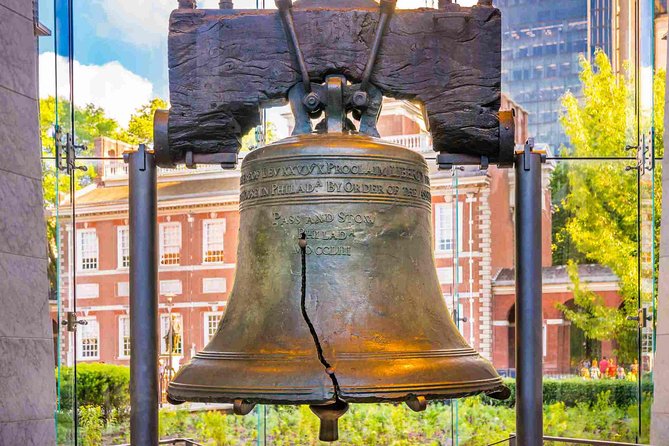
You’ll see it from the outside of the Liberty Bell pavilion, with explanations of its creation and how it cracked. The story is specific: the bell was commissioned in 1752, cracked on an initial test ring, then was recast two years later by local workmen John Pass and John Stow. The lettering includes the long biblical phrase about proclaiming liberty throughout the land.
There’s also an option tied to time: the interior of the Liberty Bell pavilion is available for an additional hour (free) if you choose to return for it. The tour is designed to keep moving, so don’t plan on a long interior visit during the main two-hour loop.
Independence Hall: timed entry passes and the East Wing pit-stop
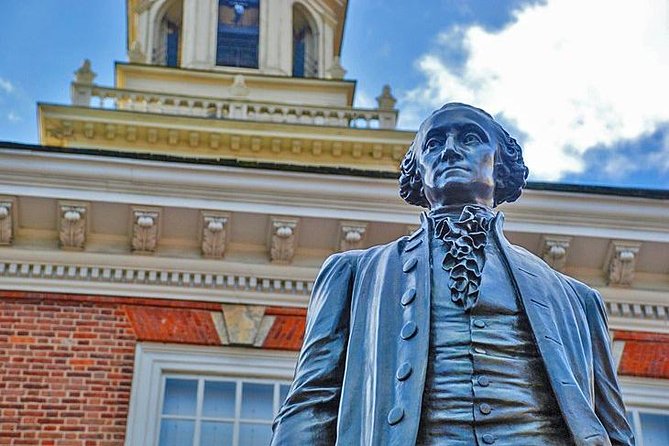
Independence Hall is the centerpiece, and the tour treats it like one. You’ll visit the building where the Declaration of Independence and the Constitution were debated and adopted—so it’s not just a photo stop.
Here’s the key practical piece: the complex requires free timed entry passes. The tour includes help with that, but you should still understand the reality—Independence Hall is timed for a reason, and the complex can take time to explore well. The tour’s approach is to keep you moving through the most essential highlights.
You may get a quick pit-stop inside the East Wing, described as the oldest and most historic part of the structure, served as Supreme Court Chambers when Philadelphia was the nation’s capital. Crowds and closures can affect what’s accessible on the day, but the tour’s goal is to keep the group oriented and not stall for long.
Washington and Adams at the first President’s House

Next you’ll move to America’s first “White House,” the President’s House, where George Washington and John Adams both served when Philadelphia was the U.S. capital from 1790 to 1800.
It’s a helpful stop because it reframes power and politics in daily life. This wasn’t a grand modern presidential campus. It was a working space that hosted official and unofficial business, and the guide uses that “real places, real people” angle to connect the revolution-era leaders to the early government period that followed.
You’ll also hear the story of Benedict Arnold, who lived in the structure after the British evacuation of Philadelphia, serving as Military Governor.



Congress Hall: where early government functioned in person
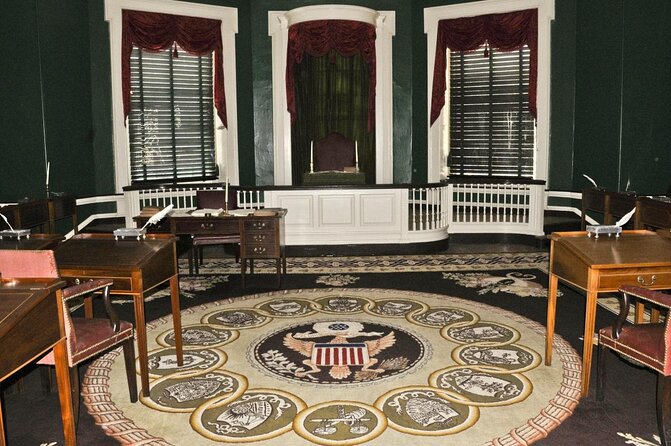
You’ll also visit Congress Hall, another anchor site. The tour notes that it hosted presidential inaugurations for both Washington and Adams. It also served as the home of the U.S. Congress from 1790 to 1800, when Philadelphia was the national capital.
What’s useful for you here is how the guide ties the buildings together. Independence Hall is about founding debates; Congress Hall is about the government learning how to run. In a short two hours, that connection can be hard to build on your own.
Franklin Court and the “hang together” connection
Franklin Court sits right inside the larger Independence National Historical Park area, and it’s where the tour starts leaning into ideas and innovation—not just buildings. You’ll learn about Benjamin Franklin’s life and his role during the Constitutional Convention period.
A highlight is the familiar line about hanging together. The tour uses it as a bridge between revolution thinking and the practical need for unity when forming a new nation.
The guide also threads in the science and communications pieces associated with Franklin—electrical experiments, printing and publishing activities—so Franklin isn’t presented as a one-dimensional “founder statue.” If you like the how-and-why behind history, this part is a strong match.
The American Revolution’s “first Pentagon” location

One stop that feels extra fun—because it’s unexpected—is the location of America’s first “Pentagon,” tied to how military strategy and intelligence were formulated during the American Revolution.
Even though you’re standing outside, not in a museum hall, the tour uses this spot to connect the revolution story to planning and information. It’s a good reminder that wars are built on systems, not just battles.
Benjamin Franklin Post Office & Museum: colonial mail, plus an odd flag detail
This is the kind of stop that can surprise first-timers: the Benjamin Franklin Post Office & Museum. The tour highlights it as the only colonial-themed post office operated by the U.S. Postal Service, and it’s presented as an active window into a bygone lifestyle.
You’ll hear an unusual detail: it’s the only active U.S. post office that does not fly the American flag. The reason given is that the flag didn’t exist yet in 1775, when Franklin was appointed Postmaster General.
The tour also points out the postmark still used for cancellations: B. Free Franklin. On a walking tour, small details like that are exactly what make the stop stick in your mind afterward.
Carpenters’ Hall: the First Continental Congress and secret talks
At Carpenters’ Hall, you’re in a location tied to the First Continental Congress (1774). The tour adds a story layer that makes the site feel alive.
It mentions that in December 1775, Benjamin Franklin held secret meetings here with John Jay, Francis Daymon (as given), and Julien Achard de Bonvouloir, a French spy. Those negotiations helped push for French support—an important reminder that the revolution was never only an American-only effort.
The building’s story doesn’t end with planning. The tour notes that during the winter of 1777, British forces occupied the American capital and took over this building.
First Bank and Second Bank: Hamilton vs Jackson on one route
If you think of founders only as writers and generals, this is the section that corrects that. You’ll see the First Bank of the United States, championed by Alexander Hamilton, founded in 1797, with significance tied to its architecture.
Then the tour also brings you to the modeled Second Bank of the United States, chartered by President James Madison in 1816 and later losing its charter under Andrew Jackson in 1834. The guide connects this to named figures and political conflict, including mention of famous duels linked to both men.
For you, the practical value is perspective: early America built institutions, then fought over them. Walking past these sites helps you see the founding period as both idealism and hard bargaining.
Franklin’s circles: American Philosophical Society and the Library Company
The tour continues with Franklin’s “thinkers’ network.” You’ll walk by the American Philosophical Society, founded in 1743 by Franklin, and closely tied to the University of Pennsylvania.
The names associated with early membership are part of the point: George Washington, John Adams, Thomas Jefferson, Alexander Hamilton, Thomas Paine, David Rittenhouse, and others. Adjacent to the area, the tour also notes America’s first surgical center—another way the guide expands what Franklin-era innovation meant.
Then there’s the Library Company, founded by Franklin in 1731. The tour emphasizes it as the first institution in the world to lend materials to the public. That’s a small sentence, but it reframes what “founding” can mean: not just laws, but access to knowledge.
Dolley Todd House: seeing the middle-class side of 18th-century Philadelphia
Not every stop is about power. You’ll also see the Dolley Todd House, where future First Lady Dolley Madison lived with her first husband, John Todd, from 1791 to 1793.
The tour frames this as a peek into the lifestyle of the middle class in 18th-century Philadelphia, with the site built in 1775. If your brain only connects the founders with grand political scenes, this stop grounds the day in everyday life.
What the walking format gets right (and what to prepare for)
A two-hour walking tour is a sweet format when you’re trying to get the lay of the land. You’ll see a tight chain of sites, and you don’t get stuck spending your entire day waiting in queues.
That said, you’re outdoors, so wear accordingly. One common theme in the experience is that guides try hard to adjust when conditions are rough. On cold days, the guide may work the route so you’re not standing in the open longer than necessary. Still, you should expect some waiting at popular corners—especially around Liberty Bell and other high-demand areas.
Also, don’t assume every major building interior is available in the moment. The tour includes timed entry help for Independence Hall, and it offers an optional add-on related to the Liberty Bell pavilion interior, but it’s still a short, efficient route. If you want long museum time, save that for later.
Guides, storytelling style, and why names matter
A big reason this tour tends to work is the guide quality: every guide has a history degree, and many are history teachers or American history professors. That changes the feel of the day. You’re not just hearing dates—you’re getting explanations that connect the buildings to decisions and consequences.
You can also end up with a guide who leans into storytelling. Names that have shown up with this tour include Josh, Kyle, Ted, Joseph, and Vince—and the repeated pattern is clear: animated delivery, strong answering of questions, and a focus on making the founding era human. One guide style may feel more theatrical than another, so if you prefer quiet lectures, consider aiming for a time when you can keep your expectations flexible.
Value check: does $29 make sense after the whole walk?
For $29, you’re buying three things: guided context, time saved, and route efficiency. In Philadelphia’s Independence-area, time is money. Timed entry planning alone can eat up an afternoon if you’re figuring it out solo. Here, the tour includes free timed entry passes for Independence Hall and helps you move through the most important highlights.
You’re also getting a lot of distinct locations tied to different founder stories: Liberty Bell, Independence Hall, President’s House, Congress Hall, Franklin Court stops, Carpenters’ Hall, banks, and Franklin-related institutions like the American Philosophical Society and the Library Company. For first-timers, that’s a strong payoff because you’re not leaving with just one landmark—you’re building a map of the era.
On top of that, the tour’s rating is extremely high (a 4.9 average with thousands of ratings). High averages don’t guarantee a perfect day, but they do suggest the company knows how to keep the experience smooth.
Who should book this tour—and who might prefer something else
This tour is a great fit if you:
- Want a first Philadelphia orientation focused on revolution and founders
- Like walking and learning at the same time, with minimal dead time
- Enjoy hearing about the founders as people shaped by politics, science, finance, and networks
- Travel with families, since the structure is aimed at making the material understandable
You might choose something else if you:
- Want lots of deep museum time inside major buildings during the same visit
- Are very sensitive to cold weather and long standing periods outdoors
- Prefer a lighter “facts only” approach with little performance
Should you book Revolution and the Founders: History Tour of Philadelphia?
Book it if you want an efficient, story-driven introduction to Philadelphia’s founding landmarks and you’re comfortable with a walking format. The value is strong for the price, and the guide setup (history degree, teaching background) helps you leave knowing what you saw and why it mattered.
Skip or pair it with extra independent time if you know you’ll want long interior museum stays—this tour is designed to keep your day open after the walk, not to replace a full museum afternoon.
FAQ
How long is the Revolution and the Founders: History Tour of Philadelphia?
The tour is about 2 hours.
How much does the tour cost?
It costs $29.00 per person.
Is the tour offered in English?
Yes, it’s offered in English.
Do I get a mobile ticket?
Yes, the tour includes a mobile ticket.
Which major sites will you see?
You’ll visit stops including the Liberty Bell area and Independence Hall, plus sites connected to the founders such as Franklin Court, Carpenters’ Hall, the First Bank of the United States, and other nearby landmark locations.
Is Independence Hall interior access included?
The tour includes free timed entry passes for Independence Hall. The tour also includes a quick pit-stop inside the East Wing, subject to crowds and closures.
Can you go inside the Liberty Bell Pavilion?
You get the story from the exterior area of the pavilion, and there is an option to return for the interior. The interior is not the main focus of the two-hour walk.
Does the tour run rain or shine?
Yes. It runs in rain or shine, and if it’s canceled due to poor weather, you’ll be offered a different date or a full refund.
Where is the meeting point and where does the tour end?
Meeting point: Grim Philly Twilight Tours, 523 Market St, Philadelphia, PA 19106.
End point: Merchant Exchange Building, 143 S 3rd St, Philadelphia, PA 19106.
Are children and service animals allowed?
Children must be accompanied by an adult, and service animals are allowed.