REVIEW · BOSTON
2 Hour Boston Historical and Heritage Walking Tour
Book on Viator →Operated by Boston Free Walking Tours · Bookable on Viator
Boston history packs into two hours. This walking tour threads Boston Common and the Freedom Trail core with stories that guidebooks usually skip, and you’ll get plenty of time to ask questions as you walk. I especially like the small group feel and the way the guide connects monuments to real people and real arguments. The main thing to consider is pace: it’s a lot of talking, and it can run fast in wind or with other street noise competing for your attention.
You’ll meet at the Boston Common Tablet by Freedom Trail (11:00 am) and finish near the James Michael Curley statues by City Hall, just a short walk from Faneuil Hall. Stops are free to view, and you’ll move at an easy walking tempo for about a one-mile loop through some of Boston’s most important civic spaces. If you’re the kind of person who likes history with names, motives, and consequences, this works.
One more practical note: the “2 hours” on paper can feel like more if the guide keeps answering questions or shares extra details when the group is engaged. That’s usually a good sign. Just plan for a long, cold, or noisy morning if weather or sound is an issue.
In This Review
- Key highlights worth your time
- Starting at Boston Common: the park that keeps changing roles
- Park Street Church and the abolitionist thread you can follow
- Robert Gould Shaw and the 54th Regiment: Civil War courage with Boston fingerprints
- The Massachusetts State House: golden dome, hard choices, and political theater
- The Brahmins’ private library, Scollay Square, and the Boston of reputations
- Old State House, the Tea Party lead-up, and the Boston Massacre site
- Boston Irish Famine Memorial: immigration as lived experience
- Old Corner Bookstore and Boston Latin School: ideas in brick-and-stone form
- Faneuil Hall to City Hall: liberty speeches and the end of the one-mile loop
- Price, group size, and the pace you should plan for
- Should you book this Boston historical walking tour?
- FAQ
- How long is the Boston Historical and Heritage Walking Tour?
- How much does the tour cost?
- Where do I meet the tour?
- Where does the tour end?
- What language is the tour offered in?
- Are any paid admissions required for the stops?
- Is a mobile ticket used?
- What happens if weather is bad?
- Can I get a refund if I cancel?
Key highlights worth your time
- Boston Common as a civic stage: military drills, public punishments, peaceful promenades, and later protest energy in one park
- Abolition-era context at Park Street Church: plus the July 4, 1831 debut link to My Country, ’Tis of Thee
- Civil War memory that feels personal: the 54th Massachusetts story paired with the memorial’s meaning
- Revolution, then consequences: Old State House, the Boston Massacre site, and the Tea Party lead-up
- Boston’s immigrant stories aren’t an afterthought: Irish Famine memorial stops you where it matters
- Old publishing and old-school education: Old Corner Bookstore and Boston Latin School in one line of walking
Starting at Boston Common: the park that keeps changing roles
Boston Common is the perfect first stop because it’s not just pretty green space. The tour frames it as America’s oldest public park, and then immediately shows why that matters: people used the same ground for totally different purposes across centuries.
You’ll hear how the Common once held colonial military drills, cattle pasturing across about forty-five acres, and even grim public events like hangings and duels. Then the story shifts to a later, more genteel Boston image—strolling under the elms on the Promenade—and it all lands as one big idea: this park has always been a gathering point for community power and community conflict. That’s why your photos here feel more than scenic. You’re photographing a stage.
What I like as a traveler: the guide treats the Common like a living timeline, not a static landmark.
What to watch for: it’s a wide open area. Wind can be brutal, and sound carries. If you’re sensitive to cold or hard to hear, dress like you’re standing outside for a while—because you are.
You can also read our reviews of more tours and experiences in Boston.

Park Street Church and the abolitionist thread you can follow
From Boston Common, the walk moves into a different kind of space: a church with serious political weight. Park Street Church is presented as a hub for abolitionist activity and missionary work, with speeches and influential advocates tied to the fight for freedom and justice.
The stop also has a specific cultural moment that’s easy to remember: the church hosted the debut of My Country, ’Tis of Thee on July 4, 1831. You don’t just get the fact. You get the sense of why a melody mattered in a political cause—words and music turned conviction into something people could share.
Why this stop is valuable: it explains how moral campaigns used public settings and public sound. Boston wasn’t only arguing in print; it was arguing in rooms where people gathered.
A realistic caution: this is a short stop. If you’re the type who loves to linger, plan to take your questions into the next block while you’re still walking.
Robert Gould Shaw and the 54th Regiment: Civil War courage with Boston fingerprints
The Robert Gould Shaw and the 54th Regiment Memorial stop brings the tour’s themes into sharp focus: who gets remembered, who gets named, and why bravery needs context.
You’ll learn about the 54th Massachusetts Infantry Regiment as one of the first African American units in the Civil War and about their commander, Robert Gould Shaw. The tour’s tone here is respectful, but never vague. You’re not just looking at stone; you’re being pointed toward the story behind it—courage, risk, and the way Boston’s public memory can preserve what society tried to overlook.
What I like: the memorial doesn’t float as an isolated monument. It’s placed in the wider arc of abolitionist and civic action you started hearing at Park Street Church.
Who will enjoy this most: history fans, museum-goers, and anyone who wants American history to include the people it tried to sideline.
The Massachusetts State House: golden dome, hard choices, and political theater
Next up is the Massachusetts State House with its iconic golden dome and the practical fact that it has been the seat of the state legislature since 1798. The guide uses architecture here as a clue: government buildings aren’t neutral. They’re built to project authority.
You’ll also notice the statues. The tour points out General Joseph Hooker’s presence and Mary Dyer’s memorial connection—Mary Dyer hanged for Quaker beliefs. Those names matter because they show Boston and Massachusetts government history wasn’t only about laws and reforms. It was also about punishment, belief, and control.
A traveler takeaway: standing outside a government building after hearing about rebellions and abolition gives you a fuller picture of what the state was doing at different points in time.
The Brahmins’ private library, Scollay Square, and the Boston of reputations
Midway through, the tour shifts into two flavors of Boston identity: the elite intellectual world and the messier entertainment past.
There’s a stop about the Private Library of the Brahmins described as a hidden holding place for rare and valuable books—an angle that helps explain how Boston’s upper tier shaped American thought through publishing and ideas, not only wealth. It’s the kind of detail that makes you feel like you’re getting a clue from an insider, especially if your other Boston stops so far have been mostly civic monuments.
Then the walk moves toward the West End and Scollay Square, where the stories turn rowdy. You’ll hear about theaters, vaudeville shows, and colorful characters—plus a glimpse of the Love Nest of the Kennedys tied to romantic family lore. It’s not a “best-of entertainment district” pitch. It’s a reminder that Boston’s image has always had two faces: polished public institutions and private, human chaos.
Why this section works: it balances the heavy parts of history with the fact that cities are also about culture, amusement, and reputation.
Photo reality check: there are multiple photo moments, but the tour keeps moving. If you want lots of long shots, plan to grab them quickly at each stop.

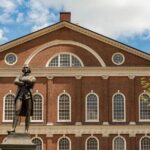



Old State House, the Tea Party lead-up, and the Boston Massacre site
This is the core “why Boston sparked a revolution” stretch, and the guide keeps it pointed and story-driven.
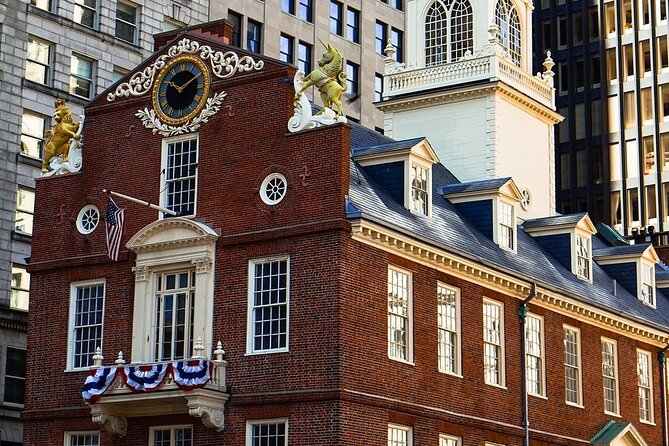
At the Old State House, you’ll connect several moments: the reading of a copy of the Declaration of Independence to Boston citizens in 1776, the building’s later disrepair, and the surprising rescue detail that Chicago offered to buy it at the end of the nineteenth century. Boston didn’t let it go. The site was meticulously restored.
Then the tour continues to the Boston Massacre site, where you’ll hear the confrontation between British soldiers and American colonists that fueled outrage in the lead-up to revolution. The effect of this stop is emotional even if you’ve read the event before—because you’re seeing the place where tension turned into memory.
From there, the tour layers in the Tea Party lead-up. You’ll stand near the action frame for December 16, 1773, when about five thousand citizens gathered during the tea crisis agreeing to prevent the landing of British tea ships. The guide describes disguised men as Mohawk Indians leading a mob down Milk Street to Griffiths Wharf.
This is where you really feel the tour’s strength: it turns dates into a chain of choices. It’s not only who said what; it’s how communities organized.
Boston Irish Famine Memorial: immigration as lived experience
A quieter but powerful stop comes with the Boston Irish Famine Memorial. The tour frames it as a tribute to thousands of Irish immigrants who fled the Great Famine of 1845–52 and found refuge in Boston, becoming the largest ethnic group by 1850. It also credits the broader immigrant story—this memorial isn’t only about one group.
Why you should pay attention here: it interrupts any temptation to treat history as old wars and old politics. Immigration shapes cities long after the headlines fade.
This stop is brief, but it’s the kind of moment where you’ll likely slow down without being told. If you’re traveling with anyone who likes reflective spaces, this is a solid inclusion.
Old Corner Bookstore and Boston Latin School: ideas in brick-and-stone form
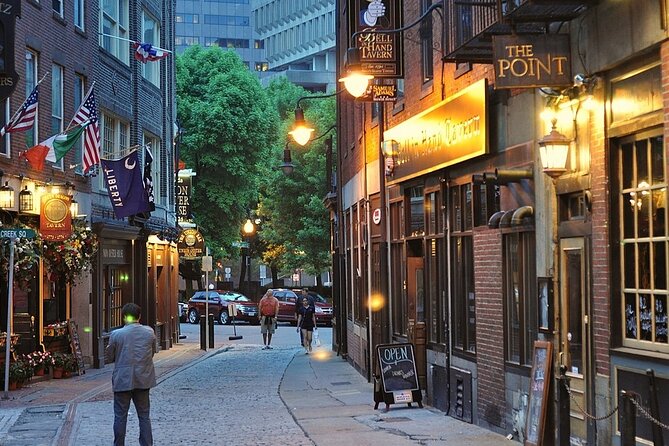
The route then goes from memorial memory to intellect and publishing.
Old Corner Bookstore is described with a clear timeline that makes the building feel useful, not just historic. It was built as a residence and apothecary in 1718, first used as a bookstore in 1828, and later home to the Ticknor and Fields publishers for about three decades. The tour also names the authors who used it as a meeting place: Henry Wadsworth Longfellow, Nathaniel Hawthorne, Oliver Wendell Holmes Sr., and Ralph Waldo Emerson.
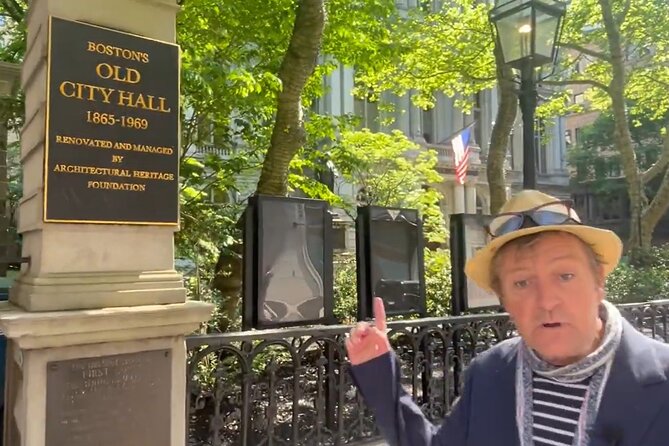
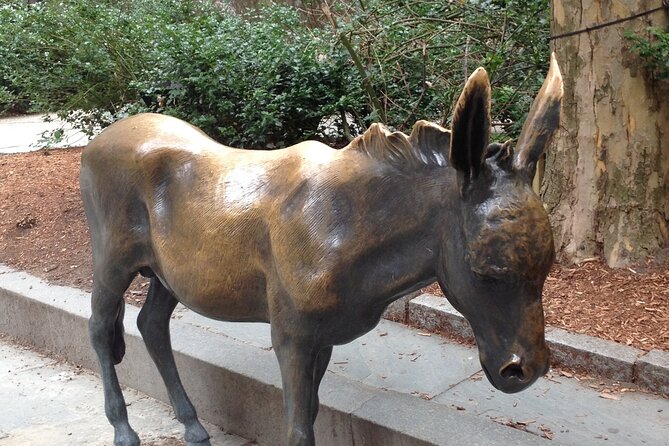
After that, Boston Latin School enters the picture through School Street’s name, tied to the site of the first public school in the United States. The guide also notes that the walk passes King’s Chapel, Old City Hall, and the Parker House, and you’ll even spot Boston’s donkey waiting patiently on School Street.
What I like here: the tour shows that education and literature weren’t side quests. They were part of how Boston produced thinkers who influenced the country.
Practical note: this section involves more sidewalk time with fewer indoor breaks. If you’re doing this in winter, plan your layers and keep moving.
Faneuil Hall to City Hall: liberty speeches and the end of the one-mile loop
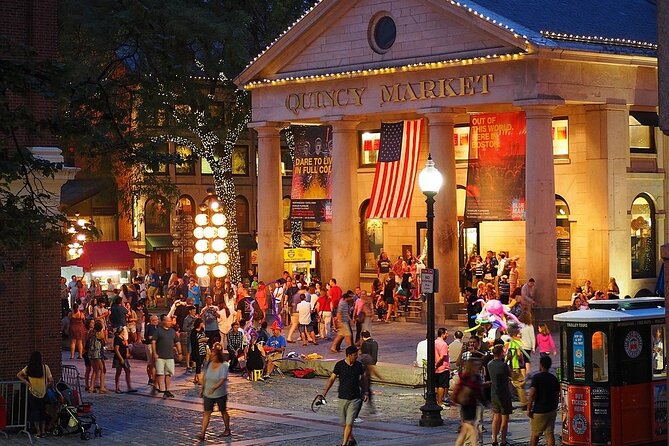
The tour closes with Faneuil Hall Marketplace, and it’s a strong finish.
You’ll learn about the grasshopper weathervane on the building, described as believed to be modeled after London’s Royal Exchange. Then the guide makes the symbolic label practical: Faneuil Hall is referred to as the Cradle of Liberty, and it became a meeting place for revolutionary leaders. One of the tour’s most honest details is the origin story: Peter Faneuil gifted it to Boston, and he is described as a slave trader. The tour doesn’t dodge that. It uses the site to show how American liberty stories often include ugly footnotes.
The guide adds one more civic detail: Faneuil Hall is the headquarters of the Ancient and Honorable Artillery Company of Massachusetts, the oldest military body in the Western Hemisphere, with a charter in 1837.
Finally, you end near Boston City Hall in the shadow of the James Michael Curley statues. Curley gets described as a four-time mayor, governor, and congressman with a long run in big-city politics. The tour’s finish area also connects you with nearby landmarks if you want to keep walking on your own, including Union Oyster House and the Bell in Hand tavern, described as the oldest pub in town, plus Hanover Street as a gateway to the North End.
Price, group size, and the pace you should plan for
Let’s talk value. This is priced at $5 per person and runs about two hours. That’s excellent value for a structured walking loop through high-demand stops like Boston Common, Park Street Church, the State House area, and Faneuil Hall, especially when access to the key sites is free and the guide provides the narrative glue.
But here’s the trade-off: it’s a lot of information in limited time. Several people have pointed out issues tied to pace and sound—wind, crowds, and other tour noise can make it harder to follow if you’re toward the back. A few also noted there isn’t a long window for photos at every stop.
My advice to make it work for you:
- Position yourself where you can hear the guide clearly, even if it means moving a little closer to the front when the group stops.
- Dress for the weather. If it’s cold, you’ll want that attention on the story, not on shivering.
- If you care about photos, think speed. Grab shots at the key moment, then focus on listening while you’re still walking.
- If you’re sensitive to fast speech or heavy detail, go in expecting a “history thinking cap on” tour. It’s not a light stroll with occasional facts.
The guide is known for answering questions, and the group stays small—maximum 24 travelers—so you’re not lost in a wall of people. That’s a real quality-of-life upgrade compared with massive city bus-style tours.
Should you book this Boston historical walking tour?
Book it if you want a structured, story-rich walk through Boston’s civic landmarks, and you like history that connects religion, politics, protest, immigration, and literature. It’s also a good pick if you enjoy asking questions in real time and want a small-group experience instead of getting swept along by crowds.
Skip it or choose it with caution if you dislike fast pace, hate street noise, or need long stops for photos. This tour is designed to cover a lot of ground and a lot of eras, so it rewards travelers who can stay flexible and listen while moving.
FAQ
How long is the Boston Historical and Heritage Walking Tour?
It’s listed at about 2 hours.
How much does the tour cost?
The price is $5.00 per person.
Where do I meet the tour?
You start at the Boston Common Tablet at 1634 Freedom Trl, Boston, MA 02108.
Where does the tour end?
The tour ends at the James Michael Curley Statues at Congress St @ North St, Boston, MA 02108, near Faneuil Hall.
What language is the tour offered in?
The tour is offered in English.
Are any paid admissions required for the stops?
The tour descriptions list free admission ticket for the stops.
Is a mobile ticket used?
Yes, it uses a mobile ticket.
What happens if weather is bad?
The experience requires good weather. If it’s canceled due to poor weather, you’ll be offered a different date or a full refund.
Can I get a refund if I cancel?
Yes. Free cancellation is available up to 24 hours in advance for a full refund.