REVIEW · BOSTON
Boston: Votes for Women History Tour of Back Bay
Book on Viator →Operated by Hub Town Tours · Bookable on Viator
Boston’s vote-right story is written in plain sight.
This small-group walking tour shines a bright light on women’s rights history with an expert guide and keeps you moving through the Back Bay’s best-known streets and buildings. I like that it’s built for real conversation (small group, questions welcome) and that the landmarks are linked to named people, not just big themes. One drawback to plan for: it’s still a 2.5-hour walk, so if you struggle with extended standing, this may feel like work rather than fun.
You start at Make Way for Ducklings on Charles Street and end at the Boston Women’s Memorial on Commonwealth Avenue. Expect about 2 hours 30 minutes walking time, free stops at major sights, and a route that mixes grand public spaces with quieter residential corners tied to the suffrage fight. You won’t be dealing with museum lines or any inside museum admission here, and the tour is offered in English with a mobile ticket.
In This Review
- Key reasons this tour earns top marks
- Votes for Women in the Back Bay: What this $35 tour really gives you
- 15 people max, Maura on point: the tour pace and guide style
- Starting at Make Way for Ducklings: a playful entry into serious politics
- Boston Public Garden and the Washington equestrian statue: where the walk stays calm
- 6 Marlborough Street and the surprise of named organizers
- A historic church, Transcendentalism, and the suffrage-era push-pull
- Ames Mansion, anti-suffrage influence, and one family’s split loyalties
- College Club of Boston: women organizing with education in mind
- The Historic Museum of Natural History building (and Katherine McCormick’s protest)
- Copley Square and Boston Public Library: political life in stone
- Marathon finish line and a Spiritualist Temple: public space, public voice
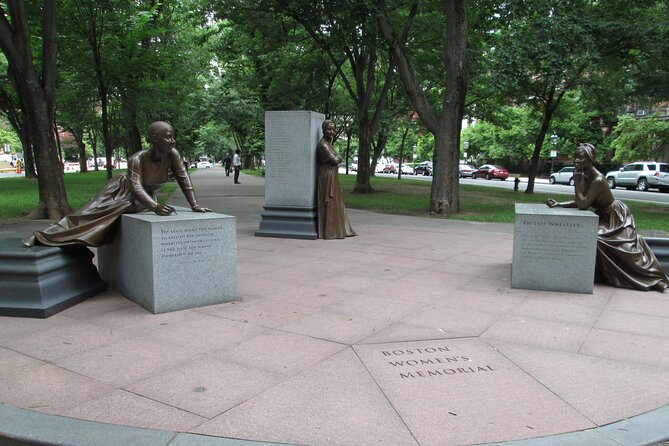
- Boston Women’s Memorial: the ending that turns names into meaning
- Who should book this Votes for Women Back Bay tour?
- FAQ
- FAQ
- How long is the tour?
- What does the tour cost?
- Is this a small-group tour?
- What language is the tour offered in?
- Where does the tour start and end?
- What time does the tour start?
- Is a mobile ticket included?
- Are museum entrances included?
- Are guides in period costume part of the experience?
- Is the tour suitable if I have trouble standing for a long time?
- Do I need good weather for the tour to run?
- Is free cancellation available?
- Should you book this tour or look for something else?
Key reasons this tour earns top marks
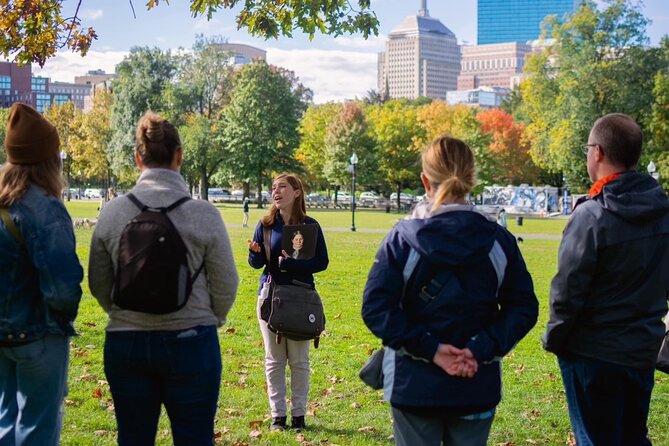
- Small group size (max 15) keeps the focus on you and your questions.
- Storytelling by guide Maura turns familiar buildings into suffrage-era evidence.
- Free outdoor landmarks make the $35 price feel straightforward and low-friction.
- Both sides of the debate show up, including pro- and anti-suffrage voices.
- Back Bay pacing works well if you like history you can actually see and point at.
- A clear finish at the Boston Women’s Memorial gives the whole story a satisfying endpoint.
Votes for Women in the Back Bay: What this $35 tour really gives you
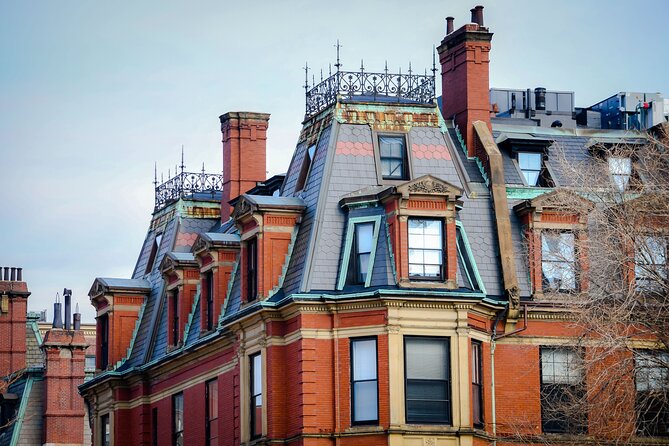
At $35 per person for about 2.5 hours, this tour is priced like a no-nonsense history outing. You get a structured walk, a named guide, and a route packed with stops that are free to view. That matters because Boston can eat money fast with paid attractions; here, the cost mostly goes to interpretation and guidance, not entrance fees.
The bigger value is how the tour frames the suffrage story. Instead of treating women’s rights history as a single march toward progress, you see it as a local political fight fought street by street, address by address. That’s how the Back Bay works, too: buildings look elegant, but they also record who had influence, who organized, and who pushed back.
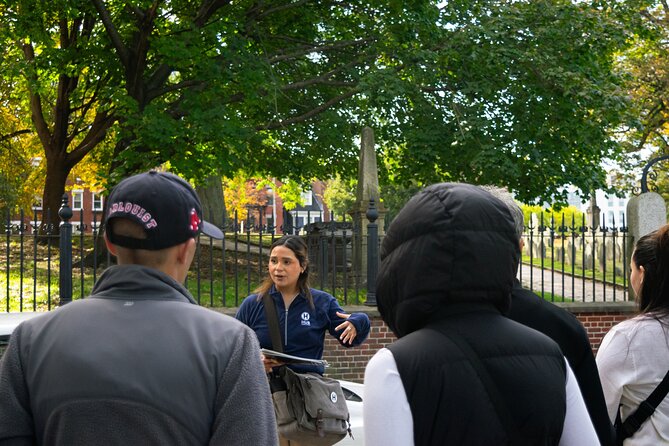
I also like the tone: this is not lecturing-only. The guide invites interaction and uses the urban setting as the lesson plan. If you enjoy walking tours because they let you ask why something mattered, you’ll feel at home here.
One practical note: this is an outdoors-first experience. You’ll want comfy shoes and to bring water, even if the tour includes free outdoor viewing at most stops.
You can also read our reviews of more tours and experiences in Boston.


15 people max, Maura on point: the tour pace and guide style
The experience is designed as a true small-group walk, with a maximum of 15 travelers. That’s not just a comfort detail. With a group this size, it’s easier to follow along, harder to get lost, and more likely you’ll get answers when you ask something specific.
This tour is led by a guide named Maura, and her style shows up in the way people talk about the experience: focused, passionate, and built around the details that make suffrage history feel real instead of textbook-flat. You’ll hear about Boston women and the organizations tied to them, not just distant national headlines.
Language is English, and you’re given a mobile ticket. The tour also runs in good weather only, so if Boston is doing its usual rain-or-glare thing on the day you pick, you’ll want flexibility.
If you know you’ll be fine standing and walking for 2.5 hours, you’re set. If you’re limited by long periods on your feet, plan on sitting opportunities before you arrive or consider a shorter option.
Starting at Make Way for Ducklings: a playful entry into serious politics
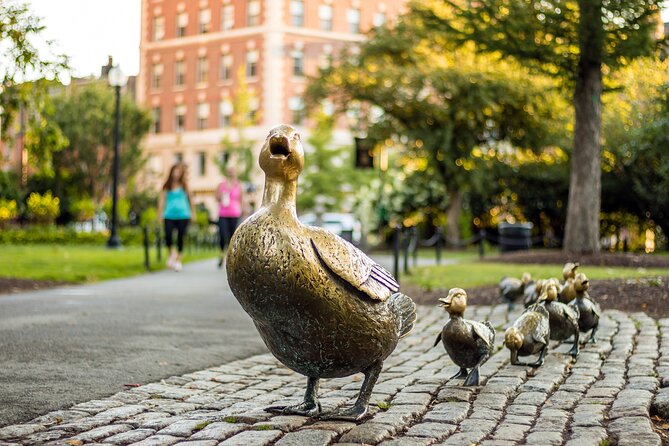
The tour begins at Make Way for Ducklings, a well-known sculpture by Nancy Schön based on Robert McCloskey’s classic picture book. It’s a friendly start that helps you get your bearings fast in Back Bay. More importantly, it sets the pattern you’ll see throughout the walk: Boston’s public art and public spaces aren’t separate from history. They’re part of how a city tells its story.
From here, the route pivots into the 1800s and early 1900s, when suffrage ideas were being argued in meeting halls, offices, and drawing rooms all around Boston. Starting at a spot you already recognize is a smart way to make the rest of the tour feel approachable.
Boston Public Garden and the Washington equestrian statue: where the walk stays calm
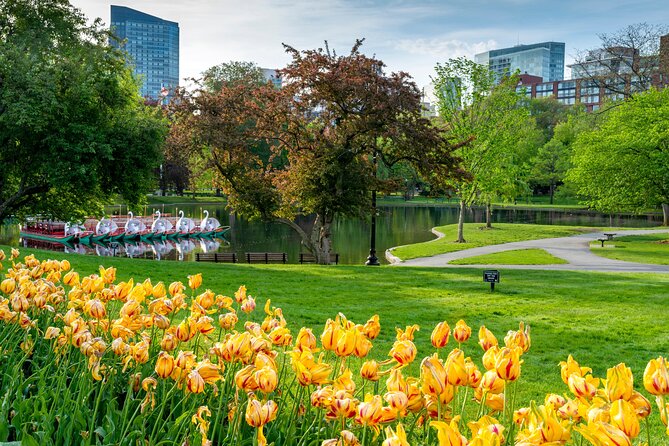
Your next stop lands in Boston Public Garden, established in 1837 as the first public botanical garden in the United States. It’s a good place for a history tour because the space gives your eyes a break while your guide sets the political stage.
Then you move on to an equestrian statue of George Washington by Thomas Ball, commissioned in 1859. This isn’t just a photo stop. The tour uses monuments like this to connect power, public image, and the idea of leadership—then flips that idea by asking who was allowed to lead politically and who wasn’t.
The Garden and the statue work together as a warm-up: you’ll still be in an outdoor setting, but you’ll be thinking about civic life, not just sightseeing.
6 Marlborough Street and the surprise of named organizers
At 6 Marlborough Street, the focus tightens to Pauline A. Shaw, a financier in Boston’s women’s suffrage movement and founder of the Boston Equal Suffrage Association for Good Government. This is one of the tour’s most grounded stops because it gives you a specific person tied to political money, political organization, and political strategy.
This is where the tour’s approach really clicks. It’s not enough to know the vote was fought for. You also learn who funded and organized the fight in Boston, and how that work operated from ordinary-seeming streets.
If you like history that includes real names, this is the sort of stop you’ll remember later. It turns the suffrage movement from a slogan into a chain of decisions and contributions.





A historic church, Transcendentalism, and the suffrage-era push-pull
The walk passes a church site that was established in 1630 and later became a center of the Transcendentalist movement. Even without stepping inside, the tour makes a point: Boston’s reform energy wasn’t just political. It also lived in religious and intellectual circles.
Then you meet people on opposite sides of the suffrage debate. The stop sequence includes Elizabeth Putnam, described here as an anti-suffragist and noted as the first woman to preside over a state electoral college. It also includes Julia Ward Howe, and then moves to Blanche Ames, a pro-suffrage cartoonist and early advocate for birth control.
That mix is valuable. It shows you that debates weren’t neatly divided into one simple moral camp. The suffrage movement had allies, critics, and internal arguments. When you walk past these addresses, you’re seeing how politics and culture intersected in personal lives.
Ames Mansion, anti-suffrage influence, and one family’s split loyalties
The tour then highlights the Ames Mansion area, tied to the fortune and political involvement of the Ames family. What makes this section interesting is the contrast: it points to anti-suffrage influence through Mary Shreve Ames and pro-suffrage advocacy through Blanche Ames.
This is a great reminder that families were not always aligned behind every cause. Politics could fracture even among people with the same last name, the same wealth, or the same circle. You can also start to notice how Boston’s neighborhoods concentrate influence: some addresses matter because they housed decision-makers, not because they were museum-worthy.
This stretch of the walk also travels through a long avenue with trees, grassy areas, benches, and statues. It’s not just scenery. It gives you a slower rhythm so the guide can connect the dots between people, institutions, and the public face of power.
College Club of Boston: women organizing with education in mind
Next is The College Club of Boston, identified here as the first women’s college club in the United States. That detail matters because it frames suffrage work as part of a broader push for women’s intellectual and social authority.
Instead of picturing the vote fight as only rallies and leaflets, you’re also seeing the groundwork: women forming clubs, shaping ideas, and creating spaces where they could network and plan. If you’re the kind of traveler who wants the “how” behind big movements, this stop delivers.
The structure is also practical: about 10 minutes here, free to view, then you keep walking. You’re not stuck in one place long enough to lose energy.
The Historic Museum of Natural History building (and Katherine McCormick’s protest)
The route continues to RH Boston, specifically The Gallery at the Historic Museum of Natural History. The building previously hosted the Museum of Natural History from 1864 to 1951, and that museum association helps you understand why this area is so tied to ideas and institutions.
The tour connects the site to Katherine McCormick, who protested popular fashion as part of the suffrage movement. That’s an unexpectedly smart link. It reminds you that movements often challenge more than one system at a time, including the social expectations that shape everyday life.
The building also dates to 1877 and is considered by members of the American Association of Architects as one of the top 10 buildings in the country. That architectural credibility matters because it places the suffrage era in the same physical world as major civic design. This isn’t a fringe movement happening only in back rooms.
Copley Square and Boston Public Library: political life in stone
Copley Square is the next major public space on the walk, described as the cultural center of Boston. The tour uses the square as a pivot into how women’s organizations worked through the city’s institutions.
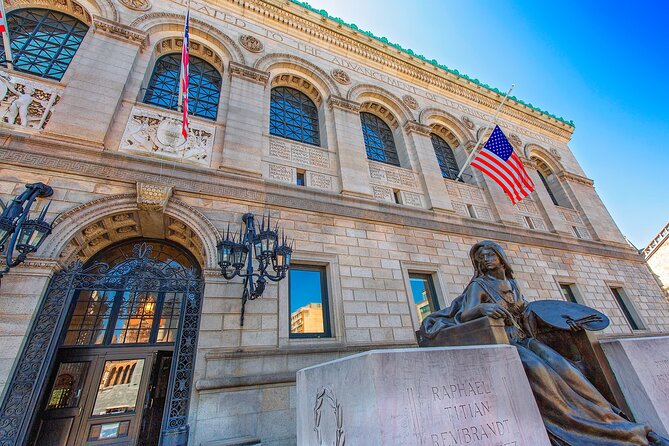
Then you reach the Boston Public Library, founded in 1848 and now the third-largest public library in the United States. Again, you don’t need to go inside to get value, because the tour ties the library’s surrounding space to suffrage organizations and political argument.
A key detail here is that the tour mentions Chauncy Hall, described as the former name of the area where offices of pro-suffrage organizations were located, including the Massachusetts Woman Suffrage Association and The Women’s Journal. It also references the Kensington Building (demolished in 1967), which housed the offices of the Massachusetts Association Opposed to Further Extension of Suffrage to Women.
I like how that sets up a clear mental picture: the debate happened on real office desks, in real publications, and under real organizational banners. The “pro” and “anti” labels aren’t abstract here; they are described as entities with locations.
Marathon finish line and a Spiritualist Temple: public space, public voice
As you continue through the Back Bay core, the tour passes the finish line of the iconic Boston Marathon. That’s a fun, modern landmark used as an orientation anchor while the guide connects civic spectacle to civic rights. It also gives you a chance to think about who gets included in public ceremonies and who got excluded from political power for decades.
The walk also moves through a popular street area known for shopping and dining and luxury brands. Even that commercial feel isn’t treated as a distraction. It helps show how public life changes over time while the power structures behind it keep echoing.
Finally, you reach a former Spiritualist Temple, described as a place where women were allowed to lead public meetings. This section adds an important layer: some women gained political skill and public presence through alternative institutions before the broader political system would recognize them.
You end up ready for the finale, and by now you’ve seen how the suffrage story involved many kinds of organizations, not one single tactic.
Boston Women’s Memorial: the ending that turns names into meaning
The tour finishes at the Boston Women’s Memorial, with depictions of Abigail Adams, Phillis Wheatley, and Lucy Stone. This is a strong closing stop because it reframes everything you just walked past. You start noticing names as more than labels: they become a way to organize memory and power.
It’s also a convenient end point within Back Bay, on Commonwealth Avenue Mall. The finish helps you transition to your next plan, whether that’s a coffee break nearby or an easy hop toward other parts of Boston.
Who should book this Votes for Women Back Bay tour?
Book it if you want women’s suffrage history that’s grounded in place: specific addresses, specific names, and visible landmarks across Back Bay. It’s also a great fit if you like the format of a guided walk and you want a guide who encourages questions.
You might skip it if you have trouble with standing for extended periods. This is moderate in physical demand, and even with frequent short stops, you’ll still be on your feet most of the time.
This tour also suits:
- Solo travelers who like meeting a small group
- Couples looking for something more local than the Freedom Trail-style approach alone
- History lovers who enjoy architecture and who want civic life explained through real people
FAQ
FAQ
How long is the tour?
It’s approximately 2 hours 30 minutes.
What does the tour cost?
The price is $35.00 per person.
Is this a small-group tour?
Yes. The tour maximum is 15 travelers.
What language is the tour offered in?
The tour is offered in English.
Where does the tour start and end?
It starts at Make Way for Ducklings, 4 Charles St, Boston, MA 02116. It ends at the Boston Women’s Memorial, 256 Commonwealth Ave, Boston, MA 02116.
What time does the tour start?
Start time is 10:00 am.
Is a mobile ticket included?
Yes, the tour includes a mobile ticket.
Are museum entrances included?
No. Admission inside museums is not included.
Are guides in period costume part of the experience?
No. Guides in period costume are not included.
Is the tour suitable if I have trouble standing for a long time?
It’s not recommended for travelers who have trouble standing for extended periods.
Do I need good weather for the tour to run?
Yes. The experience requires good weather, and if canceled for poor weather you’ll be offered a different date or a full refund.
Is free cancellation available?
Yes. You can cancel up to 24 hours in advance for a full refund.
Should you book this tour or look for something else?
If you want a strong dose of Boston-specific women’s rights history without spending extra money on admissions, this is a smart buy. The small group size, the focus on named figures, and the way the guide connects public spaces to the suffrage debate make the walk feel purposeful rather than just scenic.
Book it if your goal is to see the city as a map of political conflict and organizing. Skip it if you need lots of sitting time or you’re unlikely to handle a moderate walk. Otherwise, this is exactly the kind of tour that turns a familiar neighborhood into a much more interesting place to stand and look around.