REVIEW · CHARLESTON
Evening History Tour
Book on Viator →Operated by Peninsula Walking Tours · Bookable on Viator
Charleston glows after sunset. This evening walk keeps you out of the worst daytime heat, and I love how the guide ties the city’s big moments together through stops like the Robert Smalls monument and Rainbow Row. With a local guide named Evans, the stories feel connected, not random. The main drawback to plan around is the good-weather requirement.
You’ll be moving at a comfortable walking pace for about 2 hours, with a small group capped at 20. It’s offered in English, and you’ll get a mobile ticket, so you’re not fumbling around when you’re trying to start seeing. If you’re prone to getting cold or you hate being outside after dark, bring a layer—Charleston evenings can feel different from the day.
This tour is a strong fit if it’s your first time in Charleston or you’re coming back and want history you can actually place on the map. It’s also a smart pick if you want the highlights without spending your whole day in museums.
In This Review
- Key highlights you’ll feel on this Charleston walk
- Why this Charleston evening history tour works (especially when it’s hot)
- Meeting at 80 Broad St: where the tour begins and how it flows
- Stop 1: Pineapple Fountain and the Robert Smalls monument story
- Stop 2: Rainbow Row—what you’re looking at and why it’s everywhere
- Stop 3: Fort Sumter National Monument links from the Charleston Harbor
- Stop 4: Old Exchange, Customs House, and Provost Dungeon
- Stop 5: St. Michael’s Church and the Four Corners of Law
- What makes the guide experience stand out (Evans factor)
- Comfort and logistics that actually matter on a 2-hour walk
- Who this evening history tour is best for
- Should you book the Evening History Tour with Peninsula Walking Tours?
- FAQ
- How long is the Evening History Tour in Charleston?
- Where does the tour start?
- Where does the tour end?
- Is the tour offered in English?
- Does the tour use a mobile ticket?
- How many people are in the group?
- Are admission tickets required for the stops?
- What is the weather policy?
- Is there free cancellation?
- Are service animals allowed?
Key highlights you’ll feel on this Charleston walk
- Robert Smalls at the Pineapple Fountain: a major Civil War escape story told right where you can connect it to the street
- Rainbow Row’s timing and context: famous facades with a quick explanation of what makes the place so iconic
- Charleston Harbor history with Fort Sumter links: from the American Revolution to the Civil War, all in one walking route
- Old Exchange & Provost Dungeon storytelling: a mix of presidents, customs, and pirates in one stop
- St. Michael’s Church and the Four Corners of Law: God, local state law, and federal law, tied to Robert Ripley’s naming
Why this Charleston evening history tour works (especially when it’s hot)
Charleston daytime sightseeing can be a lot—heat, glare, and that slow march of fatigue. This is built as an evening alternative, so you’re out when the light is friendlier and the walking feels more human.
What I like most is that the tour doesn’t try to cover everything. Instead, it gives you a tight circuit of famous landmarks and then adds the “why it matters” right in front of you. You leave with the sense that Charleston’s streets are basically a timeline you can walk.
Group size matters here. With a maximum of 20 people, you’re less likely to feel like you’re being herded past stops like a photo line. It’s still a walking tour, so you do need comfortable shoes, but the vibe stays personal enough to make the historical details land.
You can also read our reviews of more tours and experiences in Charleston.



Meeting at 80 Broad St: where the tour begins and how it flows
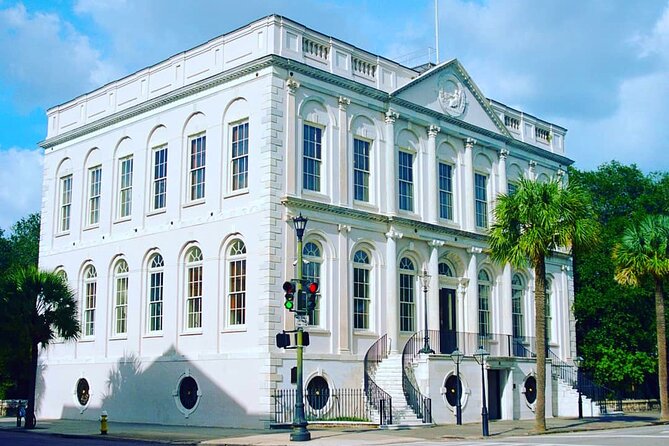
The tour starts at 80 Broad St, Charleston, SC 29401, and it ends at the intersection of Broad and Meeting Streets, in front of Charleston City Hall. That end point is convenient because it puts you back in the heart of downtown, where it’s easy to grab dinner or continue on your own.
Since the duration is about 2 hours, I treat this as a great “anchor” activity. You can plan your evening around it. You’re also dealing with a route that’s set up for walking, so you get a real sense of how these historic sites relate to one another without needing a car.
A small but helpful detail: the tour uses a mobile ticket, so there’s less logistics stress and more time for looking up. That matters when you’re bouncing between streets and rooftops and trying to catch architectural details.
Stop 1: Pineapple Fountain and the Robert Smalls monument story
Your first stop is the Pineapple Fountain, a classic Charleston symbol of hospitality. It’s a great opener because it gives you something visual and instantly understandable before the story time starts.
Right next to it is the monument to Robert Smalls. This is where the tour turns the key from “pretty landmark” to “this town has scars and courage.” You’ll hear about the escape by an enslaved African American during the Civil War—described as the bravest escape—so you’re not just hearing a generic Civil War reference. You’re starting with a specific name and a specific kind of action that changed outcomes.
Why this works as the first stop: it frames Charleston’s history as more than old buildings. It’s about people making dangerous choices, and about how communities remember them in public space.
Practical consideration: since this is a street-side start, you’ll want to be ready for quick listening while you stand in a downtown setting. If you’re sensitive to crowds, keep an eye on where your group positions itself, and try not to block anyone trying to walk through.
Stop 2: Rainbow Row—what you’re looking at and why it’s everywhere
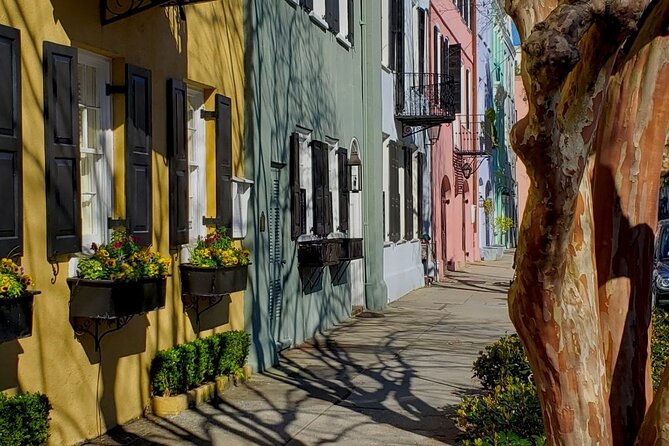
Next up is Rainbow Row, the most famous landmark in Charleston. The tour connects the fame to the facts: the row was built between the 1740s and 1750s, which helps you understand why these colors and facades got turned into the city’s branding.
You’ll also get the kind of detail that explains why Rainbow Row shows up on everything—from needlepoint designs to shot glasses. That might sound like souvenir talk, but it actually helps you read the landmark. You start to see Rainbow Row as a symbol people carry home, not just a row of buildings you snap photos of.
One more reason I like this stop: it’s short. You get a hit of context without losing the evening’s momentum. Then you move on while the story is fresh.
A quick tip if you want to make this stop count: spend a minute looking beyond the obvious. Notice the uniformity of the row, then look for small differences the guide points out through the narrative. The more you look, the less it feels like a cliché photo stop.
Stop 3: Fort Sumter National Monument links from the Charleston Harbor
Charleston Harbor is where the city’s history starts making sense as a connected system—war, trade, geography, and the politics of access. This stop focuses on Fort Sumter National Monument as a thread through several major moments.
You’ll hear how the story runs from the battle of Ft. Sullivan during the American Revolution, to the first shots of the Civil War at Ft. Sumter, and then to the Massachusetts 54th connected to Battery Wagner. Even if you’ve heard parts of this before, hearing it in one compact explanation helps you place the players and the timeline in your head.
Why this stop is valuable on an evening walking tour: you get the “big-picture” history without the commitment of a longer museum day. You’re also outdoors, which makes the harbor context easier to understand. The water and the space between buildings make it easier to grasp how strategic locations mattered.
Possible drawback: because this is a walking tour, you may not get the same depth of access you’d get from a full day focused on one site. Plan to use this as context that sets you up for deeper follow-up later, not as your only history stop in Charleston.






Stop 4: Old Exchange, Customs House, and Provost Dungeon
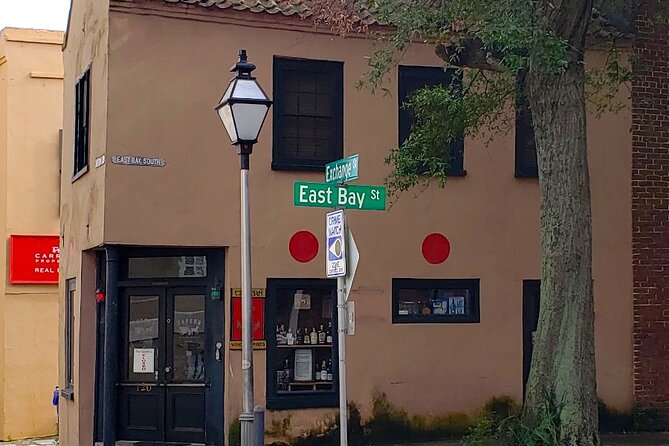
One of the most interesting aspects of Charleston history is that it covers many functions—commerce, law, punishment, and power—often within the same cluster of buildings. That’s exactly the vibe you get here at Old Exchange & Provost Dungeon.
The stop is described as one of the most historic colonial American structures, and it groups the Exchange, the Customs House, and the Prevost Dungeon together. The story thread spans presidents to pirates, which might sound like a marketing line, but it gives you a clear promise: you’re going to hear how these buildings were tied to real authority and real trouble.
I like this stop because it refuses to treat history as only one thing. Customs connects to trade and control. A dungeon connects to imprisonment and punishment. When your guide ties those together, you can see how the city ran—then and now.
What to expect with a tour like this: shorter time at each stop, but stronger storytelling. You won’t have hours to wander. You’ll get a structured understanding of what these spaces were used for, and then you’ll be able to decide if you want to return later for a longer look.
Stop 5: St. Michael’s Church and the Four Corners of Law
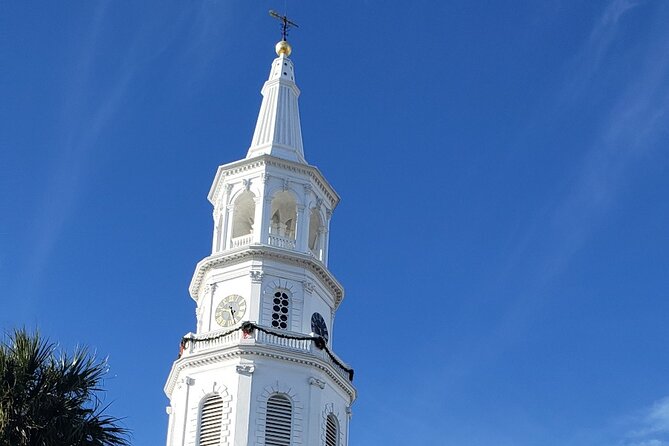
The final cultural anchor in the route is St. Michael’s Church. This stop is shorter—about 5 minutes—but it lands a memorable concept: the Four Corners of Law.
This idea was named by Robert Ripley of Ripley’s Believe it or Not, and the tour explains that God, Local State Law, and Federal Law are represented here. Even if you don’t think you’re a “law” person, this is a fun way to understand how Charleston expressed authority in a visible, symbolic form.
Why I think this is a smart way to end: you’re not finishing with another battle detail or another architecture fact. You’re finishing with how the city frames rules and responsibility. Then you walk out toward City Hall and the downtown streets feel even more meaningful.
Practical consideration: this is a quick stop. If you want photos, do them fast and keep your attention on the guide while the key idea is being explained. This is the kind of detail that you’ll miss if you step away half a minute too early.
What makes the guide experience stand out (Evans factor)
The biggest “buy-in” for this tour is the human part. In the reviews, Evans is singled out for sharing a strong amount of Charleston history, and that matches what you should look for in a tour like this: a guide who can connect landmarks to the lived story behind them.
On a short tour, your guide is doing heavy lifting. They’re deciding what to say quickly and what needs a bit of emphasis. Here, the route is built around major themes—hospitality, public memory, warfare, law, and civic power—so a good guide can help you see patterns instead of isolated facts.
If you’re visiting Charleston for the first time, you’ll like this because it helps you get your bearings fast. If you’ve already been around, you’ll likely appreciate it because it gives names and storylines to places you might otherwise treat as photo stops.
And with a maximum group size of 20, the experience is easier to keep track of. You’re not shouting across a huge crowd to hear one sentence.
Comfort and logistics that actually matter on a 2-hour walk
This is a 2-hour experience, and each stop is timed for a brisk but not rushed explanation. Short stops keep the tour from turning into a long classroom walk, but you still get enough time to stand, listen, and look.
Here’s what I’d plan for:
- Wear comfortable shoes. Downtown streets add up fast.
- Bring a layer for the evening.
- Keep an eye on weather. The experience requires good weather, and that’s the one factor that can change your date.
The tour is in English and uses a mobile ticket, which keeps the start smooth. Service animals are allowed, it’s near public transportation, and most travelers can participate. Those details help it feel like a tour you can actually fit into a normal day, not a special event with extra hoops.
As for value: each of the listed stops includes free admission for what you’re doing at the location during the tour. That’s a big deal because it means you’re not stacking museum entry fees onto your night plan. You’re paying for guided context and time on foot, not for a bunch of separate tickets.
Who this evening history tour is best for
This tour is ideal if:
- You want a history-focused walking route without committing your whole day
- You’re visiting Charleston for the first time and need landmark-to-meaning connections
- You’re returning and want more story behind famous spots like Rainbow Row
It also works well for history fans who like variety. You go from Civil War escape story to harbor battles to colonial institutions and symbolic law—so you don’t get stuck in one era for the entire night.
If you dislike walking or you need long, slow time inside buildings, you might find the short stops limiting. Think of this as a curated orientation and story sprint, not a full museum day.
Should you book the Evening History Tour with Peninsula Walking Tours?
I’d book it if you want an easy win: a small-group evening walk that hits major Charleston landmarks and gives them clear historical meaning—without baking in the daytime heat.
Choose it if you like guides who tell stories you can picture in front of the actual places: the Pineapple Fountain and Robert Smalls, Rainbow Row’s built-in fame, Fort Sumter-linked harbor history, and the Old Exchange and Provost Dungeon mix of power and punishment.
If you can’t handle standing outside in the evening or you’re traveling during a weather-iffy stretch, you might wait for a forecast that looks good. Otherwise, this is a smart, high-value way to experience Charleston’s history while the city cools down.
FAQ
How long is the Evening History Tour in Charleston?
The tour lasts about 2 hours.
Where does the tour start?
The tour starts at 80 Broad St, Charleston, SC 29401, USA.
Where does the tour end?
The tour ends in front of Charleston City Hall at the intersection of Broad and Meeting Streets.
Is the tour offered in English?
Yes, it is offered in English.
Does the tour use a mobile ticket?
Yes, it uses a mobile ticket.
How many people are in the group?
The tour has a maximum of 20 travelers.
Are admission tickets required for the stops?
The information provided lists admission tickets for the stops as free.
What is the weather policy?
The experience requires good weather. If it’s canceled due to poor weather, you’ll be offered a different date or a full refund.
Is there free cancellation?
Yes. You can cancel for a full refund up to 24 hours in advance of the experience’s start time.
Are service animals allowed?
Yes, service animals are allowed.