REVIEW · CHENNAI
Exploring Georgetown: A Heritage Walking Tour of Chennai
Book on Viator →Operated by Wonder tours · Bookable on Viator
Chennai’s market maze tells its story fast. This heritage walk through Georgetown is built around the places where trade actually happens, from small winding lanes and wholesale areas to a few big architectural landmarks tied to the city’s colonial-era shifts. I like that the tour gives you a clear way to read the neighborhood instead of just walking through it.
I also love that so much of the cost is doing the heavy lifting for you: the guide, bottled water, snacks, all fees and taxes, and admission tickets are included at key stops. One caution: meeting points and shop availability can be tricky in busy markets, so I’d treat the confirmation message as the final word and expect that some stalls may open later than you think.
In This Review
- Key things to notice before you go
- Georgetown in Chennai: trade lanes with a built-in timeline
- Price and value: what $29 really buys you
- How the 2.5-hour route actually feels
- Stop 1: Kotwal Chavadi Market and the art of reading a wholesale street
- Stop 2: Madras High Court, Indo-Saracenic architecture with a long paper trail
- Stop 3: Armenian Church streets and the trading story behind it
- Stop 4: Dare House #234 and Parry’s company, from merchant roots to Art Deco
- Who this tour suits best (and who might want a different plan)
- Should you book this Georgetown heritage walk?
- FAQ
- How long is the Georgetown heritage walking tour in Chennai?
- What is the price per person?
- Is pickup available?
- Are admission tickets included for the stops?
- Where does the tour start?
- Is this a private tour?
Key things to notice before you go
- Georgetown’s name change: from Black Town to New Black Town, then Georgetown after King George’s 1910 visit
- Kotwal Chavadi Market: a wholesale-style sweep where you can find practically anything that’s legal to sell
- Madras High Court: Indo-Saracenic grandeur tied to a Queen Victoria decree from 1862
- Armenian Church area: a trade story that goes back over 300 years with silk, spices, and gems
- Dare House #234: Art Deco architecture linked to Parry’s company and Thomas Parry, a Welsh free merchant
Georgetown in Chennai: trade lanes with a built-in timeline
Georgetown is one of those places where the geography explains the history. The neighborhood grows out of Fort St. George and the way people clustered around it to work, buy, sell, and move goods. Long before Georgetown became Georgetown, this area was known as Black Town, showing up in the late 1600s after the fort was founded.
Here is what I find useful about learning that backstory before you walk: you start seeing why streets feel layered. In the 1700s, part of Black Town was flattened to create an open space outside the fort. Later residents moved outward into what was called New Black Town. Then, in the mid 1800s, that open area became the site for the Madras High Court. Finally, in 1910, when King George visited India, Black Town was renamed Georgetown.
On the ground, that means your walk isn’t just about one era. You’re moving through working markets, plus buildings tied to empire-era decisions, plus community footprints from older trade networks.
You can also read our reviews of more tours and experiences in Chennai.

Price and value: what $29 really buys you
This tour is priced at $29 per person, and the value is in the extras that are easy to overlook on market walks. You’re not just paying for a guide to point in the right direction. Included are all fees and taxes, a guided route, bottled water, and snacks. On top of that, admission tickets are included for the main stops.
If you’ve ever done a “walk and look” tour where entry costs suddenly pop up at a building gate, you’ll appreciate how this one is set up. You can keep your attention on the neighborhood instead of doing math at each stop.
It also runs as a private tour/activity for your group only, and it offers pickup along with group discounts. Pickup is especially helpful here because you’re starting near the Flower Bazaar police station area, and the streets in George Town can be easy to misread if you arrive on your own.
How the 2.5-hour route actually feels
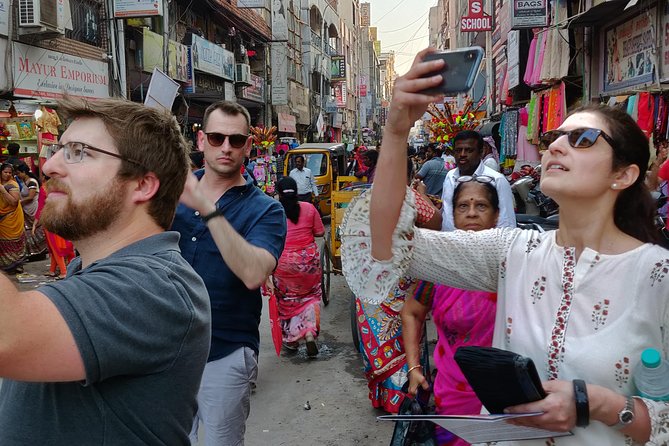
The whole experience is about 2 hours 30 minutes. The time split is practical: you get a longer stretch in the market area, then shorter landmark stops where you can focus without dragging your feet.
A typical flow looks like this:
- About an hour in the market (Kotwal Chavadi)
- About 30 minutes at Madras High Court
- About 30 minutes at the Armenian Church
- About 15 minutes at Dare House #234
- Then the walking time between them, which is part of the fun because the streets keep changing
One thing I like about this timing is that it respects how markets work. You get enough time to look closely at shops and stalls without turning it into a fatigue marathon. Still, wear shoes you trust. George Town’s lanes can be uneven, and you’ll be on your feet for most of the tour.
And yes, there’s a real-world note here: market shop hours can be inconsistent. In one unfortunate situation, part of the bazaar plan didn’t match what was expected because some shops weren’t open. That doesn’t mean the tour is broken—it means you should go in ready for the market to be a little unpredictable, especially if your timing lands at the edge of opening hours.
Stop 1: Kotwal Chavadi Market and the art of reading a wholesale street
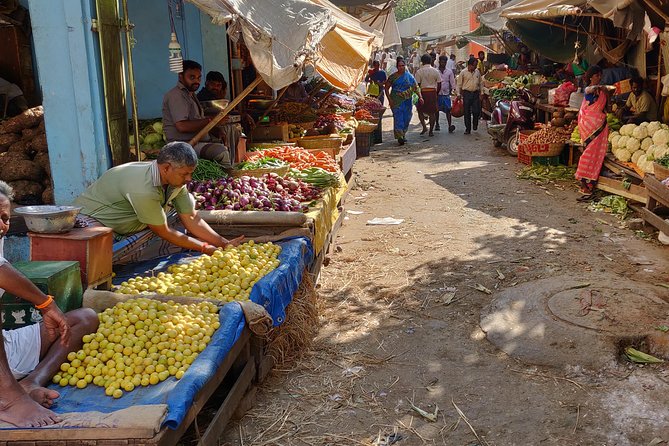
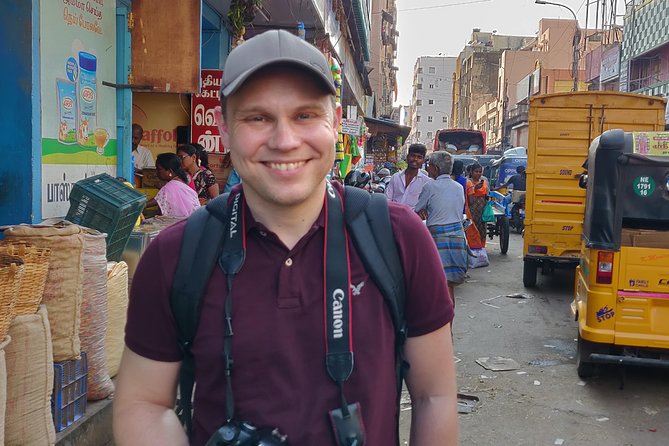
Kotwal Chavadi Market is the heart of the walk, and it’s framed as a place where trade is the point. This isn’t a quiet “browse for souvenirs” lane. It’s described as a wholesale-style market where practically anything that can be legally sold can be bought at the right price.
What I like about starting here is that it sets the tone for the rest of the tour. Before you see any monumental building, you understand what the neighborhood has been built to do: move goods and money. You’ll pass through the kind of scene that usually makes new arrivals feel lost—warehouses, covered wholesale markets, street stalls, and retail shops side by side.
If you want to get more out of the market time, I’d use simple tactics:
- Watch how different stalls specialize. Georgetown is known for selling everything from bangles and fabrics to fruits, vegetables, spices, stationery, and jewellery.
- If you’re tempted to buy, keep your spending mindset flexible. Market pricing can shift based on what you ask and how you compare.
- Don’t try to photograph everything. Pick a few things—packaging styles, shop signs, how goods are stacked—then let the rest register in your head.
A drawback to keep in mind: markets can be loud, crowded, and warm, especially during busier hours. If you’re the type who gets overwhelmed by sensory overload, plan for breaks and keep your expectations realistic. This is a working neighborhood, not a museum corridor.
Stop 2: Madras High Court, Indo-Saracenic architecture with a long paper trail
Next comes a hard contrast: Madras High Court. This stop is about the building’s role and its architectural identity.
The court was originally established in 1862 by a decree from Queen Victoria, and it’s known for Indo-Saracenic architecture. That combination matters, because it signals a specific design language used during that period—part local visual vocabulary, part imperial-era prestige.
Even if you’re not a law buff, I think this stop works because it connects the story of Georgetown’s open area to something you can actually stand inside and see. Remember: the high court sits where an open space outside Fort St. George was created, and it’s part of the same chain of events that reshaped the neighborhood.
Practical tips for making the most of your time here:
- Give yourself a moment to look at the building as a whole before you start focusing on details.
- Use the included admission ticket time to slow down. The stop is about 30 minutes, so it’s enough for a solid exterior-to-interior sweep without turning into a long sit-and-wait.
Also: expect security processes typical of active institutions. The tour includes admission, but you’ll still want to be patient and ready to follow instructions.
Stop 3: Armenian Church streets and the trading story behind it
Then you’re back in the neighborhood, heading toward the Armenian Church area. This is one of the most interesting concept stops because it shifts the focus from colonial administration to older migration and commerce.
The Armenian presence here goes back over 300 years, with refugees establishing trade in silk, spices, and gems. That’s a big deal. It turns a church visit into a reminder that global trade routes didn’t just pass through ports—they created communities inland and across trading neighborhoods.
What I enjoy about this stop is that it helps you connect the market energy from earlier with a human storyline. You’re not only looking at buildings; you’re looking at who profited, who worked, and how faith and commerce often traveled together.
You’ll have about 30 minutes at the Armenian Church, and admission is included. Go in with a calm pace. This is the kind of place where a few careful glances—like how the church looks in its street setting—can do more than frantic photo-taking.
A small consideration: religious sites often have rules for behavior and dress. The tour guide will help you navigate what’s appropriate, but it’s smart to have your shoulders covered and avoid anything too casual.
Stop 4: Dare House #234 and Parry’s company, from merchant roots to Art Deco
The final highlight is Dare House #234, an iconic Art Deco building. It’s tied to the business history of Parry’s company, which was founded by Thomas Parry, a Welshman and one of Chennai’s early free merchants.
This is a quick stop—about 15 minutes—but it’s also a good reality check. Georgetown isn’t only old colonial institutions and community churches. It’s also commercial modernity, expressed in architecture.
Here’s what I think you can actually do with a short time window:
- Look for the geometric feel that Art Deco is known for, and connect it to the idea of corporate headquarters.
- Notice how the building’s style contrasts with the older textures around it in the neighborhood.
- Use the guide to ask how Parry’s role fits into Chennai’s wider trade story.
This kind of closing stop works well because it gives you a final “lens” on the same city theme: commerce shapes the skyline.
Who this tour suits best (and who might want a different plan)
This is a strong fit if you:
- Want a heritage walk that treats markets as living history, not just a place to shop
- Like your sightseeing with practical context: why the streets and buildings are where they are
- Appreciate a paced route with time allocated to both commerce and landmarks
It may be less ideal if you:
- Struggle with crowds or noise in busy bazaars
- Need very predictable quiet stops with long sit-down times
Because the tour is private for your group and includes water and snacks, it’s easier to manage than a larger group walk. And since it says near public transportation and most travelers can participate, you should be able to make it work even if you’re not staying right next door.
Should you book this Georgetown heritage walk?
I’d book it if you want a practical way to get oriented in Chennai’s George Town and understand how Black Town became Georgetown—not as trivia, but as something you can feel in the streets, the markets, and the landmark buildings.
The one reason to pause is the market-variable nature of the experience. If you’re arriving expecting perfectly consistent shop opening times or a meeting spot that never changes, you might get frustrated. My fix is simple: confirm the exact meeting location in your message and plan to arrive with a little flexibility.
If you want a short, well-timed tour that mixes markets with real architecture and included entry costs, this is good value for the money.
FAQ
How long is the Georgetown heritage walking tour in Chennai?
It runs for about 2 hours 30 minutes.
What is the price per person?
The price is $29.00 per person.
Is pickup available?
Yes, pickup is offered.
Are admission tickets included for the stops?
Yes. Admission tickets are included for the market and the listed landmark stops.
Where does the tour start?
The start point is C1 Flower Bazaar Police Station, Rattan Bazaar Rd, Rattan Bazaar, George Town, Chennai, Tamil Nadu 600001, India.
Is this a private tour?
Yes, it is a private tour/activity, and only your group will participate.