REVIEW · ATHENS
Ancient Corinth, Acrocorinth, Museum, & Canal – Private Tour 5Hrs
Book on Viator →Operated by Ancient Greece Tours & Transfers · Bookable on Viator
Corinth in a single half-day sounds impossible, until you do it. This private tour strings together the Corinth Canal plus the hilltop power of Acrocorinth, then finishes at Ancient Corinth where Paul’s world comes into focus. It’s a smart way to connect engineering, myth, and first-century life without spending your whole day on logistics.
I love how smoothly the day runs: hotel pickup and drop-off, a private air-conditioned vehicle with Wi‑Fi, and a driver-guide who keeps the story clear from start to finish. I also like the human touch from the guide I met, Tas, who stayed flexible with the schedule and kept things personal and relaxed, even sharing photos later on WhatsApp.
The one drawback to plan for is time. You’ll cover several major sites in 5 hours (including travel), and Ancient Corinth’s entrance fee is not included, so you’ll want a little cash or card ready for that stop.
In This Review
- Key highlights you should care about
- Athens to Corinth, minus the hassle: what this private half-day really feels like
- Stop at the Isthmus Corinth Canal: the gateway that changed trade
- Diolkos: the ancient limestone road that hauled ships
- Acrocorinth: the fortress acropolis with Ottoman-era water
- Hadgimoustafa spring: why water still makes this place feel real
- Ancient Corinth and its Archaeological Museum: Paul’s setting, explained on your terms
- Museum first: artifacts that show Corinth across Greek, Roman, Byzantine, and Ottoman eras
- Temple of Apollo: a rare Doric form in the Peloponnese and mainland Greece
- The Roman Agora: the market-and-meeting center you can still picture
- Paul’s Bema and the story of Acts 18
- Other site highlights that round out the picture
- Why this private format is often better value than you’d expect
- Tas’s guide style: the kind of detail work that makes sites stick
- How to get the most out of your 5 hours in Corinth
- Who this tour is best for
- Should you book this Corinth Canal, Acrocorinth, and Ancient Corinth tour?
- FAQ
- Is pickup from Athens included?
- Are tickets included for all stops?
- How long is the tour?
- Is this a private tour?
- What language is the tour guide?
- What happens if the weather is poor?
Key highlights you should care about
- Private door-to-door pickup in Athens, with a meet-up point organized for hotels, Airbnbs, or the port
- Corinth Canal + Diolkos in one sweep, linking 19th-century engineering to ancient boat hauling routes
- Acrocorinth views from a major fortress rock, with Ottoman-era water still flowing at Hadgimoustafa spring
- Ancient Corinth Museum (Greek, Roman, Byzantine, Ottoman artifacts) paired with the key ruins most people travel for
- A flexible, friendly guide experience, including thoughtful comfort touches like cold water and small refreshment surprises
Athens to Corinth, minus the hassle: what this private half-day really feels like
This is the kind of day trip that works when you want big sights but hate the stress. You get picked up in Athens and you’re back at your accommodation at the end, so you’re not wrestling with buses, ticket lines, or transfers between different parts of Corinth. For a half-day, the flow is efficient, and that matters because Corinth sites are spread out.
You also get a private vehicle with A/C and Wi‑Fi, plus bottled water. That sounds like the usual “tour perk” line, but it genuinely helps once you’re in the car for part of the day and you want everyone comfortable and ready to move when you arrive.
Most stops on the route are free at the door according to the tour details, so you’re not paying multiple small admissions along the way. The main site entrance cost is for Ancient Corinth, and that’s a clearer way to budget: you’re spending your money where the ruins and museum time happen.
You can also read our reviews of more tours and experiences in Athens.

Stop at the Isthmus Corinth Canal: the gateway that changed trade
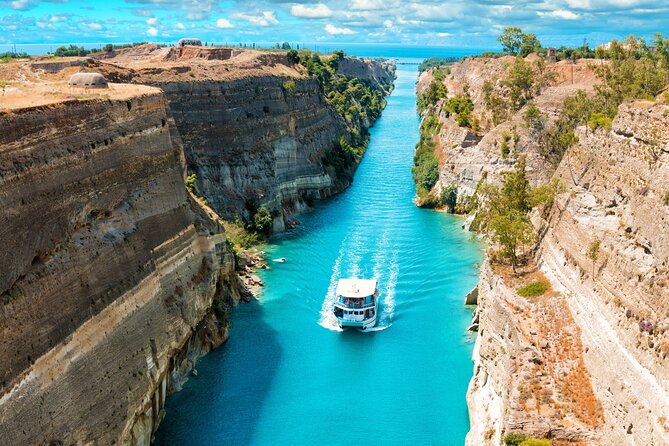
You start with a drive to the Isthmus Corinth Canal, often called the gateway to the Peloponnese. It’s a short visit, but it’s one of the best places on this route to reset your thinking: you’re not just visiting ruins, you’re seeing how geography and engineering shape real-world movement.
The canal is described as one of the most important projects of the 19th century and an engineering masterpiece, and it played a catalytic role for Mediterranean trade. In other words, this isn’t sightseeing for the sake of it. You’ll quickly get why the canal still matters today: it turns distance into something that can be managed.
Diolkos: the ancient limestone road that hauled ships
Then you move to the Diolkos, where the big idea is different. Here you’re not watching modern ships pass through a canal; you’re learning how Corinth solved the same problem centuries earlier using land-based hauling.
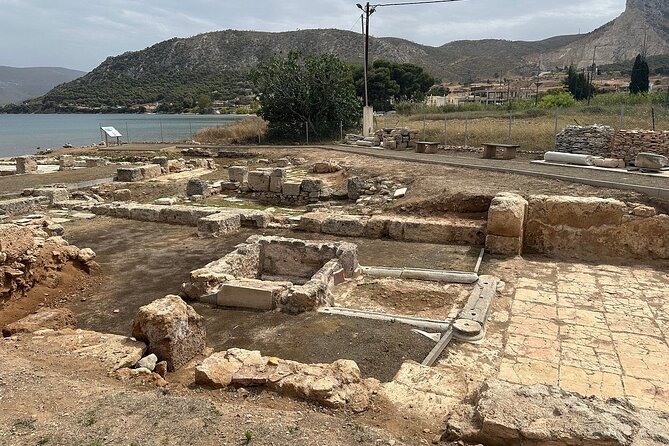
This section focuses on the ancient limestone roads where boat trailers and animal power were used to heave ships from the Corinthian Gulf to the Saronic Sea. The route is tied to Corinth’s control over 270 Greek colonies, which helps explain why Corinth mattered politically and economically.
It also gives you a useful bridge to the next sections of the day: it’s hard to understand Paul’s setting without understanding Corinth’s reach. The tour frames Diolkos as part of the bigger system that made Corinth a strong base, helping explain why the Apostle Paul chose to stay for 18 months and why he pushed for his ministry there.
Acrocorinth: the fortress acropolis with Ottoman-era water
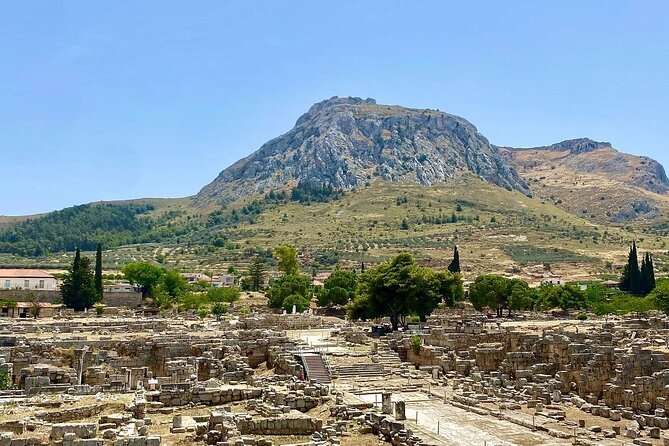
Acrocorinth is where the day starts to feel dramatic. You’re visiting the acropolis of ancient Corinth, set on a monolithic rock about 1886 ft above sea level. The scale is impressive: walls totaling around 4.9 miles, plus the keep and three gates, so you can see how it functioned as a dominant defense position.
What you gain from this stop is a clear sense of why people built here. Even if you’re not a military history buff, you’ll get the logic of control: high ground, long sight lines, and natural defensibility. The tour also points out remains of churches, mosques, houses, and cisterns, plus the temple of Aphrodite that once stood. That mix of layers matters because it turns Acrocorinth from a single-era ruin into a lived-in site across time.
You also get myth woven into the walk. Pegasus, the winged horse that grazed in the area, is part of the story you’ll hear, and it’s not just trivia. It’s how Acrocorinth’s reputation survived in local imagination while the political power kept changing hands.
Hadgimoustafa spring: why water still makes this place feel real
At Acrocorinth, you also visit Hadgimoustafa spring, a fountain built during the Ottoman empire in 1555 AD. Running water from the Upper Pieriene spring is said to have been discovered by accident when Pegasus hit his hoof while trying to fly away from Velerefonte, and the goddess Athena is still connected to the story.
The practical takeaway: this is a spot where you’re not only looking at ruins. You’re looking at a living feature of the site, a reminder that people valued usable water even while living under fortified conditions.




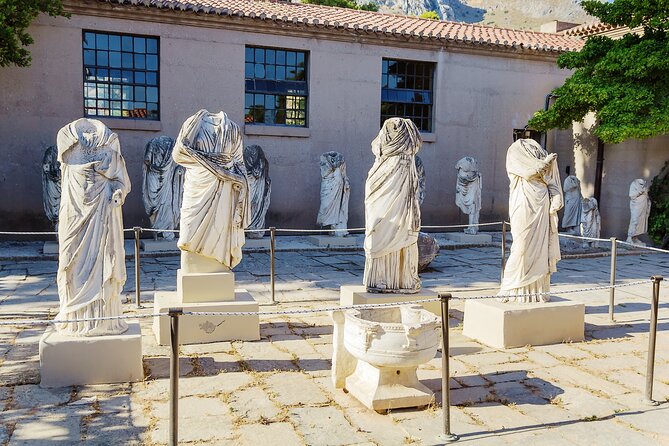
Ancient Corinth and its Archaeological Museum: Paul’s setting, explained on your terms
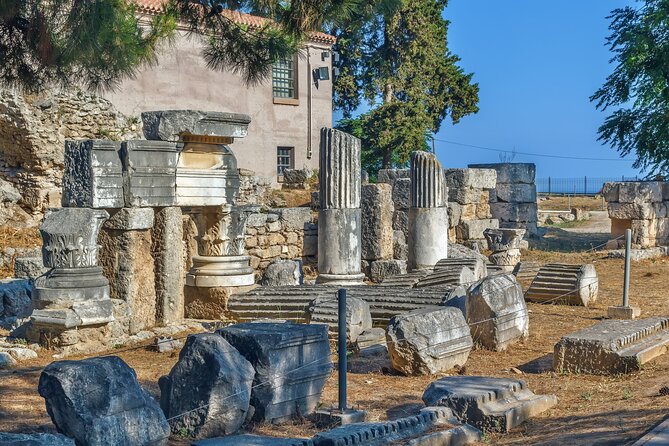
The museum and ruins at Archaia Korinthos are the heart of the day. You get both the Archaeological Museum and the archaeological site, but you have to think of it as a focused overview rather than a slow crawl. The total time for this part is about 1 hour 15 minutes, which is enough to hit the main stops and get the story straight if you keep your eyes on the big pieces.
Museum first: artifacts that show Corinth across Greek, Roman, Byzantine, and Ottoman eras
The museum houses a large collection of artifacts from the local site and neighboring smaller sites. The tour’s emphasis is on what the artifacts reveal about multiple eras: Greek, Roman, Byzantine, and Ottoman.
This helps you avoid a common mistake at ancient sites. Without a quick museum primer, you can end up treating ruins like isolated snapshots. The museum time gives context so the later walk through temples, plazas, and public buildings feels connected.
Temple of Apollo: a rare Doric form in the Peloponnese and mainland Greece
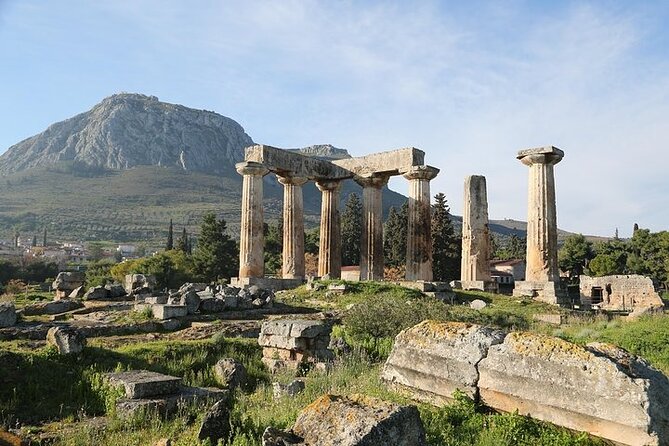
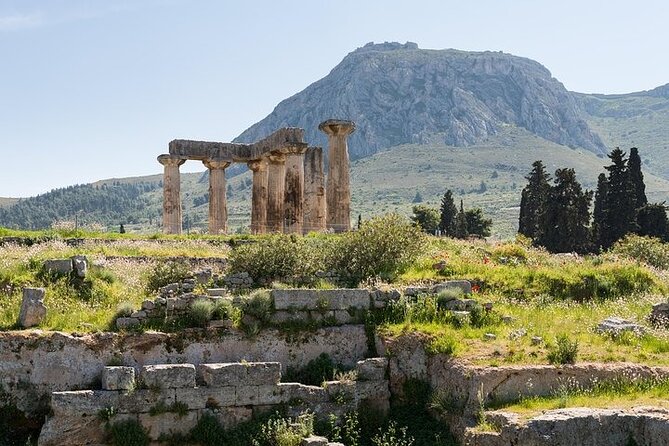
At the archaeological site, you start with the Temple of Apollo. The tour notes it as one of the earliest Doric temples in the Peloponnese and Greek mainland, with Doric monolithic columns that are rare in the ancient world. The date given is around 560 BCE.
This is one of those moments where you can see how Greek temple design developed and why Doric columns mattered. Even if you don’t remember every architectural term, the size and style give you a quick “this was a big deal” understanding.
The Roman Agora: the market-and-meeting center you can still picture
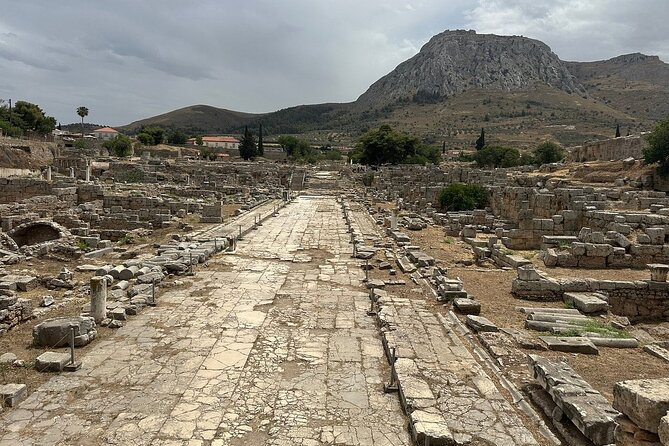
Next comes the Roman Agora. The description here is clear: central shops, a strong example of a Roman marketplace, along with smaller temples and altars, Roman buildings, an amphitheatre, and an Odeon. There’s also mention of features like the Glaufkus fountain, Roman baths, and the Lechaion road.
The value for you is mental visualization. You’re learning where people would have worked, gathered, and passed news, not just where they prayed. That helps make the later Paul connection feel less abstract.
Paul’s Bema and the story of Acts 18
One of the most important stops is the podium or Bema. The tour ties it directly to Acts 18 12:17, describing it as the platform where the Apostle Paul was judged and presented officially for the first time to Greeks and Romans as a Roman citizen, and from where he preached.
This is the part that lands best if you like connecting places to events. You don’t just see stones. You hear what the place likely meant in the political and public life of Corinth.
Even with limited time, the way the tour frames the Bema helps you get a sense of scale: public judgment, public presentation, public speech. That makes the ruins feel like a stage rather than a pile of remains.
Other site highlights that round out the picture
The tour mentions additional pieces around the agora complex, including a Roman forum and the Roman Odeon, plus Roman baths and more roads. It’s a lot for one visit, but it’s also a helpful snapshot of how the city functioned.
If you’re the type who hates “stop, picture, move on” tourism, this tour’s strength is that it keeps circling back to meaning. The goal is to leave you with a coherent idea of Corinth as a working city, not just a checklist.
Why this private format is often better value than you’d expect
Let’s talk money, because $228.56 per person is not cheap for a 5-hour day. The value comes from what you’re getting for that cost.
You’re paying for a fully private vehicle and driver-guide, plus hotel pickup and drop-off in Athens. You also get Wi‑Fi, A/C, and bottled water, which keeps the comfort level high during the driving portion. On top of that, there’s mobile ticketing, and group discounts are listed, which can make the per-person cost more tolerable if you’re traveling with people.
Then there’s the admission setup. Many of the route stops are free at the door per the tour details, so you’re not stacking multiple paid admissions on the way to the main experience. The Ancient Corinth site entrance is the part that isn’t included, so you’re budgeting for one main ticket instead of five separate ones.
Private tours also save time in subtle ways. You don’t spend energy figuring out where to meet, which station goes with which ticket, or how to get everyone into the right order. For a half-day, that efficiency adds up.
Tas’s guide style: the kind of detail work that makes sites stick
The best tours don’t just show you places. They help you remember what you saw and why it matters. In the experience I’m basing this on, Tas did exactly that.
He planned the day well but stayed flexible when it came to pacing, and he shared details in a way that felt warm and engaging rather than scripted. The vibe mattered: the day felt personal and relaxed, not like you were being rushed through a museum conveyor belt.
There were also practical comfort touches. The car felt like a cozy break, with cold water and refreshments, and even cookies during the day. If you like having photos at the end without asking strangers to take them, Tas took beautiful pictures and shared them via WhatsApp afterward.
That combination—good pacing, human warmth, and small comfort wins—turns a historic route into a trip you actually enjoy while you’re doing it.
How to get the most out of your 5 hours in Corinth
This is a fast-moving half-day, so your best strategy is to decide what you want to feel most strongly when the day ends.
If you’re most interested in early Greek sites, lean into Temple of Apollo and the main temple area at Ancient Corinth. If you’re more into how power and trade worked, pay attention to how the Diolkos and Corinth Canal are connected by the idea of moving ships efficiently. And if you want the emotional punch of faith and public life, spend extra time absorbing the Bema context connected to Acts 18.
Wear comfortable shoes and plan for some walking in and around archaeological grounds. The tour gives you set time blocks, so you’ll get more out of it if you don’t stop too long for one photo and miss the next key point.
Also, since the day requires good weather, think ahead. If conditions look poor, you might find the experience rescheduled or refunded, depending on what happens locally.
Who this tour is best for
This private tour is a strong fit if you:
- Want a private, door-to-door day from Athens without juggling transport
- Care about connecting places to stories, especially the world around the Apostle Paul
- Like seeing how Greek, Roman, Byzantine, and Ottoman layers overlap in one region
- Prefer a guide who can keep things relaxed while still covering major highlights
It’s also a good choice for couples and small groups who want comfort and clarity more than they want to roam independently.
Should you book this Corinth Canal, Acrocorinth, and Ancient Corinth tour?
I’d book it if you want one well-structured half-day that covers the best-known Corinth stops with a guide who explains the “why,” not only the “what.” The private setup, the comfort details in the vehicle, and the emphasis on key sites like Acrocorinth and the Bema make it feel more meaningful than a rushed bus tour.
Skip it or rethink timing if you’re trying to do everything slowly. The day moves through several major areas, and if you need lots of unstructured time for wandering, you may feel slightly constrained by the scheduled time blocks. Also note the Ancient Corinth entrance fee is not included, so budget for that when you plan your spend.
FAQ
Is pickup from Athens included?
Yes. Your driver picks you up from your chosen hotel, Airbnb, or apartment in Athens and returns you there at the end of the tour.
Are tickets included for all stops?
Most stops are free of charge as listed in the tour details, but the entrance fee for the Ancient Corinth site is not included.
How long is the tour?
It lasts about 5 hours, and that total includes travel time.
Is this a private tour?
Yes. It’s private, so only your group participates.
What language is the tour guide?
The tour is offered in English.
What happens if the weather is poor?
The experience requires good weather. If it’s canceled due to poor weather, you’ll be offered a different date or a full refund.