REVIEW · ATHENS
Ancient Corinth And Corinth Canal Half Day Tour From Athens
Book on Viator →Operated by Transfer To Athens · Bookable on Viator
Corinth in one half-day is a smart move. You get easy round-trip transportation from Athens, plus admission tickets included for the stops that matter most for first-time planning.
You’ll also like the feel of this tour: you’re not trapped in a long, slow group march. You can pause for photos, move at your pace through the ruins, and still have a history-minded driver keeping the story straight.
One thing to plan for: a couple of key entrances are not included (Ancient Corinth and the Archaeological Museum, and the Temple of Apollo), so you’ll want a bit of cash or card ready for on-site payment.
In This Review
- Key highlights to know before you go
- Why this half-day Corinth trip works (and saves your time)
- Price and value: what your $163 buys (and what it doesn’t)
- Pickup in Athens and Piraeus: the small details that make it smooth
- Corinth Canal + Isthmia: engineering photos and a sacred sports stage
- Temple of Apollo: best-preserved Doric columns, but you pay for entry
- Akrokorinthos fortress: the dramatic viewpoint you came for
- Archaeological Museum of Corinth: pay the €15 and get context fast
- Archaia Korinthos ruins: agora, temples, walls, and the sense of a working city
- The Diolkos at Loutraki: ancient ship hauling you can almost picture
- How to time your day for easier photos and calmer pacing
- Who this tour suits best
- Should you book this Ancient Corinth and Canal half-day tour?
- FAQ
- How long is the tour?
- Is pickup offered from Athens?
- Do I need a car seat or transportation for cruise passengers?
- Is the tour private or shared?
- What language is available?
- What’s included in the price?
- Which entrances are not included?
- Is lunch included?
- Can I request a licensed tour guide?
- What do I pay for at the sites that are not included?
- What is the cancellation policy?
Key highlights to know before you go
- Door-to-door pickup and drop-off from Athens (hotel, Airbnb, or Piraeus Port)
- A/C private vehicle with Wi‑Fi and bottled water for the ride
- Admission included for Corinth Canal and Akrokorinthos
- Self-paced time at major sites instead of a rigid guided-walk schedule
- Akrokorinthos fortress + Corinth ruins in one tight route
- Diolkos engine-room of ancient transport at Loutraki, with real ship-hauling history
Why this half-day Corinth trip works (and saves your time)
Corinth can swallow a day fast. By bundling the Corinth Canal, Isthmia, Akrokorinthos, and the main ruins into about five hours, you get the big hits without turning your Athens vacation into a bus tour marathon.
The ride matters here. You’re in an air-conditioned private vehicle with Wi‑Fi and bottled water, and you don’t have to figure out timing or transfers across towns. That’s a big deal in Greece, where routes can be easy on a map and slower in real life.
What makes this feel genuinely practical is the structure: you stop, you get time, and you decide how quickly you want to move. If you love photo stops, you can linger at overlooks. If you want to speed through the first rooms of a ruin, you can. The driver handles the driving and gives context, but you’re not stuck following a tight script.
For me, the biggest advantage is that the tour is designed around a short attention span. After a couple of hours of ruins, you’ll still have energy for the Diolkos, which is a fun, unusual stop that many other half-day plans skip.
You can also read our reviews of more tours and experiences in Athens.


Price and value: what your $163 buys (and what it doesn’t)
At $163.22 per person, you’re paying mainly for two things: private transportation and the stops that include entrance fees in the price.
Included admission covers the Corinth Canal and Akrokorinthos. Those are the two places where you’d hate to get stuck at the gate with an extra charge you didn’t plan for. Everything else is either optional timing or paid on site.
Not included, and worth budgeting for:
- Entrance for Ancient Corinth & the Archaeological Museum (€15 per person)
- Entrance for Temple of Apollo (listed as not included)
- Lunch (you’ll need to plan your own meal)
- Gratuities (left to your discretion)
- A licensed tour guide inside sites, unless requested for an added cost
When a tour like this includes only some tickets, it can feel annoying—until you realize it’s really about cost control and flexibility. You’ll get the main value up front, then pay the remaining entrances once you know how much energy you have for museums and extra monuments.
If you’re the type who hates surprise lines at ticket booths, this is still a good deal because the most expensive-feeling access points here are covered.
Pickup in Athens and Piraeus: the small details that make it smooth
This kind of half-day tour rises or falls on the meeting point. The good news: the pickup rules are clearly laid out.
If you’re staying in a hotel, you wait in the main lobby a few minutes before the scheduled time. If you’re in an apartment or Airbnb, you wait just outside the main entrance or building gate. If you’re arriving by ferry at Piraeus, the driver meets you directly at the arrival pier.
Two helpful touches:
- The driver holds a sign with the lead traveler’s name.
- You should keep your phone on, because they may call if delays happen or if it takes a minute to locate you.
Also, the local emergency contact number is included in your voucher, which is comforting when you’re trying to catch an excursion without stress.
One extra note: groups of 1–3 go in a luxurious sedan, and groups of 4–7 go in a comfortable minivan. That matters if you’re traveling with friends and want space to stretch out for the drive.
Corinth Canal + Isthmia: engineering photos and a sacred sports stage
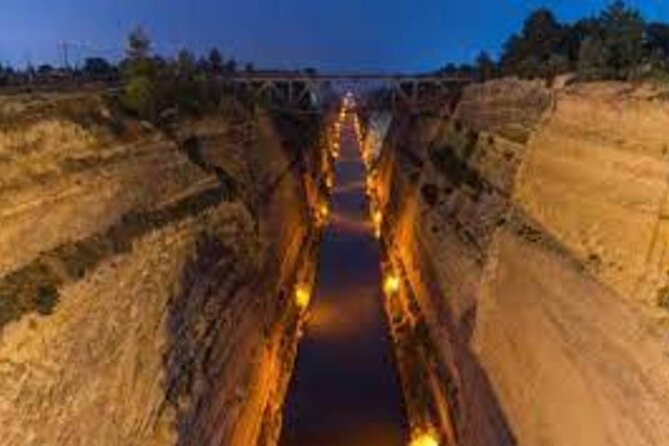
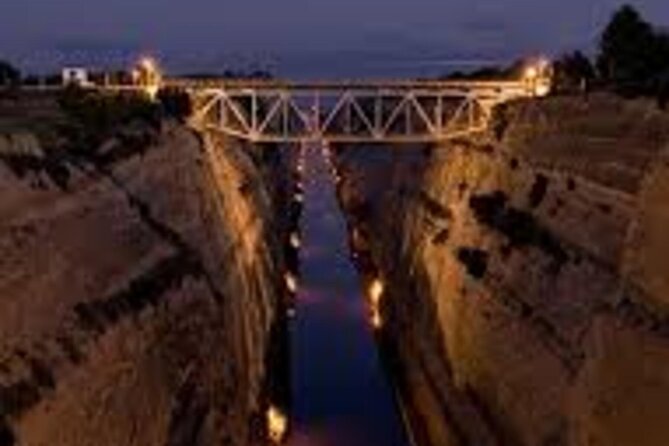
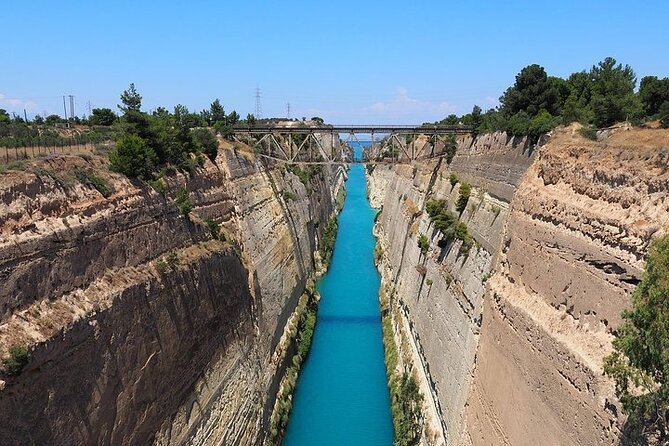
You start with the Corinth Canal and the wider Isthmia area. This is a great opening because the canal immediately sets the tone: Greece isn’t just marble columns and temples. Sometimes it’s raw infrastructure—cut through limestone, connecting seas, and shaping how ships moved.
You’ll stand above the canal’s dramatic cut and look out at the narrow waterway that links the Aegean and Ionian Seas. Expect strong photo angles. Even if you’re not an engineering nerd, the scale hits you fast.
Then you head to Isthmia, a crossroads with a strong athletic and religious footprint. The focus is the Sanctuary of Poseidon, where athletes and visitors once gathered for events connected to the Panhellenic Isthmian Games—second only in prestige to the Olympics in the ancient Greek world.
Time here is short, so treat it like a “get your bearings and learn the story” stop. You’ll have enough time to see the remains and connect them to the mythology, but not enough to wander for ages.
A practical benefit: this segment has admission ticket free in the plan, so you’re not mentally juggling payments while you’re trying to enjoy the views.
Temple of Apollo: best-preserved Doric columns, but you pay for entry
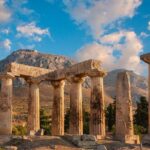
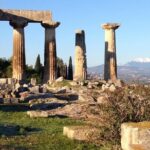
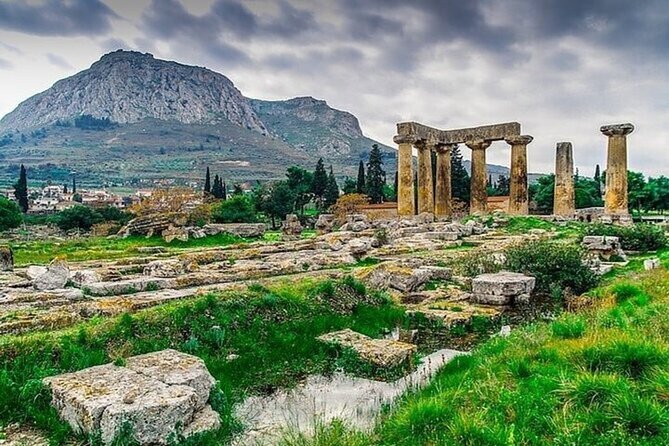
Next comes the Temple of Apollo, one of the best-preserved Doric temples in Greece, with roots in the 6th century BC. Doric architecture is all about sturdy rhythm—simple shapes that somehow feel powerful. The surviving monolithic limestone columns make the temple easy to recognize even if you’re not a classical-architecture specialist.
You get about 20 minutes here, which is enough to:
- orient yourself quickly in the sanctuary area,
- appreciate the columns,
- and scan the nearby archaeological features.
Just know the one trade-off: admission is not included at this stop. You’ll need to purchase directly on site, and that’s likely to take a little time. Still, for many first-time visitors, this is the temple stop that makes Corinth feel truly “ancient” in a way that a ruin-only glance can’t.
If you’re trying to keep the day smooth, it’s smart to do Temple of Apollo soon after the drive, when you’re still fresh and willing to stand in ticket lines without impatience.




Akrokorinthos fortress: the dramatic viewpoint you came for
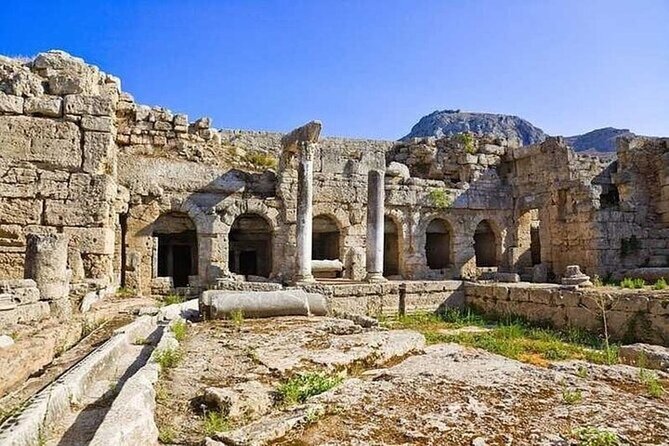
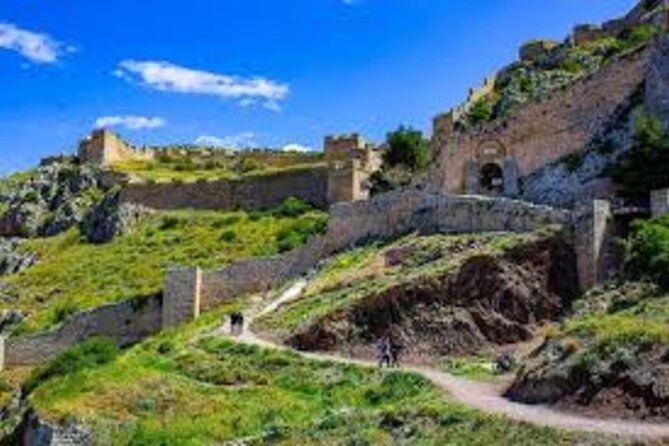
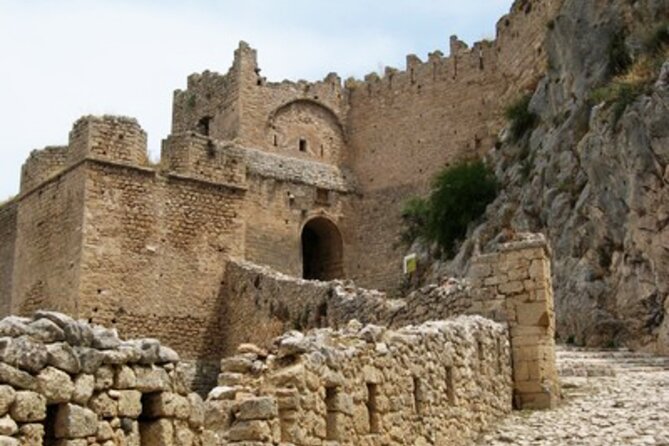
If you pick one stop that screams Corinth, it’s Akrokorinthos. This is the towering fortress/rock acropolis above ancient Corinth, shaped by centuries of different rulers.
What you’ll notice right away is the layered feel. Fortifications were built and rebuilt through Greek, Roman, Byzantine, Frankish, Venetian, and Ottoman eras. That means you’re not just looking at one period. You’re reading history in stacked defenses.
The time here is about 30 minutes, and entrance is included. That’s a rare win in a half-day plan.
From the higher ground, you’ll get sweeping views over the Corinthian Gulf and the Peloponnese, plus the fertile plains below. Views can sound like filler on a tour description, but here they do real work: seeing the position makes the entire story click. This is why Corinth mattered strategically.
One more detail to keep in mind: the site also connects to myth. Sacred areas dedicated to Aphrodite once existed here, so the fortress isn’t only military—it’s also tied to myth and cult practice.
Comfort note: this is a fortress. You’ll be walking uneven ground and navigating slopes. Wear footwear you trust, and don’t plan to sprint.
Archaeological Museum of Corinth: pay the €15 and get context fast
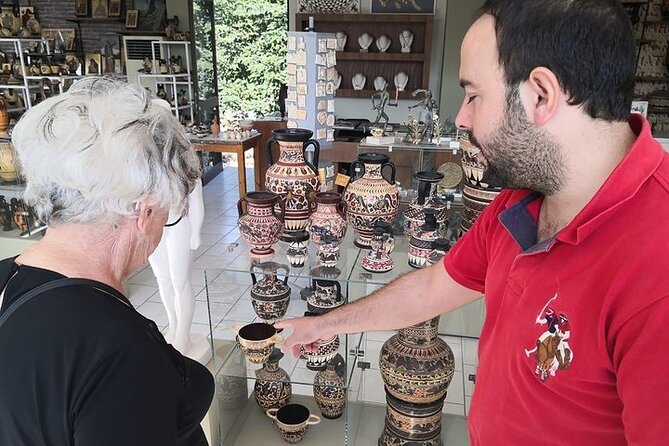
The Archaeological Museum of Corinth is the most useful “translator” on the route. Without a museum stop, ruins can feel like a bunch of scattered stones. With it, those stones turn into daily life, trade, and beliefs.
You’ll have about 30 minutes here. That’s enough to hit the big highlights without turning it into a school lesson.
The museum holds artifacts spanning prehistoric times through the Roman period, including:
- sculptures and pottery,
- mosaics and inscriptions,
- and everyday objects.
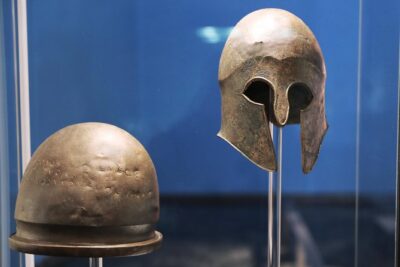
One standout is the collection of Roman mosaics, plus statues connected to gods and emperors. You’ll also see findings linked to the ancient agora and surrounding sanctuaries, which helps you understand how Corinth worked as a real city—not just as a scenic backdrop.
This stop requires the extra budget: admission is not included and is listed at €15 per person for the Ancient Corinth & Archaeological Museum combination. If you’re debating whether it’s worth paying, I’d say yes, because it makes your earlier stops easier to read.
If you’re the type who hates museums, you may feel this one is optional. But if you like artifacts that explain the ruins you just saw, this is the payoff.
Archaia Korinthos ruins: agora, temples, walls, and the sense of a working city
Then you move to Archaia Korinthos, the ancient heart of Corinth. This is where you get your longer stretch of time—about one hour—and where the city’s layers show up in the remains you can still walk around.
Here you’ll find traces of:
- the agora and public spaces,
- temples and civic structures,
- Roman fountains,
- and parts of city walls.
You’ll also get a clear visual connection to the nearby dramatic backdrop: the Corinthian Gulf and the fortress of Akrokorinthos in the distance. Seeing how these pieces relate is key. Corinth wasn’t built by accident. It was built for defense, trade, and movement of people and goods.
Time is generous enough that you can slow down. You can pause at key features and actually imagine how people moved through the city—where they met, where they worshiped, and how the built environment supported the city’s status.
Admission at this stop is listed as free in the plan, so it’s a good place to spend energy without worrying about another ticket purchase.
The Diolkos at Loutraki: ancient ship hauling you can almost picture
The final stop is one of the most fun and unusual segments: the Diolkos. This is an ancient stone-paved roadway built as far back as the 6th century BC that allowed ships to be hauled over land across the Isthmus of Corinth.
The point was simple: skip the dangerous, longer trip around the Peloponnese. Ships could be moved overland using this route, connecting the Aegean and Ionian Seas more efficiently.
You’ll walk along surviving limestone tracks, and you can still see grooves carved by centuries of use. That tactile detail matters. It’s not just a story; you’re stepping onto the physical route people used for real logistics.
This stop sits near the modern Corinth Canal and the Gulf, so you’ll get history plus modern scenery in the same frame. It’s about 20 minutes, so it’s not a time sink—and it leaves you with something memorable that isn’t just another temple photograph.
How to time your day for easier photos and calmer pacing
With any half-day route, the best strategy is arriving with energy. If you can choose a start time, go early. Starting sooner usually means cooler temperatures, easier parking, and more comfortable walking.
Also: decide what you want most.
- If you want views, give more time to Akrokorinthos.
- If you want context for what you’re seeing, don’t rush the museum.
- If you want photos and fewer ticket interruptions, be ready for on-site payments at Temple of Apollo and the museum complex.
The tour gives you flexibility at each stop, but the clock still matters. Keep moving between sites, and treat the time inside each location as your chance to slow down on the parts that genuinely pull you in.
One tip that’s worth repeating: a driver with strong site understanding can make short stops feel richer. A name that popped up in connection with this operator was Paul, praised for good knowledge of the sites. Even when you’re not hiring a licensed guide inside the monuments, a driver who can explain what you’re looking at changes the whole day.
Who this tour suits best
This experience fits best if you:
- have limited time in Athens and want Corinth highlights without DIY planning,
- prefer self-paced visiting over a strict group schedule,
- travel as a small group (since you’ll be in a sedan or minivan),
- and want comfort on the road with A/C, Wi‑Fi, and bottled water.
It’s also a solid match if you’re the type who likes structure. You get a clear plan with stops that connect well: canal and Isthmia → Apollo → fortress views → museum context → ruins → Diolkos finale.
If you’re a true history purist who wants every inscription explained inside each site, you might find the time short and the driver isn’t a licensed inside-guide. In that case, you can request a licensed tour guide for an extra cost, depending on availability.
Should you book this Ancient Corinth and Canal half-day tour?
Book it if you want an efficient, comfortable introduction to Corinth that doesn’t lock you into a forced pace. The best reasons are the private door-to-door transfer, the comfort perks (A/C and Wi‑Fi), and the smart inclusion of entrance fees for Corinth Canal and Akrokorinthos.
Consider passing or changing your plan if you know you’ll skip museums or you strongly dislike paying on-site for extra entrances. Temple of Apollo and the museum complex are listed as not included, so you’ll need to accept that part of the cost happens when you arrive.
If you can do one half-day from Athens that feels like real travel planning instead of a stress sprint, this one is easy to recommend. You’ll leave with the canal story, fortress views, and enough ruins and artifacts to connect the dots.
FAQ
How long is the tour?
The tour lasts about 5 hours (approx.).
Is pickup offered from Athens?
Yes. Pickup is offered from Athens Hotel, Airbnb residence, and Athens city center, plus Piraeus Port.
Do I need a car seat or transportation for cruise passengers?
Cruise ship passengers are met at the cruise terminal exit immediately after security/customs.
Is the tour private or shared?
It’s a private tour/activity. Only your group participates.
What language is available?
The tour is offered in English.
What’s included in the price?
Private transportation, Wi‑Fi, A/C, bottled water, pickup and drop-off service, and entrance fees included for Corinth Canal and Akrokorinthos.
Which entrances are not included?
Ancient Corinth & the Archaeological Museum entrance is not included (€15.00 per person), and the Temple of Apollo entrance is also not included.
Is lunch included?
No, lunch is not included.
Can I request a licensed tour guide?
Yes, a licensed tour guide may be available upon request, depending on availability, with an extra cost.
What do I pay for at the sites that are not included?
Excluded entrance fees must be purchased and paid directly on site on the day of the tour.
What is the cancellation policy?
Free cancellation is available up to 24 hours in advance for a full refund.