REVIEW · SPLIT
Private History tour – small group
Book on Viator →Operated by Ivan Fistanić · Bookable on Viator
Split’s stone tells stories fast. This Private History tour in Split is a practical walking route through Diocletian’s Palace, guided by Ivan Fistanić (a Master’s Degree in History). I love how the stops are chosen for maximum clarity, like the Golden Gate and the Peristyle, and I love that the guide explains what you’re looking at in plain terms. One drawback: you’re mostly outdoors, so good weather matters.
The format is easy to plan: it’s a small group (up to 10), about 1 hour 30 minutes to 2 hours, and you get a mobile ticket. You meet at Ul. kralja Tomislava 15 and end right back there, which is a nice change from complicated meet-up errands. Just note that the Cathedral of Saint Domnius and the Temple of Jupiter have admission tickets that are not included.
If you’re the type who asks questions, this tour is a good fit. It’s built for focused pacing and real explanations, not a rushed highlight reel. You’ll also spend some time looking at Roman architecture and then seeing how later Christianity changed the meaning of the same spaces.
In This Review
- Key highlights worth knowing before you go
- What makes this Split history walk work so well
- Meeting point, timing, and how to plan your day
- Golden Gate: the Roman entrance that sets the tone
- Peristyle of Diocletian’s Palace: the “imperial square” feeling
- Cathedral of Saint Domnius: see the parts without entering
- Temple of Jupiter: a Roman temple repurposed for faith
- Vestibulum and the Triclinium: private-space clues
- Riva Harbor: where Split still lives
- Fruit’s Square and Pjaca: the palace’s outer world
- Gregory of Nin: the story you can feel at the statue
- Price and value: what $238.28 per group gets you
- Who should book this tour (and who might skip it)
- Short checklist for a smoother experience
- Should you book this Split Private History tour?
- FAQ
- How long is the Private History tour in Split?
- Where do we meet for the tour?
- Is this tour private, and what group size should I expect?
- Are admission tickets included for all stops?
- Do I need a special ticket format?
- What if the weather is bad?
- Can I cancel and get a full refund?
Key highlights worth knowing before you go
- Ivan Fistanić’s history training turns big ruins into a clear story you can follow
- Diocletian’s Palace route on foot covers major spaces from Golden Gate to the Peristyle
- Roman-to-Christian connections explained outside at the Cathedral of Saint Domnius and Temple of Jupiter
- Great Split photo angles without detours at Riva Harbor and along the Palace walls
- A memorable local superstition at Grgur Ninski’s statue: rub the toe for good luck
What makes this Split history walk work so well
Split can feel like a maze if you just wander in. Streets twist, walls block views, and it’s hard to tell which stones are truly important. This tour solves that with a tight loop built around Diocletian’s Palace and the civic center outside it.
The biggest value is that you don’t just see objects—you learn what each one is, and why it mattered. The Golden Gate isn’t described as a random arch. The Peristyle isn’t treated like a courtyard you can glance at. The guide connects the architecture to the kinds of use and change the site went through, including how expansion of Christianity affected buildings and life.
You’ll also appreciate the pace. It’s short enough that you can keep your energy for the rest of Split, but long enough to get context at each stop. Plus, the small group size (up to 10) makes it easier to ask questions without losing your turn.
You can also read our reviews of more tours and experiences in Split.

Meeting point, timing, and how to plan your day
You start at Ul. kralja Tomislava 15, 21000 Split, and the tour ends back at that same spot. That matters more than it sounds. If you later want to pop into a café, browse the old town, or meet someone else, you’re not stuck crossing town after the tour.
Timing is about 1 hour 30 minutes to 2 hours. That puts this in the sweet spot for a history-focused walk: enough time to cover multiple landmark zones, not so long that you feel cooked by the end.
Admission costs are mostly straightforward. Several stops are free (like the Golden Gate and the Peristyle area), but the Cathedral of Saint Domnius and the Temple of Jupiter list tickets as not included. If you want zero surprises, plan a little extra budget for those two.
Golden Gate: the Roman entrance that sets the tone
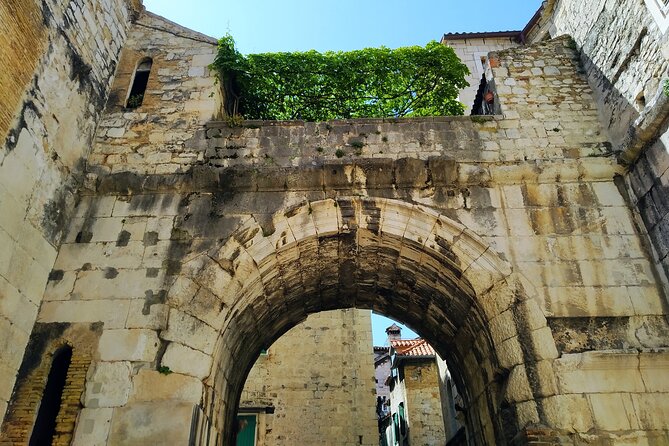
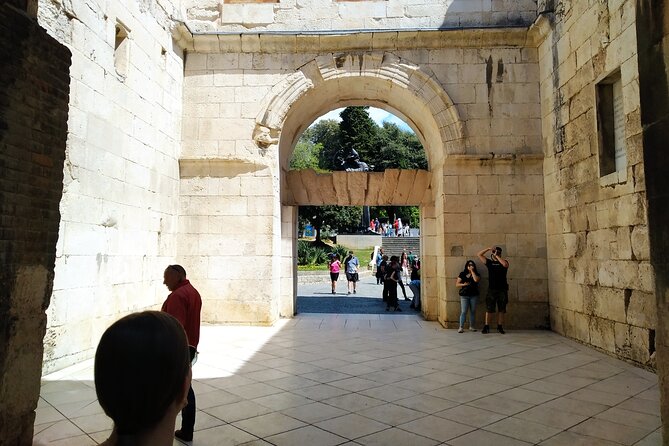
Stop 1 is the Golden Gate, the main entrance to Diocletian’s Palace and one of the four main Roman gates into it. You’re also placed where the setting makes sense. The gate is on the road to the north toward Salona, described as the capital of the Roman province of Dalmatia and Diocletian’s birthplace.
What I like here is how the guide uses location to do the teaching. You can see how entrances and routes weren’t just architecture. They were part of a bigger Roman system—movement, power, and the idea of where authority was coming from.
You also get a built-in visual contrast. The Golden Gate is opposite the Gregory of Nin area, so your first stop already links to one of Split’s most recognizable modern landmarks. It’s an efficient way to start: Roman gate now, local legend next.
Peristyle of Diocletian’s Palace: the “imperial square” feeling
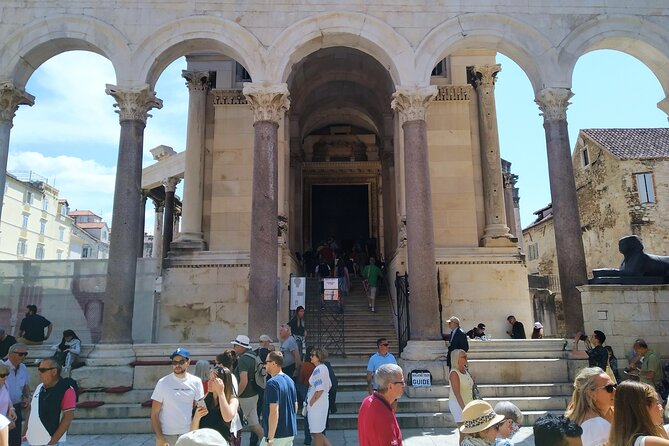
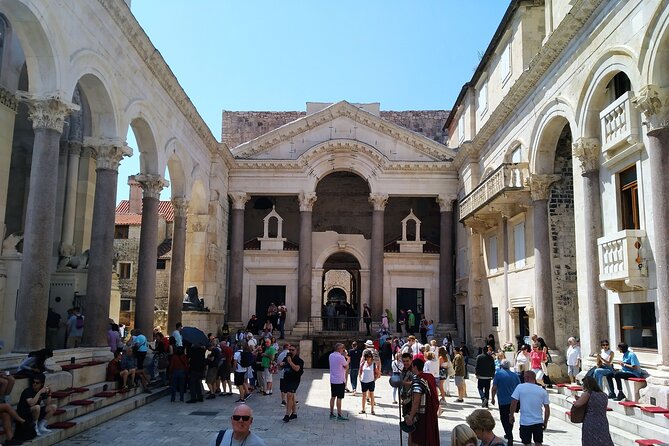
Stop 2 brings you into the central part of Diocletian’s Palace spaces, including cellars before you reach the Peristyle. The Peristyle is the open space of the imperial square, framed by monumental arcades and oriented toward the imperial loggia.
This is where the tour earns its name. The guide points out how the architecture works as a set: colonnades framing space, open-air visibility, and the way orientation shapes what people would experience. Even if you’re not a detail person, you’ll feel the difference between standing in a casual courtyard and standing in what’s described as the center of an imperial complex.
Then comes the smart part: you hear how transitions happened as Christianity expanded. Instead of treating the site as frozen in time, the explanation gives you a sense of layered use—Roman design, later meaning.
Cathedral of Saint Domnius: see the parts without entering
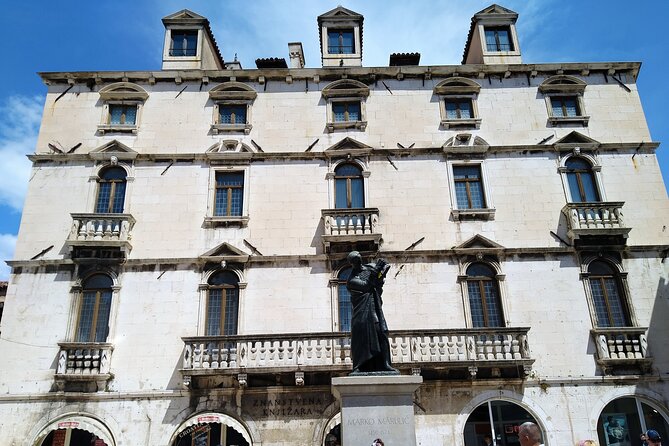
Stop 3 is the Cathedral of Saint Domnius. From the Peristile, you can’t miss it. The guide focuses on significant parts of the structure and tells the stories tied to what you’re looking at.
A key detail: you don’t enter the interior. The tour is built around observation from outside, with everything you need to know explained on the spot. That’s a real advantage for most people. You get context without losing time to entry lines or extra pacing.
The tour notes that it’s one of the best preserved Roman structures in the city and that it’s still in use today. Even from outside, that kind of continued use changes your perspective. You’re not viewing a dead museum piece—you’re standing in the orbit of an active building.




Temple of Jupiter: a Roman temple repurposed for faith
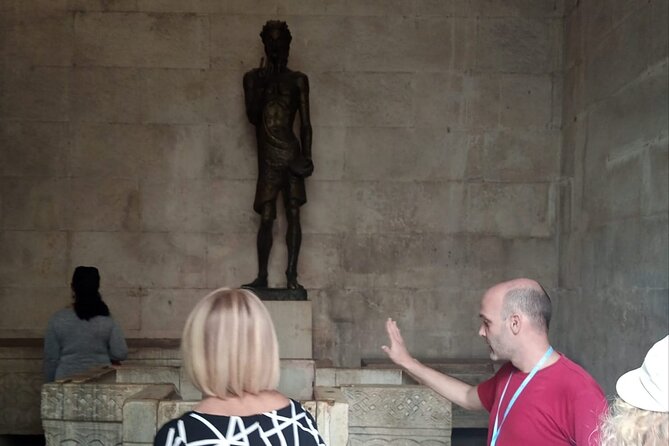
Stop 4 is the Temple of Jupiter, described as one of the best-preserved late Roman temples in the world. The guide connects the temple’s location to the symbolic purpose: the divine connection between Emperor Diocletian and Jupiter, with Jupiter framed as the sky-and-thunder king of the gods.
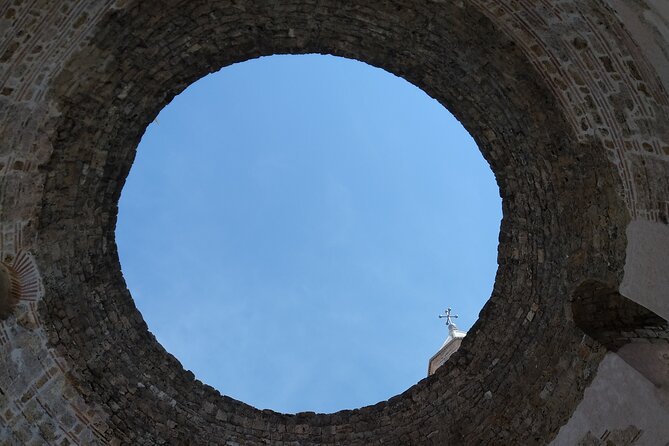
This stop is also about change over time. During the Middle Ages, the temple was converted into a baptistery dedicated to St. John the Baptist. The guide’s job here is to help you look at the building and understand what that conversion likely meant for how space was used.
One practical consideration: tickets here are not included, and you’re not being sold an interior experience. You’ll get the story and the architecture cues from the outside, then move on.
Vestibulum and the Triclinium: private-space clues
Stop 5 is the Vestibulum, the pre-entrance of Diocletian’s private chambers. The tour focuses on what it looked like and its function, based on its stated importance and decorated character. From there, you check up Triclinium.
This part can feel slightly different from the big public spaces you just saw. Instead of “this is where everyone gathered,” you’re in the “this is where access and routine mattered” zone. It’s a good contrast because it makes the palace feel less like a single ruin and more like an organized set of spaces with different roles.
Another plus: it includes explanation time while keeping you moving. It’s free entry here, so you spend your money where you actually need it—if you choose to cover the paid stops later.
Riva Harbor: where Split still lives
Stop 6 starts at Riva, the main city promenade and a meeting point for locals and visitors. The guide explains how Riva was built over the centuries and why it became central for everyday life.
This matters because Diocletian’s Palace is the big headline, but Split is not only ruins. Riva is the bridge between the ancient complex and modern walking rhythms. From this spot, you also get a beautifully framed view of the southern wall of Diocletian’s Palace.
If you’re trying to balance photos with learning, this stop hits both. It gives you a wide, usable view, not just close-up stone details. And because it’s a promenade, you can relax your feet for a moment while still staying in tour mode.
Fruit’s Square and Pjaca: the palace’s outer world
Stop 7 is Fruit’s Square (Trg Brace Radic), described as one of the most picturesque squares just outside the emperor’s palace. You’ll hear about a significant monument in the middle of the square and the surrounding important sights.
The square is dominated by remains of a 15th-century Venetian fort. That detail is useful because it gives you a visual reason to look around instead of walking through. It’s not just a pretty stop. It’s evidence that power changed hands and left physical traces.
Stop 8 is Pjaca, in front of the old Town Hall outside the western wall of Diocletian’s Palace. It’s presented as the main square of the city since medieval times. You get to see the 14th-century Town Hall and other interesting structures.
This section is where the tour shifts from strict palace architecture to civic life. You start asking different questions: What did people gather to do? Where was administration? Where did visitors naturally flow? Even if you’re not a historian, it helps your brain map the old town.
Gregory of Nin: the story you can feel at the statue
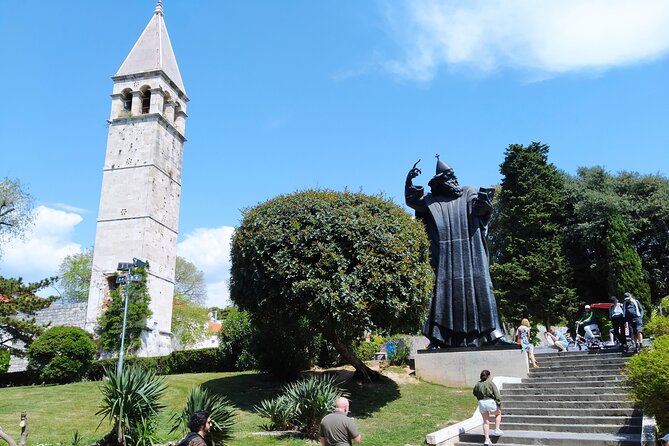
Stop 9 brings you to the Grgur Ninski statue, a dominant landmark of Split. The guide shares interesting facts about Gregory of Nin, including that the highest monument in Split is dedicated to him.
Then you get the sculptor story too. The monument is the work of Ivan Mestrovic, one of Croatia’s famous sculptors. It’s one of those moments where art and history meet, and you can suddenly see why people make pilgrimages to a simple statue.
The tour also includes a fun practical tip: rub the toe for good luck. I like that kind of local ritual because it’s small, memorable, and it gives you something to do right there without needing a ticket.
Price and value: what $238.28 per group gets you
The price is $238.28 per group, up to 10 people. That sounds high if you compare it to a standard museum ticket. But for a private history walk, you’re paying for a trained guide, a planned route, and time spent explaining the architecture in context.
The biggest value is the “coverage per hour.” You get multiple stops tied to Diocletian’s Palace, plus key squares and harbor views. You also get education that would be hard to recreate solo without spending extra time figuring out what you’re looking at.
Here’s how to think about cost fairly: if you’re traveling as a couple, it may be best if you’re genuinely into history and want someone to help you connect dots quickly. If you’re a small group of friends, the per-person cost drops fast because the rate is per group, not per person.
Also remember the two stops with admission tickets not included: the Cathedral of Saint Domnius and the Temple of Jupiter. Plan for that, but it’s only two ticketed elements in the full walk.
Who should book this tour (and who might skip it)
This works best if you want structure while you’re in Split’s old town. If Diocletian’s Palace feels like a blur when you read about it online, you’ll appreciate a guide who can slow you down and point you to the right parts.
It’s also ideal for people who ask questions. The tour format is clearly set up for back-and-forth, and the guide’s training (Master’s Degree in History) shows in how the explanations stay grounded.
If you already know Split’s history and just want to roam at your own pace, you might feel limited by the planned stops. But even then, the route is efficient, and the guide can help you notice things you’d otherwise miss—especially around the palace spaces and the Roman-to-Christian story.
Short checklist for a smoother experience
You’ll be outdoors for most of it, so dress for the weather and plan comfortable shoes. The tour is listed as requiring good weather, and you should expect that to affect scheduling if conditions are poor.
Bring a charged phone. You’ll get a mobile ticket. And if you think you’ll want to visit the Cathedral and Temple separately later, this tour helps you understand where to focus so you don’t spend that extra time guessing.
Should you book this Split Private History tour?
Book it if you want a clear, guided path through Split’s most important ancient and medieval spaces, without wasting your vacation time figuring out what’s where. I especially think it’s a smart pick for first-timers who want Diocletian’s Palace to make sense fast.
Skip it only if you prefer free-roaming at your own pace and you’re happy reading history on your own. Otherwise, this is one of those tours where the guide’s explanations do real work—turning iconic locations like Golden Gate, the Peristyle, and Gregory of Nin into a story you can carry through the rest of Split.
FAQ
How long is the Private History tour in Split?
It runs about 1 hour 30 minutes to 2 hours.
Where do we meet for the tour?
The meeting point is Ul. kralja Tomislava 15, 21000 Split, Croatia. The tour ends back at the same meeting point.
Is this tour private, and what group size should I expect?
Yes, it’s private. Only your group participates, and the group size is up to 10 people.
Are admission tickets included for all stops?
Most stops list admission tickets as free, but the Cathedral of Saint Domnius and the Temple of Jupiter have admission tickets not included.
Do I need a special ticket format?
You receive a mobile ticket.
What if the weather is bad?
The tour requires good weather. If it’s canceled due to poor weather, you’ll be offered a different date or a full refund.
Can I cancel and get a full refund?
Yes. You can cancel up to 24 hours in advance for a full refund. If you cancel less than 24 hours before the start time, the amount you paid will not be refunded.