REVIEW · ROME
Private Tour of Catacombs and Ancient Appian Way (hotel pick up)
Book on Viator →Operated by Eternal City Private and Guided Tours · Bookable on Viator
Underground Rome has a way of sticking with you. This private tour strings together the Catacombs of San Callisto and a walk on the Appian Way, with hotel pickup by car so you’re not juggling buses and stops. The pacing is tight but not rushed, and the mix of ancient Rome plus early Christianity gives you a more complete picture of the city than the center-only circuit.
What I like most is that you get real time underground at San Callisto (45 minutes) with admission handled as part of the experience. I also like the way the day is built around distinct “chapters” of Rome, from Porta San Sebastiano to St. Paul Outside the Walls, so it feels like a story instead of random photo stops.
One heads-up: catacombs aren’t a modern museum display. You’ll see ancient burial niches in tunnels carved into stone, and if you’re expecting lots of dramatic relics, it can feel a bit underwhelming—especially when the site is busy and sound carries poorly in close quarters.
In This Review
- Key highlights worth planning around
- Porta San Sebastiano: where the Appian Way really begins
- A small timing tip
- Catacombs of San Callisto: what you’ll see underground (and what surprises people)
- Noise, hearing, and tight quarters
- Photography rule
- Cool factor
- Walking the Appian Way: legends meet cobblestones
- What to watch for (so you’re not disappointed)
- Domine Quo Vadis: a small chapel with a big tradition
- Basilica Papale di San Paolo Fuori le Mura: scale, stillness, and pope portraits
- Why this stop is worth the time
- Private car value: what you’re paying for (and when it feels too expensive)
- The biggest variable: the guide and the group inside
- Who should book this Appian Way + Catacombs combo
- Small group note
- Should you book this tour?
- FAQ
- What’s included in the tour price?
- How long does the tour take?
- Is this tour private?
- What language is the tour offered in?
- Do I get hotel pickup?
- Can I cancel for free?
Key highlights worth planning around
- Hotel pickup with private, air-conditioned transportation so your day starts calmly and stays efficient
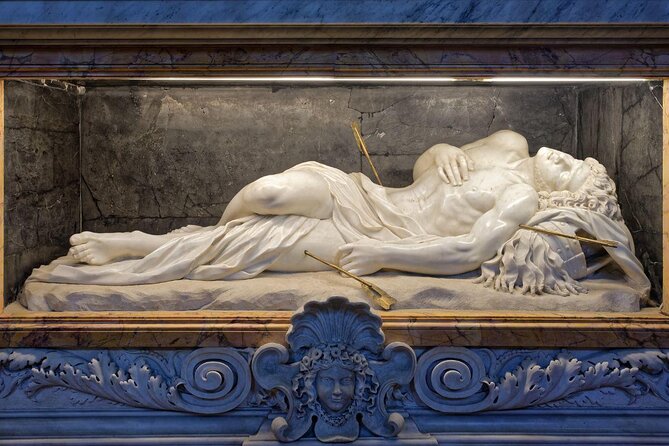
- Catacombs of San Callisto admission included, with a guided experience inside the underground passages
- Appian Way walk on Via Appia Antica, framed by legendary Roman stories
- Domine Quo Vadis chapel and the tradition tied to Saint Peter’s encounter
- Basilica of St. Paul Outside the Walls with a major spiritual and architectural stop plus a long gallery of pope portraits
- Cool relief underground—the catacombs can feel notably cooler than summer street level
Porta San Sebastiano: where the Appian Way really begins
Most Rome sightseeing is about ruins you can see from street level. This day starts at a place that feels like Rome’s machinery at work: Porta San Sebastiano, originally called Porta Appia. It’s one of the largest and best-preserved gates in the Aurelian Walls, dating to the 3rd century AD, and it marks the start of the historic road people called Rome’s Queen of Roads.
What makes this stop more than a quick wall-and-gate photo is the context. Porta San Sebastiano wasn’t decorative; it was a defensive checkpoint. When you stand there, the Appian Way stops being a name in a guidebook and starts feeling like a strategic corridor—one that funneled soldiers, trade, and travelers toward the south of Italy.
Expect a short window (about 10 minutes), not a long linger. Use that time to do two practical things: orient yourself toward the road network, and take a moment to notice the scale. If you’ve only seen “Rome” as fragments, this gate gives you the full idea of how a city protected itself and moved people efficiently.
You can also read our reviews of more tours and experiences in Rome.

A small timing tip
Because the day is about efficient movement, be ready to step out and look the second you arrive. This is a “good first 10 minutes” stop—then you’ll head straight to the underground.
Catacombs of San Callisto: what you’ll see underground (and what surprises people)
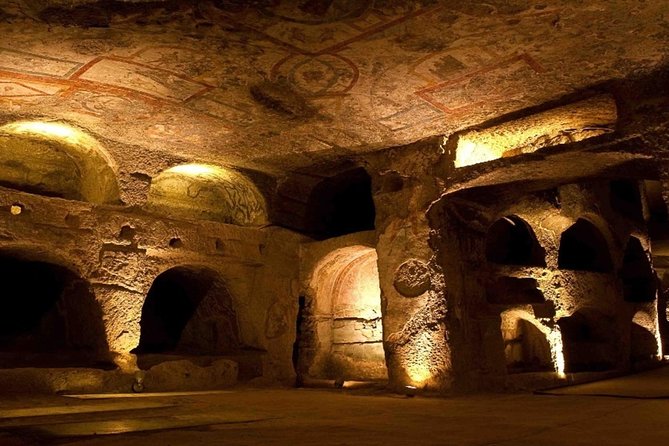
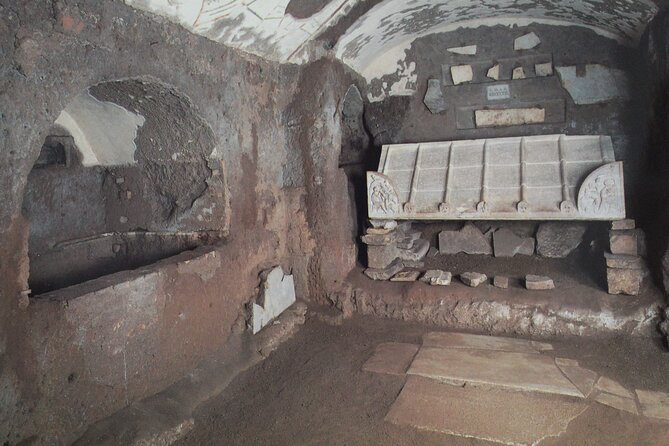
San Callisto is one of Rome’s key early Christian burial sites. The catacombs were established in the 2nd century, and they served as the official cemetery of the Church of Rome. You’ll be guided through passageways that extend for over 12 miles (you won’t walk anywhere close to that, but the scale is the point).
Here’s how to set expectations correctly. Catacombs are not about finding a single famous tomb with a dramatic entrance. They’re about systems of burial: tunnels, chambers, and wall niches. That’s why the experience can divide people into two camps: those who love the quiet, historical “how it worked,” and those who wanted more visual spectacle.
If you’re the first type, you’ll love the atmosphere and the story line. The catacombs are tied to popes and martyrs laid to rest there in early centuries, and even when many later remains or major relics moved elsewhere, the underground spaces still carry weight. You’re looking at the architecture of devotion and the practical reality of faith under pressure.
If you’re the second type, you can still get value—just recalibrate. Think of it as an underground map of early Christian life, not an action-packed treasure hunt. One past visitor even described it as “holes in the wall” before the meaning clicked, and that’s a common pattern: it improves when you understand what you’re looking at.
Noise, hearing, and tight quarters
Because the catacombs operate with guided groups on site, your ability to hear the guide can depend on the crowd and positioning. If you want the best experience, stay close to the guide and avoid drifting to the edge of the group. It’s also worth remembering the space is built for walking in close quarters, so comfort and patience matter.
Photography rule
Inside the catacombs, no photos are allowed. Plan for that mentally so you don’t waste time trying to set up a shot and worrying about it.



Cool factor
Underground also means cooler air. One reviewer mentioned it felt around 15°C in summer. Even if your day isn’t exactly that cool, you’ll likely want a light layer.
Walking the Appian Way: legends meet cobblestones
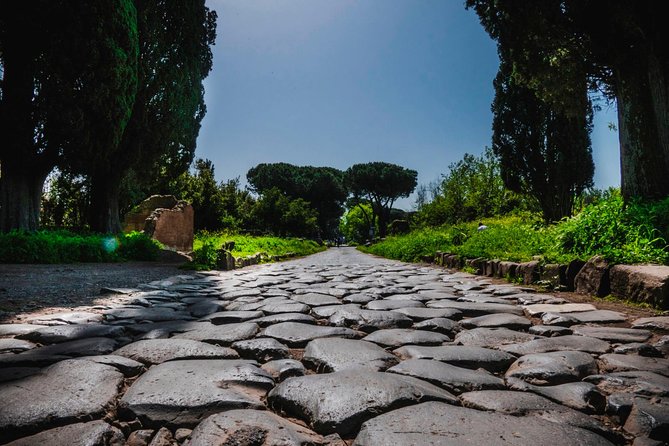
After the underground, you surface onto something that feels completely different: the Appian Way, or Via Appia Antica. This is where Rome stops being all “buildings” and becomes “infrastructure”—a road that shaped history long after its first stones were laid.
Your time here is brief (about 15 minutes), so don’t expect an all-day hike. Instead, treat it like a curated walk: enough to feel the texture underfoot and the scale of what once connected major parts of the empire.
The stop is framed with big names and big stories:
- The tragic episode tied to Spartacus and thousands of followers
- Connections associated with Crassus and Commodus
That matters because it changes how you perceive the road. It’s not just old pavement. It’s the path where events unfolded—and where power played out across distances.
What to watch for (so you’re not disappointed)
Some people picture a long grand boulevard with open countryside. The preserved area you can access in this kind of outing can feel more like a cobblestone street in an ancient corridor than a modern highway with empty fields. That doesn’t make it less historic, but it does mean your mental image should be closer to a “surviving segment” of the ancient system rather than the entire mythical road stretching forever.
Domine Quo Vadis: a small chapel with a big tradition
Next is Chiesa del Domine Quo Vadis (also known as the Church of Saint Mary in Palmis). It’s small, but it’s famous for being emotionally specific: it’s tied to a tradition about Saint Peter fleeing persecution in Rome and having a vision of Christ.
The story goes like this: Peter asks, Domine, quo vadis (Lord, where are you going?), and Christ responds with the idea that he’s going to Rome to be crucified again. Whether you treat the tradition as faith, history, or both, it works as a pause in the middle of an otherwise very physical day.
Inside, you’ll find a marble slab believed to bear the footprints of Christ. That’s the kind of detail you remember because it’s tangible—less “lecture,” more “touchpoint.”
This stop is also about pacing. Your visit is about 15 minutes, long enough to read, look, and absorb the tone without turning it into a production. If you like spiritual sites but don’t want a long detour, this is a good fit.
Basilica Papale di San Paolo Fuori le Mura: scale, stillness, and pope portraits
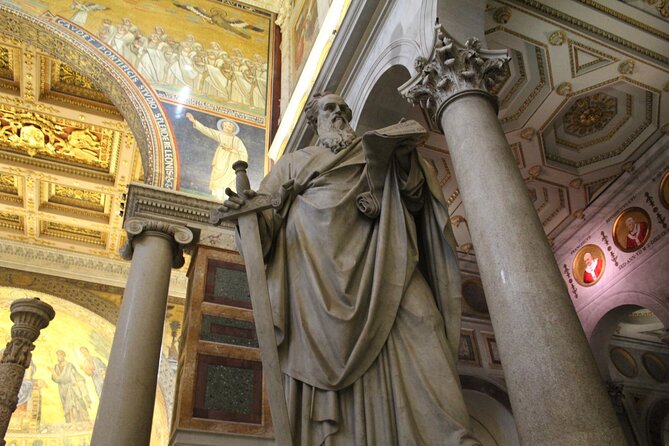
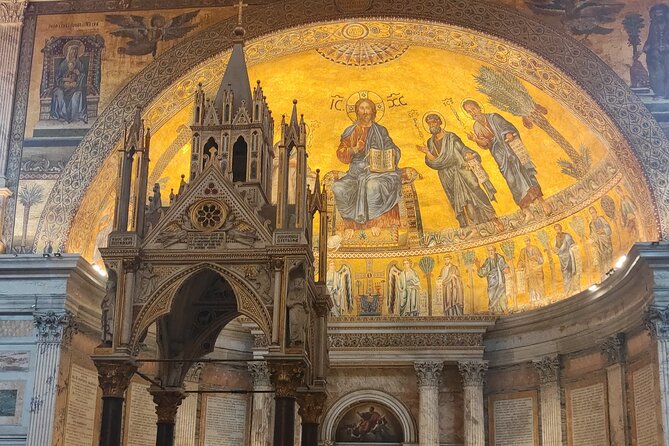
You finish with Basilica of Saint Paul Outside the Walls, one of Rome’s four major basilicas. It’s built over the burial site of Saint Paul the Apostle, so it carries both spiritual importance and historical architectural value.
What you’ll notice first is size and proportion. This isn’t a small church you glance at and move on. The basilica is meant to hold a crowd and a ritual, and even if your visit is only about 20 minutes, it’s long enough to feel the space.
One specific feature to look for: a long gallery of pope portraits, with medallion faces representing the line of popes. It’s a smart detail because it turns a basilica visit into a timeline you can see.
Why this stop is worth the time
After catacombs and a road walk, this is your “human pause.” The day becomes more about light, marble, and reverence. Even if you’re not deeply religious, you’re walking into a space that has shaped European Christian culture for centuries.
Private car value: what you’re paying for (and when it feels too expensive)
At $190.67 per person for about 2 hours 30 minutes, this is not a bargain. It’s priced like a private service, and the math only works if you care about comfort, time savings, and having someone handle the logistics.
So what are you really buying?
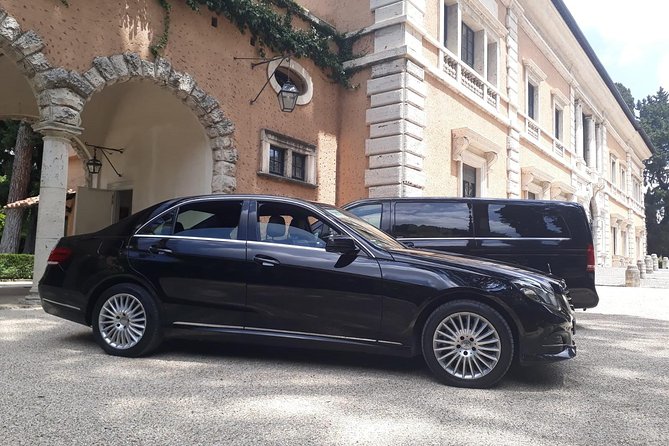
- Hotel pickup and drop-off (meeting point: your hotel)
- A private vehicle for the travel parts
- Admission handled for Catacombs of St. Callixtus / San Callisto
- Guided elements on the day, including context as you move and a guided visit inside the catacombs
Where some people feel burned is when they compare that catacomb admission alone to the full price. But the higher cost isn’t only the ticket—it’s the car, planning, and the effort to stitch together multiple locations in one clean itinerary.
The biggest variable: the guide and the group inside
In real life, this kind of tour can swing based on two things:
- How strongly your driver-guide tells the story while you’re in the car and between stops
- How your catacombs visit feels once you’re underground in a guided group
If your driver is friendly and communicates clearly, the day feels like more than transportation. Several guide names pop up in feedback—Stefano, Alessandro, Lorenzo, Patrick, George, Georgian, Victor, and Giorgio—usually connected to the same idea: good narration makes the itinerary click.
If you end up with spotty sound or a crowd inside the catacombs, the experience can feel less “tour” and more “transfer.” You can’t control the site’s on-the-ground realities, but you can control your approach: be early, stand near the guide, and treat the catacombs as an architectural and historical visit rather than a visual spectacle.
Who should book this Appian Way + Catacombs combo
This tour makes sense for you if:
- You want a single, structured half-day that links early Christianity with ancient Rome’s road history
- You value hotel pickup and a stress-free car ride
- You’re comfortable with walking a bit and spending time in a cool underground environment
- You want a mix of tunnels (catacombs) and monumental sites (basilica) in one run
It may feel like the wrong fit if:
- You want lots of photo-friendly displays inside the catacombs (photos aren’t allowed)
- You expect a long Appian Way hike with open fields
- You’re very sensitive to hearing and sound in crowded spaces
Small group note
Even though the overall experience is a private one for your party, the catacombs visit itself is described as a guided group tour. That’s a key detail: it means you’ll still be part of a group underground, even if your outside-day travel is private.
Should you book this tour?

Yes, if you’re the type who likes history with texture: stone corridors, carved niches, and real sites that explain how Rome worked and how faith organized itself under pressure. I’d especially say go for it if you’re tired after travel and you want someone to handle pickup, driving, and ticket logistics.
Be cautious if your main goal is dramatic “relic hunting” or if you hate tight spaces and unpredictable crowd noise. In that case, consider whether a museum-style guided tour in the city center would suit you better, or at least be mentally prepared for catacombs to be quiet, simple, and meaning-heavy.
If you do book, one practical strategy helps a lot: decide in advance what you’ll focus on. For me, that would be the story of early burial practices in the catacombs, then the road’s legendary associations on the Appian Way, then the spiritual pause at Domine Quo Vadis and the scale of Saint Paul Outside the Walls.
FAQ
What’s included in the tour price?
The price includes admission tickets to the Catacombs of St. Callixtus / San Callisto and a guided experience on-site there. Hotel pickup and private transportation are also part of the experience, along with the other scheduled stops.
How long does the tour take?
The duration is about 2 hours 30 minutes.
Is this tour private?
Yes. The experience is described as private, with only your group participating. Note that the catacombs portion is a guided group tour once you’re inside.
What language is the tour offered in?
The tour is offered in English.
Do I get hotel pickup?
Yes. Pickup is offered, and you’re asked to provide your hotel name for pickup details.
Can I cancel for free?
Yes. You can cancel up to 24 hours in advance for a full refund.
If you want, tell me your travel dates and group size, and I’ll help you sanity-check whether the 2.5-hour format will match your pace and priorities.