REVIEW · ATHENS
Ancient Sparta Ancient Corinth Private Tour from Athens/ Nafplio
Book on Viator →Operated by GREECE TAXI · Bookable on Viator
Sparta and Corinth in one day sounds wild, then it works. This private tour strings together Corinth Canal, Sparta sights, and Ancient Corinth with a dedicated English-speaking driver and round-trip transport. I especially like the time-saving drive-by-first-stop plan and the fact that you can set the pace like a true private group. One heads-up: it’s a long day, and key museums can be closed on Tuesdays, so timing matters.
You also get a practical mix of big-picture context and hands-on viewing. The vehicle is air-conditioned and stays with you the whole day, so you’re not wrangling buses or transfers across the Peloponnese. The main drawback is that the driver is not an archaeologist guide inside the sites, so if you want deeper on-the-ground explanations, you’ll need to arrange that separately.
In This Review
- Key things to know before you go
- One Day, Two Legends: Corinth Canal and Sparta without the stress
- Price and what you really get for $265.50
- Morning pickup, drive time, and how to avoid a cranky day
- Stop 1: Corinth Canal—man-made engineering and a real photo moment
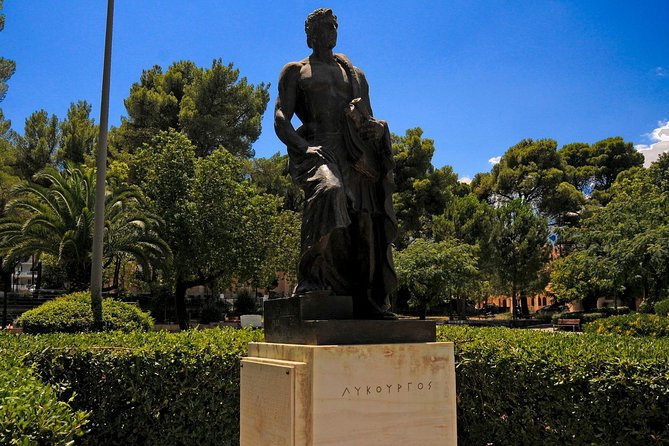
- Stop 2: Sparta in 30 minutes—Lycurgus, the social system, and what’s left
- The Sparta museum and your Tuesday plan
- Stop 3: Sparta’s Acropolis and Ancient Theater—Roman marble with big echoes
- Leonidas Monument—quick stop, strong mood
- Optional Stop: The Olive and Greek Olive Oil museum (and when to skip it)
- Ancient Corinth walk: ruins, Paul, and the feeling of time travel
- Archaeological Museum of Corinth: included and timed by season
- Food breaks and the local touches that make it feel personal
- Who this private tour is best for
- Should you book this Athens-to-Sparta-and-Corinth tour?
- FAQ
- FAQ
- How long is the Ancient Sparta Ancient Corinth private tour?
- What’s the pickup like from Athens?
- Is pickup available from Nafplio too?
- What’s included in the tour price?
- What admission fees are not included?
- Are any museums closed on Tuesdays?
- Is the tour guided by an archaeologist?
- Can you customize the itinerary?
- What vehicle sizes are available?
- What’s the best start time?
Key things to know before you go

- Dedicated driver all day keeps the day efficient, not fragmented by transfers
- Corinth Canal photo stop includes a walkable vantage and views from height
- Sparta doesn’t try to be Athens: short stops, then you see what remains
- Tuesday closures affect the Sparta museum and the olive oil museum
- Ancient Corinth ticket depends on season, and it’s worth budgeting
- Optional olive oil museum can be swapped in/out depending on time
One Day, Two Legends: Corinth Canal and Sparta without the stress
If your Greece trip is limited to a few days in Athens, this kind of tour can feel like cheating—in a good way. You cover the jump from Athens to the Peloponnese with round-trip transport, then you still get multiple stops that actually let you look closely, take photos, and eat without rushing through everything like a checklist.
What makes it work for me is the rhythm. You start with a quick, scenic win at the Corinth Canal, then you move into Sparta while the day is still fresh. By the time you reach Corinth, you’re ready to slow down a little for the ruins and the story of the city that mattered for centuries.
The tour is private and flexible, but you still have to respect the clock. Budget a full day and bring the energy for walking at open sites. It’s not a stroll-only outing.
You can also read our reviews of more tours and experiences in Athens.


Price and what you really get for $265.50
At $265.50 per person, the headline number can look steep until you see what’s included. Your price covers a private, air-conditioned vehicle with fuel, tolls, and parking, plus pickup and drop-off from your Athens hotel (up to 7 km from the city center) or another agreed location. You also get a professional English-speaking driver who shares background as you travel, and the tour is designed for you as a single group rather than a shared bus schedule.
Where the money goes: you’re paying to remove friction. No public transport planning. No waiting around. No “what bus is this?” moments. For a day that runs roughly 10 hours, that matters more than it sounds.
Admissions are not included for several stops:
- Museum of the Olive and Greek Olive Oil (optional): €5
- Archaeological Museum of Sparta: typically €5 in winter / €10 in summer
- Ancient Corinth (combined ticket): €8 in winter / €15 in summer (and the museum is included in that combined ticket)
So a realistic mindset is: your base price pays for the vehicle and guiding drive; tickets are the extras. Also plan on gratuities (listed at about €1 per person).
If you like traveling with control—especially families, couples, and small groups—this is priced like a convenience tour, not a budget mass-transit day.
Morning pickup, drive time, and how to avoid a cranky day
The tour recommends a start time of 8:00 am or earlier in winter. That’s not just a scheduling note. In practice, early departures give you cooler temperatures, fewer crowds, and more daylight to enjoy outdoor sites.
Pickup in Athens is offered from hotels/apartments in Athens center up to 7 km. If you’re coming from the port areas like Piraeus Port or a Piraeus Cruise Terminal, expect an extra €15 per way under prior agreement. If you’re starting from Nafplio, pickup is available too, and the cost typically changes because Sparta and Corinth are closer.
Your vehicle choice matters if you’re traveling with kids:
- Sedan: up to 3 adults (or a family of 4 configuration with children listed as free under age 12)
- Minivan: 1 to 7 people (2 kids under 12 free)
- Minibus: 1 to 14 people (2 kids under 12 free)
If you’re the one organizing the day, the best way to keep it from feeling stressful is simple: plan water, snacks, and comfortable shoes, because you’ll have multiple short walks and photo stops.
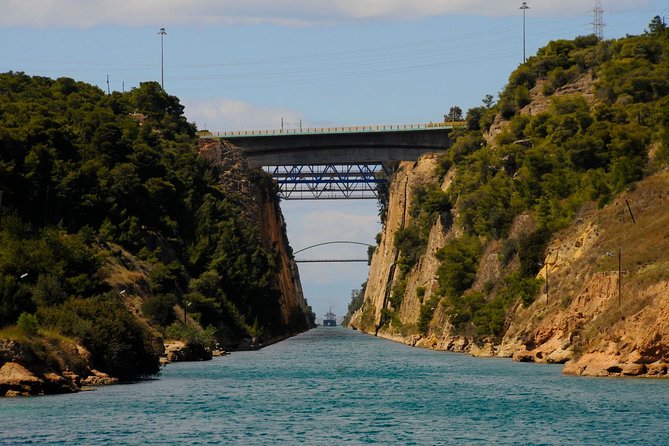
Stop 1: Corinth Canal—man-made engineering and a real photo moment
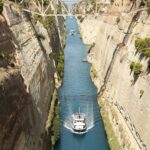
This is a quick stop that earns its place. The Corinth Canal links the Aegean and Ionian seas and cuts through the Peloponnese, so you’re looking at a modern feat set inside an ancient geography.
Expect about 15 minutes. You can:
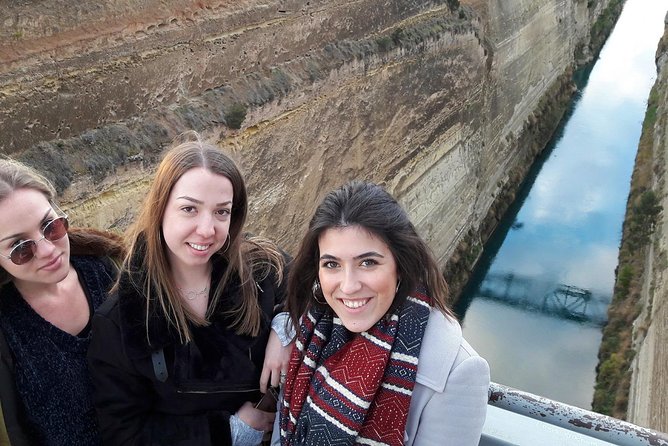
- grab photos at multiple angles
- walk across on the pedestrian bridge
- admire the canal from roughly 80 meters high
Since it’s brief, it works like a “warm-up” stop. You get to stretch your legs, take in the views, and settle into the day before the longer historical stops begin.
Stop 2: Sparta in 30 minutes—Lycurgus, the social system, and what’s left
Sparta gets myth-level attention, but the experience here is more grounded. You learn that Sparta’s fame wasn’t just battle talk—it was built on a social system designed to maximize military proficiency.
In this stop, you’ll be oriented to how Spartiates (citizens), perioikoi (free residents engaged in commerce), mothakes (raised as Spartans), and helots (state-owned serfs) fit into the broader structure. It’s a lot of concepts for a short visit, which is why the drive-and-talk approach helps.
The on-site time is about 30 minutes, so manage expectations: Sparta’s surviving remains are smaller and more scattered than the big museum-style sites you might be used to. What you’re really doing is seeing the bones of the story—then continuing to the most visit-worthy preserved areas.




The Sparta museum and your Tuesday plan
The Archaeological Museum of Sparta is described as the oldest provincial archaeological museum in Greece. It’s in a neoclassical building built between 1874 and 1876, and it has listed architectural and historical interest.
Timing matters:
- The museum is closed on Tuesdays.
- Tickets are not included in the base price (listed around €5 winter / €10 summer depending on season).
You should treat this as an optional boost rather than the centerpiece. If your day falls on a Tuesday, you may need to accept that you’ll shift your attention to the outdoor sights and the other museum elements later in the day.
Stop 3: Sparta’s Acropolis and Ancient Theater—Roman marble with big echoes
This part is easy to love. The Sparta Acropolis area and the Ancient Theater are built of local white marble from the Roman period, and the theater is described as one of the larger Classical-world theaters, with a capacity estimate of around 16,000 people.
You’ll likely feel the mismatch between scale and what remains. Much of the auditorium was destroyed during the Byzantine period, and the surviving marble and limestone blocks show erosion. That doesn’t ruin it; it actually makes it more honest. You see how history wears down, not how history stays preserved.
The stop length is about 1 hour, and because it’s mostly open-air, it’s a good time to slow down and look around rather than rush to the “main” viewpoint.
Leonidas Monument—quick stop, strong mood

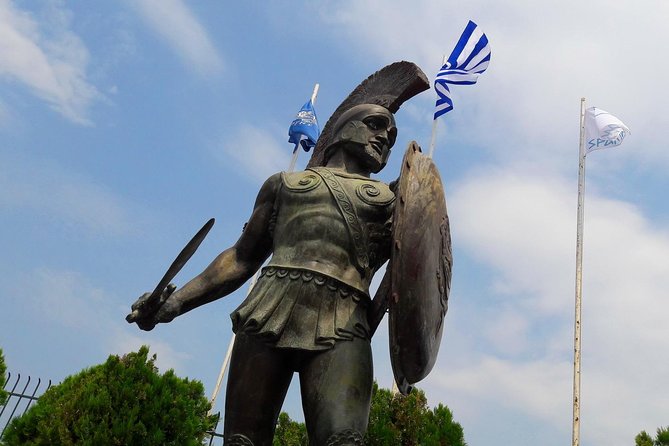
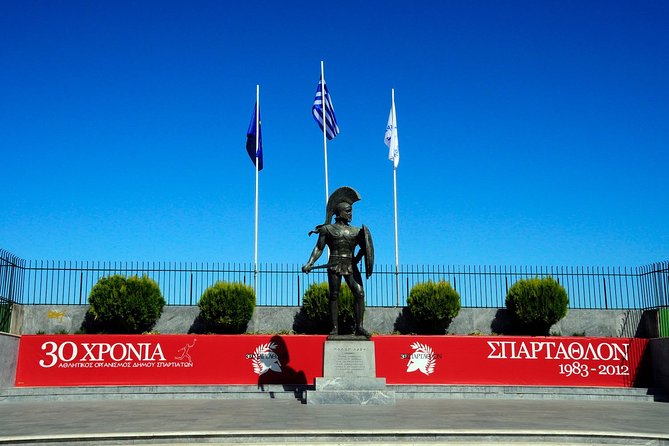
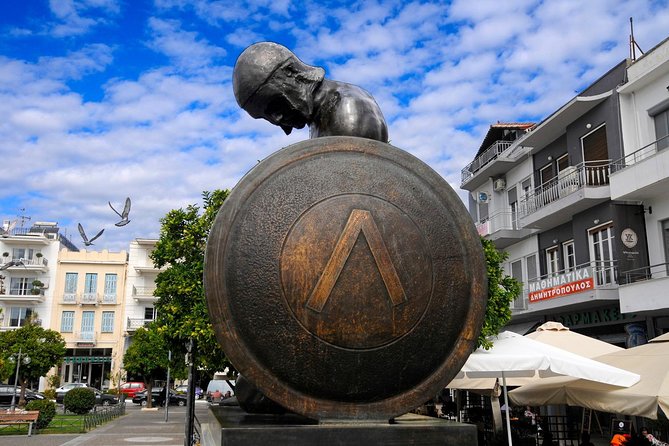
You’ll get around 15 minutes here. The Leonidas Monument includes a statue of the king in front of a stadium area, tied to the story of Thermopylae and the famous response “Molon labe” (come and get them).
There’s also archaeological context: limestone construction from the 5th century BC, uncovered north of modern Sparta. The use isn’t fully verified, but it’s believed to be linked to Leonidas, with an account that his remains were transferred and buried there after Thermopylae.
It’s not a long stop, but it gives the day a “character moment.” It helps the earlier Sparta social-system talk snap into something visual.
Optional Stop: The Olive and Greek Olive Oil museum (and when to skip it)
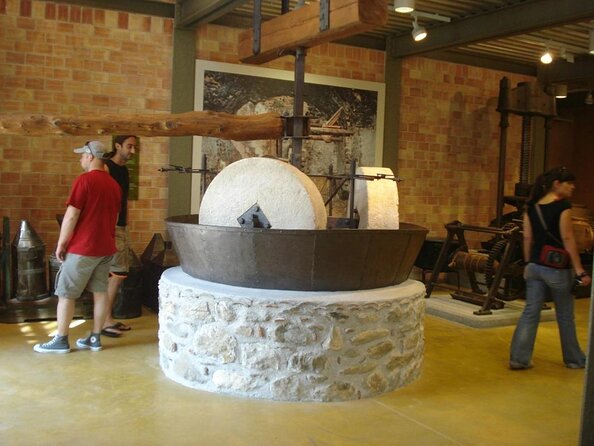
If you like food history, this is the kind of museum you don’t regret spending time on. The Museum of the Olive and Greek Olive Oil in Sparta focuses on olive cultivation and olive oil production technology and culture, stretching from prehistoric times to the early 20th century.
What I’d call the “wow” items are included in the description:
- very old fossilized olive leaves from Santorini (reported as 50,000–60,000 years old)
- Linear B tablets (as exact replicas) connected to early written testimonies about olive and olive oil
The stop is about 20 minutes, and it costs €5. It’s also closed on Tuesdays, so if you’re touring on Tuesday, you may want to assume this won’t happen.
In practice, this is also the easiest stop to adjust if your day is running late. Some private tours can swap time between stops when needed, and the olive museum is often the one people trade.
Ancient Corinth walk: ruins, Paul, and the feeling of time travel
Ancient Corinth is where the day starts to feel larger. You’re visiting the remains of one of the biggest ancient Greek cities, and walking through the area is described as feeling like stepping back in time. Corinth is also tied to the New Testament letters of Saint Paul and mentions in Acts as part of Paul’s missionary travel.
Plan around 1 hour 10 minutes. The combined ticket for Ancient Corinth is listed as:
- €15 in summer
- €8 in winter
and it includes the museum.
In other words, you’re paying for a “two-for-one” experience: ruins plus museum content under one ticket system. That makes it a better value stop than buying separate pieces.
One practical tip: bring your patience for uneven ground and sun exposure. Ruins are ruins. I’d rather be prepared than forced to cut corners.
Archaeological Museum of Corinth: included and timed by season
Alongside Ancient Corinth, the Archaeological Museum of Ancient Corinth is included through the site ticket system. The description also notes it’s closed on Tuesdays in winter.
The time allowed is listed as about 30 minutes. For many people, that’s enough to get the big story without feeling like you’re spending half the day inside a room.
Food breaks and the local touches that make it feel personal
This tour is heavy on sightseeing stops, but what people remember tends to be what happens between the stops. Drivers sometimes suggest good lunch options and can steer you toward quick, local bites.
A couple examples from the day’s descriptions:
- One driver-style story includes grabbing fresh cherries from a tiny roadside fruit stand on the way to Sparta.
- Another mentions lunch at a small cafe overlooking the Temple of Apollo area in ancient Corinth.
You shouldn’t count on those exact moments, since the day depends on timing and the driver. But you can count on this: the private setup makes it easier to fit a bathroom stop, adjust pacing, and find food that works for your group.
If you want to add a nearby extra like Mystras (mentioned as an additional stop in some days), you’ll need to coordinate with your driver and keep it realistic within the overall schedule. If you do extend, the tour info lists additional hourly charges depending on vehicle type.
Who this private tour is best for
This is a strong match if:
- you want a single-day route that hits Corinth and Sparta without transit hassle
- you care more about seeing multiple key sites than spending all day in museums
- you’re traveling with kids or a mixed-age group that benefits from a car and flexible stops
- you like hearing stories explained while you travel, not just reading plaques
It might not be the best match if:
- you want a true archaeologist-guided deep dive at every site (the driver is not an archaeologist)
- you dislike long drives and multiple short walks
- you’re traveling on Tuesday and you strongly want to see the Sparta museum and the olive oil museum
Should you book this Athens-to-Sparta-and-Corinth tour?
I’d book it if you’re trying to make Athens feel like more than a city break. The value isn’t only the destinations; it’s the logistics solved for you: private transport, organized stops, and a day plan that keeps moving without turning into a sprint.
Before you book, do two quick checks:
- Confirm whether your travel date is a Tuesday, since museum closures can reshape the day.
- Decide whether you’ll be happy with a driver who explains history during the trip, rather than a separate archaeologist inside the sites.
If those points align, this is a practical, memorable way to connect Sparta’s myth and Corinth’s real-world spiritual and historical footprint in just one long day.
FAQ
FAQ
How long is the Ancient Sparta Ancient Corinth private tour?
The tour runs about 10 hours (approx.).
What’s the pickup like from Athens?
Pickup/drop-off is offered from your hotel or apartment in Athens center up to 7 km, at the arranged tour time.
Is pickup available from Nafplio too?
Yes. Pickup/drop-off is offered from Nafplio as well, and the price changes since Sparta and Corinth are closer.
What’s included in the tour price?
Air-conditioned private transportation, fuels/tolls/parking, hotel pickup and drop-off, a professional English-speaking driver, and informative books and audio documentary historical details during travel.
What admission fees are not included?
Admission fees are not included for the Museum of the Olive and Greek Olive Oil (€5), the Ancient Corinth ticket (winter €8 / summer €15), and the Archaeological Museum of Sparta (winter €5 / summer €10). Gratuities are also noted.
Are any museums closed on Tuesdays?
Yes. The Archaeological Museum of Sparta is closed on Tuesdays, and the Museum of the Olive and Greek Olive Oil is also closed on Tuesdays. The Archaeological Museum of Ancient Corinth is closed on Tuesdays in winter.
Is the tour guided by an archaeologist?
The driver is not an archaeologist guide to accompany you on walk-throughs or museum explanations. If you want an archaeologist guide, you’ll need to hire one separately.
Can you customize the itinerary?
Yes. Since it’s private and flexible, you can adjust pacing and potentially trade time between stops depending on the day’s schedule. Extending beyond the agreed hours requires an additional arrangement with the driver.
What vehicle sizes are available?
You can choose among sedan (up to 3 adults or family of 4), minivan (1 to 7), or minibus (1 to 14). Children under 12 are listed as free for up to 2 kids.
What’s the best start time?
The tour recommends starting at 8:00 am or earlier in winter time. If that doesn’t work for you, timing can be adjusted with the provider.