REVIEW · ATHENS
Biblical Corinth Taste Faith & History with wine & Oil Tasting
Book on Viator →Operated by Yomadic.Tours & Transfers · Bookable on Viator
Corinth gets spiritual and delicious here. This is a small-group Athens outing that ties Paul’s Corinth to ship routes, temples, and a fortress view from Acrocorinth.
I like how the day links key stops on the isthmus—Corinth Canal and the old Diolkos trackway—so the ruins make sense as a working crossroads. I also like the option to add a wine and oil tasting day-boost, without turning the day into a pure food tour.
One drawback to plan for: entrance fees and museum tickets are not included, and the main archaeological stop can occasionally be impacted by filming or safety closures.
In This Review
- Key highlights at a glance
- Entering Corinth’s World: Faith Meets Shipping Routes
- Price and Logistics: What You Really Pay For
- Athens to the Corinth Coast: Small Van, Real Flexibility
- Corinth Canal and the Diolkos: The Clever Fix for an Ancient Problem
- Isthmia and the Paul Connection: Games, Tents, and Early Christianity
- Isthmia Museum Stops: Artifacts That Put Detail Back Into the Story
- Ancient Corinth and the Corinth Museum: Temples, Roads, and Paul’s City
- Temple Time, Lunch Break, and Shopping Without the Stress
- Acrocorinth: The Fortress View That Explains Everything
- Optional Wine and Oil Tastings: Extra, But a Nice Pairing
- Guides, Comfort, and What Makes the Day Feel Good
- Who Should Book This Corinth Taste and Faith Tour
- Should You Book This Corinth Taste & Faith Tour?
- FAQ
- How long is the Corinth and Acrocorinth tour?
- What’s included in the price?
- Do I need to pay entrance fees?
- Is pickup offered from hotels in Athens?
- Is this a bus tour?
- Are wine and oil tastings included?
- Is lunch included?
- Do I need a separate licensed tour guide?
- What if the weather is bad?
- Are there any reasons the main site could be closed?
Key highlights at a glance
- Private van, small group size: up to 7 people, with A/C, WiFi, and bottled water
- Paul-focused Corinth route: Acts and 1–2 Corinthians show up in the story
- Isithmus engineering stops: Corinth Canal and the Diolkos explain how ships moved
- Fortress time at Acrocorinth: upper-city views and defense-by-design
- Museums add context: Isthmia artifacts + the Corinth museum pieces
- Optional tastings: wine is extra, oil tasting with finger food is extra
Entering Corinth’s World: Faith Meets Shipping Routes
Ancient Corinth wasn’t just another Greek city. It sat on the narrow isthmus between Central Greece and the Peloponnese, which meant people, goods, and ideas flowed through it. That’s why this route feels more connected than a checklist of ruins. You’re not only looking at stone—you’re understanding why Corinth mattered.
This tour also leans into the Faith side. Corinth shows up in the New Testament in Paul’s letters (1 and 2 Corinthians) and in Acts as part of his missionary travels. So when you walk through the area, you’re not just seeing Roman and Greek remains—you’re seeing why a coastal commercial hub mattered to early Christians trying to speak to real cities, real crowds, and real travel routes.
And yes, the title isn’t kidding about taste. You can add wine and oil tasting extras, which gives you a more sensory way to remember the day. It’s not required to enjoy the history, but it’s a nice pairing if you like Greek food culture.
You can also read our reviews of more tours and experiences in Athens.

Price and Logistics: What You Really Pay For

The base price is $190.46 per person, and the day runs about 5 hours. For Athens-based tours, the value depends on what you want: if you’re tired of bus transfers and crowded site bottlenecks, this small-group setup is the real draw.
Here’s what’s included:
- Pickup and drop-off from Athens Hotel, Airbnb, or the Port (and airport pickup is optional)
- Modern private vehicle with WiFi, A/C, and bottled water
- Driver/host who works in English and is set up to explain Greek history
- Fuel and tolls
Here’s what’s typically not included:
- Entrance fees are extra (the info lists €15 per person for the archaeological site; some museum tickets are also listed as not included)
- Lunch is on you
- Licensed tour guide is optional at extra cost (€140 per person)
- Wine tasting (€15 per person) and oil tasting with finger food (€80 per person) are extra add-ons
So, how do you judge value? If you want a route that feels coherent—canal engineering, Paul’s Corinth context, then fortress views—and you’d rather ride in comfort with just your group, the base price makes sense. If you’re the type who only cares about one main site and hates paying extra at every stop, you may want a simpler single-site plan.
Athens to the Corinth Coast: Small Van, Real Flexibility
This isn’t a big bus day. Your group travels in a private vehicle: luxury sedan for 1–3 people and mini van for 4–7. That matters more than it sounds, because it changes how the day flows. You can get in and out efficiently, pause for photos without a long crowd jam, and ask quick questions without waiting for a microphone.
Pickup works like a real concierge transfer. If you’re at a hotel, the driver waits in the lobby. If you’re in an apartment, they wait at the entrance. If you’re at the airport or Port, the driver meets you holding a sign with your name. You also get a mobile ticket, which tends to make day-of coordination smoother.
The most practical part: because this is small-group, the day can feel less rushed. Even with several stops, you usually get short, focused time windows where you can breathe, walk a bit, and then move on.
Corinth Canal and the Diolkos: The Clever Fix for an Ancient Problem
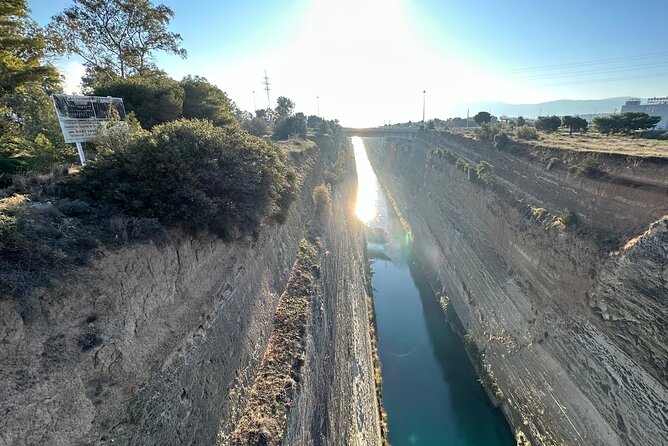
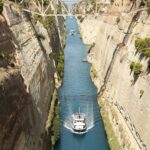
The tour starts with the Corinth Canal, a waterway that cuts across the narrow isthmus and links the Gulf of Corinth to the Saronic Gulf. That instantly turns your mental map upside down: instead of Greece as one big land mass, you get the idea that the Peloponnese might as well be an island—if you’re sailing with intent.
You’ll also hear the longer story: the canal was built in the late 19th century, but the idea was a 2000-year dream. In ancient times, ships that wanted to cross toward the Adriatic or anchor in Corinth had to circle the Peloponnese, adding about 185 nautical miles of travel. That’s the kind of friction you can feel when you imagine how long voyages took.
Then comes the Diolkos, the paved trackway where ships could be moved overland across the isthmus. It ran roughly 6 km to 8.5 km, and it operated from around 600 BC until the mid-1st century AD. In other words: Corinth didn’t just sit there. Someone planned shortcuts for reality. Aristophanes even used the phrase as fast as a Corinthian, tied to the Diolkos’ reputation for speed.
These are quick stops on the clock, but they’re valuable. They turn later ruins into something you can picture as infrastructure, not just scenery.
Isthmia and the Paul Connection: Games, Tents, and Early Christianity
After the canal area, the day shifts to Isthmia, where major ancient athletic competitions took place. This matters because the story isn’t only political or architectural—it’s social. The games drew visitors from across the ancient world, and Isthmia sat at a key junction where Peloponnese connected to Central Greece.
The tour also makes the biblical link clear. The information provided connects Apostle Paul to the Isthmian region and to the games context. It specifically notes that Paul worked at the games as a tent maker for accommodation of athletes and visitors. It also frames this as the first official Christian presence connected with those games.
That faith angle is the reason this stop doesn’t feel like random detour. You’re watching how travel hubs become mixing pots: athletes, traders, pilgrims, preachers. Corinth and its region weren’t just commerce—they were conversation.



Isthmia Museum Stops: Artifacts That Put Detail Back Into the Story
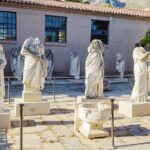
You’ll also have time at the Archaeological Museum of Isthmia. This is the kind of stop that can be a win if you like evidence. The displays connect the area to specific objects and time periods, so it’s not just broad background talk.
Some highlights from what’s listed:
- An Archaic marble pediment dated to the end of the 7th century BC, linked to an earlier temple area
- Glazing of Kechreon, colored glass pieces that arrived packed on a ship from Alexandria, Egypt and were found submerged in a temple context associated with Isis
- A statue of Zeus type from the mid-2nd century BC
- An epinician stele with a portrait tied to the Corinthian musician Lefkios Cornelius (150 AD)
- Votive and animal offerings, including a golden bull connected to a sanctuary vow
- Amphorae and offerings connected to cult and weapon dedications, plus objects tied to Mycenaean and Roman cemetery areas
This museum time is short, but it does one useful thing: it gives you a way to remember the region with specifics. If you tend to forget what you saw after a temple photo, this helps. It turns your brain from tourist mode into evidence mode.
Ancient Corinth and the Corinth Museum: Temples, Roads, and Paul’s City
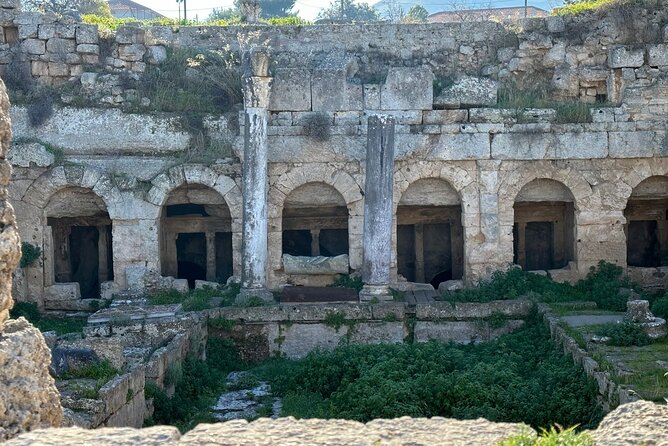
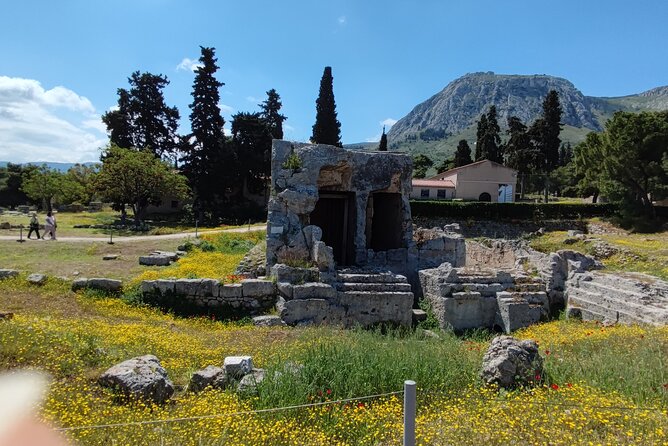
The heart of the day is Ancient Corinth (Archaia Korinthos), plus the nearby Archaeological Museum of Corinth. Expect about 1 hour for the main site, then more time for the museum portion later.
What makes Ancient Corinth worth planning for? It’s Corinth’s layered rebuilds. The information notes:
- Corinth was a major city-state on the isthmus
- In 146 BC, the Romans destroyed Corinth
- Romans then built a new city in 44 BC
- Later it became the provincial capital
So you see more than one era. The area also ties directly into Paul’s life and letters. For Christians, Corinth is well known from 1 and 2 Corinthians and from Acts, and it’s mentioned in Pausanias’ Description of Greece.
For the museum side, the Archaeological Museum of Corinth is described as built between 1931–1932 to present finds from excavations. It’s also located within the archaeological site. The kind of things you might connect to what’s around you include sites like the Fountain of Peirene, the Agora, the Stoa, and other named areas such as the Hadgimoustafa spring and Lechaion Road.
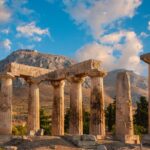
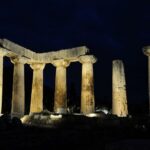
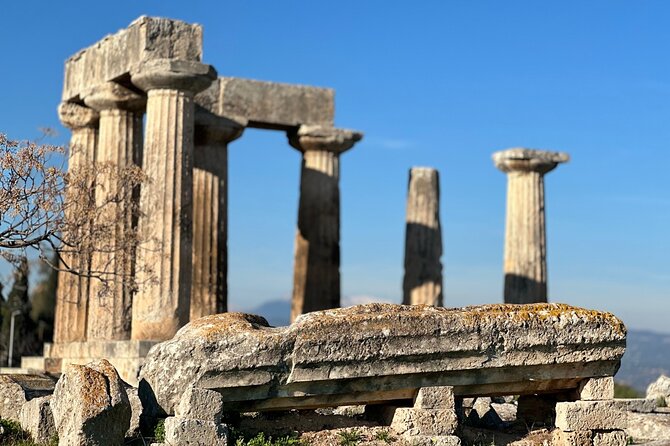
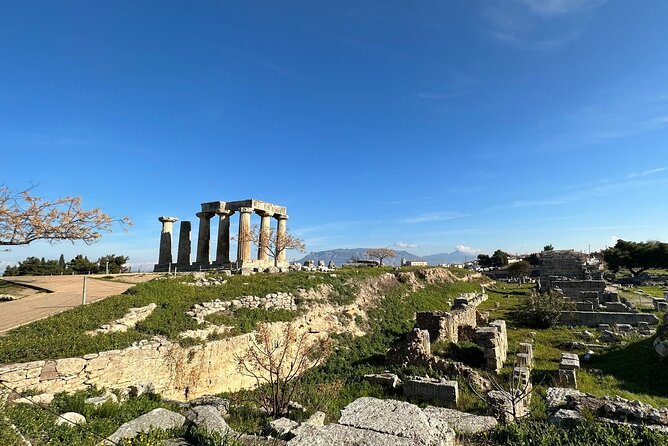
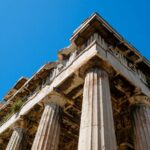
Then there’s the Temple of Apollo stop. It’s dated to around 550 BC and described as one of the earliest Doric temples in the Peloponnese and on the Greek mainland, with monolithic columns that are rare.
Practical note: admission tickets aren’t included in the base price, so you should budget for them if you care about seeing inside or fully using the museum spaces.
Temple Time, Lunch Break, and Shopping Without the Stress
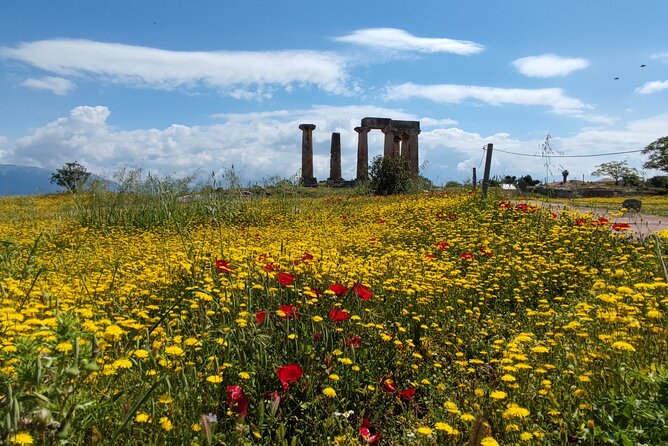
After the main temple and museum time, you get free time for lunch and shopping. The schedule lists about 45 minutes for that gap.
This is one of those parts of a tour where you can either feel rushed or use it well. With short breaks like this, I suggest you do two things:
- Decide ahead of time what you want from lunch: a quick sit-down meal or grab-and-go
- Keep shopping limited to small, easy souvenirs so you don’t eat your time twice
Because this is a private small-group day, you’re more likely to get helpful lunch direction from your driver. The day is set up so you can pause for food, pictures, and a calmer moment, instead of racing from gate to gate.
Acrocorinth: The Fortress View That Explains Everything
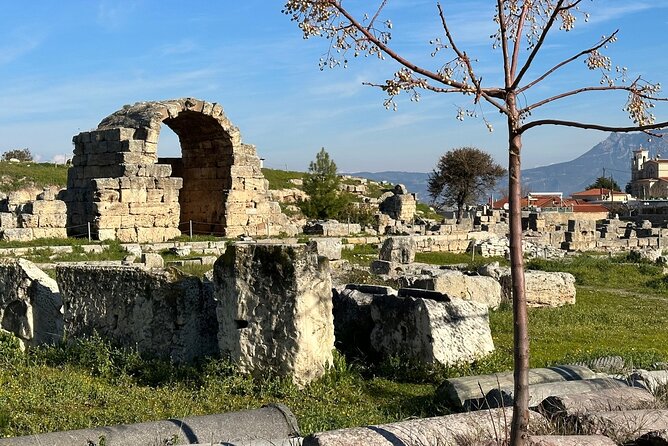
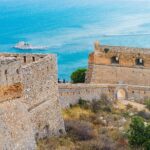
Then comes the best payoff: Acrocorinth, the upper city and fortress overlooking Ancient Corinth. Acrocorinth is described as a monolithic rock that commands the isthmus. It had secure water supply, and it was used as a last line of defense in southern Greece—repelling enemies who tried to enter the Peloponnese by land.
This stop is short on paper—about 30 minutes—but it often feels longer, because the views help you understand geography fast. You can see how the terrain controls movement. You can also connect the dots between shipping routes down below and the defensive control above.
If you want one photo that sums up the day, this is it. Not because it’s Instagram-ready, but because it makes the rest of your memory click into place.
Optional Wine and Oil Tastings: Extra, But a Nice Pairing
The tour’s main structure is history-first, but the title promises taste, and the pricing list confirms tastings are available as add-ons:
- Wine tasting: €15 per person
- Oil tasting with finger food: €80 per person
Are they worth it? If you enjoy Greek food culture and you like learning through taste, adding at least the wine can be a low-effort way to extend the day’s theme. Oil tasting tends to be more of an experience—especially if it comes with food—so it’s pricier.
Here’s the balanced take: if you’re the type who wants to spend every minute walking and you don’t care about food tastings, you can skip them and still have a full, meaningful day. If you do care, treat tastings like part of your Corinth story: Corinth was a trade center, and wine and oil are part of that economic reality.
Guides, Comfort, and What Makes the Day Feel Good
This tour leans on the host experience. It states an English-speaking tour driver well-versed in Greek history. In practice, the best days depend on whether your driver can connect the dots between the sites quickly and clearly.
The reviews for this kind of service highlight a repeat theme: strong communication, lots of on-the-spot explanation, and helpful choices for how to pace the day. Names that show up include Nikos, Panos, Periklis, Andreas, and Christos—so if you have a chance to request a driver, it’s worth considering those styles.
Comfort helps too. Private vehicle, A/C, WiFi, bottled water. For a 5-hour day in Athens weather, that simple stuff can change your mood fast.
One more reality check: sometimes the biggest archaeological stop can face closures. One documented example says Ancient Corinth could be closed on Tuesdays due to filming of a major production and for safety reasons, with little warning. That’s not unique to this tour type, but it is a real consideration. If your schedule is strict, choose flexibility.
Who Should Book This Corinth Taste and Faith Tour
This tour is a strong fit if you want:
- Corinth with context: shipping routes plus the biblical thread tied to Paul
- A small-group private vehicle experience instead of a bus day
- Time at both the ruins and the museums
- Optional tastings if you like wine and olive oil culture
You might want to think twice if:
- You dislike paying for extra admission fees and add-ons
- Your schedule is tight and you can’t handle a site closure day
- You only care about one single must-see attraction and would rather keep the day simpler
Should You Book This Corinth Taste & Faith Tour?
I’d book it if you’re the type who likes your travel days to make sense. The Corinth Canal and Diolkos give you the engineering logic. Isthmia gives you the human scale, with the Paul connection tied to the games and visitors. Ancient Corinth, the museum, and Apollo’s temple supply the religious and civic core. Then Acrocorinth turns it all into geography you can understand in seconds.
Skip it only if you’re trying to minimize costs and time. The base price is clear, but the day still expects you to budget for entrance tickets and to choose tastings if you want them.
If you’re planning a first trip to the Corinth area from Athens, this is one of the more coherent ways to do it—especially when you want a private, no-crowd flow.
FAQ
How long is the Corinth and Acrocorinth tour?
It runs about 5 hours (approximately).
What’s included in the price?
The price includes an English-speaking driver/host, pickup and drop-off in Athens (hotel, Airbnb, or Port), private modern transportation with WiFi, A/C, and bottled water, and fuel and tolls.
Do I need to pay entrance fees?
Yes. Entrance fees for attractions are listed as €15.00 per person, and some museum or site tickets are marked as not included.
Is pickup offered from hotels in Athens?
Yes. Traveler pickup is offered from Athens Hotel, Airbnb residence, or the Port.
Is this a bus tour?
No. It’s described as a small group tour with only your group participating, using a luxury sedan (up to 3) or a mini van (4–7).
Are wine and oil tastings included?
Wine tasting (€15.00 per person) and oil tasting with finger food (€80.00 per person) are listed as not included, meaning they’re optional add-ons.
Is lunch included?
Lunch stops are scheduled, but meal costs are not included.
Do I need a separate licensed tour guide?
A licensed tour guide is optional upon request, with an extra cost listed as €140.00 per person. The tour already includes an English-speaking driver/host.
What if the weather is bad?
This experience requires good weather. If it’s canceled due to poor weather, you’ll be offered a different date or a full refund.
Are there any reasons the main site could be closed?
There can be unexpected closures. One provided explanation says Ancient Corinth could be closed on Tuesdays due to filming and safety reasons, with limited information on timing.