REVIEW · LONDON
City of London History Tour: The Square Mile that Rose to Empire
Book on Viator →Bookable on Viator
A Roman wall. A City hall. And the Bank of England—connected by one walk. This tour threads together London’s Square Mile story from early fortifications to the institutions that shaped modern power.
I especially like how it blends big-name stops with smaller, quieter spots you’d likely miss on your own. You also get a strong sense of how trade and governance grew side by side around the City’s livery-company world.
One consideration: it’s a walk of many short stops, so if you want long museum-style time in one place, this might feel a bit brisk.
In This Review
- Quick hits you’ll actually remember
- Where Roman walls meet City power in 2.5 hours
- St. Alphage London Wall to Salter’s Hall Garden: the story starts with protection
- Brewers’ Hall, Aldermanbury Garden, and the City government mindset
- Guildhall and St. Lawrence Jewry: power, mythology, and the City’s memory
- St. Margaret Lothbury, the Royal Exchange, and legends on money’s doorstep
- Mansion House, the London Troops War Memorial, and the Bank of England
- Price and logistics: worth it for first-timers to the City
- Who this tour fits best (and who might want a different pace)
- Should you book the Square Mile that Rose to Empire?
- FAQ
- How long is the London City of London History Tour?
- What does the tour cost?
- What language is the tour offered in?
- Are the stops admission tickets required?
- Is the tour accessible for strollers or wheelchairs?
- Where do the tour start and end?
Quick hits you’ll actually remember
- Roman foundations right in the City at St. Alphage London Wall and the Roman city wall section
- Old churches with Norman roots, including St. Giles Cripplegate
- Livery company landmarks tied to trade, governance, and sacrifice (Salters Hall Garden, Brewers’ Hall, and more)
- Guildhall in multiple layers of time, with influences running from Greek through Roman, Saxon, and Norman
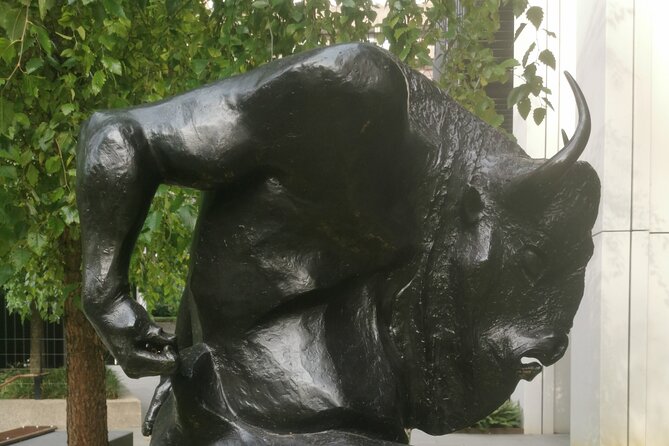
- Empire-era finance and legend points, like the Golden statue at the Bank of England and the golden grasshopper on the Royal Exchange
- A finish at a war memorial circle of 12 dragons, linked to the 12 great livery companies and the Minotaur story
Where Roman walls meet City power in 2.5 hours
The City of London is small on a map, but it punches above its weight in how it grew. This tour walks you through that story in order—starting where protection mattered, then moving into the places where people organized, traded, and ruled.
You’ll move through a mix of gardens, churches, and landmark buildings, without spending the whole time in obvious tourist traps. I like the way it gives you signposts for the bigger ideas: walls first, then institutions, then the symbolism and legends that locals keep repeating.
The price is about $30.69 per person for a 2 hours 30 minutes walk, and that time adds up fast because you’re not just seeing buildings—you’re getting a guided narrative that connects them. The group size is capped at 8 travelers, so you’re less likely to get lost in the crowd noise.
You can also read our reviews of more tours and experiences in London.

St. Alphage London Wall to Salter’s Hall Garden: the story starts with protection

Your tour begins near Barbican at Barbie Green2 London Wall Pl (EC2Y 5AU). The first stop is St. Alphage London Wall, in the Salters garden, where the tour sets the stage for how different peoples and eras overlap in this exact patch of ground.
What I like here is the immediate feeling of continuity. You’re not looking at random landmarks—you’re standing in a place where layers of London history literally sit close together, with the Roman-to-Norman thread called out from the start. You also get a quick primer that helps the rest of the walk make sense later.
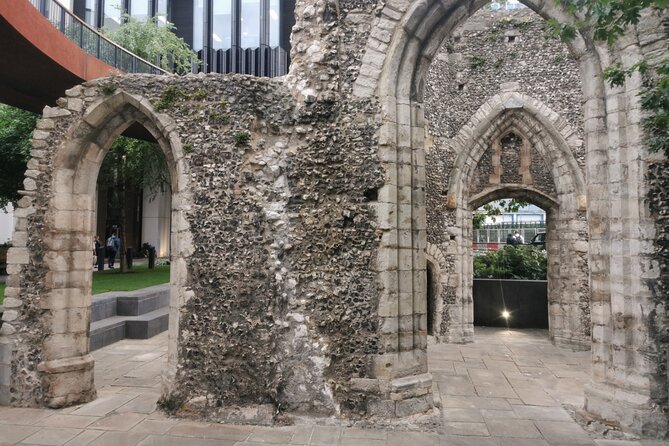
Next comes the Roman city wall itself, described as the oldest part of the wall and tied to a fort here. Even if you’re not a “walls are my thing” person, you’ll probably find the physicality useful. A wall is a real-world answer to a real-world problem—keeping outsiders out—and it makes the later rise of the City feel less like a miracle and more like a sequence.
Then you move to St. Giles Cripplegate, one of the oldest medieval churches in the City since Norman time, once tied to an even older Saxon church. This stop is short, but it’s the kind that helps you “see” the medieval City as living space, not just ruins on a postcard.
After that, Salter’s Hall Garden is where the tour shifts from defense into society. You’re told how the Roman wall helped fortify the City from outside influence, and you also hear about Celtic people and why Romans fortified Londinium with a wall. That’s a key theme: the City didn’t grow in a vacuum, and the fortifications were tied to conflicts and local realities.
The garden also points you to Salter’s Hall as a livery-company site ranked 9th among the 12 most important livery companies. In other words, you’re not only learning where power was—you’re learning who held it and how.
Brewers’ Hall, Aldermanbury Garden, and the City government mindset
The next set of stops leans into who ran the show day to day. Brewers’ Hall comes next as the livery company that set the standard for booze. It’s playful on the surface, but the point is serious: these were trade organizations with influence, not just old-time names for pub trivia.
A short walk later is St Mary Aldermanbury Garden. The tour connects the church’s name to an ancient court or bery of the aldermen, and ties that to where that type of governing activity is held today at the Guildhall. Even if you only catch a few details, you’ll walk away with a better understanding of how governance was tied to the people managing the City’s affairs.
This is also where you’ll find memorials tied to Shakespeare and two legends from different livery companies. I found this kind of stop satisfying because it makes London’s “famous names” feel anchored to local institutions, not floating in the tourist ether.
Then you get a quick look at the City of London itself—its municipal governing body and the historic centre of London. It’s brief, but it works as a hinge. After walls and churches, you’re now seeing how the City describes itself and how authority is organized.
Guildhall and St. Lawrence Jewry: power, mythology, and the City’s memory
At Guildhall, the tour centers on the town hall of the City of London, with its current site traced to at least the 13th century. What makes this stop useful is the way it’s described through layers—mythology and influences moving from Greek to Roman, Saxon, and Norman.
This isn’t just “look at the building.” It’s learning how one place becomes the City’s stage for multiple eras at once. If you’ve ever visited a historic building and thought, okay, but where does the story really live, this is the kind of stop that clarifies that.
Next comes St. Lawrence Jewry, tied to the City of London Corporation’s remembrance of the saint and a sacrifice described as unforgettably cruel. That wording may be heavy, but it helps the tour avoid a too-clean version of medieval spirituality. Even short church stops can add emotional texture to the City story.
You then reach the Guildhall Art Gallery, noted as the location of the Roman amphitheatre. This matters because it’s another example of the City’s past sitting under later uses. If you’re traveling with limited time, it’s a smart way to connect what you see above ground with earlier life below or adjacent to it.
St. Margaret Lothbury, the Royal Exchange, and legends on money’s doorstep
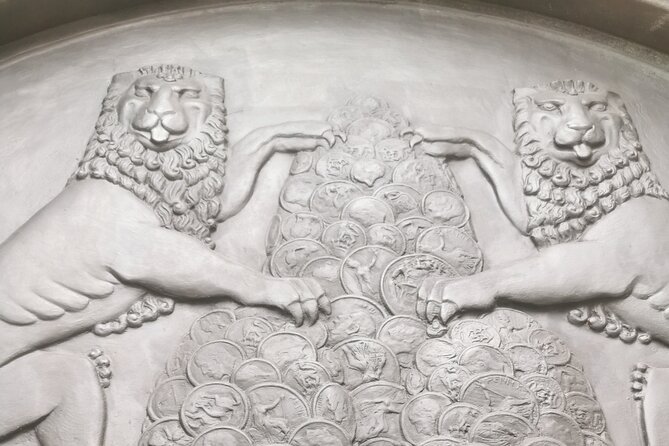
St. Margaret Lothbury Church is a quick stop that connects two City wards of the City of London. You’ll also hear how livery companies came to be named as worshipful companies. That “title” angle might sound small, but it’s actually helpful: it explains why these organizations matter and how they earned status.
Then comes one of the biggest swing moments of the walk: the Royal Exchange. The tour frames it through legend—adventurers meeting there—and points out how those men helped shape the new world. You’ll also hear about the golden grasshopper on top of the exchange.
This is one of the places where the tour turns symbolism into a reason to slow down. If you’ve ever walked past decorative details and thought they were just ornament, the tour’s emphasis can help you look again and notice how meaning is built into the architecture.
If you like walking tours that teach you to notice, you’ll probably enjoy this section. And if you’re not a symbol person, you can still appreciate the logic: this is where trade and global ambition meet the City’s identity.




Mansion House, the London Troops War Memorial, and the Bank of England
Mansion House is next, linked to the Lord Mayor of the City of London and described as his home. The tour also mentions his role as an international ambassador for the UK’s financial and professional services sector, which ties the City’s governance directly to modern influence.
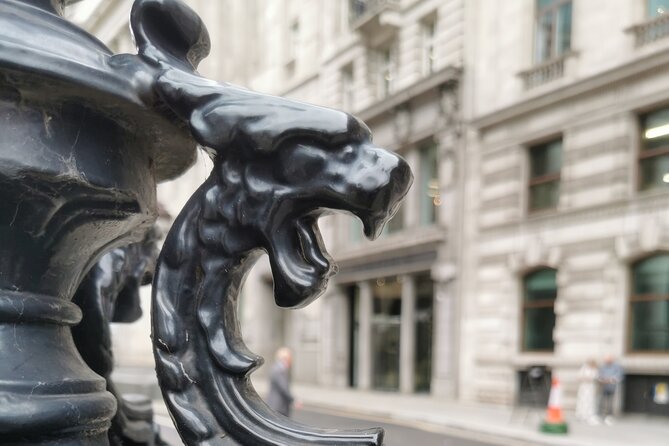
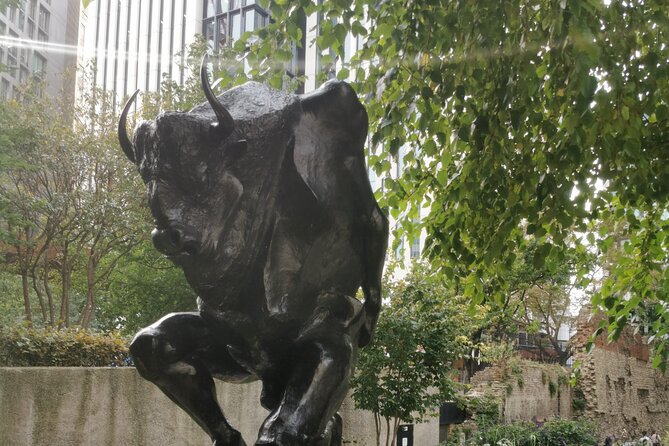
Next you reach the London Troops War Memorial. This one is visually striking: it sits inside a circle of 12 dragon lamposts representing the 12 great livery companies. The tour highlights notable figures remembered around this area, then concludes by returning to the Minotaur story.
That last thread matters because it shows the tour isn’t just doing a list of stops—it’s shaping a narrative. The Minotaur element is an example of how myth and civic identity blend in the City, and you get to see it land at the end.
Finally, you finish at the Bank of England. The tour emphasizes the institution as influential, traditional, but also forward looking, with a Golden statue on top that has an interesting story attached. Even though the stop is short, it feels like a clean payoff: you start with fortification and end with finance and power.
Price and logistics: worth it for first-timers to the City
At $30.69 for about 2.5 hours, you’re paying for guided interpretation rather than just the right to stand somewhere. You also benefit from the small group size (max 8), which makes it easier to ask questions and keep track of the story as you move between sites.
Stops run mostly at street level and in outdoor or semi-outdoor spaces like church areas and gardens, so the pace stays active. That said, it’s still a lot of moving for a guided experience—so if you want more sitting, bring comfortable shoes and plan for short walking stretches between landmarks.
The tour is offered in English and uses a mobile ticket. It’s also wheelchair and stroller accessible, which is a big plus for anyone who needs smoother movement through the City.
One more practical note: it’s near public transportation, and the meeting point is close enough to transit hubs that you can fit it into a day without too much planning.
Who this tour fits best (and who might want a different pace)
I think this tour is ideal for two groups:
- History-buffs and London newcomers who want a guided way to understand how the City of London became the center of governance and finance.
- Anyone who likes civic stories—how institutions, trade groups, churches, and legends connect in one place.
You might want to choose something else if you prefer long, museum-style time in one building or if you’d rather focus only on a few major landmarks rather than many smaller stops.
That said, the balance is what makes it work. You get Guildhall, the Royal Exchange, Mansion House, the Bank of England—and Roman wall and medieval church sites that help you understand how all of that came to be.
Should you book the Square Mile that Rose to Empire?
Yes, if you want a coherent walk through the City’s identity, not just a grab bag of sights. The guide-led connections—Roman fortification to Norman-era churches to livery-company governance to the symbols on finance buildings—make the neighborhood feel logical and alive.
If you like being taught where to look and why certain details matter (like the golden grasshopper and the Minotaur thread), this is a strong fit. If you’re the type who hates lots of short stops, keep that in mind—but for most first-timers and history-minded walkers, this one delivers strong value for the time you spend.
FAQ
How long is the London City of London History Tour?
It runs for about 2 hours 30 minutes.
What does the tour cost?
The price is $30.69 per person.
What language is the tour offered in?
The tour is offered in English.
Are the stops admission tickets required?
Each listed stop includes admission ticket free.
Is the tour accessible for strollers or wheelchairs?
Yes, it’s wheelchair and stroller accessible.
Where do the tour start and end?
It starts at Barbie Green2 London Wall Pl, Barbican (EC2Y 5AU) and ends at London Troops War Memorial, 1 Cornhill (EC3V 3LN).