REVIEW · ROME
Colosseum & Ancient Rome by Night Guided Walking Tour
Book on Viator →Operated by Tours of the Colosseum · Bookable on Viator
Night turns Rome’s stones into a story. On this Colosseum & Ancient Rome by Night guided walk, you see major monuments lit up after dark and learn what they were really for. The best part is the way the tour makes the city’s layers click, so you stop guessing and start understanding.
I especially love the archaeology-led explanations and the small-group feel that keeps the questions coming. The sites are all outdoors, which is great for avoiding entrance hassles, but the trade-off is you won’t go inside the Roman Forum or the Colosseum during the tour. If you’re hoping for interior time, you’ll need a separate visit.
In This Review
- Key things I think you’ll care about
- Why Rome at Night Changes the Colosseum Story
- Meet at Campitelli, Walk the Historic Core, End at the Colosseum
- Teatro di Marcello: A Roman Theatre You Can Still Sense
- Piazza del Campidoglio: Michelangelo’s Square Meets Imperial Views
- Mercati di Traiano and the Museo dei Fori Imperiali: Power Built in Layers
- Colonna Traiana: War Reliefs as Propaganda (and Almost Like a Comic)
- Roman Forum by Night: Courts, Trade, Temples, and the Center of Rome
- Colosseum Outside at Night: Gladiators and Shows Without the Ticket Stress
- Arch of Constantine: A Survivor That Influenced Later Landmarks
- What Makes This Tour Worth the Money (and Where It May Not Fit)
- Who This Private Night Walk Is Best For
- Should You Book This Colosseum & Ancient Rome by Night Tour?
- FAQ
- How long is the Colosseum & Ancient Rome by Night guided walking tour?
- Is this tour offered in English?
- Does the tour include admission tickets?
- Will we enter the Colosseum or the Roman Forum?
- Where do we start and where does the tour end?
- Is this a private tour?
- What if the weather is bad?
- Can I change or get a refund if I cancel?
Key things I think you’ll care about
- Teatro di Marcello by night: a well-preserved Roman theatre that’s easier to picture when it’s dark and quiet
- Campidoglio viewpoint: Michelangelo’s Piazza del Campidoglio plus a classic forum panorama
- Trajan’s big-picture sites: Mercati di Traiano / Museo dei Fori Imperiali framing the power of the empire
- Colonna Traiana’s “comic strip” battle reliefs: Roman propaganda you can actually read with help
- Outside-only Colosseum time: you get the atmosphere and the stories without entering
- Private group experience: only your group participates, so it feels less like herding cats
Why Rome at Night Changes the Colosseum Story
Rome by day can be impressive, but it can also be loud and fast. At night, the same monuments feel calmer and more theatrical, and that fits this tour’s goal: help you understand the city as a lived-in place, not just a postcard.
What you’re buying is not access to buildings. It’s interpretation. With an official guide, the tour turns street-level views into a coherent narrative, from Roman performance culture to imperial politics. That’s why the tour works so well even though it’s “just walking.” You’ll spend the time looking at the right details, not standing around hoping things make sense.
You’ll also like the practical rhythm: it’s a compact 2 hours 30 minutes that moves you through several major stops, with breaks built in by design. It’s long enough to feel satisfying, short enough to keep energy for a late dinner afterward.
You can also read our reviews of more tours and experiences in Rome.
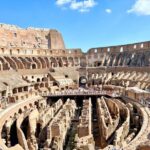
Meet at Campitelli, Walk the Historic Core, End at the Colosseum
The tour starts at Chiesa di Santa Maria in Portico in Campitelli on Piazza di Campitelli, 9. It ends at Piazza del Colosseo, which is convenient because you’re already in the neighborhood for transport. The route is near public transportation, so you’re not stuck playing tourist shuttle with your own legs.
It’s also offered in English, and confirmation comes at booking time. The experience is designed for “most travelers,” and it’s listed as all outdoors. That matters because it shapes what you should expect: you’ll be close to the monuments and learn from them, but you won’t enter any site during the walk.
Timing is part of the value here. You’re out for about 2 hours 30 minutes, and the pacing is built around key views: a series of short stops for look-and-learn moments, then a couple longer points where the story expands.
Teatro di Marcello: A Roman Theatre You Can Still Sense
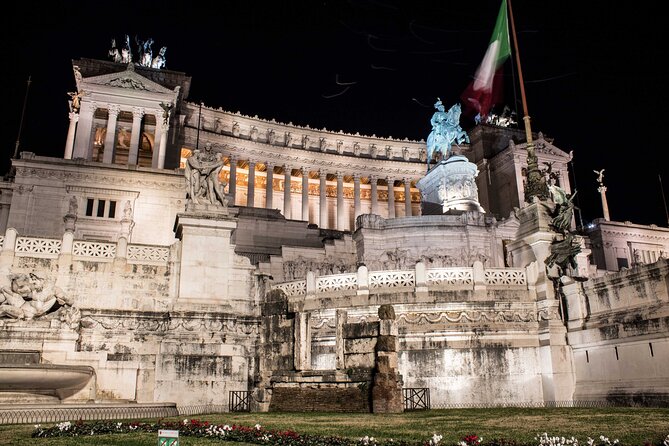
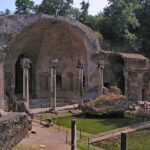
Your first stop is Teatro di Marcello. This is one of the most best preserved ancient theatres in Rome, and it’s a smart opener because theatres explain the Romans as people, not just conquerors and politicians.
Even if you’re not an expert in ancient architecture, the structure gives you clues: where the audience would have sat, how the space would have carried sound, and why Roman entertainment was a form of public life. With a guide’s explanations, you’ll connect the dots between stone and spectacle.
The time here is about 15 minutes, and that’s ideal for a night tour. You don’t need a long sit-down lecture in the open air. You need enough minutes to see the scale and understand what it meant.
One drawback to keep in mind: this stop is more about observation and story than “wow, we’re going in.” If you want interior access from the start, this may feel different than you expected.
Piazza del Campidoglio: Michelangelo’s Square Meets Imperial Views
Next up is Piazza del Campidoglio, designed by Michelangelo. It’s a gorgeous shift in mood because it blends Renaissance planning with the ancient world right beyond it. You also get to see the town hall area and the statue of Marcus Aurelius.
Then comes the practical payoff: you’ll enjoy a great view of the forums. This is one of those moments where the city layout starts making sense. From here, it’s easier to picture how Romans would have moved between law, commerce, religion, and power.
Time on this stop is about 30 minutes, which is generous enough to let the guide explain the significance of the square and then use the view to anchor the rest of your night. It’s not just a photo break; it’s your mental map.
If you’re visiting in cold or windy conditions, remember it’s an outdoor viewpoint. Dress for night air. Rome at night isn’t usually freezing, but it can feel cooler than you expect.
Mercati di Traiano and the Museo dei Fori Imperiali: Power Built in Layers
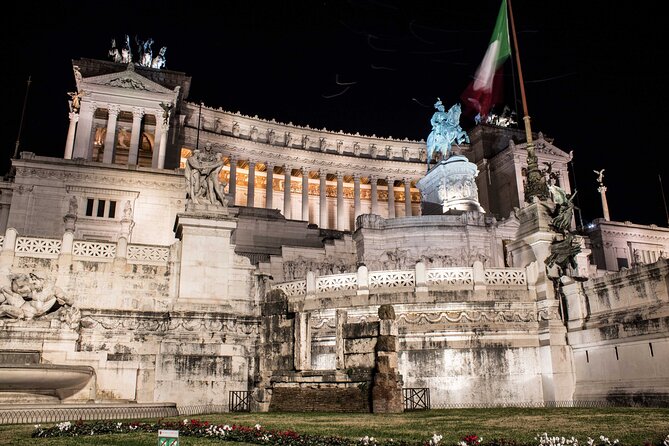
Your third stop is Mercati di Traiano – Museo dei Fori Imperiali. This is where the tone tilts more toward empire-building. Trajan’s forums were among the biggest statements of authority in ancient Rome, and the “markets” element matters because it shows power wasn’t only ceremonial. It was functional too.
You’ll learn about the grandest forum of Ancient Rome built by Trajan. That phrase lands differently when you’re outside and looking at the complex footprint. The scale can be hard to wrap your head around, so the guide’s job is to point out how the different parts worked together.
This stop is about 15 minutes. Again, that’s purposeful. You want short, high-impact explanations that help you keep momentum for what’s coming next.
Colonna Traiana: War Reliefs as Propaganda (and Almost Like a Comic)
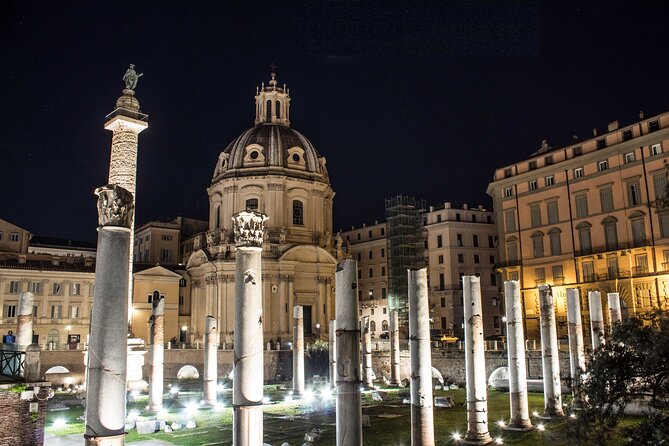
Then you’ll see Colonna Traiana. This is a standout stop because it turns ancient art into something easier to read. The column shows Trajan’s campaign of war, and the reliefs have that almost comic-book feel—panel-like storytelling wrapping around the monument.
The tour’s value here is the “what you’re looking at” translation. Without a guide, you might notice decoration. With help, you can understand it as narrative propaganda: Rome telling its story about victory, leadership, and legitimacy using public art.
Time is around 10 minutes. It sounds short, but it can be enough if your guide tells you what to look for as you circle your eyes over the reliefs.
If you’re the type who loves symbols, messaging, and design, this stop will probably be one of your favorites.
Roman Forum by Night: Courts, Trade, Temples, and the Center of Rome
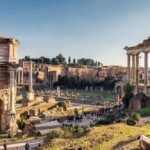
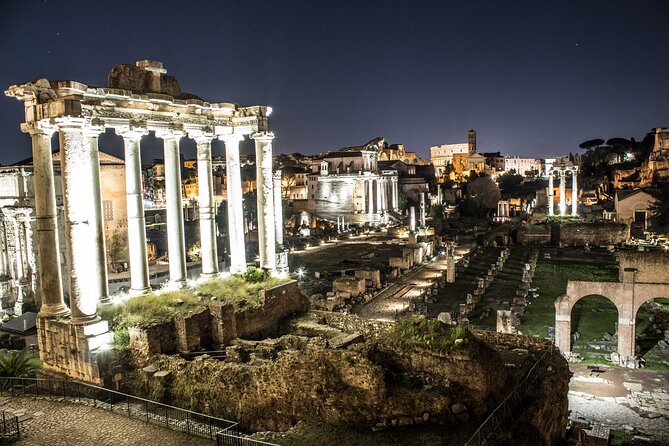
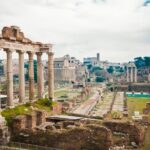
After that, you’ll reach the Roman Forum. This is the big “everything happened here” zone: the center of Rome and the heart of the Roman Empire, with the location of important judicial courts, trade areas, and temples.
This stop is about 30 minutes. That length matters because it allows the guide to connect a bunch of different functions into one picture. You’ll start to see the Forum not as one ruin, but as a hub of daily governance and civic life.
Important detail: admission tickets are not included for the Roman Forum stop. The tour is described as all outdoors, so you should treat this as an exterior look-and-learn. Still, even from outside, it’s one of the most effective ways to understand how the Roman world organized power and public life.
Practical note: the Forum area can involve uneven ground and crowds nearby. Night lighting helps your eyes, but it doesn’t make the pavement any more comfortable. Wear shoes you trust.
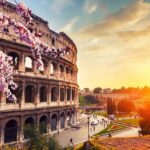
Colosseum Outside at Night: Gladiators and Shows Without the Ticket Stress
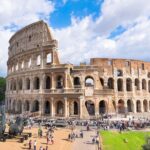
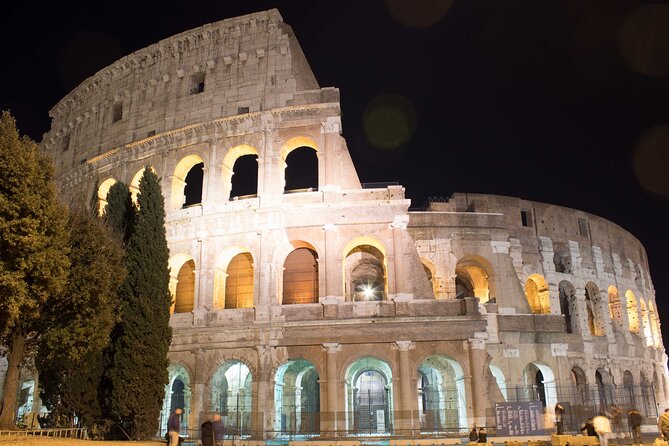
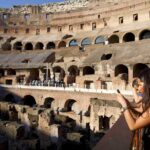
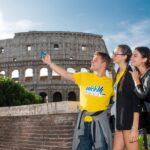
Next is the Colosseum. You’ll see it from the outside while learning about gladiators and Roman shows. Since the tour is all outdoors, you’re not entering the amphitheatre. Admission tickets for the Colosseum are not included, so plan on viewing the monument and hearing the story from the perimeter.
This is still worthwhile. The Colosseum is one of those places where night lighting changes the feel instantly. It reads like a stage, which fits the theme of entertainment and spectacle. Your guide’s focus helps too, especially if they explain how gladiators fit into politics, popular culture, and public ritual.
The stop time is about 30 minutes, so you get enough moment-to-moment explanation while the monument stays in your field of view.
If your dream trip includes actually walking inside, do this tour first for context, then book an interior visit on another day. You’ll likely understand what you’re looking at much faster.
Arch of Constantine: A Survivor That Influenced Later Landmarks
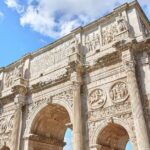
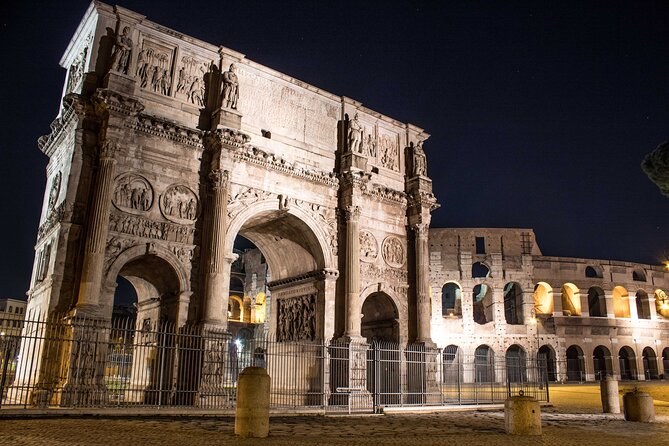
You’ll finish with the Arch of Constantine. This is described as the best preserved ancient arch in Rome, and it’s known as a model that influenced later triumphal arches elsewhere, including references like the Arch of Triumph in Paris and Marble Arch in London.
This stop is about 20 minutes, which is perfect for a “wrap-up with meaning” moment. Arches are tricky: from far away they can look like simple decoration. Up close, with the right explanation, they become political messaging—who’s being celebrated and why.
Night helps here too. It’s easier to appreciate the arch’s mass and craftsmanship under artificial light. You’ll get a stronger sense of how these monuments were built to be seen, not just recorded.
After the tour ends at Piazza del Colosseo, you can hop into the Metro or take a taxi. That’s a nice end-game because you’re done with the guided part and free to choose dinner.
What Makes This Tour Worth the Money (and Where It May Not Fit)
At $272.83 per person for about 2 hours 30 minutes, this isn’t a bargain-basement walking tour. The value comes from three things the tour does well:
- You get an official guide and structured storytelling across multiple major sites.
- You’re not paying separate admission tickets for the tour itself, since the experience is outside only.
- It’s private, so your group gets a more tailored experience than a big group that moves like a school line.
I also like how the tour uses short stops strategically. Instead of dragging you through one place for too long, it keeps the pace moving and the learning varied—teatre, Renaissance square, Trajan’s world, imperial art, the Forum, and then the Colosseum.
Where it might not fit is simple: if you strongly want to enter monuments, this tour won’t satisfy that specific itch. You’ll see a lot, but you’re not going inside.
Also, since the experience requires good weather, it’s not the best pick if your schedule is extremely tight and you hate the possibility of rescheduling. You can still book, but keep your flexibility in mind.
Who This Private Night Walk Is Best For
This tour is a strong match if you want:
- A guided night walk that connects monuments to real Roman life
- A small-group style experience (private, only your group)
- English explanations that help you interpret ruins instead of just taking photos
It’s also a great option if you’re doing your first Rome trip and you want to understand the “big picture” of Ancient Rome quickly. The stops work together as a story arc—from entertainment to empire to public power.
If you already know a lot and mostly want architectural deep-cut detail, you might still enjoy it, but you’ll want to ask plenty of questions to steer the guide into the level you prefer. The format supports questions, and that’s where the experience can really pay off.
Should You Book This Colosseum & Ancient Rome by Night Tour?
I think this is worth booking if your goal is to understand Rome at night, not to collect stamps. The route hits iconic points, and the guide-led context turns exterior viewing into something meaningful.
Skip it if your top priority is interior access to the Colosseum or the Roman Forum. This one is built for outside views and night atmosphere. For many people, that’s actually the right trade: you get a coherent story in a manageable time window, and you can plan separate entry tickets for the monuments you want to tour fully.
FAQ
How long is the Colosseum & Ancient Rome by Night guided walking tour?
It runs for approximately 2 hours 30 minutes.
Is this tour offered in English?
Yes, it’s offered in English.
Does the tour include admission tickets?
No. Admission tickets are not included because the tour is all from outside, and Roman Forum and Colosseum admissions are listed as not included.
Will we enter the Colosseum or the Roman Forum?
No. This experience is all outside, and you won’t enter any monument.
Where do we start and where does the tour end?
It starts at Chiesa di Santa Maria in Portico in Campitelli, Piazza di Campitelli, 9, 00186 Roma. It ends at Piazza del Colosseo, 00184 Roma.
Is this a private tour?
Yes. Only your group will participate.
What if the weather is bad?
The experience requires good weather. If it’s canceled due to poor weather, you’ll be offered a different date or a full refund.
Can I change or get a refund if I cancel?
This experience is non-refundable and cannot be changed for any reason.