REVIEW · ROME
NIGHT TOUR THINK BIG, GO MINI! Rome in Mini Cooper Classic Cabrio
Book on Viator →Operated by MINI TOUR ROMA · Bookable on Viator
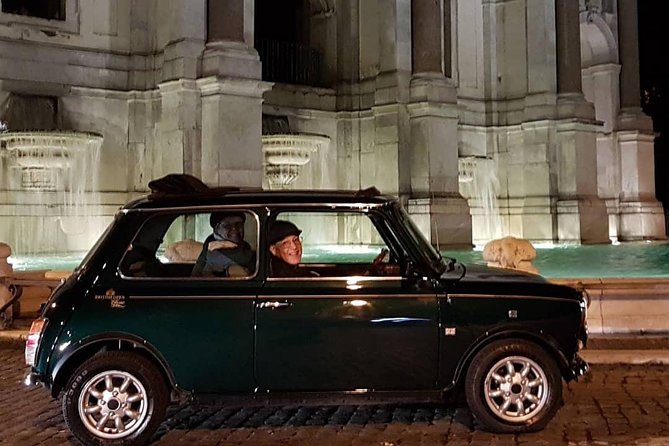
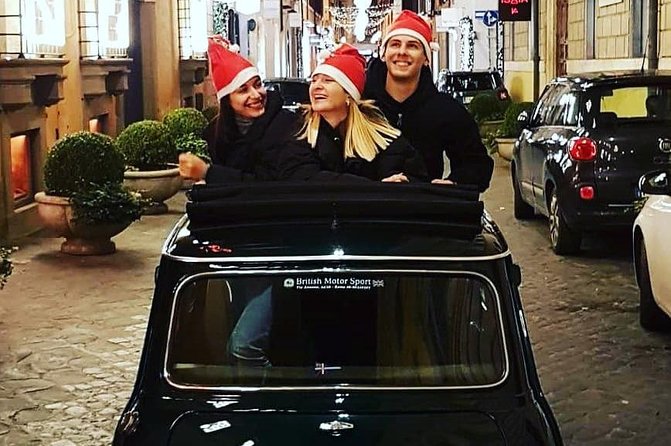
Rome after dark feels like a movie. This classic Mini Cooper Cabrio tour threads you through Rome’s best sights and viewpoints with hotel pickup and live English guiding.
I love the feel of seeing monuments lit up while you stay comfortable in a small open-top car, and I love how the route blends big-name stops with quieter neighborhoods you’d skip on your own. The biggest thing to consider is the pace: most stops are quick (about 10 minutes), so this is for photos and big moments, not slow museum time.
Because it’s a private nighttime drive (9:00 PM–11:30 PM), it’s also weather-dependent. If it’s canceled for poor weather, you’ll be offered another date or a full refund, but you should still plan to dress for the night air.
In This Review
- Key highlights worth caring about
- Why a Mini Cooper Classic Cabrio beats the usual Rome night tour
- The night rhythm: how the timing really feels (and who it fits)
- Hotel pickup and the mini-adventure start
- Piazza Navona: Bernini and Borromini in one quick stop
- Trevi Fountain: the 10-minute photo mission that still works
- Castel Sant’Angelo: Roman power along the Tiber
- St. Peter’s Square: the emotional stop
- Piazza di Spagna and La Barcaccia
- Pantheon: a pagan temple moment with Roman logic
- Colle del Gianicolo: view-first sightseeing
- Fontana dell’Acqua Paola: another scenic angle
- Trastevere at night: where Rome gets loud in a good way
- Area Sacra di Largo Argentina: the Cesare reference point
- Altare della Patria: grand symbolism, quick angles
- Foro Romano and Palatine Hill: the center of the ancient city
- Aventine viewpoint and the Keyhole-area moment
- Piramide Cestia and Circo Massimo: Roman shapes in open air
- The old Roman spa area and Monte Testaccio: the less-famous Rome
- Colosseum: a quick photo stop with admission included
- Snacks, drinks, and the small comforts that matter
- The guide factor: why Luca’s style keeps showing up
- What to watch for during your 9:00 PM–11:30 PM window
- Should you book this Rome Mini Cooper night tour?
- FAQ
- What time does the Rome Mini Cooper Classic Cabrio tour run?
- How long is the tour?
- Is this tour private?
- What’s included in the price?
- Does the tour include admission for the Colosseum?
- Do you pick me up and drop me off?
- Are there any age or dress requirements?
Key highlights worth caring about
- Classic Mini Cabrio driving at night: easy viewing from the street and from lookouts
- Private tour with live English commentary: your guide can shape the night to your interests
- Snacks, coffee/tea, and drinks included: it helps keep the long evening comfortable
- A tight loop of top sights: from Piazza Navona and Trevi to St. Peter’s Square and the Colosseum
- Trastevere and high viewpoints: you get both famous Rome and the areas locals actually hang out in
Why a Mini Cooper Classic Cabrio beats the usual Rome night tour
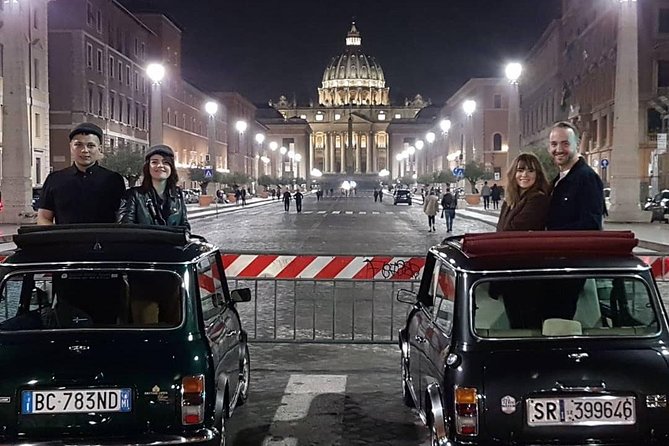
You can tour Rome by foot, taxi, bus, or the “let’s do everything and regret it” method. This one is different because you’re in a small, classic Mini Cooper Classic Cabrio that fits Rome’s narrow streets and keeps you moving without losing the night’s vibe. At 9:00 PM, the crowds tend to thin and the city turns warmer in color—perfect for pictures that don’t look like a daytime stampede.
The other win is how the tour stays social without turning into a big-group grind. It’s private, so you’re not stuck behind other people’s cameras or slowed by someone who needs a bathroom break every 12 minutes. Your guide/drivers role is part chauffeur, part storyteller, part local radar—especially on a route that jumps between plazas, bridges, hills, and old neighborhoods.
The price is $223.26 per person for about 3 hours of guided private transport. That sounds steep next to a group bus tour. But when you factor in hotel pickup/drop-off, round-trip private transfer, live commentary, and snacks/drinks, you’re paying for convenience plus access—time that you’d otherwise spend figuring out logistics at night.
You can also read our reviews of more tours and experiences in Rome.
The night rhythm: how the timing really feels (and who it fits)
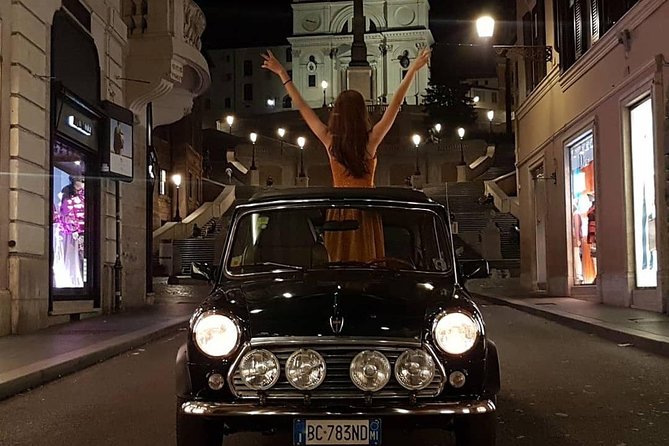
This tour runs roughly 3 hours in the evening window (9:00 PM to 11:30 PM). You’ll stop often, but each stop is brief—around 10 minutes at many sights. That means you’re not doing deep dives in galleries or long climbs. Instead, you get a smart sampling of Rome’s must-sees plus extra stops that help you understand where things sit in relation to each other.
This is ideal for you if:
- you want a first-night overview so your next day in Rome makes sense
- you like seeing multiple landmarks without spending your whole evening in transit
- you want photos from the right angles, including hilltop views
It may be less ideal if you want long, quiet time inside major churches and monuments. This is a “see it, learn the essentials, take the best photos, move on” style of night.
Hotel pickup and the mini-adventure start
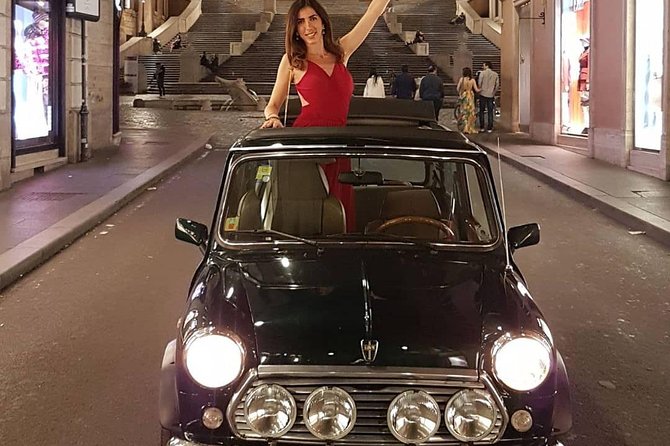
The tour starts in central Rome and offers pickup and drop-off wherever you want. That matters more than it sounds. At night, you don’t want to waste energy herding yourself to a meeting point, then negotiating with taxis after dark. With pickup included, you get to focus on the experience.
You’ll also get a mobile ticket, and confirmation happens within 48 hours of booking (assuming availability). Dress code is smart casual—bring layers because open-top driving plus Rome’s night air can feel cooler than you expect.
Piazza Navona: Bernini and Borromini in one quick stop
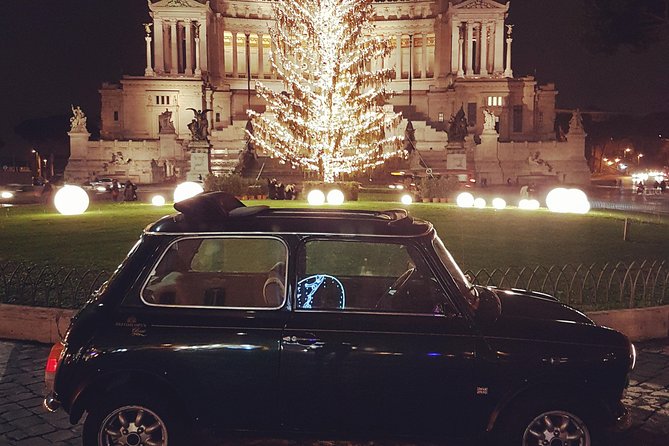
Your first big plaza is Piazza Navona, a classic Rome set piece after dark. Here you’ll see the three fountains by Bernini and the church associated with Borromini. Night lighting makes this kind of baroque geometry look even sharper, and it’s one of the easiest places to orient yourself in the city.
Quick stop downside: because it’s only about 10 minutes, you’ll want to pick your camera spots fast. If you’re hoping for long lingering, this first stop is more about the wow-factor and orientation than deep exploration.
Trevi Fountain: the 10-minute photo mission that still works
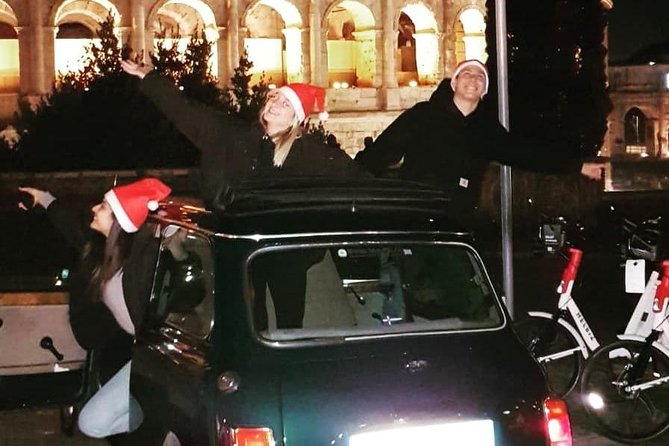
Next up is Trevi Fountain, described as Rome’s biggest fountain by Nicola Salvi (with the 1732/1762 timeline noted). Even with crowds, seeing Trevi after dark is a different experience. The glow against the stone gives it a softer look than daytime flashbulbs.
Practical tip: plan your photos for what you can actually control—where you stand, how you frame, and how quickly you move. Ten minutes sounds short, but it’s long enough to get a strong shot if you don’t get trapped by slow-moving pedestrians.
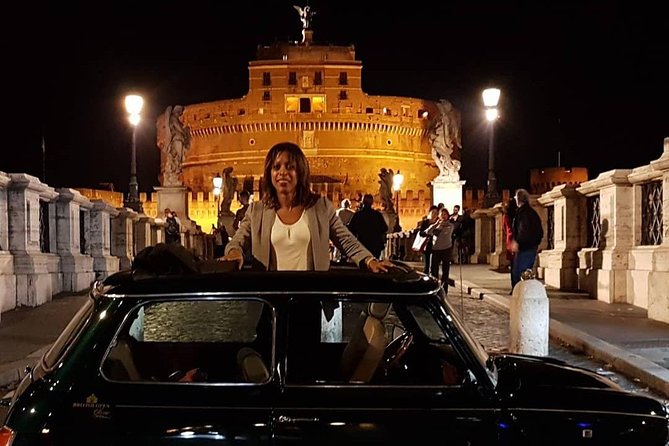
Castel Sant’Angelo: Roman power along the Tiber
Then you’ll reach Castel Sant’Angelo, with the stop described as connected to Adriano Imperator. This fortress-like landmark sits like a watchful silhouette at night. From the outside, you get an instant “Rome used to run on stone and strategy” feeling.
Because you’re in and out quickly, you’re mostly absorbing the visual and hearing the key story points from your guide. That’s the right format for a night drive—less “read the entire site,” more “understand why it matters.”
St. Peter’s Square: the emotional stop
From the riverbank vibe, you shift to St. Peter’s Square, where the itinerary notes the Basilica. This is one of those places where night changes the mood. The open space and lighting help the scale hit you harder, even if your stop is brief.
If you’re the kind of visitor who likes to feel the moment, this can be surprisingly moving even with a short visit. I’d treat it as your “slow down for 60 seconds” stop: one good look up, one calm moment before you move.
Piazza di Spagna and La Barcaccia
Piazza di Spagna is next, with the Fontana di La Barcaccia by Bernini called out in the tour notes. This area is famous for a reason: it’s visually dramatic and easy to recognize from above, but it also feels graceful at street level.
Watch-outs: the 10-minute window means you’ll likely see the fountain and the square’s main angles rather than wandering all the side streets. Still, it’s an efficient way to check this “Rome postcard” box early in the night.
Pantheon: a pagan temple moment with Roman logic
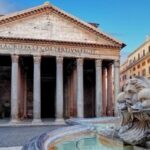
Your route continues to Pantheon, described as a pagan temple. The Pantheon always has presence, and at night the approach feels more mysterious than it does in daylight. In a guided quick stop format, the goal is to understand what you’re looking at and why Romans built so boldly with proportions and math.
You won’t get long inside time from this schedule. Instead, you’ll get a guided external orientation and context so when you revisit (if you choose), you’ll recognize details faster.
Colle del Gianicolo: view-first sightseeing
Then comes Colle del Gianicolo, with its Rome viewpoint listed as a highlight. This is the kind of stop that helps the whole trip click. From a hill, Rome stops being a list of monuments and becomes a city with layers.
Quick stop downside: if you want a relaxed sunset-style moment, this may feel rushed. But if you love rooftops, lights, and “look what Rome does at night,” you’ll appreciate the payoff.
Fontana dell’Acqua Paola: another scenic angle
You’ll also stop at Fontana dell’Acqua Paola, again described as offering beautiful viewpoints of Rome. The theme here is clear: after the big-name monuments, the tour keeps giving you high-level perspectives so you get the geography along with the sights.
If you’re prone to overheating while touring in the day, you’ll likely like this shift to open-air views and nighttime cooling.
Trastevere at night: where Rome gets loud in a good way
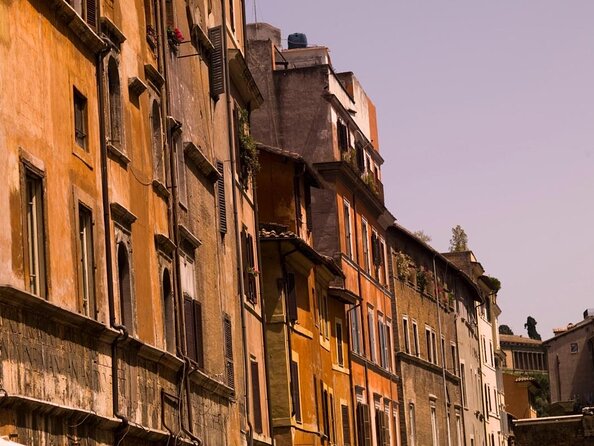
Next is Trastevere, described as one of Rome’s best and biggest nightlife neighborhoods, around 1000 years old. This is a key stop because it changes the feel of the evening. You’re not just looking at monuments—you’re passing through a living neighborhood where nightlife happens.
Because it’s a short stop, treat it like a taste test. You’ll get the atmosphere and likely some street-level energy, then you’ll move on—so you don’t end your night exhausted or lost.
Area Sacra di Largo Argentina: the Cesare reference point
The itinerary includes Area Sacra di Largo Argentina, described as the exact point where Giulio Cesare was killed. This stop is a good reminder that “history” in Rome isn’t abstract. It has a location, a street address, and a moment people still talk about centuries later.
In a brief stop format, your guide’s explanation is what makes it click. If you’re into political drama, you’ll probably find this one memorable.
Altare della Patria: grand symbolism, quick angles
You’ll then visit the Altare della Patria area, referenced in the notes as the complex connected with Vittoriano/Brasini wording. This part of Rome can look theatrical even in daylight. At night, its illumination helps the monument read as intentional and symbolic.
Again, expect a short viewing window. This isn’t the place to plan a long sit-down. It’s a look-around and photo-check moment.
Foro Romano and Palatine Hill: the center of the ancient city
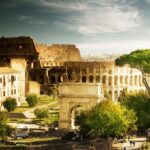
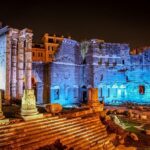
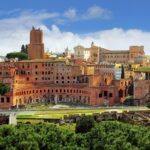
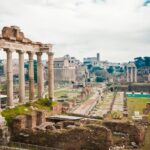
Now the tour turns to ancient Rome’s core: Foro Romano (described as the cultural and politics center) and Palatine Hill (called one of Rome’s seven hills, with Romolo’s early building mentioned). These stops are where your guide’s storytelling matters most, because the ruins can otherwise feel like scattered stones.
The 10-minute format is the trade-off. You’ll get the big ideas and key spatial relationships, but you won’t get the “read every plaque” experience.
Aventine viewpoint and the Keyhole-area moment
Next is Turo Aventi (Monte Aventino area), described with multiple viewpoint details: an Orange Park, a secret key hole, and Sant’Anselmo Church. This is one of the route’s most famous-feeling moments, and it’s not just about the photo. The hilltop setting gives you a different skyline view than you get from flatter streets.
A practical consideration: because this stop is time-limited, you’ll want to keep your group together and move efficiently. The fun here is the surprise moment and the angle, not slow wandering.
Piramide Cestia and Circo Massimo: Roman shapes in open air
You’ll then see Piramide Cestia, tied to Caio Cestio Imperator (noted as from 12 A.C. burial). After that, you’ll pass Circo Massimo, described as an old arena. These stops work well at night because the forms are bold—straight lines, clear silhouettes, and large empty spaces that feel dramatic when lit.
Short stop downside: if you’re the kind of visitor who wants to trace every architectural detail, you’ll likely want a second visit on a day tour. For a night drive, though, this is the right “hit the highlights fast” approach.
The old Roman spa area and Monte Testaccio: the less-famous Rome
Your itinerary includes an Old Roman Term (spa) stop, then Monte Testaccio, described as an old market. These feel like the tour’s “less touristy” bones—places where the vibe is more about the city’s depth than about one famous landmark.
Because you get limited time, you’re not “touring a museum.” You’re taking in a sense of what Rome looked like beyond the headline sites. If you like places that feel lived-in or historically specific, this section is a strong point.
Colosseum: a quick photo stop with admission included
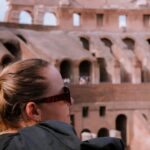
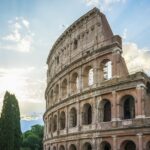
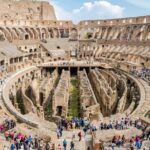
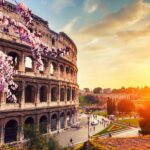
Finally, you’ll reach the Colosseum, with about 10 minutes for photos. Admission is noted as included. Even in a short stop, that combination—getting inside access plus a guided context—makes this last leg feel more complete than a purely outside viewpoint.
You’ll want to plan your priorities: take the money-shot photos, listen for the story beat your guide emphasizes, then keep moving so you don’t lose the rest of the night’s momentum.
Snacks, drinks, and the small comforts that matter
Included in the experience are snacks and a drink, plus coffee and/or tea. The tour also lists alcoholic beverages as included, while also noting alcoholic drinks can be purchased. In plain terms: plan on getting refreshments, and if you want something specific, you can check what’s available.
This matters because Rome nights can run long. Having snacks and a warm drink option takes the edge off and helps you stay alert on a route with frequent stops.
The guide factor: why Luca’s style keeps showing up
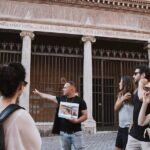
A lot of this tour’s value comes from the human element. The guide named Luca is described as someone who cares about tailoring the night, and several accounts mention he asks questions before setting off. That’s the difference between a standard route and a night that feels personal.
You’ll also benefit from the way the Mini can slip into places you might never reach on foot. In Rome, that access isn’t just comfort. It’s time saved, and it’s angles you can’t always get safely or efficiently without a car.
Also worth noting: one detail shared is that Luca has multiple Minis (five), which can help with flexibility for larger groups. Even on a private booking, it points to real operational capacity rather than a one-car setup.
What to watch for during your 9:00 PM–11:30 PM window
Night touring sounds easy until you factor in clothing, walking, and crowd flow. Here’s what I’d plan for based on how this experience is structured.
- Bring layers: open-top driving and night air can chill you fast.
- Expect brief stops: most are around 10 minutes, so keep your camera ready but don’t rush the whole experience.
- Use the guide’s pace: the timing is built for movement, not prolonged wandering.
- Alcohol and age rules: the minimum drinking age is 18 for those who drink.
And one more honest note: since the tour is weather-dependent, you should have a backup day in mind. The good news is you’ll be offered an alternate date or a full refund if it’s canceled due to poor weather.
Should you book this Rome Mini Cooper night tour?
If you want a high-impact first night in Rome, I think this is a strong pick. The combination of private driving, a classic Cabrio feel, hotel pickup, and a route that hits both iconic monuments and viewpoints makes it a practical way to start your trip with context. It’s especially good if you like photos and big moments more than slow, museum-style pacing.
Book it if:
- you’re short on time and want a smart overview
- you like neighborhoods like Trastevere as much as landmarks
- you’d enjoy an experienced local guide like Luca guiding the story beat by beat
Skip it if:
- you need long indoor time at major sites
- you hate quick-stop itineraries
- you’re traveling when weather is very unpredictable and you won’t have flexibility
FAQ
What time does the Rome Mini Cooper Classic Cabrio tour run?
The tour runs Monday through Sunday from 9:00 PM to 11:30 PM.
How long is the tour?
It’s listed as about 3 hours.
Is this tour private?
Yes. It’s a private tour/activity, so only your group participates.
What’s included in the price?
The included items list includes hotel pickup and drop-off, round-trip private transfer, a driver/guide with live commentary, snacks, bottled water, coffee and/or tea, and alcoholic beverages (plus local taxes).
Does the tour include admission for the Colosseum?
Yes. The stop at the Colosseum includes admission, and it’s about 10 minutes for photos.
Do you pick me up and drop me off?
Yes. Pickup and drop-off are offered everywhere the customers want, and the activity returns you back to the meeting point.
Are there any age or dress requirements?
The minimum drinking age is 18. The dress code is smart casual, and children must be accompanied by an adult.