REVIEW · POMPEII
Ancient Pompeii Private Tour: Skip the Line & Kid-Friendly Option
Book on Viator →Operated by Leisure Italy · Bookable on Viator
Pompeii is huge—your time shouldn’t be wasted. This private tour uses skip-the-line entry and a private guide so you can focus on the big scenes of Roman daily life, not ticket lines. I especially like the flexible pacing: if you want photos or extra explanation, your guide can slow down. One thing to keep in mind is that even with a private setup, the 2-hour format can feel rushed if your guide is moving at a quick clip.
What makes this outing work for families is that there’s a true family option, not just a kids disclaimer. You get a kid-friendly map with stickers plus games and clues that help ages 6–11 stay engaged without turning the tour into a lecture. I also appreciate that the “Pompeii for grown-ups” stops stay intact, so adults don’t get shortchanged.
At $165.05 per person for about 2 hours, the value comes from the combination of access + guidance, not from seeing a long checklist. It’s not a cheap ticket, but with a private guide you’re buying time-savings, better interpretation, and less stress—especially useful at a site where crowds can change fast.
In This Review
- Key Things I’d Prioritize
- Skip-the-Line Access at Pompeii: Why Private Beats Solo
- Where You Start (Via Villa dei Misteri) and How to Plan Your 2 Hours
- The Forum, Via dell’Abbondanza, and Terme del Foro: Your Daily-Life Shortcut
- Temple of Apollo to the Basilica: Reading Sacred Space and Civic Power
- Casa dei Vettii and Teatro Grande: Luxury and Entertainment in One Sweep
- Antiquarium and Victim Casts: A Moment You Can’t Rush
- What Else Your Guide Can Work In (City Walls, Markets, and More)
- The Family Option for Kids 6–11: Map, Stickers, Games, and Clues
- Picking the Right Guide Pace: The One Caution I’d Listen To
- Price and Value: Is $165.05 Per Person Fair?
- When to Go and What to Bring (Especially for Summer)
- My Take: Should You Book This Pompeii Private Tour?
- FAQ
- How long is the Ancient Pompeii private tour?
- Is this tour private or shared with other groups?
- Does the tour include skip-the-line entry?
- What’s included for kids in the family option?
- Is transportation like pickup and drop-off included?
- Is admission fee included in the tour price?
- Do children need a passport?
Key Things I’d Prioritize
- Skip-the-line entry so you start seeing Pompeii sooner
- Private, flexible guiding that can shift based on what your group wants
- Forum + baths + major temples/villas to get the clearest “daily life” storyline
- Antiquarium cast room for a sobering view of the eruption’s victims
- Family option for kids 6–11 with a map, stickers, games, and clues
Skip-the-Line Access at Pompeii: Why Private Beats Solo
Pompeii rewards preparation. The site is vast, with many “cannot-miss” corners, and the entrance areas can be slow when you arrive unplanned. Here, the tour is built around fast-track entry (your guide can purchase tickets quickly on the spot, and you’re given mobile ticket support). That changes the day in a very practical way: more time walking, less time waiting.
A private guide also matters because Pompeii is not intuitive at first glance. Yes, you can read signs. But signs don’t explain what you’re looking at: how a bath complex functioned, why certain buildings sat where they did, and what the Forum meant for politics and commerce. This tour’s setup is meant to turn scattered ruins into a story you can follow.
You can also read our reviews of more tours and experiences in Pompeii.


Where You Start (Via Villa dei Misteri) and How to Plan Your 2 Hours
Your meeting point is Via Villa dei Misteri, 2, 80045 Pompei NA, Italy, and the tour ends back there. That matters because Pompeii can swallow time in either direction—starting at the right edge keeps you from crossing the wrong paths later.
The timing is roughly 2 hours, and that’s tight in a good way. It’s long enough to hit the most important landmarks and get real interpretation, but short enough that you still have energy for photos and a quick coffee afterward. You do need moderate physical fitness and good walking shoes; Pompeii includes uneven surfaces and cobbled areas.
The Forum, Via dell’Abbondanza, and Terme del Foro: Your Daily-Life Shortcut
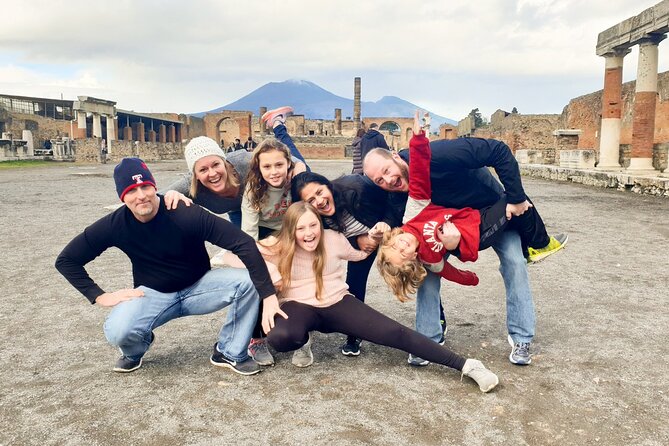
If you only had one area of Pompeii to understand, the Forum zone is it. You’ll spend time at the Forum of Pompeii, which served as the political, religious, and commercial hub. It’s a big pedestrian plaza, and your guide helps you connect the geometry of the space to how people would have moved, debated, traded, and gathered.
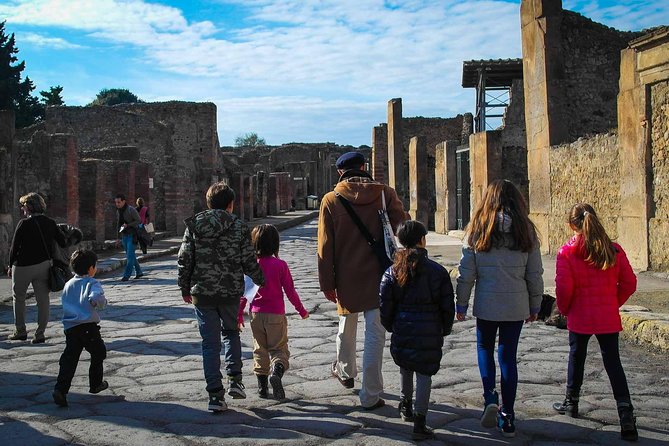
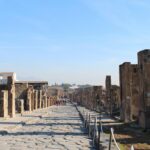
Then you head onto Via dell’Abbondanza, Pompeii’s main commercial and social street. This is where Pompeii starts to feel like a living city rather than a museum. You’ll get a vivid look at the idea of a “main street” that linked civic life to shops and daily routines. In practice, the route also tends to give some relief during warm weather—one review noted how the route’s orientation can create a pleasant breeze down the street.
After that comes the Forum Baths, Terme del Foro—one of the best-preserved public bath complexes at the site. Your walk through the bath sequence (changing room to cold, warm, then hot rooms) is one of those moments where Pompeii becomes understandable fast. You’re not just seeing rooms; you’re seeing a system of movement and routine.
One small drawback of bath stops: you may have less shade than you’d like depending on the time of day and weather. If you’re visiting in summer, I’d treat this tour as a “morning or late-morning” strategy, not an afternoon gamble.
Temple of Apollo to the Basilica: Reading Sacred Space and Civic Power
Next, you’ll hit the Temple of Apollo, a major landmark with origins dating back to the 6th century BC. What I like here is the mix of cultural influences: the temple reflects both Greek and Italic styles. You also get a practical visual reference with Apollo and Diana figures (replicas are shown at the site, while originals are preserved in Naples).
From there, the Basilica gives you the sense of how public life functioned. This is one of the most imposing public buildings in Pompeii’s Forum area, dating to the 2nd century BC. Even if you don’t know Roman architecture yet, your guide helps you understand what made it important—how the space worked for public business and gatherings.
This part of the tour is less about “wow, that’s pretty” and more about building a mental map. By the time you reach the basilica, you’ll usually feel like you’re finally walking through the same kind of civic center you’ve seen in modern cities—just with two thousand years of dust and history.
Casa dei Vettii and Teatro Grande: Luxury and Entertainment in One Sweep
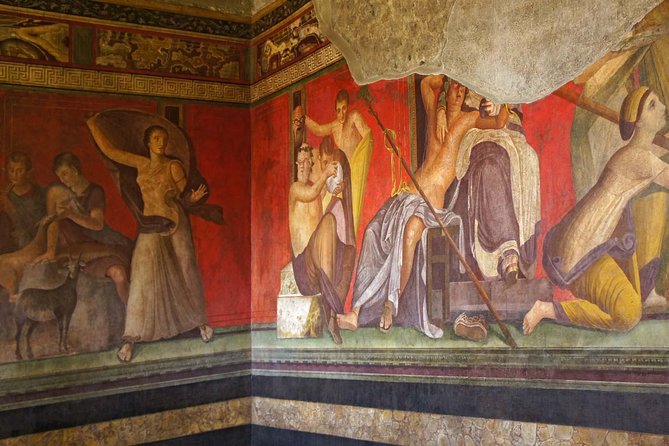
The highlight swing for many people is Casa dei Vettii, often compared to the Sistine Chapel of Pompeii. It reopened after a long restoration, and the payoff is visible: fresco-like wall paintings and a sense of how wealthy freedmen presented themselves.
In this home, you’ll learn that the owners were two former slaves who became immensely wealthy in the wine trade. That detail changes how you look at the decoration. You’re not just seeing expensive finishes—you’re seeing status being performed.
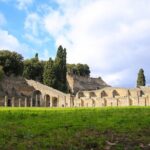
Then you transition to Teatro Grande, a masonry theater carved into a lava hillside. It’s one of the world’s oldest surviving masonry theaters, and it helps show how architecture shifted from Greek to Roman styles. If your group enjoys storytelling, this stop often connects well to the idea of Pompeii as a place where culture and politics shared the same physical stage.


Antiquarium and Victim Casts: A Moment You Can’t Rush
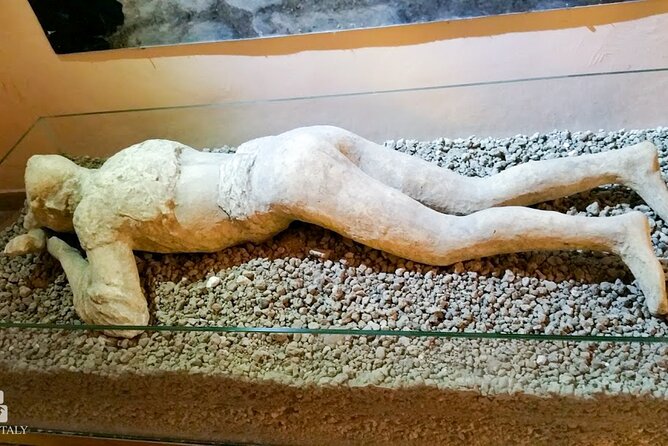
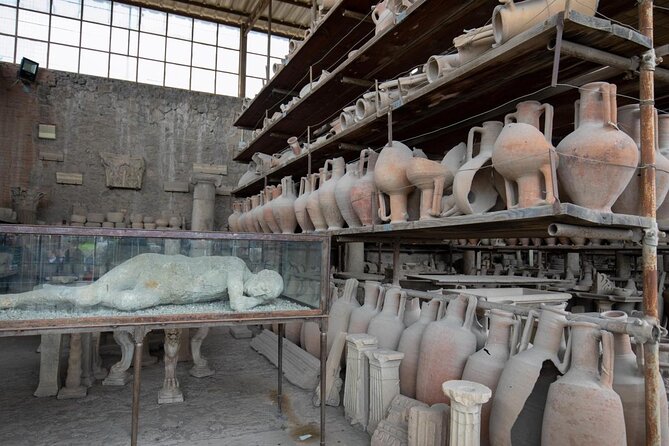
The Antiquarium di Pompei is a climate-controlled stop where the tour uses modern display to protect fragile artifacts. This is also where you see casts—plaster forms of victims preserved in the moments they were caught.
I’ll be direct here: this isn’t a casual photo moment. It’s heavy, even when the museum presentation is carefully done. Your guide’s role is important because the interpretation can help you process what you’re seeing without turning it into spectacle.
If you’re traveling with children, this part may be the hardest emotionally. The family option can help kids stay engaged earlier with games and clues, but you should still expect a more serious tone when you reach the cast displays.
What Else Your Guide Can Work In (City Walls, Markets, and More)
Even though the core stops are structured, the tour description emphasizes that your guide can tailor the route. Depending on timing and your interests, you may also be pointed toward big Pompeii landmarks beyond the main sequence—like the city walls and Porta Marina gate, the Roman fast-food-style dining areas with large storage vases, the stepping-stone blocks used in wetter, messy street conditions, the Macellum market area, and even the remains associated with an old brothel.
This is one reason I like the private format for Pompeii. You can make the day match your curiosity: history-only, architecture-focused, or daily-life and street-level attention.
The Family Option for Kids 6–11: Map, Stickers, Games, and Clues

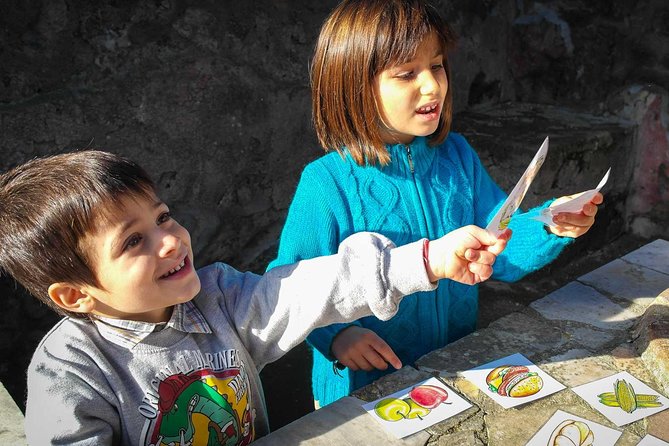
If your kids are roughly 6 to 11, the family tour is the smartest way to do Pompeii with less whining and more real learning. You’ll get a “Pompeii4kids” kit that includes a map with stickers plus activities and a workbook. The guide also uses games, puzzles, and clue-based moments to guide the route.
Here’s what’s practical: the map turns ruins into locations for a game. Kids start to look for specific characters or roles tied to buildings (gladiator, actor, slave, politician are examples of what kids get as stickers). The guide can ask questions on the spot and then have kids place the sticker near the building. That’s how you get attention without constantly telling children to sit still.
I also liked the flexibility in how guides handle kids’ energy. Multiple guides are praised for being patient with hot, dusty children and for keeping the pace friendly. That kind of patience isn’t guaranteed everywhere in Pompeii, but this tour is designed for it.
Picking the Right Guide Pace: The One Caution I’d Listen To
One negative note sticks out: a guide can run ahead and make the group feel like it’s chasing. With Pompeii’s spacing and steps, that can be genuinely stressful—especially if anyone has mobility limits or just needs more time to see details.
My advice: set expectations at the start. Ask your guide to match your walking speed and to pause at the spots you care about. If your group wants slower interpretation, say so early. A good private guide will adjust because the whole point is not being stuck in a preset conveyor-belt tour.
Price and Value: Is $165.05 Per Person Fair?
At $165.05 per person, this is priced like a true private experience, not a budget group ticket. So you need to judge it on what you’re not buying elsewhere.
You’re paying for:
- Skip-the-line entry and fast-track handling
- A private guide who explains what you see at each stop
- A structured route that includes Forum, baths, key temples/villas, and the Antiquarium casts
- The option to add a family kit (if you choose the kids-focused tour)
If you’re a couple or a small family and you’d otherwise need to hire a guide to make sense of Pompeii, this can be a good deal. If you’re traveling solo and enjoy wandering without interpretation, you might skip a private guide and cobble together a self-guided plan. But you’ll likely spend more time figuring out priorities and more time standing in lines.
For value, the big question is: do you want Pompeii to feel understandable in 2 hours? If yes, the price starts to make sense.
When to Go and What to Bring (Especially for Summer)
Pompeii is best treated like a warm-weather walking site with sun exposure. You should plan for good walking shoes and expect some stretches with limited shade.
If you have a choice, go earlier rather than later. One family noted that the tour was fine at 11 a.m., but by the end it was hot—and if they went again they’d book around 9:30. That matches what you’ll feel on the ground: the ruins are beautiful, but you can’t escape the sun in open areas.
Bring:
- sunscreen and water
- a hat or cap
- a light layer for indoor museum spaces like the Antiquarium
My Take: Should You Book This Pompeii Private Tour?
Book it if you want Pompeii to make sense quickly. This is the kind of tour where the order of stops helps you build a story: civic center (Forum), public routine (baths), sacred landmark (Temple of Apollo), major public building (Basilica), a status display (Casa dei Vettii), and then the human cost made visible through victim casts at the Antiquarium.
Skip it if your priority is unlimited roaming. With only about 2 hours, you won’t cover every corner of Pompeii—and you shouldn’t expect it to.
If you’re bringing kids 6–11, I’d lean toward booking the family option. The map-and-sticker approach turns the ruins into a scavenger hunt, and that’s usually the difference between a frustrating visit and a memorable one.
FAQ
How long is the Ancient Pompeii private tour?
It’s about 2 hours (approx.).
Is this tour private or shared with other groups?
This is a private tour/activity. Only your group will participate.
Does the tour include skip-the-line entry?
Yes. The tour includes skip-the-line access, and your guide can also purchase tickets quickly on the spot with fast-track access.
What’s included for kids in the family option?
If you select the family option for ages 6 to 11, you get the Pompeii4kids kit with a map, stickers, activities, and an activity-book, plus games and clues during the route.
Is transportation like pickup and drop-off included?
No. Pick up and Drop off not included.
Is admission fee included in the tour price?
The details list an admission fee as included, but the family-option notes also say admission fees aren’t included and that guides can buy tickets quickly on site. Double-check what’s included in your booking.
Do children need a passport?
Yes. A current valid passport is required for children under 18 years on the day of travel.