Big myths, big walls, one long day. This tour strings together the Corinth Canal, Acrocorinth, and Mycenae so you get a serious Ancient Greece overview without the stress of planning two separate outings. I also like the door-to-door pickup around Athens plus the onboard Wi‑Fi, which makes the long driving part feel far less tedious.
The only real drawback is time. With so many stops in about 8 hours, the pacing can feel full, so if you want to linger, you’ll need to keep your priorities straight.
In This Review
- Key things to know before you go
- A Private Athens Start: Pickup, Wi‑Fi, and How the Day Runs
- Corinth Canal and Ancient Diolkos: Where Trade Got a Shortcut
- Acrocorinth’s Fortress City: Walls, Temples, and Frankish Tower Views
- Upper Peirene Fountain and Geraneia Viewpoint: Quick Stops That Mean Something
- Ancient Corinth: Apollo’s Columns, Paul’s Bema, and the Museum
- Corinth Village Time: Souvenirs, Snacks, and an Easy Reset
- Mycenae: Cyclopean Walls, Lion Gate, Tholos Tombs, and Gold
- Price and What You’re Really Buying at $299.78
- Driver Quality Matters on a Day Like This
- Who Should Book This Tour (and Who Might Want Something Else)
- Should You Book This Private Corinth and Mycenae Day Trip?
- FAQ
- How long is the Private Tour of Isthmus Canal, Ancient Corinth & Mycenae?
- Is this tour fully private?
- What’s included with the tour price?
- Are entrance fees included for all the sites?
- Is lunch included?
- Can I add a licensed tour guide for inside the sites and museum?
- What is the cancellation policy?
Key things to know before you go
- Private door-to-door pickup: from hotels and Airbnbs in Athens, with a driver meeting you at the lobby or building entrance.
- Corinth Canal + Ancient Diolkos: you see both a modern shipping shortcut and the ancient overland ship path.
- Acrocorinth’s layered fortifications: three circuit walls, traces of the Temple of Aphrodite, and the Frankish Tower plus remains of churches and mosques.
- Ancient Corinth with Paul landmarks: Agora and the Bema connected to Apostle Paul, plus a St. Paul church mosaic mural.
- Mycenae’s signature sights: Cyclopean walls, Lion Gate, Treasury of Atreus, and the Tomb of Clytemnestra, capped by the gold-filled museum.
- Flexible stop timing with your driver: you can slow down for photos and adjust how long you spend at each point.
A Private Athens Start: Pickup, Wi‑Fi, and How the Day Runs
This is a fully private outing, so you’re not sharing the day with random strangers. Your driver picks you up from your Athens hotel or Airbnb and brings you back at the end, which is a big deal in a city where parking and traffic can turn a “simple day trip” into a headache.
On board, you’ll have Wi‑Fi, bottled water, and refreshing wipes. That sounds small, but on a hot, long route it helps you stay comfortable and focused, not cranky and dehydrated. You’ll also have a professional driver with strong Greek history knowledge, and the driver is fluent in English (with multi-lingual support), which helps when you want quick context on what you’re seeing.
You can also read our reviews of more tours and experiences in Athens.

Corinth Canal and Ancient Diolkos: Where Trade Got a Shortcut
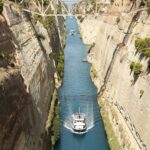
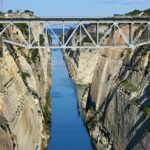
Your first major stop moves from Athens to the Corinth Canal area, where the big idea is transportation. The canal is described as a major 19th-century engineering project that played a catalytic role in Mediterranean trade. Even if you just watch boats transit, you’ll feel why this corridor mattered so much.
Right alongside that modern feat, you visit Ancient Diolkos, a paved trackway designed to move boats over land across the Isthmus of Corinth. It’s a great “aha” moment: before you had a canal, they solved the same problem with muscle, planning, and rails. This is also one of those stops that doesn’t require an admission ticket from you for the time you’re there, which makes it a good early anchor before the heavier archaeological sites.
Time tip: take a few minutes to stand back and watch the layout. The canal and Diolkos connect in your mind faster if you can see the geography, not just read about it later.
Acrocorinth’s Fortress City: Walls, Temples, and Frankish Tower Views
Acrocorinth is the dramatic centerpiece of ancient Corinth’s skyline: a monolithic rock holding the acropolis. The scale is what hits first. You can think of it as the old city’s high-security address, sitting above everything like it owns the place.
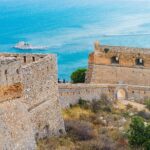
What’s especially cool here is the layers. The fortress had a system of three circuit walls reinforced by towers. You also find traces of the Temple of Aphrodite at one of the highest points, plus the Frankish Tower on the southwest edge—fortified during Frankish times as the inner keep.
Even better, the site holds remains of churches, mosques, houses, fountains, and cisterns. So you’re not only seeing “ancient Greece.” You’re seeing how later eras reused and repurposed this commanding hilltop.
One practical caution: the grounds can feel steep and exposed. Wear shoes you trust, and if it’s hot, use your breaks strategically—this stop tends to invite lingering, but it also drains energy.
Upper Peirene Fountain and Geraneia Viewpoint: Quick Stops That Mean Something
After the big fortress, the itinerary squeezes in smaller stops that still add flavor.
At Upper Peirene Fountain, you’ll find Peirene Spring, described as a gift of Asopus to Sisyphus inside the encircling walls. It’s a myth-rooted moment that helps connect the physical site to the stories people told long before there were guidebooks.
Then comes Geraneia, with short time for views of Geraneia Mountain, the Corinthian Gulf, and the southwest coast of the Peloponnese. This is the kind of stop that makes your mental map work. When you can look out and understand the terrain, the next archaeological sections feel less like random ruins and more like a functioning world.
If you’re the type who hates rushing, you’ll appreciate these quick pauses because they don’t require ticket lines or heavy walking. They’re more about orientation and atmosphere.
Ancient Corinth: Apollo’s Columns, Paul’s Bema, and the Museum
Ancient Corinth is where the day earns its weight. You get both outdoor site time and museum time, and the mix works well because it helps you see artifacts after you’ve seen the landscape.
In the archaeological museum, you’ll see a large collection of artifacts from the local site and nearby smaller locations. It’s the kind of visit that turns vague impressions into sharper ones—especially if you’ve been picturing ancient Corinth mainly through literature and headlines.
Then you head to the big-name structures:
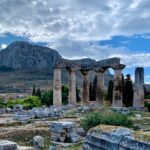
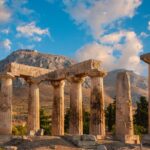
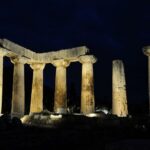
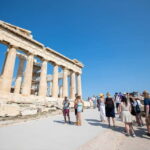
- The Temple of Apollo, noted as one of the earliest Doric temples in the Peloponnese and Greek mainland, with monolithic columns built around 560 BCE. Seeing monolithic columns in person gives you a stronger sense of ancient engineering than any photo can.
- The Agora, described as a rectangular space with central shops, small temples, an altar, and the Bema (podium) where Apostle Paul addressed the Corinthians in 52 AD. This is the moment where the religious significance becomes specific, not general.
You’ll also see Roman buildings, plus the theatre and Odeon/Asklepieion areas. And along the Lechaion road—facing the Corinthian Gulf toward the port of Lechaion—you get a clearer sense of movement: trade routes, foot traffic, and how a city supported itself.
There’s also St. Paul’s church, known for a mosaic mural depicting Saul’s vision from Christ as he traveled to Damascus to persecute Christians. If you want a fast emotional connection to why this place mattered, this mural does it without needing a long lecture.
Lunch is built into the schedule at Ancient Corinth: treat yourself to an authentic village-style lunch on a terrace overlooking the archaeological site and the Temple of Apollo. Even though meals aren’t included, this is one of the most valuable parts of the day because you’re eating with the ruins in your line of sight.
Reality check: you’ll have around 3 hours here. That’s enough for a solid museum + site visit, but you won’t have endless time. Pick a few must-sees (Temple of Apollo, Agora/Bema, and the mosaic church area) and don’t try to chase every corner at maximum speed.



Corinth Village Time: Souvenirs, Snacks, and an Easy Reset
After the main ruins, you switch gears with a stroll in Corinth village shops for about an hour. This is simple, but useful. You can buy handmade souvenirs for family and friends without feeling like you’re shopping during the most intense part of the day.
I also like that this break is scheduled after archaeology. Your brain gets to cool down. If you’ve been moving between viewpoints and ticketed areas, it helps to spend a little time just walking streets and browsing.
Keep an eye on your energy here. If you’re planning to take lots of photos in Mycenae later, it’s smart not to overdo it with heavy snacks now.
Mycenae: Cyclopean Walls, Lion Gate, Tholos Tombs, and Gold
Mycenae is the big payoff for the “myths plus proof” feeling. You’ll drive there (about 40 minutes), then step into one of the late Bronze Age’s most important centers—often linked with King Agamemnon in Homeric epics.
The itinerary focuses on the most iconic stops, including:
- Grave Circles A and B, the royal cemeteries near the Lion Gate area.
- The Cyclopean Walls, built from huge limestone boulders. Even in a limited viewing time, you get the point: this wasn’t small-scale building.
- The Royal Palace area, including domestic apartments, the Throne Room Suite, the Grand Staircase, rooms for officials, and the Forecourt.
Then you move to the classics you’ve likely seen in photos for years:
- Lion Gate, the main entrance of the Bronze Age citadel, dating to the 13th century BC.
- The Treasury of Atreus, a large tholos (beehive) tomb around 1250 BC.
- The Tomb of Clytemnestra, another tholos type tomb from around 1250 BC.
One smart way to handle limited site time: stand at each “signature” spot long enough to understand its geometry. Cyclopean walls, the Lion Gate threshold, and tholos tomb shapes all reward a quick pause where you look up, not just forward.
The final museum stop is the flashiest part. The Archaeological Museum of Ancient Mycenae houses the most important Mycenaean artifacts, and you’ll likely notice the gold grave goods fast—burial masks, jewelry, weapons, worship idols, and frescoes. If you like your archaeology with a visual payoff, this is where the day turns memorable.
Price and What You’re Really Buying at $299.78
At $299.78 per person, you’re paying for speed, comfort, and a tight route that covers a lot of ground in one day. The big value isn’t just the sites—it’s the private logistics.
Included in the price is a fully private vehicle, a professional driver, door-to-door pickup/drop-off in Athens, onboard Wi‑Fi, bottled water, and refreshing wipes. You also get skip-the-line ticket service on request. That matters because it reduces dead time and keeps your schedule from slipping.
What’s not included:
- Entrance fees to sites
- Food and drinks
- Tips & gratuities
- A licensed tour guide to go into sites and the museum (available on request at extra cost)
So the real question isn’t only is the price fair. It’s whether you want a day that’s designed to be efficient. If you’re okay with a curated pace—seeing highlights without having a guide inside every room—this can be a strong deal. If you want deeper interpretation on every stop and longer museum time, you may want to request an additional licensed guide, or plan a separate visit.
Driver Quality Matters on a Day Like This
On a route packed with historic layers, your driver isn’t a background role. They’re the person shaping how smoothly you move, where you linger, and how you handle heat and timing.
The driver approach described here tends to emphasize arriving a bit early, staying flexible, and choosing smart stops for photos, food, and souvenirs. For example, one praised driver named Nikos was highlighted for arriving a few minutes early, being friendly, and steering the day toward good photo angles and a great lunch setup. Another driver named Gregory was praised for keeping things calm on a very hot day and giving plenty of time at each site.
You can use that as a hiring filter when you book: if the company offers driver choice or preferences, set them with your priorities—site pacing, photo stops, and where you want time to go.
Who Should Book This Tour (and Who Might Want Something Else)
This works best if you want a one-day overview that hits the highest-impact Ancient Greece anchors:
- Corinth Canal and Diolkos for the engineering story
- Acrocorinth for the fortress view and layered history
- Ancient Corinth for Temple of Apollo, Agora/Bema, and Paul’s local landmarks
- Mycenae for Cyclopean walls, tholos tombs, and the museum’s gold
It’s also a solid pick if you dislike car hire. You avoid the logistics of renting, driving, and navigating unfamiliar parking and roads between Athens, Corinth, and Mycenae.
You might think twice if:
- you want a very relaxed pace with long museum wandering
- you want a licensed guide inside every major site by default
- you’re sensitive to long driving days and repeated walking on uneven ground
If you’re traveling with service animals, this tour allows them, and most people can participate, based on the general guidance provided.
Should You Book This Private Corinth and Mycenae Day Trip?
If you’re on a first visit to Athens and you want the Peloponnese’s highlights in one structured day, I’d book this. The value is in the private transport, the door-to-door pickup, and a route that connects engineering, fortress history, city life, and Bronze Age power.
I’d only hesitate if your main goal is deep study at just one site. In that case, you may get more satisfaction from splitting it into two slower days and adding a licensed guide for more time inside the museum and key interiors. Otherwise, this is a smart way to see a lot without feeling like you’re wrestling logistics all day.
FAQ
How long is the Private Tour of Isthmus Canal, Ancient Corinth & Mycenae?
The tour runs about 8 hours.
Is this tour fully private?
Yes. It’s a private tour, with only your group participating.
What’s included with the tour price?
It includes fully private transportation by first-class vehicle, a professional driver with English (and multi-lingual) support, hotel/Airbnb pickup and drop-off in Athens, onboard Wi‑Fi, bottled water and refreshing wipes, and skip-the-line ticket service on request.
Are entrance fees included for all the sites?
No. Entrance fees to sites are not included in the price.
Is lunch included?
No. Food and drinks are not included, though there’s time for an authentic village-style lunch with views over the Ancient Corinth archaeological area.
Can I add a licensed tour guide for inside the sites and museum?
Yes, a licensed tour guide can be arranged for an additional cost on request.
What is the cancellation policy?
You can cancel for a full refund up to 24 hours in advance of the experience start time.