REVIEW · POMPEII
Pompeii Ancient City Walking Tour – Italian & English Guide
Book on Viator →Operated by Sesto Continente Tours · Bookable on Viator
Pompeii is best when someone points the clues. This tour gives you guided time through the big archaeological park and key houses, then adds a second day with the Roman Catholic Sanctuary of Pompeii. I like the focus on recognizable “stop points” that turn ruins into a timeline, and I also like the entry-gate facilitation that helps you get started faster.
The biggest drawback to note is that the main Pompeii entrance ticket is not included, so your total cost will be higher once you add the onsite admission.
In This Review
- Key Things to Know Before You Go
- Enter Pompeii with Fewer Headaches at the Ticket Gate
- Day 1: Pompeii Archaeological Park and the Houses That Tell You How People Lived
- Pompeii Archaeological Park: Your Big-Picture Orientation
- Casa del Fauno: The Mosaic That Makes History Feel Human
- Tempio di Giove Capitolino: A Temple Built for the Big Gods
- Temple of Apollo: Oldest Religious Building Energy
- Anfiteatro Romano: A Reality Check on Gladiator Spectacle
- Casa del Menandro: Frescoes That Earn the Name
- Casa dei Vettii: When Freed Status Gets Loud
- Villa dei Misteri: The Nine-Scene Story in One Room
- Day 2: The Roman Catholic Sanctuary of Pompeii (Included Visit)
- Price and Value: What You’re Actually Paying For
- Language, Pacing, and How This Tour Fits Different Travelers
- Practical Tips to Make Pompeii Feel Easier
- Should You Book This Pompeii Guided Tour?
- FAQ
- Is the Pompeii Ancient City Walking Tour available in English?
- What’s included in the tour price besides the guide?
- Do I need to buy the Pompeii entrance ticket separately?
- Are any visitors eligible for free admission to Pompeii?
- How long is the tour?
- What do I do on Day 2?
- How large is the group?
- Where is the meeting point?
- What happens if weather is bad?
- Is free cancellation available?
Key Things to Know Before You Go
- Guide-led route through the core sights so you’re not stuck guessing what you’re looking at
- Entrance facilitation at the ticket office area to cut down friction at the start
- Day 1 covers major highlights like the Amphitheatre, Temple of Apollo, and Villa dei Misteri
- Admission varies by stop: the park ticket isn’t included, but day 2’s sanctuary visit is
- Smallish group size (max 25) which usually makes Q&A and pacing easier
Enter Pompeii with Fewer Headaches at the Ticket Gate
Pompeii can feel like a maze at first. The tour’s first practical win is that your guide provides facilitation at the Ticket Office entrance, which matters when crowds, lines, and confusion can slow you down. Meeting at Piazza Porta Marina also helps you start in a known spot instead of wandering near the gates.
You should still plan to arrive with a clear head and the right budget. The tour price is $36.12 per person, but it does not include the main Pompeii entrance fee. If you don’t factor that in before booking, you’ll hit a surprise at the ticket stage.
Group size is capped at 25 travelers, which is a sweet spot in a place this big. You’ll have enough people to feel like you’re in it together, but not so many that you disappear into the crowd every ten seconds.
And yes, there can be hiccups. One report described issues around communication and not meeting as arranged. I’d treat this as a reminder to double-check your confirmation and keep an eye on the meeting area at the right time.
You can also read our reviews of more tours and experiences in Pompeii.


Day 1: Pompeii Archaeological Park and the Houses That Tell You How People Lived
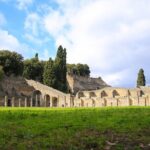
Day 1 is where you do the heavy walking. You start at the Pompeii Archaeological Park with your guide, and you’ll move through some of the site’s most famous buildings and neighborhoods.
A great thing about this day is that it’s not just a list of monuments. The route is built around major civic and domestic spaces, so you get contrast: public spectacle, temples, and then homes decorated with mosaics and frescoes.
Here are the day’s main stop points and what makes each one worth your time:
Pompeii Archaeological Park: Your Big-Picture Orientation
Your guide brings you through the world-famous archaeological park, and the highlights mentioned include the Anfiteatro, Tempio di Apollo, Tempio di Giove, and several standout houses (like Casa del Fauno and Casa del Menandro), plus Villa dei Misteri and more. This is the part that helps you start building a map in your brain.
Admission is not included here, so budget for the Pompeii entrance ticket separately. Once you’ve paid that, this day is mainly about interpretation: what the spaces were for, how the city functioned, and why certain buildings became famous.
If you want Pompeii to feel more than “cool rocks,” this is the day that does that work.
Casa del Fauno: The Mosaic That Makes History Feel Human
Casa del Fauno is one of the larger residences in Pompeii, and it’s often remembered for a specific visual hit: a reproduction of the famous mosaic pavement of Alexander, showing the battle between Alexander the Great and King Darius III.
This stop is short, but the payoff is strong. A mosaic like that isn’t just decoration; it signals taste, wealth, and cultural ideas people wanted to display. Standing in front of it with a guide’s context makes it easier to connect art to daily status and ambition.
Tempio di Giove Capitolino: A Temple Built for the Big Gods
Next comes the Tempio di Giove Capitolino, framed with Vesuvius in the background (when visibility is good). The tour connects the temple to the Roman idea of the Capitoline Triad: Jupiter, Juno, and Minerva.
Even if you don’t call yourself a Roman-empire person, temples are powerful in Pompeii because they show how power and belief sat right in the middle of city life. This is the type of stop where a guide helps you understand why these structures mattered beyond their architecture.


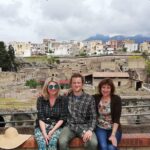
Temple of Apollo: Oldest Religious Building Energy
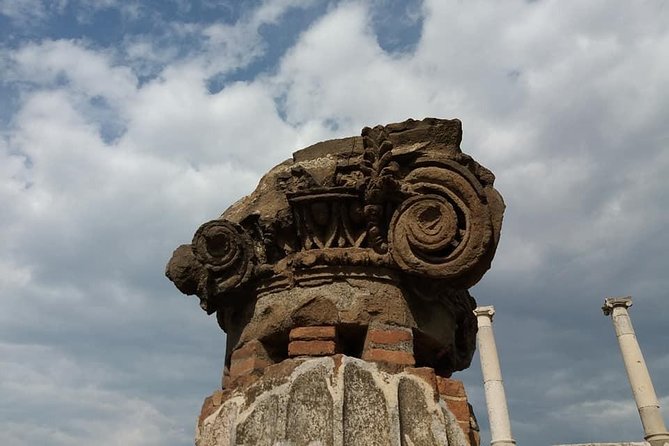
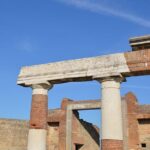
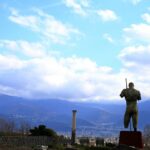
The Temple of Apollo is described as the religious building considered the oldest in Pompeii. Here, you’ll see a reproduction of a bronze statue of Apollo shown in a pose holding a bow and arrow, positioned near a row of Corinthian columns.
Why I think this stop works for most visitors: it gives you a clear “anchor” object and a clear architectural feel. Instead of wandering a temple shell and hoping it clicks, you have an interpretive target.
Anfiteatro Romano: A Reality Check on Gladiator Spectacle
The Roman Amphitheatre is one of the most dramatic structures you’ll see. It was built around 80 BC and is described as the oldest amphitheater of its kind, designed for gladiatorial shows with capacity up to about 20,000 spectators.
The tour highlights that seating was arranged in three sections by social class. That detail changes how you see it. You start thinking about who sat where, how control and hierarchy worked inside the arena, and how entertainment reinforced status.
Casa del Menandro: Frescoes That Earn the Name
Casa del Menandro is known for its affreschi and mosaics. It’s named not for the original family owners (the Poppaei are mentioned), but for a remarkable fresco featuring the Greek poet Menander.
This is a good stop if you care about art history without getting stuck in the weeds. Naming stories like this help you understand how we ended up calling a place by what’s visible now, not what paperwork said long ago.
Casa dei Vettii: When Freed Status Gets Loud
Casa dei Vettii is connected to the Vettii brothers, described as brothers who, after becoming freed slaves, didn’t hold back on spending to display their new social standing. The focus here is on frescoes and wall paintings that reflect that ambition.
Short stop or not, this is one of the stops that can make Pompeii feel personal. It’s hard not to read these walls as a message: we made it, and we want you to see.
Villa dei Misteri: The Nine-Scene Story in One Room
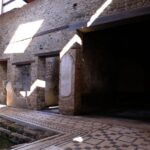
Villa dei Misteri is the final “art-and-ritual” anchor on Day 1. You’ll spend time with the nine painted scenes in sequence on the walls of the “Camera d’Iniziazione,” showing a rite of passage of a bride moving into adult status, tied to the worship of Dionysus (the Greek god of wine and fertility).
This is the kind of stop where pacing matters. If you rush, you miss the idea that the images form a sequence. With a guide, the room becomes a narrative you can follow, not just a wall of pigments.
Day 2: The Roman Catholic Sanctuary of Pompeii (Included Visit)
Day 2 is lighter on the logistics and shorter on the monument list. You get a free, included visit to the Roman Catholic Sanctuary of Pompeii with a 1-hour time slot.
The key value here is simple: it’s included in the tour package, so you don’t need to add another onsite admission fee just to complete the second day. It also gives your visit a modern layer. Pompeii isn’t only about the ancient city; it’s also a place where later religious life took root on top of older ground.
Price and Value: What You’re Actually Paying For
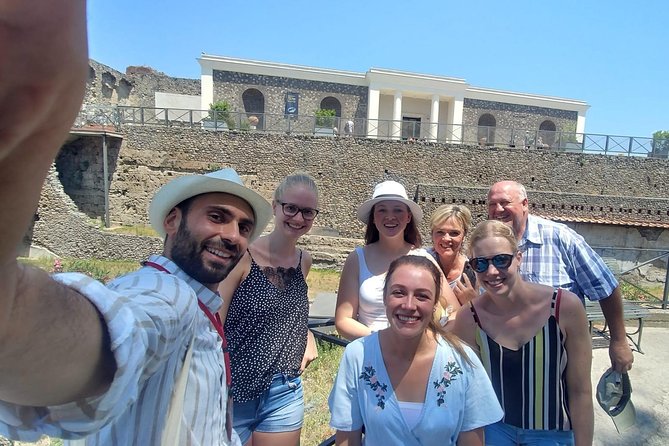
Let’s do the math plainly. The tour price is $36.12 per person, but the big Pompeii entrance ticket—€22.00 per person—is not included. So the realistic “all-in” cost for most adults is the tour fee plus the onsite entry fee.
That can still be good value if you:
- want a guided route through major sights without spending your energy figuring out where to go next, and
- care about interpretations that make the houses and temples feel connected.
If you qualify for free entrance on the Pompeii ticket (the tour info lists minors under 18, EU senior +65, journalists, and students/docents with EU credentials), your total cost can drop a lot. In that case, the guided portion becomes a cheaper way to get structure and context.
Also note how the tour delivers: it’s not a “skip-the-hard-parts” plan. It’s a guided, sight-focused schedule built around recognizable stops, and that’s what you’re paying for.
Language, Pacing, and How This Tour Fits Different Travelers
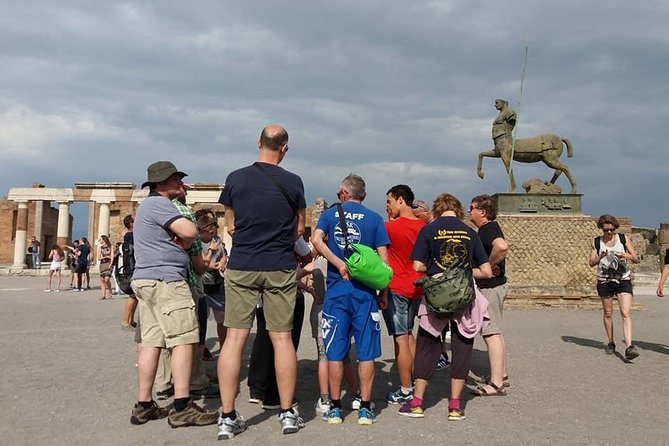
The tour is offered in English, and it’s described as Italian & English guide. That matters because Pompeii’s best moments are often the quick explanations right at the ruins, not just the photos you can take.
One report mentioned a guide named Simone, who was able to run the English portion and repeat things in Italian when needed due to an agency issue. That’s a practical example of how helpful it can be when your guide can adjust to a mixed group.
This tour suits you best if:
- you want guided structure through a huge site,
- you like art and social stories tied to specific houses,
- you don’t want to rely entirely on a map and guesswork.
It may be less ideal if you:
- prefer complete freedom with no set stops,
- hate waiting for a group pace, or
- want maximum time inside every building (this format focuses on key highlights, with short time windows at each stop).
Practical Tips to Make Pompeii Feel Easier
Pompeii rewards smart prep. Here are a few things that help regardless of the guide:
- Wear shoes you can trust on uneven ground. You’ll be walking a lot, and smooth soles don’t always win here.
- Bring sun protection. Temple areas and open plazas get bright fast, and shading varies by stop.
- Keep your expectations realistic about time. Even with guidance, you’re seeing many highlights in short segments, so choose what you want to see twice.
- If you’re counting on your guide to help at the ticket area, arrive a little early so the meetup doesn’t turn into a stress test.
And if you want to reduce the risk of a bad start, confirm your meeting details the day before and have your confirmation handy. That’s the simplest way to protect your time.
Should You Book This Pompeii Guided Tour?
Book it if you want a structured, guide-led Pompeii that hits the big names without you having to build your own route from scratch. The inclusion of entrance facilitation and the emphasis on major stops—Amphitheatre, temples, and standout villas—makes it a strong value when you factor in the onsite interpretation you’ll get.
Skip it or think twice if you’re extremely price-sensitive once the Pompeii ticket is added, or if you absolutely need lots of free time with no group pacing. Also, do your homework on day-of communication and meetup details, because there has been at least one account of an operator failing to meet as expected.
If your priority is understanding Pompeii and not just collecting photos, this is a sensible way to do it over two focused days.
FAQ
Is the Pompeii Ancient City Walking Tour available in English?
The tour is offered in English.
What’s included in the tour price besides the guide?
You get facilitation at the entrance to the Ticket Office, and Day 2 includes the Roman Catholic Sanctuary of Pompeii visit.
Do I need to buy the Pompeii entrance ticket separately?
Yes. The Pompeii entrance fee is not included. The listed Pompeii entrance ticket is €22.00 per person.
Are any visitors eligible for free admission to Pompeii?
The tour info states free entry is available for minors under 18, EU senior +65 years, journalists, students, and teachers/docents with EU credentials.
How long is the tour?
It’s listed as 2 days (approximately).
What do I do on Day 2?
Day 2 is a visit to the Roman Catholic Sanctuary of Pompeii for about 1 hour, and admission for that stop is included.
How large is the group?
The tour has a maximum of 25 travelers.
Where is the meeting point?
The tour starts at Piazza Porta Marina, 80045 Pompei NA, Italy, and it ends back at the meeting point.
What happens if weather is bad?
The experience requires good weather. If it’s canceled due to poor weather, you’ll be offered a different date or a full refund.
Is free cancellation available?
Yes. You can cancel up to 24 hours in advance for a full refund.