REVIEW · BERLIN
Berlin Protest History Tour: Rebels, Resistance, and Revolution
Book on Viator →Operated by Beyond and Beneath Tours · Bookable on Viator
Berlin’s protest history hits you fast. This 2-hour walk connects rebels, resistance, and revolution with real locations you can see in daylight. I especially like how the guide turns street-level details into clear cause-and-effect stories you actually remember.
I also like that many stops are free to enter, so your money goes to the thinking, not ticket math. One consideration: it is a walking tour with multiple outdoor stops, so wear comfortable shoes and keep an eye on the weather.
In This Review
- Key highlights you will feel in your feet
- Rotes Rathaus and the terracotta timeline that argues with you
- Nikolaiviertel and Gasthaus Mutter Hoppe: when East Berlin builds a version of the past
- Marx-Engels-Forum: famous faces with a long argument attached
- Humboldt Forum: the Berlin Palace story after the protests changed the map
- Rosenstraße: 1943 civil disobedience carved into a name you can’t ignore
- St. Mary’s Church and a sermon that drew a huge crowd in 1964
- The TV Tower as a communist symbol you can spot from anywhere
- Brunnen der Völkerfreundschaft and the “T-shirt protest” in 1989
- Weltzeituhr at Alexanderplatz: the ending that reframes the whole route
- Price and value: what 30.04 gets you in real terms
- Who should book this Berlin protest walk?
- Should you book Beyond and Beneath’s Berlin Protest History Tour?
- FAQ
- How long is the Berlin Protest History Tour?
- What is the price per person?
- Is the tour offered in English?
- What is included?
- Where does the tour start and end?
- Are entrance tickets included for the stops?
- What if the weather is bad?
Key highlights you will feel in your feet
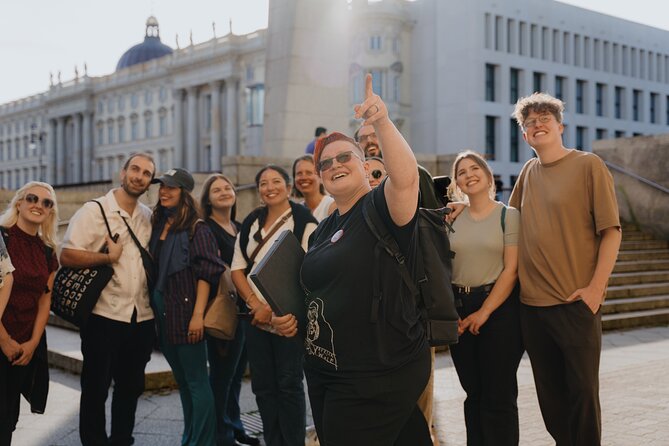
- Terracotta storytelling around Rotes Rathaus: history literally laid into the facade
- East Berlin replicas and leftovers at Nikolaiviertel and nearby sites
- Marx and Engels in public space, including why their statue sparks arguments
- Rosenstraße women’s disobedience (1943) and how this is remembered in stone and place
- 1989 Peaceful Revolution details, including the T-shirt protest story at the fountain
- Alexanderplatz time theatre with the Weltzeituhr ending the walk on a reset button
Rotes Rathaus and the terracotta timeline that argues with you
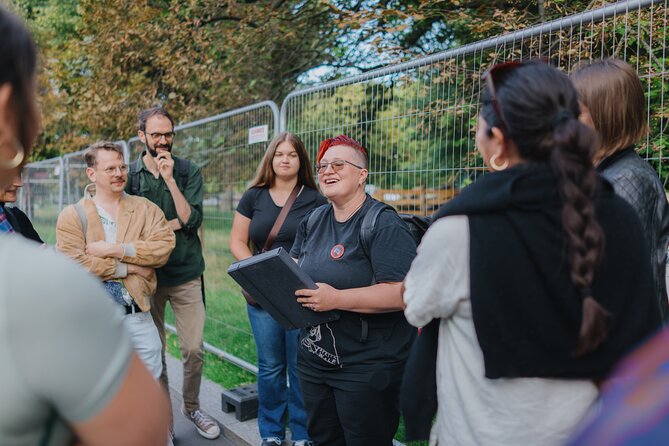
The tour starts near the Red Town Hall, at the sculpture Aufbauhelferin by Fritz Cremer, right by Rotes Rathaus. From the first minutes, the theme is set: Berlin does not only remember protests. It debates them in public art, architecture, and what gets emphasized or left out.
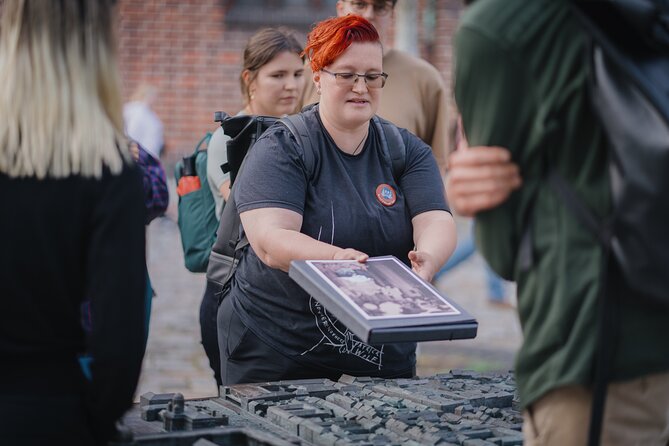
Around the Town Hall, you’ll see a terracotta timeline stretching along the building. It is not just decorative. It’s history presented like a lesson plan, with emphasis on major moments in the city’s early uprisings. The guide’s job here is to help you read the message behind the medium: stone-and-clay history isn’t neutral, and whoever pays for the facade is also choosing what matters.
This is a good start if you like structure. You are not wandering aimlessly. You’re learning how Berlin talks about rebellion before you even reach the East-West symbols that dominate the rest of the route.
You can also read our reviews of more tours and experiences in Berlin.


Nikolaiviertel and Gasthaus Mutter Hoppe: when East Berlin builds a version of the past
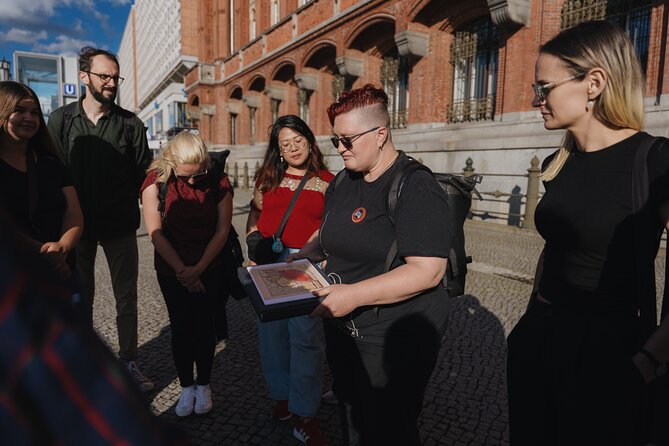
Next, the tour shifts toward Nikolaiviertel, a pocket of the city that’s often described as a carefully shaped replica area. Here you’ll catch a view of what the socialist-era imagination looked like on the ground—so-called socialist kitsch built for the 750th anniversary of Berlin. The point is not to scoff. The point is to notice how regimes use scenery to sell a story.
You also get a tangible link to the East German era through the last remnants tied to the Palace of the Republic, once the seat of the East German parliament and one of the best-known entertainment venues in socialist Berlin. The guide frames why places like this matter even after they are gone: they show how power wanted everyday life to feel.
A short hop later, you’ll encounter Gasthaus Mutter Hoppe, where another timeline concept continues the theme. This is the East German answer to the Red Town Hall’s terracotta history. The guide calls out a big irony: certain defining moments of the East German story are handled in a way that raises eyebrows—especially the absence of the Berlin Wall in that timeline presentation. It’s a reminder that memory is political, and monuments can be selective by design.
Marx-Engels-Forum: famous faces with a long argument attached
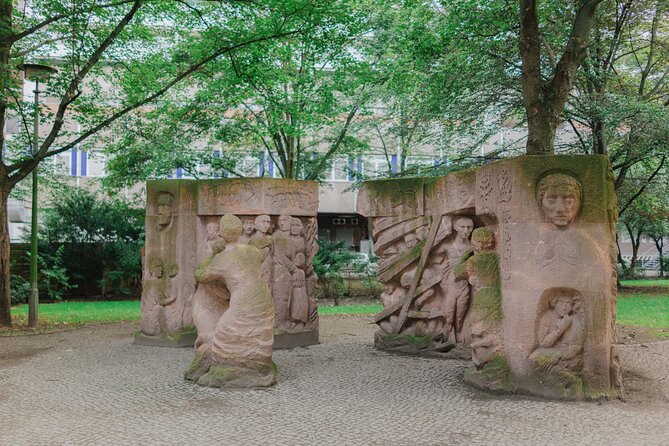
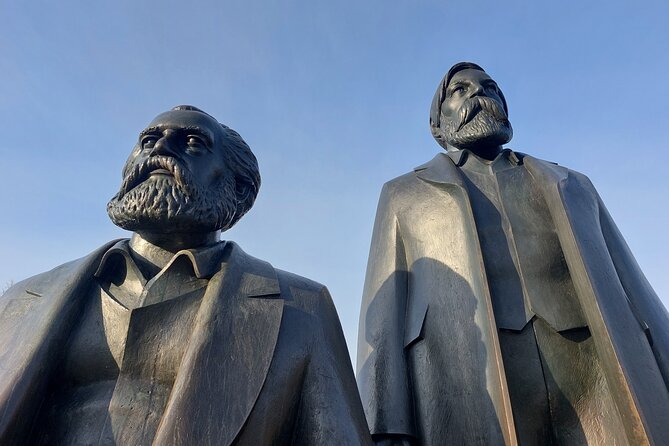
At the Marx-Engels-Forum, you meet Karl Marx and Friedrich Engels in statue form. This stop works because it’s not just about who they were. It is about what happens when ideas become public objects people must pass every day.
The statue has been debated over the years, and the guide’s framing helps you understand why. In Berlin, even a symbol you’ve seen a hundred times can still carry new meaning depending on the moment. You learn to look at the statue like a historical artifact you can still argue with today, not a museum piece that has fully settled into the past.
If you like protest history, this stop is a nice reminder that resistance is not only streets and crowds. It’s also the contest over which thinkers get physical representation.
Humboldt Forum: the Berlin Palace story after the protests changed the map
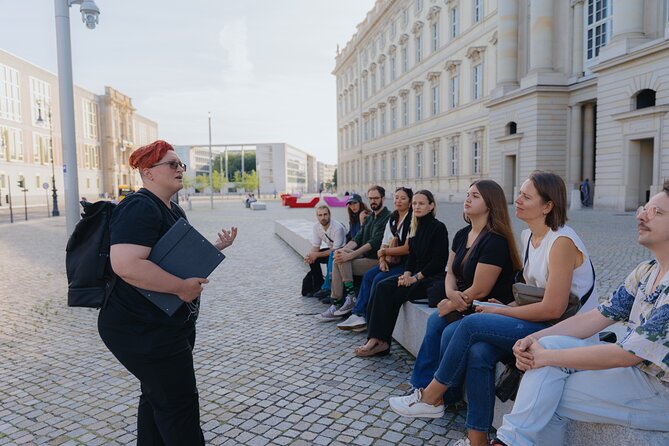
From ideology in statuary, the tour moves to Humboldt Forum, where you see the reconstructed Berlin Palace. Even if you’ve walked past the building in your own explorations, the guide gives you a reason to look again.
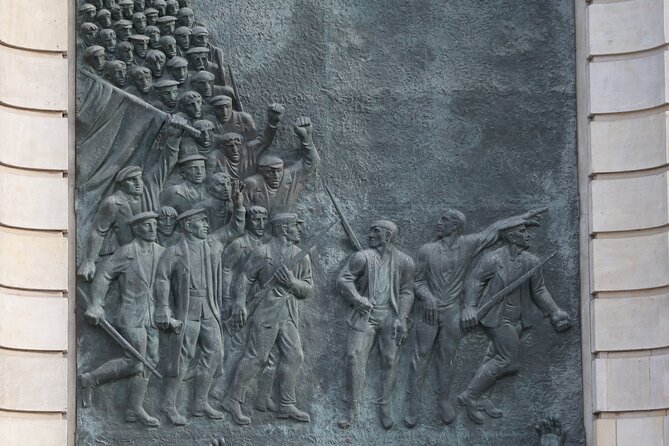
You’ll hear how the original palace served as a witness to protests and revolutions—most notably the March Revolution of 1848, often described as planting seeds of democracy in Germany. Standing here, the building stops being a background for photos and becomes a character in the wider story: power in stone, pressure in the streets, and systems that eventually shift.
This is also a good “how to read Berlin” moment. Reconstruction can be controversial, and Berlin’s layers can feel like a remix. The guide doesn’t ask you to pick a side blindly. Instead, you get to practice asking better questions: What did the palace represent then, and what does it represent now?
Rosenstraße: 1943 civil disobedience carved into a name you can’t ignore
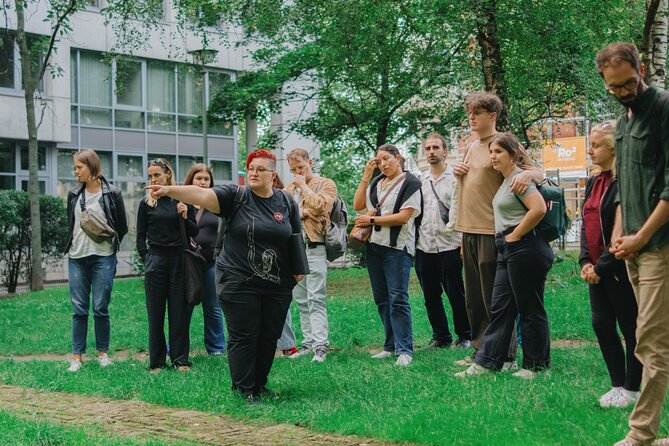
Then comes one of the most emotionally significant stops: the Rosenstraße monument. The story here centers on women who staged an act of civil disobedience in the cold winter of 1943—often described as the only protest by Germans against the Final Solution.
The guide’s pacing matters. This is not a “quick fact drop.” You’re taught to connect the name on the monument to the lived reality behind it—Jewish life under Nazi rule, and the idea that ordinary people sometimes take extraordinary risks when law and morality collapse.
Near this area, you’ll also see foundations tied to the oldest synagogue in Berlin, adding another layer to what you’re seeing. It helps the story feel grounded, not abstract. You are standing in a city that remembers faith, persecution, and survival in the same places.
If you prefer your history with empathy and clear context, this stop is the one you’ll carry with you for a while after the tour ends.


St. Mary’s Church and a sermon that drew a huge crowd in 1964
The tour then heads to St. Mary’s Church, one of Berlin’s older church spaces. Here, the spotlight is on Martin Luther King’s sermon in 1964.
This stop connects two kinds of protest: civil rights movements and the moral argument that pushes societies to change. In Berlin, you can often separate “German history” from “global history” in your head. This stop gently breaks that habit. The guide shows how Berlin also became a stage for international voices and mass public attention.
Even if you’re not religious, you can appreciate the logic of the location. Churches were major gathering places. When a globally recognized leader arrives, it isn’t just a speech. It is a statement about what the public chooses to listen to.
The TV Tower as a communist symbol you can spot from anywhere
At some point, you’ll catch sight of the Berlin Television Tower, the city landmark linked here as a symbol of communist power. This isn’t about reverence. It’s about reading symbols in real time.
From up close, you can sense why authoritarian systems love visible projects. They’re meant to say, We built this, so we control what you see. But once the political era changes, the landmark stays. It becomes a kind of visual question mark: what did it mean then, and what does it mean now?
The guide’s commentary makes it easier to see the tower as more than a postcard backdrop. You understand it as a piece of the messaging system that surrounded life in socialist Berlin.
Brunnen der Völkerfreundschaft and the “T-shirt protest” in 1989
A key portion of the tour centers on Brunnen der Völkerfreundschaft, the Fountain of Peoples’ Friendship. The focus here is the Peaceful Revolution of 1989 and the chain of events that led to the Fall of the Wall.
What makes this stop practical is the way the guide ties events to specific imagery you can actually look at. You hear the story of young East German oppositionists staging a T-shirt protest by the fountain in autumn 1989. It’s one of those moments where a simple act becomes a signal. The kind of protest you can imagine repeating anywhere.
This is also a rare chance to experience Berlin history as near-instant cause and effect. By the end of the stop, you have a clearer timeline of how pressure built, spread, and finally forced the system to break.
Weltzeituhr at Alexanderplatz: the ending that reframes the whole route
The tour finishes at Alexanderplatz, by the World Time Clock (Weltzeituhr). This is a great ending point because the clock invites you to think beyond Berlin. It’s a rotating design showing time in 148 cities around the world, which is a nice counterweight to the tour’s heavy focus on ideology and division.
Symbolically, it works. You start in a place built to teach history. You end at a place built to connect time and distance. Even if you don’t stare at the clock for long, you’ll get the feeling that Berlin’s story keeps traveling outward.
It also makes practical sense. Alexanderplatz is one of Berlin’s easiest areas to navigate if you want to continue on your own afterward.
Price and value: what 30.04 gets you in real terms
At $30.04 per person for about two hours, this is priced like a focused city walk rather than a full-day production. The value comes from two things you can feel during the experience:
- Expert guidance that focuses on the small, meaningful details you usually walk past.
- Free-to-enter stops at multiple points along the way, so your cost mainly funds interpretation and context.
The group size is capped at 15 travelers, which generally keeps the pace more human and helps the guide manage stories without rushing you through.
Also, you get a mobile ticket and the tour is offered in English, with confirmation at booking time. That combination is simple and low-stress, especially if you’re fitting this into a tight Berlin schedule.
Who should book this Berlin protest walk?
This tour is a strong match if you:
- like history that connects politics to everyday spaces like monuments, facades, churches, and fountains
- want a manageable walking length with a story that stays tight on themes like resistance and revolution
- appreciate when a guide reads city details like clues (not just dates on a sign)
It’s also a great choice if you’re staying near central Berlin and want an easy way to understand the East-West narrative without needing a separate museum day.
One more practical note: the tour is designed for most people, but it is still outdoors and weather-dependent, so plan for good walking conditions.
Should you book Beyond and Beneath’s Berlin Protest History Tour?
If you want Berlin history that you can see and interpret on foot, book it. This isn’t just a checklist of landmarks. The tour trains you to notice how buildings and public art can support a political story—or quietly contradict it.
I’d especially recommend it when your time in Berlin is limited and you want the big emotional and political turning points without feeling like you’re trapped in a classroom. If you’re the type who loves when a city facade has a point to make, you’ll get a lot out of this route.
If you hate walking or you’re sensitive to cold or rain, consider timing it carefully. The content is worth it, but Berlin weather can be the real boss fight.
FAQ
How long is the Berlin Protest History Tour?
The tour runs for about 2 hours.
What is the price per person?
It costs $30.04 per person.
Is the tour offered in English?
Yes, it is offered in English.
What is included?
The tour includes an expert guide and a mobile ticket.
Where does the tour start and end?
It starts at the Sculpture Aufbauhelferin – Fritz Cremer at Rotes Rathaus (Jüdenstraße, 10178 Berlin) and ends at the World Time Clock (Weltzeituhr) by Alexanderplatz (Alexanderpl. 1).
Are entrance tickets included for the stops?
The tour lists admission tickets at the stops as free.
What if the weather is bad?
The tour requires good weather. If it’s canceled due to poor weather, you’ll be offered a different date or a full refund.