REVIEW · ATHENS
Best of Athens and Ancient Corinth Full Day Private Tour
Book on Viator →Operated by My Athens Transfers · Bookable on Viator
One day can pack in two world-famous sites. This private full-day trip threads together the Acropolis and Ancient Corinth, plus the Corinth Canal, with door-to-door pickup in an air-conditioned van and onboard WiFi. It’s a practical way to see a lot without the headache of buses, transfers, or timing chaos.
I love the on-foot pacing where it counts: you spend time walking the major Acropolis structures like the Parthenon area, the Erechtheion, and the Temple of Athena Nike. I also like the comfort and meal included—private pickup in a clean, A/C vehicle with Greek traditional lunch, bottled water, and driver commentary in fluent English (with George and Panos showing up as standout names in the feedback).
One thing to plan for: Acropolis and Acropolis Museum entrance fees are not included, and those must be purchased in advance (limited availability), so tickets can make or break your schedule.
In This Review
- Key highlights at a glance
- Price and Logistics: Why This One Costs What It Costs
- Athens on the Hill: Acropolis Walk, Parthenon Area, and Temple Views
- Propylaea and the gateway moment
- Parthenon area: short time, big impact
- Erechtheion: where dedications overlap
- Temple of Athena Nike: the “Victory” angle
- The Theater Duo: Dionysus and Herodes Atticus From the Slopes
- Acropolis Museum: The Best Payoff for Your Ticket Time
- More Athens in Less Time: Hadrian’s Gate, Olympian Zeus, Panathenaic Stadium
- Mount Lycabettus and Syntagma: Views, Guards, and City Atmosphere
- Neoclassical Athens: Academy, Library, University, and Plaka
- Corinth Canal: The Narrow Cut With Big Drama
- Ancient Corinth: Where You Can Feel Paul’s Footsteps
- Archaeological Museum of Corinth and Temple of Apollo
- Akrokorinthos: Upper Corinth Fortress Views That Land Hard
- Lunch, Water, and the Comfort Factor You’ll Thank Yourself For
- Driver vs Licensed Guide: What You Get and What to Ask For
- Tickets and Entry Fees: The Fastest Way to Avoid a Day Gone Wrong
- Should You Book This Private Day Tour?
- FAQ
- Is this tour private?
- How long is the tour?
- Do you get pickup and drop-off?
- Is WiFi available during the tour?
- What is included with the price?
- Are entrance fees included?
- What are the Acropolis and Acropolis Museum ticket costs?
- Can I buy tickets for Ancient Corinth on-site?
- Does the driver act as a tour guide inside the sites?
- What is the cancellation policy?
Key highlights at a glance
- Private, door-to-door transportation with WiFi and bottled water so you’re not stuck juggling transit
- A real Acropolis walk: Parthenon area, Erechtheion, Temple of Athena Nike, plus the Theatre of Dionysus and Herodes Atticus Odeon viewpoints
- Museum time at the Acropolis Museum to connect statues and storylines to what you saw on the hill
- Corinth Canal viewpoints for that dramatic cut-through-the-rock perspective
- Ancient Corinth on foot, plus the Archaeological Museum of Corinth (ticket sold separately)
- Panoramas from Mount Lycabettus and central Athens photo stops around Syntagma
Price and Logistics: Why This One Costs What It Costs

At about $231.19 per person for an 8–9 hour private day, the price can look high until you break down what’s included. You’re paying for private transportation, pickup and drop-off, air-conditioning (big deal in summer heat), onboard WiFi, bottled water, and lunch. You’re also paying for a driver who can give context during the drive.
The other half of the value equation is timing. This is designed for a full-hit day, with limited time at each stop, so you don’t spend your precious hours searching for bus routes, paying for taxis between scattered sites, or waiting on other groups. If your goal is to see the headline classics—fast, organized, and with a clear narrative—you’ll likely feel the value.
The main trade-off: because it’s a packed route, your time in each major area is limited. And because some key admissions are not included, you’ll want to have tickets sorted ahead of time for the Acropolis and the Acropolis Museum.
You can also read our reviews of more tours and experiences in Athens.


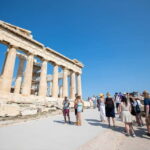
Athens on the Hill: Acropolis Walk, Parthenon Area, and Temple Views
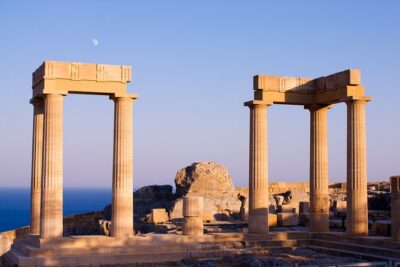
The day starts with the Acropolis, the high point ancient Athenians considered the spiritual and geographic heart of the city. You’ll step into the area that sits above modern Athens, where stone ruins still feel like they’re holding their breath.
Plan for a classic, concentrated walk. You start with the Acropolis approach and then move through the main structures in a sequence that helps you understand how the “city above the city” was arranged.
Propylaea and the gateway moment
The Propylaea is the ceremonial gateway to the Acropolis. Even with a short stop, it matters because it sets the mood: this wasn’t just an entrance, it was a statement rebuilt under Pericles after the Persian Wars. In practice, you’ll get a quick reset here—your cue to slow down, look up, and realize you’re walking into the kind of power that was built in layers over centuries.
Parthenon area: short time, big impact
The Parthenon stop is brief, but it’s timed well. When you’re on the Acropolis, your eyes naturally jump between scale, alignment, and the way light moves across the stone. Even with limited time, you’ll come away with a stronger sense of why the Parthenon became a symbol across the world.
One practical note: since you’ll spend time inside an Acropolis-ticket zone, your entry ticket timing matters. If your Acropolis entry is delayed, your whole day can feel compressed.
Erechtheion: where dedications overlap
The Erechtheion is on the north side of the hill and was dedicated to both Athena and Poseidon. That shared dedication is the kind of detail that sticks, because it shows how Greek religious space wasn’t always one-note. This is a good stop if you like seeing how different gods and stories share the same physical ground.





Temple of Athena Nike: the “Victory” angle
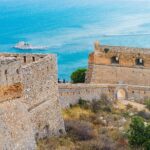
The Temple of Athena Nike, built around 420 BC, sits at the southwest corner of the Acropolis. It’s also a great contrast point: instead of the broader open Acropolis proper, this temple belongs to a victory sanctuary setting. You’ll likely notice how the structure’s position and shape change what you can see, especially from the right angle after you move past the Propylaea.
Even if you don’t memorize dates, this stop gives you the emotional logic of the Acropolis: power, protection, and victory all in one climb.
The Theater Duo: Dionysus and Herodes Atticus From the Slopes
The Theatre of Dionysus sits on the south slope. It originally hosted major Athenian festivals and reached a huge capacity in its later form. In a short visit, you’re not “touring a museum”—you’re getting a sense of how performances shaped civic life. The big takeaway is how close theater was to the religious and political identity of Athens.
Then you move to the Herod Atticus Odeon, a Roman-era stone theater completed in 161 AD and renovated in 1950. It helps to see both: the older Dionysus theater concept and the later Roman approach to staging culture. Even with photo-time limits, the shapes and grades of seating area give you a feel for how crowds once gathered here.
Acropolis Museum: The Best Payoff for Your Ticket Time
After the hill, the day turns into something more satisfying: the Acropolis Museum time. This is where you stop staring at ruins and start connecting them to the objects that explain what you saw.
The museum stop is listed for about 1 hour, and that’s realistic. In that span, you’ll focus on highlights rather than trying to cover everything. The value here is clarity—statues and artifacts help you understand the iconography and artistic choices you can’t fully decode when you’re outside on uneven stone.
If you’re trying to time this well, your best move is to treat the museum as the story’s second chapter. Do your hill walk first, then let the museum make the symbols click.
More Athens in Less Time: Hadrian’s Gate, Olympian Zeus, Panathenaic Stadium
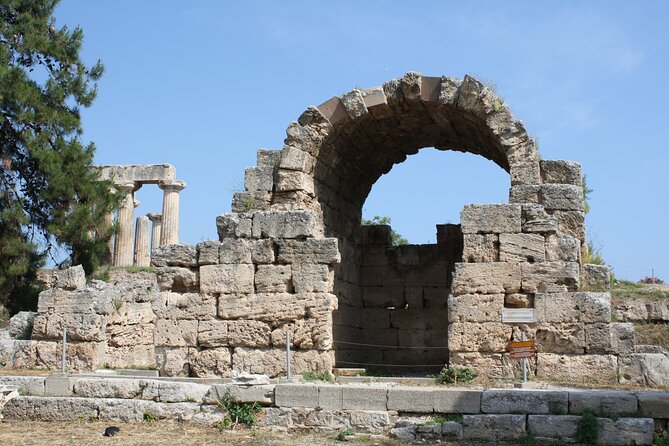
Once you head back down, you shift from dramatic ruins to “Athens clues.” These are quick stops that help you see the city as a layered place, where Roman grandeur and Olympic mythology show up right alongside the ancient core.
You’ll likely notice this pattern:
- Hadrian’s Gate (Arch of Hadrian): a grand Roman-style gateway that once marked a road toward major eastern-city structures.
- Temple of Olympian Zeus (Pillars of Olympian Zeus): big scale, even in ruins. It helps you feel the “grand shrine” vibe rather than treating it as just a few remaining columns.
- Panathenaic Stadium: a stadium tied to the first modern Olympic games, with its marble identity still tied to the ancient Olympic ideal.
These are not long museum-style stops. They work because your brain is already warmed up from the Acropolis. The key is to keep your expectations realistic: short photos, quick context, then back on the road.
Mount Lycabettus and Syntagma: Views, Guards, and City Atmosphere

If you want a sweeping sense of Athens, you’ll appreciate the push up to Mount Lycabettus. The tour includes about 20 minutes there for panoramic views and the blend of old Athens with the modern city layout below.
Then the itinerary moves to Syntagma Square, where Athens’ present-day political center sits in front of the Greek Parliament. There’s also a quick photo stop at the Hellenic Parliament and the Monument to the Unknown Soldier. You’ll see the Presidential Guard setup, and it’s one of those practical photo moments you can’t fully get from a roadside glance later.
Two tips for this portion:
- Wear shoes you can handle on uneven walkways. This is mostly short walking, but Athens can surprise you with curb edges and stone textures.
- Keep your phone charged. You’ll want it for both Lycabettus views and the Syntagma square memorial shots.
Neoclassical Athens: Academy, Library, University, and Plaka

Between the bigger monuments, the tour includes stops related to Athens’ major neo-classical institutions—like the Academy of Athens, the National Library of Greece, and the University of Athens. These brief stops help you connect the modern Greek state to the architecture that was built to express learning, nationhood, and civic identity.
There’s also a nod to the Old Parliament House, plus time near Plaka, the area near the Acropolis known for its older streets and neoclassical feel.
This section is less about monuments you climb and more about getting your bearings. If you’ve never been to Athens before, it helps your map in your head. After this, even if you come back on your own later, you’ll have a clearer sense of where things sit.
Corinth Canal: The Narrow Cut With Big Drama
After Athens, the day shifts toward Peloponnese. The route includes a stop at the Corinth Canal, which connects the Gulf of Corinth and the Saronic Gulf. The big idea: the canal slices through the narrow Isthmus of Corinth, with steep limestone walls and no locks.
You get about 10 minutes here, and that’s enough time to appreciate the scale. From high up, the view gives you the sense of how tight this passage is—while ships and watercraft navigate the narrow channel below.
Also, this is a good mental reset. You’re leaving the Acropolis-heavy part of the day, so a dramatic landscape moment matters.
Ancient Corinth: Where You Can Feel Paul’s Footsteps
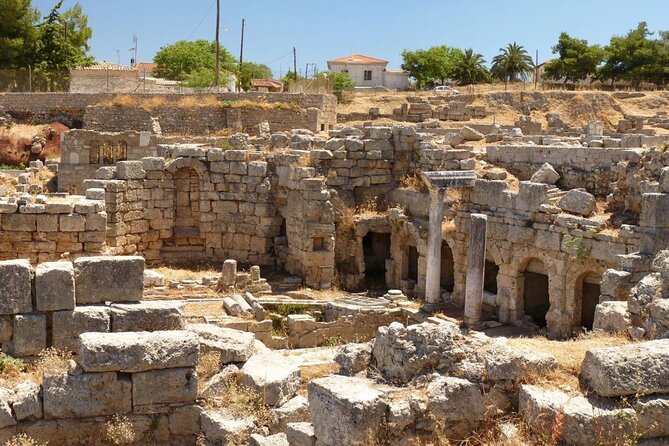
Then comes Ancient Corinth (Archaia Korinthos), a city-state that sat on the Isthmus between the Peloponnese and mainland Greece. This is one of those places where multiple eras overlap: Greek city life, Roman changes, and later Christian references from the world of Saint Paul.
You’ll get about 1 hour on-site. That’s a solid amount of time for ruins here, especially if you use the space to focus on layout rather than trying to read every inscription.
The big reason Ancient Corinth feels real is that it’s not just columns in a field. The site covers key city elements, and it helps to walk with the idea of how a city worked—roads, public areas, religious spaces, and the sense of movement between them.
Archaeological Museum of Corinth and Temple of Apollo
Right next to the main site area is the Archaeological Museum of Corinth, included for about 30 minutes. The museum is ticketed separately, and it’s often the part that helps you connect what you saw outside with actual objects and context from excavations.
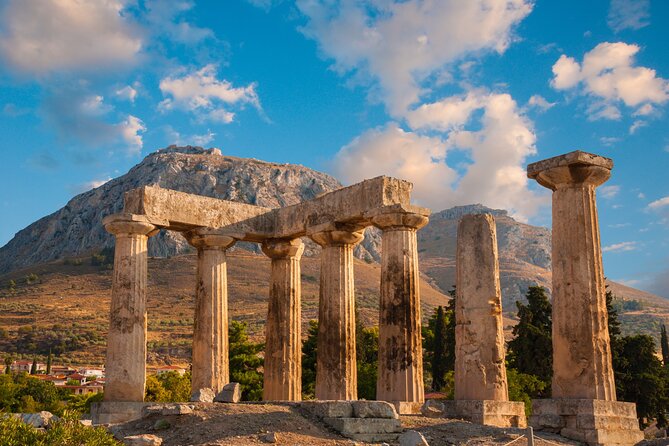
Then you’ll see the Temple of Apollo, listed as about 20 minutes. The temple’s construction date is given as 550 BC, which gives you a historical anchor. In a short visit, you’re really looking for the feeling of place: what does it mean that Apollo had a major temple here, in this city economy and religious network?
Akrokorinthos: Upper Corinth Fortress Views That Land Hard
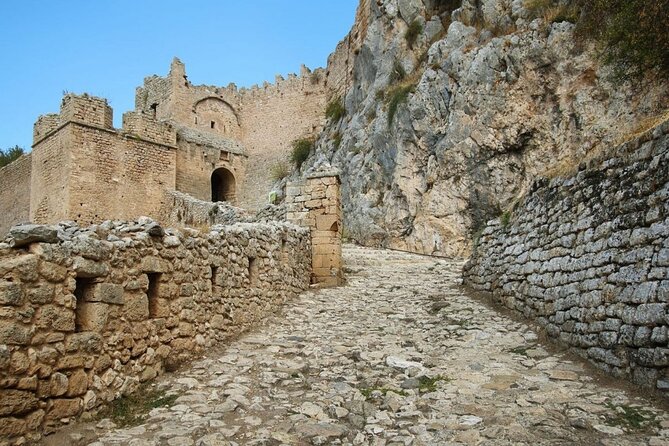
The day ends with Akrokorinthos (Acrocorinth), the upper acropolis rock fortress overseeing the ancient city. You’re told about its defensive role and why it mattered for controlling the Isthmus approach.
You’ll have about 30 minutes here. This is the kind of stop where even a short time can feel meaningful because the view is part of the story. The site’s strategic position explains why it repeatedly served as a last-line defense.
If you like places where geography explains history, you’ll feel the payoff here.
Lunch, Water, and the Comfort Factor You’ll Thank Yourself For
This tour includes lunch with a Greek traditional food option, bottled water, and an air-conditioned vehicle. Those details sound small until you’re doing a full day in Athens heat and you realize how much energy you’ll spend walking, waiting at gates, and scanning ruins.
The lunch inclusion is also a timing tool. It keeps you from hunting for food near each stop, which usually turns into wasted time and overpriced snacks. You get a planned break so your day stays on track.
Driver vs Licensed Guide: What You Get and What to Ask For
The drivers are not licensed tour guides (unless a licensed guide is requested and available). That matters, because the driver won’t enter archaeological sites with you. What they can do is provide history and explanations in fluent English during the ride and at the meeting points.
So here’s the practical way to use this setup:
- If you want a guide who walks inside sites and handles interpretation at the monuments, ask about a licensed tour guide early.
- If you prefer a flexible pace where you do the walking yourself and rely on explanations from the driver, this model works well.
In the feedback, George and Panos were singled out for being friendly and making the ride more fun, which suggests the commentary portion can be a real part of the experience, not just a background narration.
Tickets and Entry Fees: The Fastest Way to Avoid a Day Gone Wrong
Here’s what you’ll need to know for planning:
- Acropolis entrance fee: not included, about €30 per person, and you must purchase in advance (limited availability).
- Acropolis Museum ticket: not included, about €20 per person, also limited availability.
- Ancient Corinth & Archaeological Museum of Corinth: listed as can be purchased on-site, about €15 per person.
There’s an option to get skip-the-line tickets for the Acropolis and Acropolis Museum upon request or pre-purchase via links on your voucher/ticket, but availability is limited and time-sensitive.
My practical advice: if you book close to your travel date, prioritize getting Acropolis tickets confirmed first. If that goes sideways, the rest of the day will feel like it’s shrinking.
Should You Book This Private Day Tour?
Book it if:
- You want a structured, private day that hits the big Athens classics and connects them to Ancient Corinth.
- You value comfort (A/C, pickup, WiFi, bottled water) and a planned lunch.
- You like history that’s explained in a moving, human way during the day, not just signage.
Skip it or look for an alternative if:
- You hate ticket planning and worry about limited Acropolis entry availability.
- You want long, slow museum time or deep guided study at each monument. This route is built for breadth, not hours in one place.
If your goal is to return home with that strong sense of Athens on the hill and Corinth down the road—while keeping the logistics stress low—this is the kind of day-trip that makes sense.
FAQ
Is this tour private?
Yes. It is a private tour/activity, so only your group participates.
How long is the tour?
It lasts about 8 to 9 hours.
Do you get pickup and drop-off?
Yes. Hotel, airport, or port pickup and drop-off are included, and the driver returns you to the same place or to the point you prefer.
Is WiFi available during the tour?
Yes. WiFi is available on board in the vehicle.
What is included with the price?
Included items are private transportation, an air-conditioned vehicle, WiFi, bottled water, pickup/drop-off, professional drivers with history commentary, and lunch (with a Greek traditional food option).
Are entrance fees included?
No. Acropolis and Acropolis Museum entrance fees are not included, and Ancient Corinth and the Archaeological Museum of Corinth tickets are not included.
What are the Acropolis and Acropolis Museum ticket costs?
The Acropolis entrance fee is €30 per person, and the Acropolis Museum entrance fee is €20 per person.
Can I buy tickets for Ancient Corinth on-site?
Yes. Entrance fee for Ancient Corinth & Archaeological Museum of Corinth can be purchased on-site (about €15 per person).
Does the driver act as a tour guide inside the sites?
The driver is not a licensed tour guide and will not enter archaeological sites with you. A licensed tour guide can be requested depending on availability.
What is the cancellation policy?
You can cancel for a full refund up to 24 hours in advance. If you cancel less than 24 hours before the experience start time, no refund is provided.