REVIEW · ST AUGUSTINE
Private Historical Tour of St. Augustine
Book on Viator →Operated by Explore Tours And Pickups · Bookable on Viator
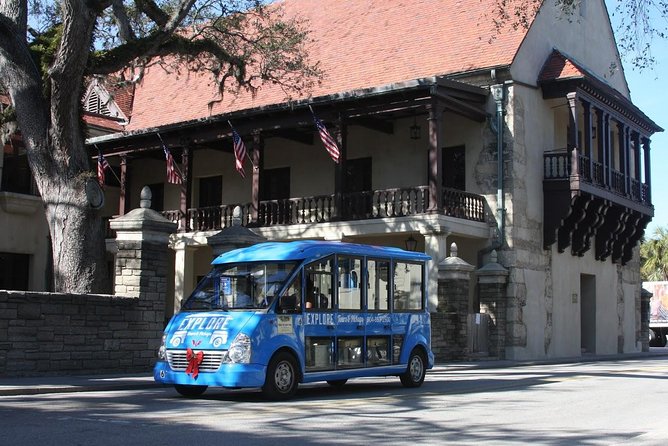
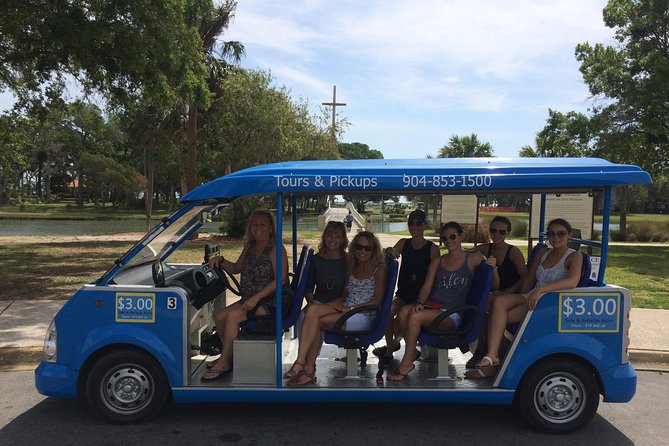
St. Augustine can feel like a lot. This private historical tour strings together the city’s key Spanish-era landmarks in about an hour, using open-air electric vehicles to keep you moving and your legs mostly unbothered. You’ll glide past the big-name sights and get the who/what/why behind America’s oldest city.
I love the way the tour gives quick orientation fast. You’ll get a smart overview of the downtown historic core, plus your guide can answer questions on the spot. I also like the format: it’s private for up to 9 people, so you’re not stuck listening to strangers argue about whether a building is “really Spanish.”
The main catch is the time. With only about 1 hour, you’ll see a lot, but you won’t have long, slow moments at every stop—especially when some landmarks are passed by rather than entered.
In This Review
- Key highlights to know before you go
- Why a private electric-vehicle loop works so well in St. Augustine
- Price and value: how $200 for up to 9 people pencils out
- Meeting at 1 Cordova St: what to do before the tour starts
- Your 1-hour route: Mission Nombre de Dios to the Plaza de la Constitución
- Shrine of Our Lady of La Leche at Mission Nombre de Dios
- Castillo de San Marcos: Spanish defense along the Atlantic trade route
- Cathedral Basilica of St. Augustine and the oldest parish angle
- Tolomato Cemetery: memory, dates, and continuity
- St. Francis Barracks: coquina walls and changing empires
- Flagler College area and Flagler Memorial Presbyterian Church (pass-by)
- Plaza de la Constitución: the city’s civic center and a market with old roots
- Pass-by: Bridge of Lions and how downtown connects to Anastasia Island
- What I’d ask your guide during the ride
- Who this tour suits best (and who might want more time elsewhere)
- Should you book this private St. Augustine electric-vehicle tour
- FAQ
- How long is the Private Historical Tour of St. Augustine?
- How many people can be in a private group?
- Where does the tour start and end?
- What major sights are covered during the tour?
- Is parking available as part of the tour?
- Is the tour offered in English?
- Are service animals allowed?
- What happens if the weather is poor?
- Do I need to cancel far ahead for a refund?
Key highlights to know before you go
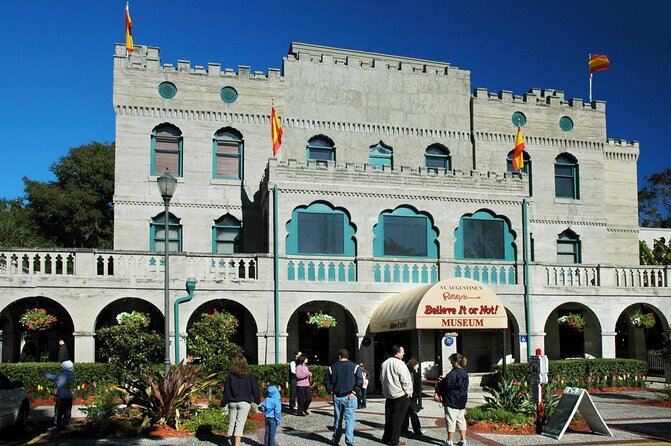
- Open-air electric vehicle comfort: Sit back and roll through downtown in an easy, low-stress way.
- One-hour orientation route: You get context for major stops like Mission Nombre de Dios, Castillo de San Marcos, and the Plaza de la Constitución.
- Your guide drives and tells stories: You can ask questions while moving between sites.
- Prime history anchors: Names and dates connect from 1565 onward, including Pedro Menéndez de Avilés and later changes under different powers.
- Some sights are pass-by only: The Bridge of Lions is something you’ll see from the road, not stop for on this particular tour.
- Mobile ticket and drop-off flexibility in the historic district: You start and end at 1 Cordova St, with drop-offs within the immediate downtown area if arranged.
Why a private electric-vehicle loop works so well in St. Augustine
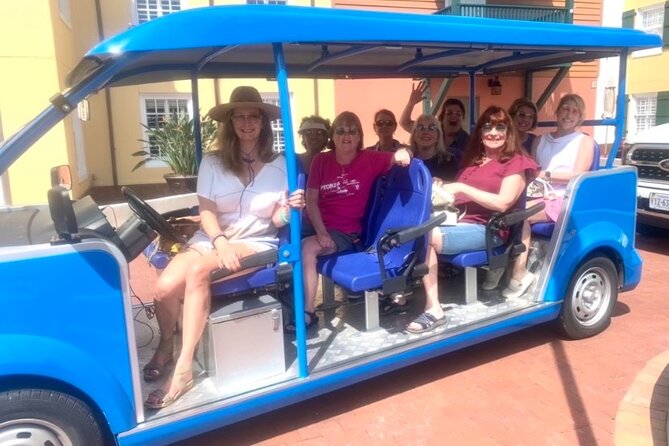
St. Augustine’s historic center is dense. Even if you love wandering, you can spend half a day zigzagging for basic orientation. This tour solves that with an open-air electric vehicle loop that keeps the pace steady and the route simple.
The big win is how your guide uses the ride to make connections. The story isn’t just “this happened here.” It’s the chain of events that shapes what you see now—Spanish founding in 1565, fortification along the Atlantic, and the later shifts in control as empires changed hands. If you’re short on time, it helps you decide what to explore more deeply after the tour.
It’s also private. That matters because you can tailor questions. If your group cares more about the religious sites, or you want the military/colonial angles, your guide can steer the conversation as you go.
You can also read our reviews of more tours and experiences in St Augustine.

Price and value: how $200 for up to 9 people pencils out
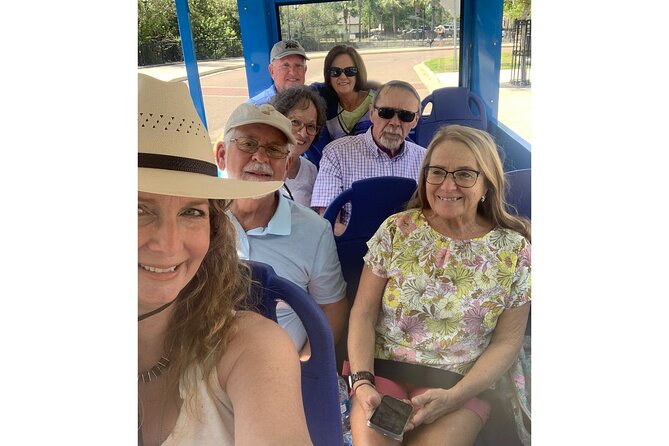
At $200 per group (up to 9 people), the math is usually the best when you’re traveling with family or friends. Split across a full group, you’re effectively paying around the low-$20s per person for a guided tour that includes vehicle time and downtown pickup/drop-off options.
If you’re traveling solo or as a couple, the price still isn’t outrageous, but the value depends on how much you benefit from the “everyone rides together with a guide” setup. In that case, you’re buying convenience and context more than you’re buying quantity of stops.
One more value point: guides here are described as strong storytellers and question-responders. Several guides are named—Mark (a retired history teacher), Karen (an engaging storyteller), Erin (fun and knowledgeable), and Andy (history-focused and good with kids). That consistency is what makes the hour feel like more than a quick loop.
Meeting at 1 Cordova St: what to do before the tour starts
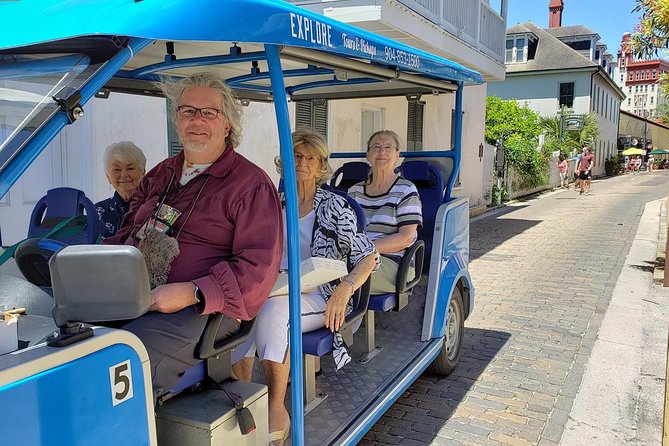
Your tour meets at 1 Cordova St, St. Augustine, FL 32084, and the tour ends at the same location. Pickup is available in the downtown district by request only, and the operator notes that you should review the meeting location details shown on your ticket under special instructions.
Parking isn’t offered. That means you’ll want to plan ahead. If you’re driving, come early to secure parking, then show up ready to board without a last-minute scramble.
You’ll also have a mobile ticket. That’s handy in a place where you might be moving between streets quickly before check-in.
Your 1-hour route: Mission Nombre de Dios to the Plaza de la Constitución
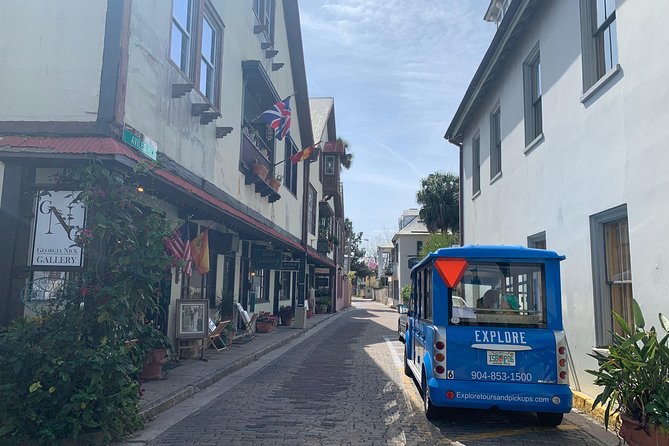
The tour is built like a guided timeline across the downtown core. You’ll cover the city’s major landmark clusters, mostly by riding past them and stopping at key points to learn.
A key feature is the way stops connect geographically and historically:
- You start in the downtown area tied to the city’s founding story.
- You move toward the fortification and Spanish colonial structures.
- You loop through the religious and cemetery history that shaped community life.
- You end in the civic heart at the Plaza de la Constitución.
- And you get pass-by views of major landmarks like the Bridge of Lions.
The operator emphasizes that between the Mission Nombre de Dios, Castillo de San Marcos, the Ponce de Leon Hotel area (now Flagler College), the Cathedral Basilica, the Tolomato Cemetery, the St. Francis Barracks, and the Plaza de la Constitución, there are lots of talking points. That’s how the hour stays educational without feeling like a lecture.
Shrine of Our Lady of La Leche at Mission Nombre de Dios
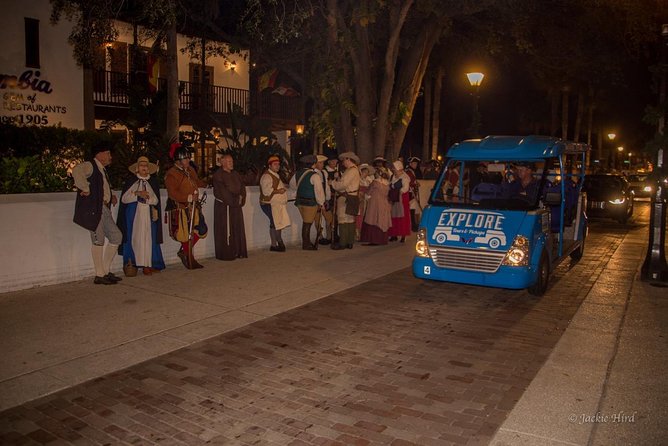
This is where the story often grabs people fast, because it ties directly to the founding of the city. The Shrine of Our Lady of La Leche at Mission Nombre de Dios traces its origins to St. Augustine’s start in 1565.
The tour’s narration centers on Pedro Menéndez de Avilés landing in September 1565 and proclaiming the site for Spain and the Church, with the name Nombre de Dios, meaning Name of God. A detail I like here is the mention of Father Lopez being put in charge and becoming the first parish priest in St. Augustine.
If you’re the kind of traveler who likes “where did this begin?” moments, this stop gives you a foundation that makes later stops much easier to understand.




Castillo de San Marcos: Spanish defense along the Atlantic trade route
Next, the fortification story takes over. Castillo de San Marcos National Monument preserves what’s described as the oldest masonry fortification in the continental United States and interprets more than 450 years of cultural intersections.
Even if you’ve heard of the fort, the value on a short guided loop is the framing. You learn it wasn’t built in isolation; it was part of Spanish efforts to defend Florida and the Atlantic trade route. When your guide connects why the fort exists, it changes how you read the walls and layout.
One consideration: this tour is mainly designed for orientation, so you’re not getting a deep “museum in every room” experience here. If you want to linger, save that for a return visit after you know what you’re looking for.
Cathedral Basilica of St. Augustine and the oldest parish angle

The Cathedral Basilica of St. Augustine is highlighted as the oldest Catholic Church in the city and also the oldest parish in the country. That’s a bold claim, and the tour gives you a reason to pay attention beyond the building façade.
On a practical level, this kind of stop is useful because it helps you understand why St. Augustine’s identity isn’t just military history. Religion and community life shaped the city’s rhythm early on—and you’ll see that thread reappearing in cemetery history next.
If your group likes faith sites, this is one of the moments where the tour is at its best: it connects dates to place without turning into a textbook.
Tolomato Cemetery: memory, dates, and continuity
The Tolomato Cemetery is described as the oldest European-founded city in the United States and notes that it was in use as a cemetery from the 18th century until 1884.
What I like about including a cemetery on a short tour is that it’s a reality check. It turns “history” from an abstract word into something lived by real communities over generations. If you’re hoping to understand St. Augustine as an evolving place (not just a set of old walls), this stop gives you that emotional and historical anchor.
If your group is sensitive to cemetery settings, tell your guide at the start so the pacing fits your comfort level.
St. Francis Barracks: coquina walls and changing empires
The St. Francis Barracks story is one of those “you can see the layers” sections. The buildings were constructed of coquina between 1724 and 1755 by Franciscan friars. Then the tour notes the conversion for military use when Florida was possessed by the British in 1763.
Later changes continue in the same line of thinking: in 1821, Florida would be claimed by the United States, and the U.S. Army took control until deactivation in 1900. It was then leased to Florida State Troops, described as the forerunner of today’s National Guard, in 1907.
This is a strong example of why an hour of guided context helps. You’re seeing architecture built for one purpose, then repurposed again and again. That’s the pattern in St. Augustine: the city keeps getting new rulers, while older walls keep standing.
Flagler College area and Flagler Memorial Presbyterian Church (pass-by)
As you head through the downtown center, the tour includes sights connected to industrial-era St. Augustine. The Ponce de Leon Hotel is referenced as now Flagler College, and the route also highlights Flagler Memorial Presbyterian Church.
The church dedicated on March 16, 1890 is tied to Jennie Louise Flagler, with the detail that her father, Henry Flagler, chose Carrere & Hastings—the same architects linked to the Ponce de Leon Hotel. The tour also notes design inspiration from the Basilica of St. Mark in Venice.
I’d call this a “nice-to-see” segment, especially if your group enjoys the turn-of-the-century story as part of the longer timeline. Since it’s not framed as the main event, you likely won’t have time for full exploration—so treat it as a prompt for what to research or revisit later.
Plaza de la Constitución: the city’s civic center and a market with old roots
The Plaza de la Constitución sits at the center of historic St. Augustine. The tour emphasizes it’s bordered by the Cathedral Basilica of St. Augustine, Trinity Episcopal, and the Government House. It’s also described as facing the Bridge of Lions and featuring a central pavilion used for city events, private events, and live entertainment.
One detail I really like here is the public market timing. The tour notes it has been in use since the 1500s, where fish, vegetables, and other goods were traded. That’s the kind of “this place did its job long ago and still does today” fact that makes a plaza feel real rather than decorative.
If you want an easy place to pause and mentally sort the tour timeline, the Plaza is that spot.
Pass-by: Bridge of Lions and how downtown connects to Anastasia Island
The tour passes by the Bridge of Lions rather than stopping. It’s completed in 1927 during Florida’s land boom times, and the bridge is described as designed as a work of art as much as a transport for cars—connecting downtown St. Augustine with Anastasia Island.
Even without a stop, it’s useful to see the bridge because it gives you spatial context. It helps you understand why the downtown core looks the way it does and how the city grew outward. If you want a closer view after the tour, you can plan a short separate walk or photo session.
What I’d ask your guide during the ride
Because this is a private setup, you’ll get the most out of it by asking questions that match your interests. Here are a few ideas that fit what the tour is designed to cover:
- Ask for the founding story in one sentence: who landed, and what did they name the site?
- Ask why coquina mattered at St. Francis Barracks and how the British/United States changes shaped the use of buildings.
- Ask for a quick “which stop should we revisit” recommendation—then base your later self-guided plan on it.
- Ask for the timeline connections between Mission Nombre de Dios, the Cathedral, and the cemetery.
The guides named here—Mark, Karen, Erin, and Andy—are repeatedly described as friendly, funny, and strong at storytelling. That means if you ask a good question, you’ll likely get a good answer, not just a shrug-and-move-on.
Who this tour suits best (and who might want more time elsewhere)
This is a great fit for:
- First-time visitors who want the lay of the land without driving and hunting for parking.
- Time-pressed groups who still want context for the big landmarks.
- Families and mixed-age groups, especially since the vehicle format helps keep energy steady.
It may be less perfect for:
- People who want long entry time at every site. With an hour, you’ll get highlights and explanations, not marathon museum time.
- Anyone who’s expecting stops at every attraction along the route. The Bridge of Lions is explicitly pass-by.
Should you book this private St. Augustine electric-vehicle tour
If you want a fast, guided orientation that makes St. Augustine click, I’d book it. The hour format is ideal when you plan to explore afterward, because you’ll know what matters and where to spend your next chunk of time.
It’s especially worth it if your group includes people who dislike parking stress or prefer staying seated while you learn. And because it’s private for up to 9, it’s an easy win for family gatherings and small friend groups.
FAQ
How long is the Private Historical Tour of St. Augustine?
It’s about 1 hour.
How many people can be in a private group?
Up to 9 people per group.
Where does the tour start and end?
The meeting point is 1 Cordova St, St. Augustine, FL 32084, USA, and the tour ends at the same location. Drop-off can be arranged within the immediate downtown historic district.
What major sights are covered during the tour?
The tour focuses on downtown landmarks including Mission Nombre de Dios, Castillo de San Marcos, the Ponce de Leon Hotel area (now Flagler College), the Cathedral Basilica, Tolomato Cemetery, St. Francis Barracks, and the Plaza de la Constitución. The Bridge of Lions is passed by.
Is parking available as part of the tour?
No. The operator does not offer parking, so plan to arrive early to secure parking.
Is the tour offered in English?
Yes, the tour is offered in English.
Are service animals allowed?
Yes, service animals are allowed.
What happens if the weather is poor?
The experience requires good weather. If it’s canceled due to poor weather, you’ll be offered a different date or a full refund.
Do I need to cancel far ahead for a refund?
You can cancel up to 24 hours in advance for a full refund. If you cancel less than 24 hours before the start time, the amount paid is not refunded.