REVIEW · ATHENS
Small-Group Women History in Ancient Greece Walking Tour
Book on Viator →Operated by Culture Hunters · Bookable on Viator
Women’s stories turn Athens into a living textbook. I like how Maelle stitches mythology into daily limits and choices for women, from Athena to Penelope to Pandora. I also like the practical flow: you hit major reference points in central Athens—Monastiraki, Hadrian’s Library, the Ancient Agora, Pnyx—without getting stuck in ticket lines, since stops are free and the walk stays street-level. One thing to consider: this is not an indoor museum tour, so you’ll mostly look at key archaeological areas (for example, the Agora) rather than go inside.
This small-group format caps the experience at 12 travelers, which helps you actually hear the details and ask questions as you go. You’ll finish on Philopappos Hill, where the view back toward the Acropolis makes the whole story land.
If you hate walking, plan for a steady two hours on uneven sidewalks and steps. Also note that the tour requires good weather, and it’s not recommended for people with mobility issues.
In This Review
- Key things to know before you go
- Women’s History in Athens, done the street-level way
- Start in Monastiraki: meeting point and the story framework
- Hadrian’s Library stop: where girls’ education fits the bigger picture
- Marriage, Eros, and Athena’s Gate at stops for daily life and mythology
- A mysterious women-only festival at Dioskouron
- The Ancient Agora from outside: public life women couldn’t access
- Areopago trials: when a woman challenged the rules
- Pnyx and democracy: men voted, but women still mattered
- Philopappos Hill finish: the Hill of the Muses view
- Price and small-group size: is $44.71 actually worth it?
- Who this women in ancient Greece walking tour suits best
- Should you book this Athens women’s history tour?
- FAQ
- How long is the Small-Group Women History in Ancient Greece walking tour?
- Where do I meet the guide for the tour?
- Where does the tour end?
- How large is the group?
- Do I need to pay admission tickets for the stops?
- Is this tour ticketless or does it require a paper ticket?
- Is the tour suitable for people with mobility issues?
- What happens if weather is bad?
- What is the cancellation policy?
Key things to know before you go

- A women-first route: your focus stays on daily life, marriage rules, education, and public space
- Maelle’s story chain: myths like Athena and Penelope connect to real social expectations
- Free-entry stops: you’re not paying for admission at each stop, and one major site is viewed from outside
- Small group size: up to 12 people keeps it conversational
- Best-view finish: the end point at Philopappos Hill gives you Acropolis viewpoints to close the loop
Women’s History in Athens, done the street-level way

Athens can feel like it’s always telling the story of men: politics, battles, philosophers who taught other men. This tour flips the lens. Instead of treating women as footnotes, it treats them as part of the city’s daily engine—sometimes as rulers and thinkers, often as people constrained by law, custom, and family power.
The format helps. You’re not rushed through a pile of plaques. You’re walking from neighborhood to neighborhood with a guided narrative that keeps returning to the same question: what did women do, what did they want, and what did the city allow?
At about two hours, it’s the right length for a first or second day in town. First day if you want context for everything else you see. Second day if you want to start noticing women’s roles in the places you already walked through.
You can also read our reviews of more tours and experiences in Athens.



Start in Monastiraki: meeting point and the story framework
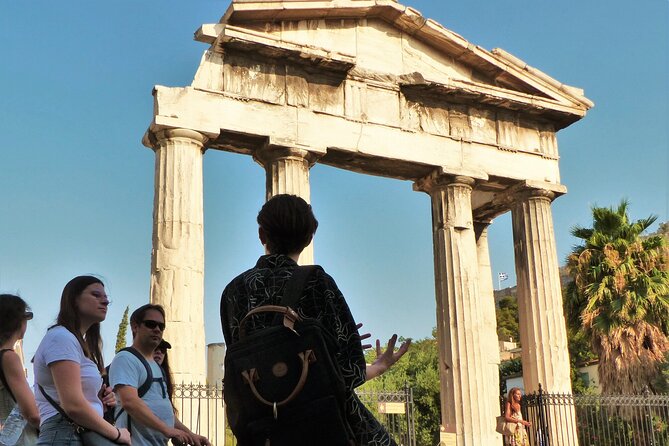
You’ll meet in Monastiraki Square at Pl. Monastirakiou 2, Athina 105 55. It’s a smart start. Monastiraki sits at a crossroads of old Athens and modern movement, so you’re already in the part of town where you can imagine everyday life.
From here, Maelle sets up the tour’s logic: ancient Greek women appear in myths, but myths aren’t just entertainment. They reflect what a society thought was proper, powerful, dangerous, or shameful. That framework matters because it keeps you from memorizing names only to forget what they meant.
You’ll also get your orientation for the walk. Even if you’re short on time in Athens, you’ll feel like you learned how the city’s spaces relate to the roles women could or couldn’t occupy.
Hadrian’s Library stop: where girls’ education fits the bigger picture
Next you’ll stand at Hadrian’s Library for a quick but telling look at women’s education in ancient Athens. The key value here is not just hearing that education existed. It’s understanding who got access, what counted as learning, and how education could be shaped by social expectations.
This stop is also a reminder that Athens wasn’t one flat story. Different periods, different institutions, and different expectations could change what life looked like for women. You’ll hear how education for girls and women ties into status, family decisions, and the long-term power that comes from knowledge.
It’s a good breather too. The tour stays moving, but this one gives you a chance to slow down and connect ideas before the walk turns more personal—marriage, love, and myth.
Marriage, Eros, and Athena’s Gate at stops for daily life and mythology

Two stops pack a lot of theme.
At the Holy Church of the All-Great Taxiarchs and the Virgin Mary Gregorousa, you’ll explore the meaning of marriage in both ancient Athens and Sparta, with Eros discussed as the passionate kind of love. This is one of those moments where the tour doesn’t treat “romance” as just romance. It asks what love was supposed to do in society: strengthen bonds, control behavior, or justify family arrangements.
Then you move to the Gate of Athena Archegetis, where the talk shifts again—married life for women in ancient Athens and Sparta, plus myths connected with the goddess Athena. The practical payoff is that you’ll start seeing Athens’s religious symbolism as social symbolism. Athena isn’t just a name on a temple. She becomes a lens for what the culture admired, feared, and expected.
If you like history that explains human behavior, this section is for you. If you came only for ruins, you might find this part heavier on ideas than stone. But that’s also what makes the tour feel different from the usual “look at this column” sightseeing.
A mysterious women-only festival at Dioskouron

At Dioskouron, the tour points you toward a festival dedicated exclusively to women. This is the kind of detail that’s easy to miss if you’re wandering on your own, because you don’t always know where to look for women-centered civic or religious life.
The value here is scale. One festival doesn’t rewrite everything, but it signals that women weren’t completely erased from public-religious culture. They had their own spaces, rhythms, and traditions—even when broader political and economic power was restricted.
This stop also breaks up the pacing, keeping the walk from feeling like one long lecture. You’ll leave it with a clearer mental map of how gender shaped who gathered, when, and why.






The Ancient Agora from outside: public life women couldn’t access
The tour heads to the Ancient Agora of Athens, described as the marketplace and center of public life. The important detail: you won’t go into the archaeological site. Instead, you’ll see it from outside while discussing women’s roles in public space—plus the lives of female slaves and courtesans in the city.
This is where the tour can feel both informative and a little uncomfortable. The point isn’t shock. The point is accuracy: in many cases, women’s presence in public wasn’t the same thing as participation. You learn how the marketplace functioned as public power, and how women’s access to that power was limited or shaped by status.
Even with the lack of interior access, the stop works because Maelle ties geography to rules. Where the Agora was, what it represented, and who moved through it all matters when you’re trying to picture real daily life.
Areopago trials: when a woman challenged the rules
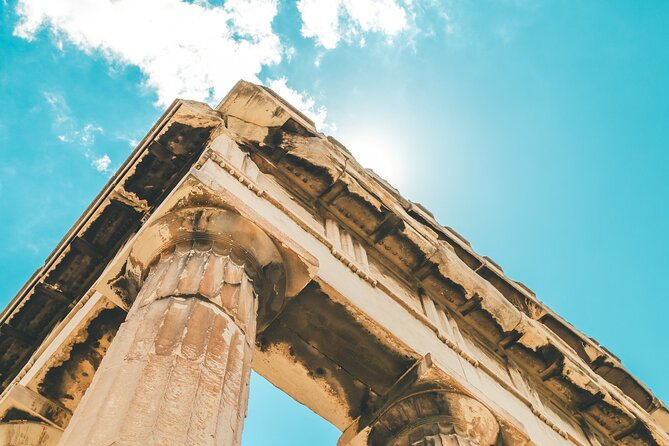
At Areopago, the focus turns to trials and consequences. You’ll learn about where some of the worst sinners were tried in ancient times, then zoom in on the story of a woman who risked a death sentence to change women’s rights.
This is one of the more striking parts of the tour because it shifts from social expectations to resistance. It’s still grounded in the ancient setting, but it has a modern energy: the idea that laws and customs don’t just happen; people fight over them.
Maelle’s storytelling approach helps here. Instead of making it a dry legal summary, she connects the personal stakes to the broader question of what women could challenge in a city that expected obedience.
If you like walks that end with a “wait, that happened?” moment, you’ll get one here.
Pnyx and democracy: men voted, but women still mattered
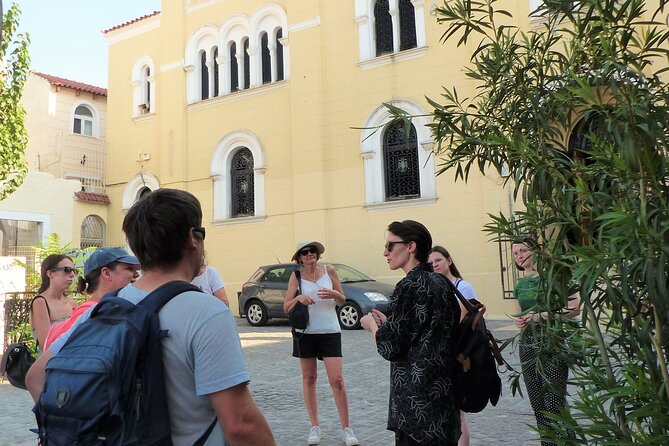
At Pnyx, you’ll hear about where democracy began—along with the reality that only men citizens used to vote. It’s a blunt contrast, and that bluntness is useful. It stops you from assuming that “democracy” automatically meant equal participation.
Then the tour pushes against the simple narrative. You’ll learn about a woman who influenced politics during Athens’s Golden Age. That theme echoes throughout the tour: even when formal power was restricted, women could still shape outcomes through influence, relationships, and reputation.
This stop is also tied to viewpoint energy. You’re in a space that once represented civic decision-making, and you’ll walk away thinking about power in more than one form—votes, yes, but also proximity to leaders and control over social networks.
Philopappos Hill finish: the Hill of the Muses view
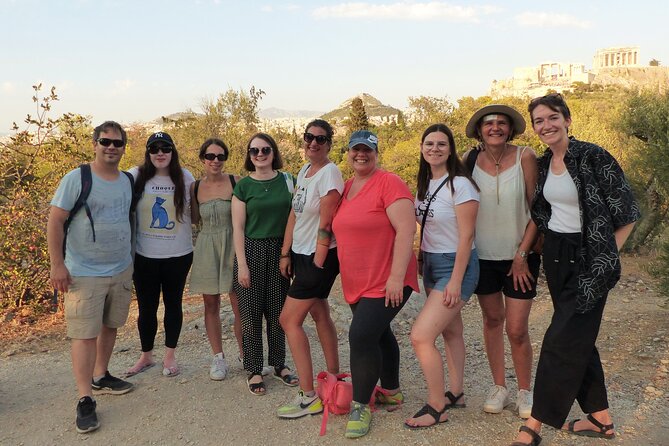
The tour ends at Philopappos Hill, specifically at the meeting end point listed near Φυλής 215, Athina 117 41. You’ll get an explanation of the Hill of the Muses and how inspiration fits into the Athenians’ self-image even down to modern times.
The best part is the payoff view toward the Acropolis. It makes a practical difference for your memory. You’re not just learning names and dates. You’re attaching the story to a final visual anchor. After you look back, the myths and social rules begin to feel like they belonged to real people who lived here, not figures from a distant textbook.
If you’re someone who likes to end a tour with a photo and a clearer mental map, you’ll appreciate this finish.
Price and small-group size: is $44.71 actually worth it?
At $44.71 per person for about two hours, the value is best understood through what you’re buying: a focused theme that you can’t easily replicate with a generic walking tour.
A big chunk of the “value” here is the angle. Athens is full of history tours. Most cover the famous male arc. This one spends the time where you’d otherwise get lost: daily life constraints, marriage meaning, education, public space limits, and women’s resistance. That’s also why the group stays small (up to 12). You can hear the story, and you’re not lost in a crowd.
You also get practical extras that reduce friction. Each stop is listed as free admission, and you use a mobile ticket. That matters when you’re juggling other sites around Athens and don’t want the day to turn into ticket-line math.
So for me, this tour is a good buy if you want a different Athens—one that helps you understand the city’s social structure, not just its ruins.
Who this women in ancient Greece walking tour suits best
I’d put this high on your list if you:
- want a women-focused Athens that most standard tours won’t cover
- enjoy myth as a way to understand society, not just as a story
- like guided walking tours where you ask questions and keep a steady pace
- are traveling with teens or a history-minded group that appreciates a fresh angle (Maelle’s style seems to land well with younger audiences too)
I’d think twice if you:
- need an itinerary packed with indoor museum time and artifacts
- hate walking on uneven ground or prefer fully accessible routes
- want only ancient ruins with minimal interpretation
Should you book this Athens women’s history tour?
Yes, if your goal is to leave Athens with context, not just photos. This tour is built around a clear theme—women’s daily lives, myths tied to social expectations, and how public spaces worked in practice. With a small group and a guide who keeps the story moving, you get a rare balance: specific locations, short stops, and ideas that stick.
Book it especially if you’ve already done the usual highlights and feel like something important is still missing. Athens has plenty of monuments. This tour teaches you the social world around them.
FAQ
How long is the Small-Group Women History in Ancient Greece walking tour?
It runs for about 2 hours.
Where do I meet the guide for the tour?
You meet at Pl. Monastirakiou 2, Athina 105 55, Greece.
Where does the tour end?
The tour ends at Philopappos Hill, Φυλής 215, Athina 117 41, Greece.
How large is the group?
The tour has a maximum of 12 travelers.
Do I need to pay admission tickets for the stops?
The stops listed are free to visit, and at the Ancient Agora of Athens there is no entrance to the archaeological site since you view it from outside.
Is this tour ticketless or does it require a paper ticket?
A mobile ticket is used.
Is the tour suitable for people with mobility issues?
Most travelers can participate, but it is not recommended for travelers with mobility issues.
What happens if weather is bad?
This experience requires good weather. If it’s canceled due to poor weather, you’ll be offered a different date or a full refund.
What is the cancellation policy?
You can cancel up to 24 hours in advance for a full refund. If you cancel less than 24 hours before the start time, the amount you paid will not be refunded.