REVIEW · ATHENS
The original Christian tour on Paul’s footsteps in Athens and ancient Corinth
Book on Viator →Operated by Athens Tours Greece · Bookable on Viator
Paul’s footsteps start right above modern Athens. This private full-day route strings together the classic Acropolis power trio with the places where Saint Paul’s story fits into the city’s religious life. I like the up-close pacing—a car and driver handle the between-sites travel—so you spend less time stuck in transit and more time looking at the stones that still hold the drama.
I also like the chance to connect ideas, not just photos. You’ll hit key stops tied to Paul’s famous preaching at Areopagus, then move on to Ancient Corinth and the Corinth Canal, where geography shaped trade and power. One thing to keep in mind: the driver isn’t a licensed guide inside the archaeological sites, so you may be doing more self-guided walking than true guided “point-and-explain” inside each area.
If you want a day that feels organized (and you’re okay with paying for the occasional paid entry), this is a strong option—especially for couples or small families. It’s a long one, though, with several outdoor stops and time on your feet, so pack water and dress for sun.
In This Review
- Key things worth knowing before you go
- Following Paul through Athens and Corinth: what this day actually feels like
- Getting to the Athens starting point: Piraeus and the Saronic Gulf drive
- The Acropolis stops that matter: Areopagus, Propylaea, Athena Nike, Parthenon
- Areopagus: the sermon site and the hill’s legal past
- Propylaea: the gate concept behind the grand entry
- Temple of Athena Nike: small temple, sharp symbolism
- Parthenon: the big one, with context that helps
- Erechtheion and the caryatid question: art, weather, and ownership
- Ancient Agora: where Athens lived for about 5,000 years
- Corinth Canal by the road: why this narrow cut mattered
- Ancient Corinth time: from early settlement to a trading powerhouse
- Lunch in Ancient Corinth: simple, local, and not included
- Driver-only guidance: what you gain, what you may miss
- Value and price: when $445.77 per group makes sense
- Who should book this Paul’s footsteps day tour
- Should you book? My honest call
- FAQ
- What is the duration of the tour?
- How many people are in a group?
- Is pickup included?
- Are entrance fees included?
- Is lunch included?
- Do I need an admission ticket in advance?
- Will the driver guide me inside the archaeological sites?
- What language is the tour offered in?
- What kind of vehicle will I ride in?
- Is there a dress code?
- Can I cancel for a full refund?
Key things worth knowing before you go
- Paul in the city: Areopagus is the headline stop for the Unknown God sermon story, marked on-site with a bronze plaque.
- Acropolis in layers: You don’t just see the Parthenon. You also pass through the gate area (Propylaea) and the Temple of Athena Nike.
- Erechtheion’s caryatid story is complicated: You’ll see why the “maidens” are split between places like Athens and London.
- Corinth Canal is short but unforgettable: A thin strip of engineering history that echoes a 2,000-year shipping dream.
- Price fits small-group private travel: It’s priced per group (up to 3), which can feel fair compared to piecing together taxis and timed tickets.
Following Paul through Athens and Corinth: what this day actually feels like
This is a private day built around a simple idea: take you from Athens’ most famous sacred precinct to Corinth, where early Christianity grew within a world of trade routes. The value here isn’t only the sights—it’s the flow. One vehicle, one schedule, and a driver who can explain what you’re seeing before you get out.
You’ll start with pickup in Athens or at the cruise pier in Piraeus. Then the day moves from sea-level city views toward hilltop ancient Athens, and later down into the Peloponnese. Expect about 8 hours total.
The experience is also flexible in a practical way. The car helps on hot days and for stops that are spread out. One review highlighted that the driver kept the car cool during extreme heat, and that kind of small comfort matters when you’re out in the sun for hours.
You can also read our reviews of more tours and experiences in Athens.

Getting to the Athens starting point: Piraeus and the Saronic Gulf drive
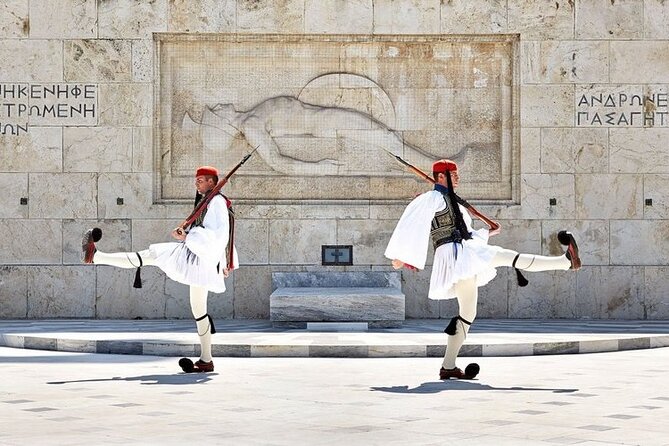
Your day begins at Piraeus, either at your hotel pickup in Athens or by meeting at the cruise ship pier exit. After pickup, you drive along the coastal road of the Saronic Gulf. This is a quiet win early on: you get a sense of where Athens sits against the water, before you hit the steep, stone-heavy reality of the Acropolis.
The itinerary also includes a later drive along the same coastal corridor toward the Corinth area. In other words, you’re not just “going from A to B.” You’re getting repeated scenic context, with the car taking the strain.
A heads-up on expectations: your driver handles the logistics and can provide cultural context while in transit, but you’ll still be doing a lot of walking and looking yourself once you reach each archaeological area.
The Acropolis stops that matter: Areopagus, Propylaea, Athena Nike, Parthenon
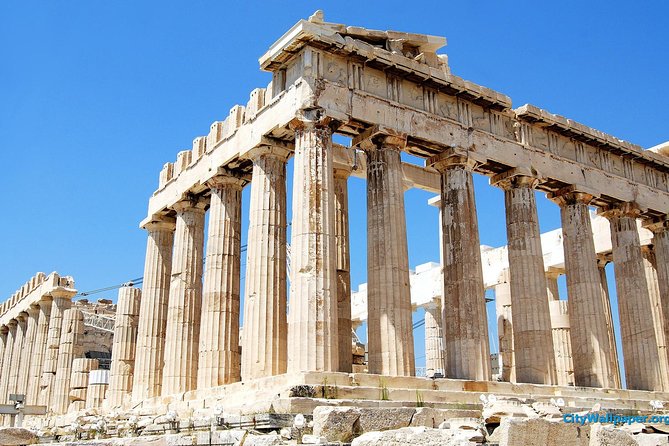
This tour is clearly strongest around the Acropolis complex. You’ll spend time at the main sights in a logical order—so your brain can connect the layout.
Areopagus: the sermon site and the hill’s legal past
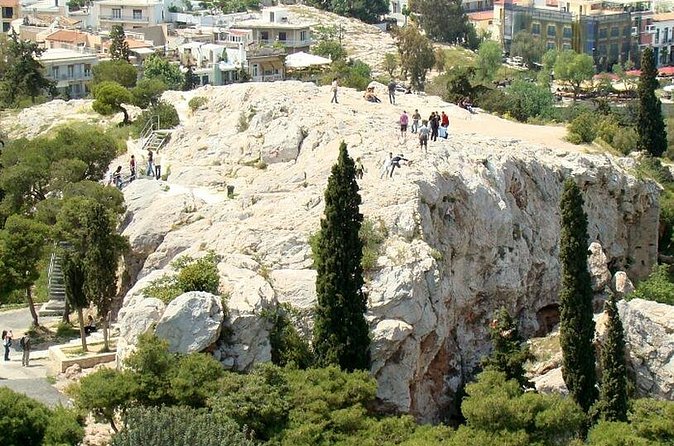
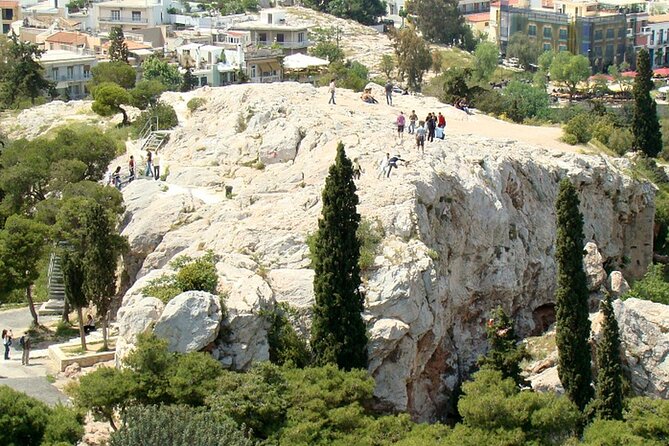
Areopagus (the Hill of Ares) sits right near the Acropolis exit. In classical times, it was linked to the council and judicial proceedings. The place is also tied to Ares trials in mythology, and stories involving Orestes.
Then comes the Paul connection: Saint Paul preached the Sermon on an Unknown God after seeing an altar dedicated to the Unknown God. On-site, there’s a bronze plaque at the foot of the rock to mark that tradition.
Even if you don’t want a lesson in Greek law, the hill is worth it. From here you’re seeing how religious, civic, and storytelling spaces overlap in ancient Athens. The Greeks didn’t separate “belief” from “public life” the way modern people often do.
Propylaea: the gate concept behind the grand entry
Next up is Propylaea, the gate structure of the Acropolis. This is the kind of stop that can feel short—minutes, not hours—but it matters because it shows you the architectural ambition of the sanctuary.
You’ll learn how different phases built on earlier fortification ideas, and how Persian destruction and later repairs shaped what exists now. The Periclean building program plays a role here too, including the fact that the original plan was daring and never finished.
If you’re the type who likes seeing how a monument “was meant to be,” Propylaea gives you that perspective.




Temple of Athena Nike: small temple, sharp symbolism
The Temple of Athena Nike is compact and built on a bastion at the southwest edge of the Acropolis. Despite its size, it’s loaded with meaning. You’ll hear about its Ionic design and its relief-carved frieze, with different thematic scenes on different sides.
The south side connects to Marathon (490 BC), including the Greek victory over the Persians. Even when sculptural remains are limited, the story still lands because the temple was meant to function as both religious space and civic symbol—Athens praising its own resilience.
Parthenon: the big one, with context that helps
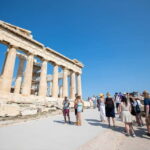
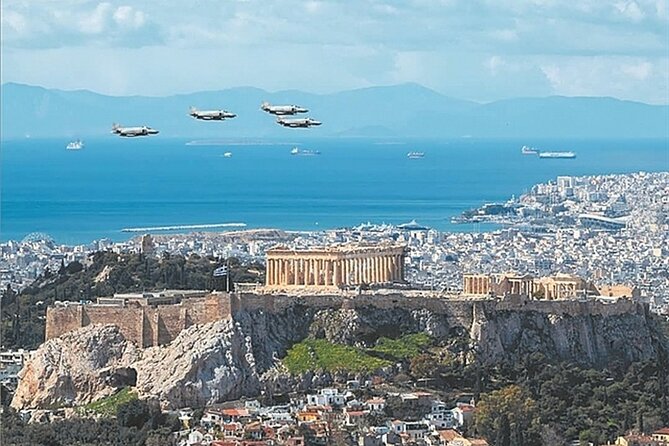
Then you reach the Parthenon, the star of the skyline. You’re looking at a temple dedicated to Athena Parthenos, built in the mid-5th century BCE. It’s often described as the culmination of the Doric order—simple forms taken to extremely high refinement.
What makes this stop better than “just seeing the Parthenon” is the framing: it’s part of Pericles’ rebuilding program after the Greco-Persian Wars, and it also served practical roles, including acting as treasury for the Delian League.
Plan on around 45 minutes here, and use that time to do two things: stand back for the full shape, then move closer to notice the way the building’s details create an overall sense of order and power.
Erechtheion and the caryatid question: art, weather, and ownership
After the Parthenon, you’ll reach the Erechtheion. This is where the Acropolis becomes more than a “big temple complex.” It becomes a case study in preservation and cultural politics.
The Erechtheion’s south porch includes six caryatids—maidens acting as columns. Pollution and weathering damaged the originals. Some were removed and replaced with replicas, and the names of institutions come up because they matter: five caryatids were moved to the Acropolis Museum in 1978.
Then the story gets sharper: one caryatid was taken in the early 1800s by Lord Elgin, and later ended up displayed in the British Museum. The British Museum acquired the sculptures in 1816, and public display followed soon after.
Even without a debate-bro spreadsheet in your day, the takeaway is clear. Ancient art wasn’t just made to be admired—it was also made to survive, and today survival is tied to where objects ended up. If you like learning what you’re actually looking at—rather than treating it as a postcard—this stop will click.
Ancient Agora: where Athens lived for about 5,000 years
Once the Acropolis is done, you shift gears to the Ancient Agora of Athens, a northwest area of the city linked to assembly life and the marketplace. The key idea is that “agora” covers both civic assembly and everyday trade.
One of the best parts of this stop is the scale of time. The Agora area stayed in use across eras for around 5,000 years, which means the ground is layered with repeated building, destruction, and rebuilding. Excavations help peel back the layers, exposing roles from Archaic through Greco-Roman and Byzantine periods.
You’ll typically have around 1 hour 20 minutes. Use it for slow walking and “pattern noticing”: you can often feel the ancient city’s logic even when the structures are fragmentary. It’s also a good place to connect back to what you just saw on the Acropolis—religion wasn’t isolated on a hill. It shaped how people organized daily life down below.
Corinth Canal by the road: why this narrow cut mattered
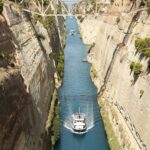
After Agora, you travel toward the Corinth area through the Peloponnese region, with time set aside for a drive along the coastal road of the Saronic Gulf. You’ll arrive at the Corinth Canal, which slices through the narrow isthmus linking the Gulf of Corinth to the Saronic Gulf.
This is a quick stop—about 15 minutes—but it’s high impact. The canal is about 6.4 kilometers long, and it’s only about 25 meters wide. Ships once had to circle the Peloponnese to cross between seas, adding roughly 185 nautical miles. The canal shortens that route dramatically.
The story also has a “why didn’t it happen sooner?” angle. The canal was executed in the late 19th century, but the idea is ancient—about 2,000 years of dreaming. You’ll hear how Periander, tyrant of Corinth (around 602 BC), conceived of the idea, and how earlier solutions included the diolkós, a stone road that moved ships over land on wheeled platforms.
If you like transportation history, this is the one stop where you get to see how engineering changes culture.
Ancient Corinth time: from early settlement to a trading powerhouse
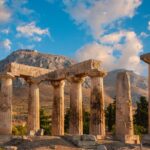
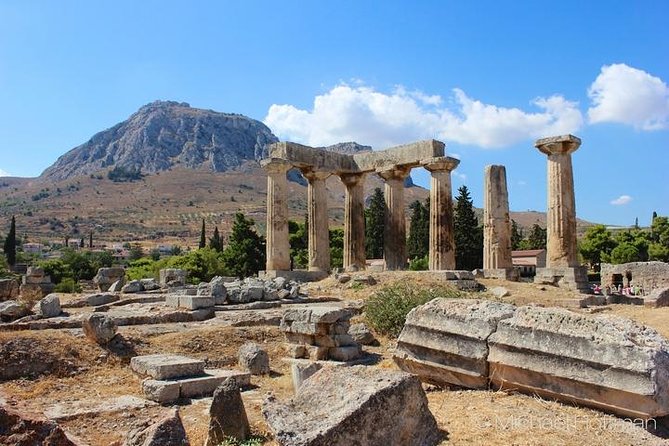
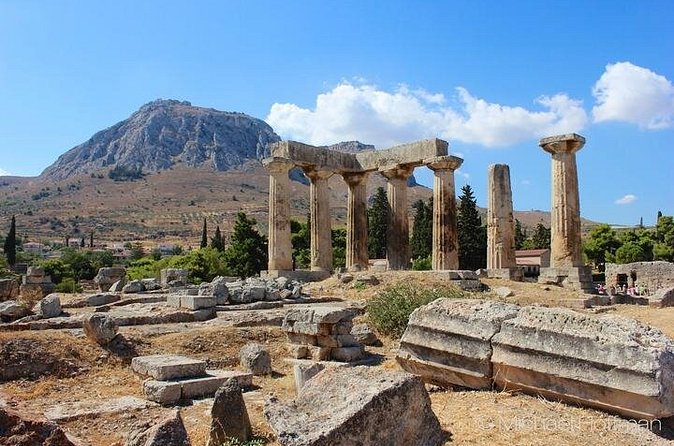
Next comes Ancient Corinth (Archaia Korinthos). This is where the day finally feels like it’s shifting from Athens’ story to Corinth’s world.
The site goes back to Neolithic settlement, around 6500–3250 BCE. But what really matters for the “Paul connection” feeling is Corinth’s geography. The area sat at a crossroads: routes moving from the Balkans toward mainland Greece and the Peloponnese, plus waterways connecting the western Mediterranean to the east.
That intersection made growth likely. Corinthian power shows up in the centuries that follow, including expansion in trade. In the 8th century BCE, Corinthian colonies were founded—places like Corfu and Syracuse.
You’ll have around 1 hour 20 minutes. Since entrance fees aren’t included, you’ll want to have tickets ready ahead of time if possible. This is one of those days where getting one step wrong—like missing a timed entry window—can cost you real minutes inside the ruins.
Lunch in Ancient Corinth: simple, local, and not included
Lunch happens as free time in a traditional restaurant in Ancient Corinth. Greek food is one of the easiest ways to keep the day grounded in the present, not just the past.
The only caution: food and drinks aren’t included in the tour price. Still, having lunch here rather than returning to Athens keeps your time with the ruins efficient.
If the heat is intense, treat lunch as a hydration moment too. You’ll be outdoors, and your time at the monuments won’t slow down just because you’re thirsty.
Driver-only guidance: what you gain, what you may miss
Here’s the practical truth of this format. You’ll have a professional English-speaking tour driver and private transportation. That’s a big win for pace and comfort.
But the tour is clear that drivers aren’t licensed to accompany you inside archaeological sites and museums. So you’re not guaranteed that one person will stand with you at each stop and keep explaining in real time while you look at details inside the boundaries.
In practice, this can go two ways:
- If your driver is strong at pre-site orientation (what to look for, why it matters), you’ll feel like you “get it” even during your walk-through time.
- If you’re hoping for constant guided storytelling inside every monument, you might feel shortchanged unless you arrange for an additional licensed guide for the museum or site time.
The reviews reflect both sides of this. Some days, people loved having an archaeologist guide (Danai) for the historical and religious context, and paired that with an attentive driver (Spyros) who handled comfort like water. Other feedback was more mixed when the experience felt more like being dropped off at stops than being guided on-site.
If you want the most guided experience possible, consider adding a licensed guide for at least the Acropolis monuments or the most time-consuming areas. You’ll still get the private vehicle convenience, but you’ll also reduce the amount of “explore and interpret yourself” moments.
Value and price: when $445.77 per group makes sense
At about $445.77 per group (up to 3 people), you’re paying for a private day that covers hotel or cruise pickup, a dedicated air-conditioned vehicle, and an English-speaking driver for the full route.
Entrance fees and food aren’t included. That means the real cost depends on which sites you enter and ticket availability, but the structure is built around common major stops. The tour suggests having admission tickets pre-purchased because availability might be limited, and they can also purchase tickets for you in advance under a small service fee.
So does it feel like good value? For me, the math depends on your travel style:
- If you’re a small group and you hate negotiating taxis, this can be cost-effective.
- If you’d rather do everything independently at your own tempo, you might spend less on transport but lose the “one-day plan” simplicity.
- If you want serious guided depth inside sites, the driver-only format might mean extra costs for a licensed guide.
The sweet spot is travelers who want a smooth, well-structured day, plus enough context from the driver to connect the sights to Paul’s story—without needing a full-time licensed guide standing beside you at every single meter.
Who should book this Paul’s footsteps day tour
This fits best for:
- Couples or small families (up to 3) who want private transportation and a tight schedule.
- Travelers interested in Christian and classical history connections, not just one or the other.
- People who can handle a moderate amount of walking and outdoor heat.
You might want a different option if you:
- Want nonstop, inside-the-sites guidance from a licensed professional at every stop.
- Are hoping the tour includes all entrance fees and meals (it doesn’t).
One more note from the tour details: dress code is listed as formal. That may be a surprise in Greece, so aim for neat and comfortable clothes that still fit the request.
Should you book? My honest call
I’d book this if you want a private, organized day that connects Athens and Corinth with Paul’s story—especially when paired with a driver who can explain what you’re looking at before you step into the ruins. The Acropolis sequence plus Areopagus gives you the spiritual and civic link, and Corinth Canal adds a smart “geography matters” moment before Ancient Corinth.
I wouldn’t book it expecting a full guide escort inside every site with constant commentary. If that’s your priority, budget for a licensed guide add-on for at least the key archaeological time.
If you’re flexible and you like structure, this is a strong way to spend a single day on Paul’s routes without burning hours on logistics.
FAQ
What is the duration of the tour?
The tour runs about 8 hours.
How many people are in a group?
It’s a private tour/activity for your group, and the price is per group up to 3 people.
Is pickup included?
Yes. You can be picked up from your hotel in Athens or from the cruise ship pier at Piraeus port, and you’ll also be dropped back at the same spot.
Are entrance fees included?
No. Entrance fees to archaeological sites and museums are not included.
Is lunch included?
Lunch is not included. You’ll get free time to eat at a traditional restaurant in Ancient Corinth.
Do I need an admission ticket in advance?
The tour suggests you have admission tickets pre-purchased due to possible limited availability. They can also purchase tickets for you in advance for a small service fee.
Will the driver guide me inside the archaeological sites?
No. The driver is not licensed to accompany you inside archaeological sites and museums. If you want that, you can arrange for a licensed English-speaking tour guide for an extra cost, subject to availability.
What language is the tour offered in?
The experience is offered in English.
What kind of vehicle will I ride in?
You’ll travel by a private air-conditioned vehicle appropriate for the size of your group.
Is there a dress code?
Yes, the dress code is listed as formal.
Can I cancel for a full refund?
Yes. You can cancel up to 24 hours in advance for a full refund.