REVIEW · ATHENS
“Tour of Ancient Corinth:Follow in the footsteps of Apostle Paul”
Book on Viator →Operated by Greece Athens Taxi GAT · Bookable on Viator
Paul meets the real terrain of Corinth.
This private tour is built for a smooth day: hotel pickup is included, and you get an air-conditioned ride out to ancient sites without wrestling with buses. The focus stays on Corinth’s story through the lens of Apostle Paul, so you’re not just looking at ruins—you’re seeing how this place sat at the crossroads of travel, trade, and belief.
What I like most is the pacing. You get enough time at each key stop—Isthmus of Corinth, Ancient Corinth, and then the Archaeological Museum—so you can absorb what you’re seeing instead of sprinting. Plus, the driver explains the history along the way (English, and based on your interests), which really helps you connect the dots before you step onto the sites.
One thing to consider: your driver is not a licensed site guide inside the museums and archaeological areas. That means the deeper on-the-ground interpretation at places like the museum may depend on a licensed guide being available on request, and you’ll also pay the Archaeological Museum ticket (€20 per person) yourself.
Key Points to Know Before You Go
- Private, paced touring: four to five hours with a plan that doesn’t feel rushed
- Corinth Canal and the strategic Isthmus: you’ll see why this narrow stretch mattered for centuries
- Ancient Corinth (Archaia Korinthos): systematic archaeology has uncovered major parts of the city
- Archaeological Museum timing: one hour inside, with collections from prehistoric through Byzantine times
- Akrokorinthos (Acrocorinth) at 575m: the fortress acropolis that guarded the Isthmus
- Paul’s connection on the hilltop: the tour specifically includes the Apostle Paul step area
In This Review
- Why Corinth Fits a Half-Day Trip from Athens
- The Comfort Setup: Mercedes, A/C, WiFi, and Thoughtful Extras
- Isthmus of Corinth: Where the Narrowest Land Controls the Route
- Ancient Corinth (Archaia Korinthos): A City-State Halfway Between Power Centers
- Archaeological Museum of Ancient Corinth: What’s Inside (and What You Pay)
- Akrokorinthos (Acrocorinth) at 575m: The Hilltop That Explains Everything
- Timing, Tickets, and How to Keep the Day from Feeling Like a Checklist
- What You’ll Get from the Driver (and What You Won’t)
- Who This Tour Suits Best
- Should You Book This Ancient Corinth Tour?
- FAQ
- How long is the Ancient Corinth tour?
- Is this tour private or shared?
- What pickup options are included?
- What sites are included in the route?
- Are museum and site tickets included in the price?
- Is the tour guided by a licensed tour guide?
- What comfort features are included in the vehicle?
- Do I get a mobile ticket?
- Can I extend the tour or add extra time?
- What is the cancellation policy?
Why Corinth Fits a Half-Day Trip from Athens
Corinth is the kind of place that can feel confusing in a big map view. On paper, it’s between Athens and Sparta. In real life, it’s a tight hinge point between mainland Greece and the Peloponnese. That’s why the Isthmus shows up again and again in history—and it’s exactly why this tour works well as a half-day excursion.
The theme is Apostle Paul’s footsteps, but the experience isn’t only “biblical history.” You’ll see how the same roads and viewpoints shaped what people could reach, trade, worship, and defend. If you like tours that make you understand the geography behind the story, this itinerary is a good match.
The Comfort Setup: Mercedes, A/C, WiFi, and Thoughtful Extras
This is a private tour with pick-up and drop-off arranged for your exact location. In Athens, that means hotel or Airbnb pickup and drop-off, plus Port Piraeus pickup right by your cruise ship entrance area (meet by sign with your name). If you’re coming from Rafina or Laurio, there’s an additional charge.
Once you’re in the vehicle, it’s built for comfort:
- Mercedes-Benz transportation with A/C
- WiFi on board
- bottled water
- mobile chargers
One small but memorable detail: people have specifically noted drivers going out of their way with helpful extras like phone charging. That’s the kind of practical care that makes a day feel easier, especially if your phone battery is already low from navigation and photos.
You can also read our reviews of more tours and experiences in Athens.



Isthmus of Corinth: Where the Narrowest Land Controls the Route
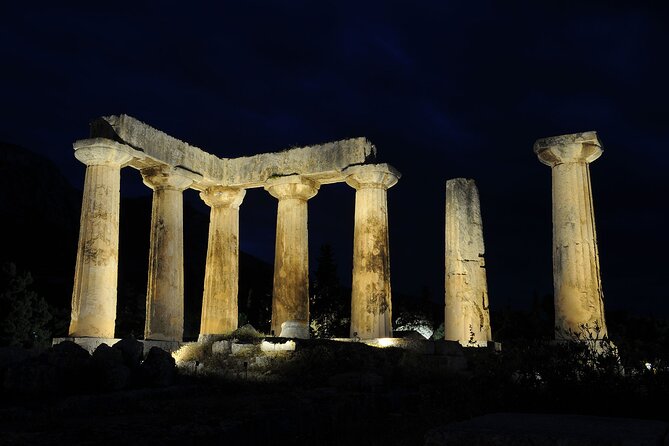
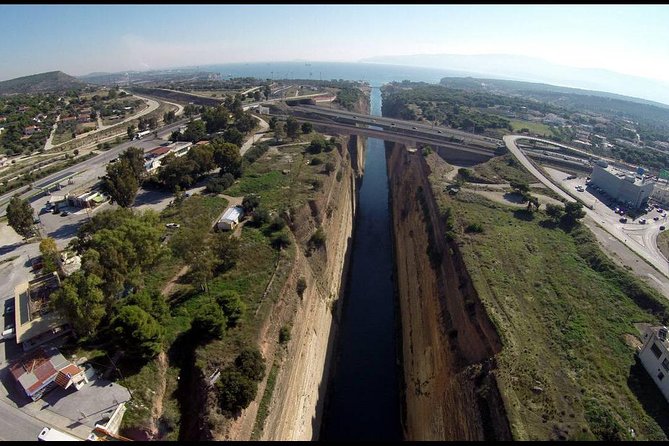
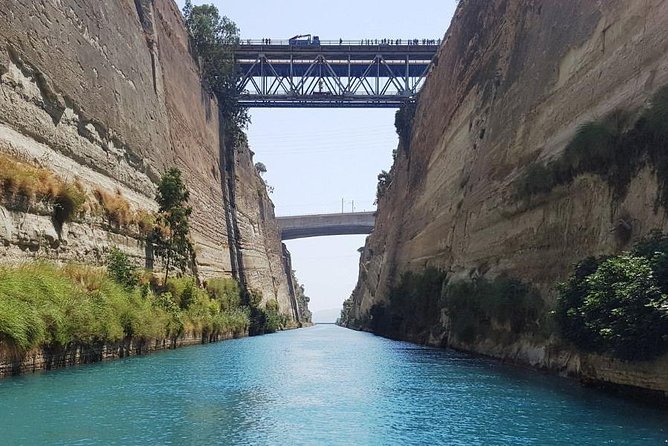
Your first major stop is the Isthmus of Corinth, a narrow strip connecting Central Greece to the Peloponnese. This is where you get your “why this matters” moment.
The canal that runs through the isthmus links the Saronic Gulf with the Gulf of Corinth. It’s about 6 kilometers long, and the narrowest point is where the Corinth Canal was built (1880–1893). Even if you know the name, seeing the setting helps you understand how strategic it always was.
What makes this stop especially interesting is the layer of defense over time. A wall was built in ancient times (end of the 5th century BC), and it was preserved until the Byzantines as the Hexamilion. So you’re not only looking at modern engineering and geography—you’re also looking at a long-running attempt to control access.
Time-wise, it’s a shorter stop (about 30 minutes). That’s a good thing here, because the goal is to get orientation and then move on while the day is still fresh.
Ancient Corinth (Archaia Korinthos): A City-State Halfway Between Power Centers
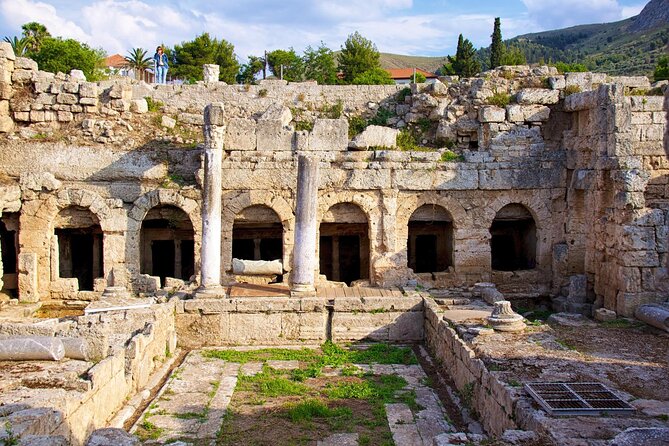
After the Isthmus, you’ll head to Ancient Corinth (Archaia Korinthos). Corinth was a polis, a city-state, positioned on the same narrow route that travelers would have to pass through. The location—roughly halfway between Athens and Sparta—explains why Corinth mattered politically and economically.
A practical detail that helps you picture the area: the modern city of Corinth sits about 5 kilometers northeast of the ancient ruins. When you’re standing around ancient remains, that gap can matter. It’s a reminder that the “Corinth you walk on” is only part of the full story.
Archaeology here has been ongoing for well over a century. Systematic investigations by the American School of Classical Studies at Athens have revealed large parts of the ancient city, and additional finds from excavations conducted by Greece’s Ministry of Culture have brought new insights. The takeaway for you: this isn’t a single monument. It’s a place that keeps yielding discoveries.
This stop also runs about 30 minutes, with admission listed as free for this portion. That makes it a nice pacing balance: you get enough time to see the key atmosphere and major remains without turning the morning into a half-day sprint.
Archaeological Museum of Ancient Corinth: What’s Inside (and What You Pay)
Now you’ll shift from open-air ruins to the Archaeological Museum of Ancient Corinth, located at the archaeological site of ancient Korinthos. The museum building dates to 1932, and it’s designed to help you make sense of what the digs uncovered.
This is the one stop where your budget should be ready. The museum ticket is not included, and the listed entrance fee is €20 per person. The site also notes that ticket prices vary by season (winter vs summer), so don’t assume the fee will always be the same month to month.
Why the museum time is worth it: it spans a long timeline of artifacts. You’ll see collections including:
- Prehistoric collections
- finds from the Asklepieion
- artifacts from the Geometric period through the Byzantine period
One detail that’s especially cool if you like archaic art: the exhibit includes the Twin Kouroi from ancient Tenea, described as an exquisite example of archaic plastic art. If you’ve ever looked at a kouros statue and wondered what else the region produced at the time, this museum is where you get that context.
Expect about one hour inside. If you’re the type who reads labels, you’ll likely fill the time well. If you prefer visuals over text, you’ll still leave with a stronger sense of how these sites connect to daily life, worship, and later Christian history.
Akrokorinthos (Acrocorinth) at 575m: The Hilltop That Explains Everything
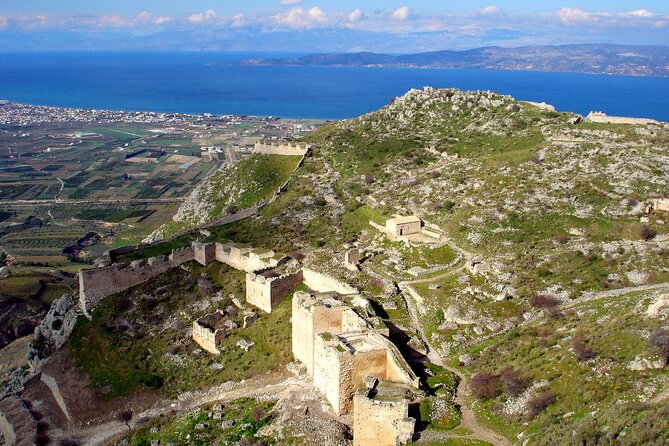
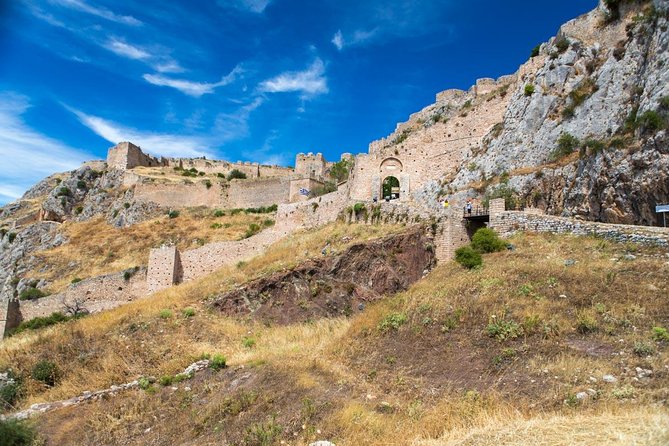
Akrokorinthos is the big viewpoint stop. It’s a steep rock around 575 meters high, and in ancient times it functioned as a type of acropolis—used as a lookout in case of raids from either central Greece or from the sea.
From a tour-value perspective, this is where the half-day really starts to pay off. From the hilltop, the geography becomes clearer. You can better understand how the fortress controlled the Isthmus and why it was used repeatedly as a last line of defense in southern Greece.
The tour also makes room for multiple major areas on the hill. Here are the highlights you should plan to look for:
- Amphitheater
- Apostle Paul’s step (this is specifically included in the route)
- Theater
- Sanctuary of Asclepius (a healing sanctuary)
- Sanctuary of Demeter and Koris
- Fountain Glavki
- Temple of Apollo
- Temple of Octavia
- Early Christian Basilica of the Skull
- Early Christian Basilica of Lechai
- Pirine
- Conservatory
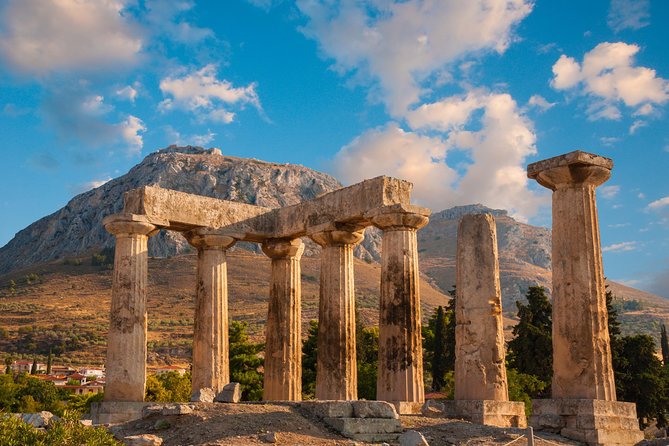
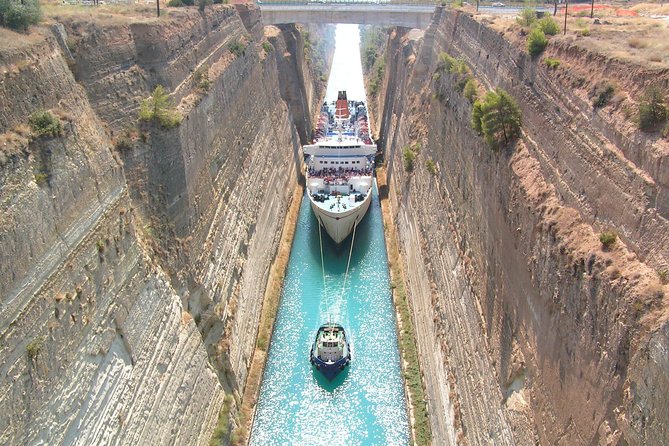
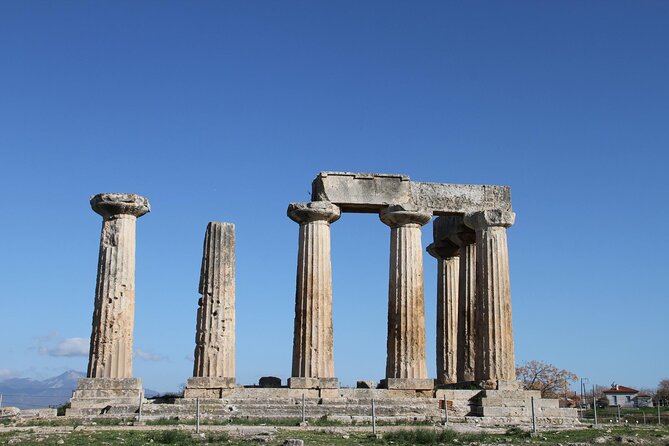
One architectural detail that’s worth keeping in mind as you walk: the Temple of Apollo is described as a structure built with 40 monolithic Dorian columns, with only seven preserved over the ruins of the ancient market. The original temple dates between the early 7th and early 6th centuries BC. It was built of stone, bricks, and wooden beams, and it had a heavy, complex four-pitched roof with clay tiles. What I find useful here is not memorizing the dates—it’s using these specifics to notice how monumental Greek temple building really was.
If you’re trying to connect the biblical theme to place, Akrokorinthos is your anchor. You’re seeing the same high-ground logic that would have shaped movement and survival—exactly the kind of physical reality that makes historical stories feel less abstract.





Timing, Tickets, and How to Keep the Day from Feeling Like a Checklist
The itinerary is set for a 4 to 5 hour experience. That range matters because it affects how much patience you need for stairs, uneven ground, and museum browsing. It’s also why a private format helps: you can adapt your pace inside the time window.
Here’s how the ticket picture lines up based on what’s included:
- Isthmus of Corinth: admission is listed as free for this stop
- Ancient Corinth: admission is listed as free for this stop
- Archaeological Museum of Ancient Corinth: €20 per person, not included
- For other archaeological places and museums: general entrance fees can apply, and the tour notes ticket prices can vary by season
You’ll also get assistance with purchasing skip-the-line tickets. The key detail: the ticket cost itself is still covered by you. In plain terms, you’re saving time at the purchase stage, but you’re not getting “free entries” across the board.
Another important note: the English-speaking driver is knowledgeable about the history, but they’re not licensed to accompany you inside sites and museums. That means you may want to rely on what signage and your own reading provide, unless a licensed tour guide is available upon request.
What You’ll Get from the Driver (and What You Won’t)
A good driver can make a day run smoothly—and this one seems to be a core strength. People have praised drivers by name, including Andreas, Spyros, and Ted, with comments focused on being on time, offering the right amount of detail, and balancing information with a comfortable conversation level.
A pattern that shows up: drivers explain the main historical ideas during the ride, then help you get positioned for what you’ll see next. That’s ideal if you don’t want to feel like you’re on rails, but you also don’t want silence and confusion.
What you should plan for: if you want a licensed, inside-the-museum style guide voice, you’ll need to request that option since the driver is not licensed for site guiding.
Who This Tour Suits Best
This is a strong fit for you if:
- you want a private tour rather than a large group bus day
- you care about the connection between geography and history
- you like biblical or early Christian themes but also want real archaeological context
- you need hotel pickup and want it to feel easy from the start
It might be less ideal if:
- you’re looking for a fully guided museum experience by a licensed guide at every stop
- you want a long, slow archaeological deep dive (the whole tour is still only about half a day)
If you’re visiting off-season, you may get a calmer feel on the sites. One of the standout practical benefits of traveling quieter months is that viewpoints and ruins can feel more personal.
Should You Book This Ancient Corinth Tour?
If your goal is to see Ancient Corinth and Akrokorinthos in a way that feels organized, comfortable, and meaningful—this is a book-worthy choice. The value comes from the private transportation plus the stop sequence that makes sense: orientation at the Isthmus, ruins at Ancient Corinth, interpretation time at the museum, then the big “why it mattered” viewpoint at 575m.
I’d recommend booking if you’re:
- on a tight Athens schedule and want a high-impact half-day
- someone who appreciates your history with a side of practical guidance and calm pacing
- traveling with someone who loves Apostle Paul’s story but also wants the real-world setting behind it
Book it with one expectation set: the museum ticket is extra, and your driver’s role is history-and-ride support rather than licensed site narration everywhere. If that works for you, you’ll likely feel like you got a complete Corinth day, not just a drive-by.
FAQ
How long is the Ancient Corinth tour?
It runs about 4 to 5 hours (approx.).
Is this tour private or shared?
This is a private tour/activity. Only your group participates.
What pickup options are included?
You can get pickup from your hotel or Airbnb and from Port Piraeus without extra charge. Pickup at Rafina Port or Laurio Port is available for an additional charge.
What sites are included in the route?
The tour includes the Isthmus of Corinth, Ancient Corinth (Archaia Korinthos), the Archaeological Museum of Ancient Corinth, and Akrokorinthos (Acrocorinth).
Are museum and site tickets included in the price?
Skip-the-line ticket assistance is included, but tickets are not included. The Archaeological Museum of Ancient Corinth entrance fee is listed as €20 per person.
Is the tour guided by a licensed tour guide?
The driver is English-speaking and knowledgeable about the history, but they are not licensed to accompany you inside sites. A licensed tour guide may be available upon request depending on availability.
What comfort features are included in the vehicle?
The tour uses a Mercedes-Benz vehicle with A/C, WiFi on board, bottled water, mobile chargers, and child seats.
Do I get a mobile ticket?
Yes, the tour offers mobile tickets.
Can I extend the tour or add extra time?
Yes, you can request hourly extensions for a fee.
What is the cancellation policy?
Free cancellation is available up to 24 hours in advance for a full refund.