Angkor Wat is the kind of place you feel in your chest. This tour strings together Angkor Wat, Bayon, and Ta Prohm in one efficient run, plus a short walk through the ancient city at Angkor Thom, guided by a local expert. You get air-con car comfort, cold towels, and a clear plan so you’re not guessing your way across the park.
I especially love the storytelling approach from the guide. In one recent group, the guide Dan stood out for mixing Cambodian history with how religions shaped the buildings and the carvings you see in the stone.
The one drawback to plan for: the $45 price does not include the temple entry fee, which is $37 per person. Budget for that up front, plus tips for guide and driver since they’re not included.
In This Review
- Key highlights to pay attention to
- A Smart Small-Circuit Combo: Angkor Wat, Bayon, Ta Prohm
- Price and What You Actually Get for $45
- Getting There: Air-Conditioned Comfort, Water, and Cold Towels
- Angkor Wat Inside and Out: What the Flag Symbol Means
- Angkor Thom South Gate and the City Walk: Tonle Oum and the Gates
- Bayon Temple Faces: Seeing the Carvings with a Guide’s Lens
- Baphuon, Elephant Terrace, Terrace of the Leper King, Royal Palace: The Stops That Round It Out
- Ta Prohm Tree Temple: The Tomb Raider Scene in Real Life
- Practical Temple Tips: Dress, Shoes, and What to Carry
- Should You Book This Tour? My call
- FAQ
- What is the total duration of the tour?
- Does the $45 price include temple admission?
- What’s included in the tour price?
- Are tips included for the guide and driver?
- What temples are visited during the tour?
- How long is spent at each main temple?
- Is there a group or private setup?
- Do I need special clothing for temple entry?
- What is the cancellation policy?
Key highlights to pay attention to
- Angkor Wat in and out, with time to learn what you’re seeing instead of just walking
- Bayon’s famous faces, plus other Angkor Thom stops like Baphuon and Elephant Terrace
- Ta Prohm as the tree-temple, the roots-and-stone scene people come for
- Hotel pickup and drop-off, plus air-conditioned transport for a long temple day
- Mobile ticket and group pricing, useful if you’re squeezing this into a tight Siem Reap schedule
- A possible extra small temple if you still have energy when the day is running long
A Smart Small-Circuit Combo: Angkor Wat, Bayon, Ta Prohm
This is a classic Angkor flow: start with Angkor Wat, then go to the Angkor Thom area for Bayon and related monuments, and finish at Ta Prohm. The logic is simple. You hit the biggest wow factor first, then move through the “city” ruins, and cap it off at the temple most linked to jungle growth.
The tour time is listed as about 5 to 7 hours, so you get a full day without turning it into an all-day slog. Also, it’s set up for a group format, but it’s private in the sense that only your group participates.
If you want the big three in one shot, this tour is a practical match. If you’re traveling extremely slowly or need frequent breaks, you might find the schedule a bit tight because temples keep you walking.
You can also read our reviews of more tours and experiences in Siem Reap.


Price and What You Actually Get for $45
The headline price is $45 per person, and it includes some of the heavy lifting. You get hotel pickup and drop-off, an air-conditioned car, bottled drinking water, and cold towels.
You also get a local English-speaking tour guide, and the day is organized to cover the main sights without wasting time. There’s also a mobile ticket mentioned, which typically means less fuss when you arrive.
Now the part that matters for budgeting: temple fees are not included and are $37 per person. So your real baseline cost becomes $45 + $37, before tips, which are recommended for guide and driver. For many people, that still ends up feeling like decent value because you’re buying guidance and logistics, not just transportation.
If you’re comparing options, don’t judge the sticker price only. Judge the full temple-day cost plus whether you want an expert to explain what you’re looking at while you walk.
Getting There: Air-Conditioned Comfort, Water, and Cold Towels
Angkor days are long under Cambodia heat and sun, even when the mornings feel pleasant. This tour’s included air-conditioned car makes a noticeable difference, especially between temple clusters.
You’ll also have drinking water and cold towels handed over during the tour. Those details are small, but they reduce the “end-of-day collapse” feeling that can hit right after Bayon or Ta Prohm.
Pickup and drop-off from your hotel means you don’t have to sort out meeting points across Siem Reap. The downside is you should be ready for a fixed day plan rather than spontaneous detours.
Also, the tour advises you not to bring valuables. Temple areas are busy, and keeping your bag light and simple is smart.
Angkor Wat Inside and Out: What the Flag Symbol Means
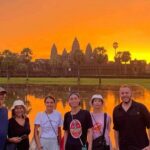
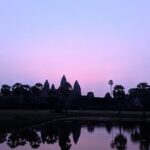
Angkor Wat is scheduled as the first stop and the biggest chunk of time, around 3 hours. You’ll see it from the outside and also go inside, with a local guide explaining the history and what the design is telling you.
Here are the concrete facts you can hold onto while you’re there: it was built from 1113 to 1150 AD by King Suryavarman II. The complex measures about 330 metres by 260 metres, and it’s laid out on three levels with five main towers.
Most people recognize it as Cambodia’s national symbol, and the guide’s explanation helps you understand why it’s more than a postcard. You’ll also see the carved details up close, and the thinking behind the structure becomes easier when someone points it out in plain language.
If you’re hoping to avoid crowds and maximize photos, the schedule helps but you still should expect busy areas, especially in peak times. Wear knee-and-shoulder-covering clothing and wear shoes you can keep on for a long walk. You’ll thank yourself later.
Angkor Thom South Gate and the City Walk: Tonle Oum and the Gates
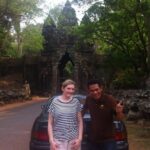
After Angkor Wat, the tour shifts to Angkor Thom, starting at the South Gate called Tonle Oum. This stop is shorter, about 30 minutes, but it’s an important reset point because it changes the vibe from palace-temple scale to city-grid scale.
You’ll learn how the city is organized: Angkor Thom has five gates—the south gate, the ghost gate (gate of the dead), the victory gate, the dei chhnang gate (north gate), and the killing gate. The city itself is described as 3 kilometres each side, which gives you perspective on how huge the footprint is.
This is also where the “short walk to ancient city” idea comes in. Even a brief walk here makes the later faces and terraces easier to understand, because you’re seeing how the monuments connect to the city’s layout.
The possible drawback? The South Gate stop is brief, so don’t expect long wandering time. This day is built for moving between points while the guide keeps the story tight.



Bayon Temple Faces: Seeing the Carvings with a Guide’s Lens
Next comes Bayon Temple, famous for the faces. You’ll view it from the outside and then go inside, with about 1 hour on site.
Bayon is where explanation pays off most. The faces are striking on their own, but the guide’s approach—how the carvings fit into religion and royal power—turns random stone details into something you can actually place in your mind.
In a recent group experience, the guide Dan was praised for being a strong storyteller, and that fits Bayon perfectly. These carvings can feel overwhelming without context, but with guidance you can focus on the features that matter.
You’ll probably walk more than you expect in this section. Build in your own pace: take photos, then pause to look carefully at the stone surfaces and the layout. That’s the difference between “I saw it” and “I got it.”
Baphuon, Elephant Terrace, Terrace of the Leper King, Royal Palace: The Stops That Round It Out
Between the South Gate and Ta Prohm, the tour description includes additional Angkor Thom-area monuments beyond Bayon. You’ll continue through Baphuon, the Elephant Terrace, the Terrace of the Leper King, and the Royal Palace.
Even if these stops aren’t listed with detailed time blocks, they matter because they fill out the story of Angkor Thom as a functioning royal center, not just a single famous temple. They also give you a rhythm break from the Bayon face theme, and they offer variety for photos.
The main consideration here is energy. The tour notes that if you have energy, you may also be taken around to another small temple. That’s a fun option, but only choose it if you can handle the added walking.
Ta Prohm Tree Temple: The Tomb Raider Scene in Real Life
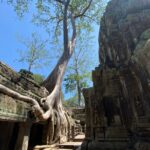
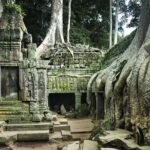
The final major stop is Ta Prohm, often called the tree temple and connected to the Tomb Raider nickname. You’ll see it from the outside and also inside, with about 1 hour on site.
This is the place where the setting does half the talking. Massive roots and thick tree growth wrap around stone, and you see the “nature taking back the ruins” effect in a way that feels immediate. It’s not just dramatic—it’s also a reminder of how time changes everything.
Because this is your last big temple stop, manage your pace. If you go too fast, you’ll end up with photos but not much memory. If you slow down for a few key shots and a careful look at the stonework, you’ll leave feeling like the day made sense.
Again, dress rules apply. Cover knees and shoulders, and keep your shoes sturdy for uneven ground and roots.
Practical Temple Tips: Dress, Shoes, and What to Carry
This tour explicitly says you must cover your knees and shoulders when entering temples. That’s not a “nice-to-have,” it’s a real entry rule. Plan your outfit before you get to Siem Reap so you don’t end up searching for something at the last minute.
Wear comfortable walking shoes. The tour involves walking between major monuments, plus you’ll likely have some time inside large temple complexes with steps and uneven surfaces.
Don’t bring valuables. Keep your day bag simple. If you carry a phone or camera, use it, then put it away before you shuffle between groups and viewpoints.
You’re also advised that most travelers can participate, so this is not described as a niche activity. Still, if you have mobility limits, consider that the itinerary has multiple temple entrances and internal viewing.
Should You Book This Tour? My call
Book this tour if you want the big Angkor hits—Angkor Wat, Bayon, and Ta Prohm—in one organized run with a guide who explains what the carvings and layout are doing. At $45, plus the required $37 temple fee, you’re paying for transport, timing, and interpretation, not just entry into temples.
You should also book if you like a guide with strong storytelling. The mention of Dan’s teaching style—tying together Cambodian history, politics, religions, and wall carvings—is exactly what turns these stone monuments into something you remember.
Skip or choose a slower option if you hate set schedules. This day is designed to move through multiple stops, and the last temple (Ta Prohm) is still a full experience, not a quick walk-by.
If you have limited time in Siem Reap and want a sensible, value-driven route, this is a solid pick.
FAQ
What is the total duration of the tour?
The tour runs about 5 to 7 hours.
Does the $45 price include temple admission?
No. Temple fee is $37 per person and is not included.
What’s included in the tour price?
You get hotel pickup and drop-off, an air-conditioned car, drinking water and cold towels, and a local English-speaking tour guide.
Are tips included for the guide and driver?
No. Tipping is recommended for the guide and driver.
What temples are visited during the tour?
You’ll visit Angkor Wat, Bayon, and Ta Prohm, plus you’ll also see the Angkor Thom South Gate and additional Angkor Thom-area monuments mentioned like Baphuon, Elephant Terrace, Terrace of the Leper King, and the Royal Palace.
How long is spent at each main temple?
Angkor Wat is about 3 hours, the South Gate stop is about 30 minutes, Bayon is about 1 hour, and Ta Prohm is about 1 hour.
Is there a group or private setup?
It’s described as private in the sense that only your group will participate, though it can still have group-discount structure.
Do I need special clothing for temple entry?
Yes. You must cover your knees and shoulders when entering temples.
What is the cancellation policy?
There’s free cancellation. You can cancel up to 24 hours in advance for a full refund. If you cancel less than 24 hours before, the amount paid is not refunded.