REVIEW · GOA
Heritage walk in Old Goa to relive the golden age of Velha Goa
Book on Viator →Operated by 5 Senses Walks · Bookable on Viator
Go back five centuries, one careful walk at a time. This Old Goa heritage walk traces 16th-century Velha Goa, when the city competed on the world stage and the Portuguese left serious architectural fingerprints. You’ll move site to site with a guide who connects the dots between victories, faith, and who built what.
I especially like how the route is built around landmark stories—from Viceroy Francisco da Gama’s memorial arch to Bom Jesus holding St. Francis Xavier’s mortal remains. I also like that it’s a small-group feel, with a maximum of 15 people, so questions don’t get lost in a crowd.
One consideration: it’s about three hours and relies on good weather, so if you’re hoping for a slow, flexible amble or you’re traveling on rainy days, plan your timing carefully.
In This Review
- Key things to know before you go
- Why this Old Goa heritage walk makes sense in 3 hours
- Where you meet and how the walking route flows
- Stop 1: Viceroy’s Arch and the Portuguese entry story (1599)
- Stop 2: St. Catherine Chapel (UNESCO, 1510) and the politics of a saint’s day
- Stop 3: Church of St. Francis of Assisi—mixed styles, one message
- Stop 4: Sé Cathedral and the Manueline victory theme
- Stop 5: Basilica of Bom Jesus—Baroque in India and St. Francis Xavier’s remains
- Stop 6: St. Augustine’s Tower—what a belfry can tell you
- Stop 7: Church of Our Lady of the Rosary—oldest survivor and fortress-like form
- Price and value: is $48 worth a 3-hour Old Goa walk?
- The guide factor: why narration can make (or break) a church tour
- Tips to plan your day around this walk
- Should you book this Old Goa heritage walk?
- FAQ
- How long is the Old Goa heritage walk?
- Where does the tour start and end?
- Is pick-up or drop-off included?
- What’s included in the ticket price?
- Is the entrance fee covered for the stops?
- How big is the group?
- Do I need a printed ticket?
- What happens if the weather is bad or I need to cancel?
Key things to know before you go
- Seven major church-and-monument stops in about 3 hours
- UNESCO sites at St. Catherine Chapel and Bom Jesus
- Portuguese history with concrete details, like dates and named rulers (Francisco da Gama, Alfonso de Albuquerque)
- Small group size (max 15) with a guide who keeps the pace of the story interesting
- Entrance charges are included, plus coffee and/or tea
- Mobile ticket, and it runs in good weather
Why this Old Goa heritage walk makes sense in 3 hours
Old Goa is one of those places where the buildings do the talking. The catch is that if you wander without context, you’ll see beautiful facades but miss why they matter. This walk fixes that fast by treating each stop like a chapter: who built it, why it was built, and what “victory” or devotion it was meant to signal.
I like that the tour is structured around key transitions in Portuguese rule. You start at an entry landmark (Viceroy’s Arch), then move through churches tied to major moments (St. Catherine’s Day victories), and you end at a church that still looks more like a fortress than a soft devotional space. You end with a sense of how power and religion sat side by side in 16th-century Velha Goa.
For you, that means less time guessing and more time understanding. You’ll get a guided way of looking at architecture—Tuscan outside, Baroque inside; Manueline styling; and the way windows and towers can be “defensive” in appearance even when the building’s purpose is spiritual.
You can also read our reviews of more tours and experiences in Goa.



Where you meet and how the walking route flows

The tour starts at Basilica of Bom Jesus, Old Goa Road, Goa 403402, and ends outside the Church of Our Lady of the Rosary (GW23+PX9, Old Goa). It’s not a round-trip loop. That matters because it changes how you’ll plan your last-mile transport after the walk.
There’s no pick-up or drop included, so you’ll want to get yourself to the start point efficiently. The good news: it’s near public transportation, which makes it easier to fit into a day without building your whole schedule around a driver.
Duration is listed at about 3 hours, and that’s the right length for this kind of route. You’ll cover a lot of ground, but it doesn’t stretch into a full half-day “slog.”
Stop 1: Viceroy’s Arch and the Portuguese entry story (1599)
Your first big “why are we starting here?” moment is Viceroy’s Arch. Erected in 1599 by Viceroy Francisco da Gama, it once marked the main street entry into Old Goa. It was also built as a memorial to Vasco da Gama, the famous explorer—and here’s the neat personal detail: Francisco was Vasco da Gama’s great grandson.
This is a smart opener because it sets the theme. You’re not just looking at monuments; you’re learning how the Portuguese framed their legitimacy. An arch isn’t only architecture—it’s propaganda in stone. When you know it was meant as a memorial to Vasco’s achievements, the structure reads differently.
A small timing note: this stop is about 20 minutes, so don’t expect a long pause. You’re meant to use it as a launchpad for the rest of the route.
Stop 2: St. Catherine Chapel (UNESCO, 1510) and the politics of a saint’s day
Next comes Chapel of St. Catherine of Alexandria, a UNESCO World Heritage Site. It was built by Alfonso de Albuquerque in 1510, right around a specific turning point: after he defeated the local Muslim ruler Adil Shah on St. Catherine’s Day, 25 November 1510.
What I find useful here is that the chapel’s design details are part of the story, not decoration. The chapel has rectangular window panes in an Old Portuguese style, described as dressed in mica shells. When your guide points out how those materials and design choices fit Portuguese aesthetics, the chapel starts to feel like an imported system—translated into local building life.
Another plus: it’s listed with free admission charges for this tour, so you won’t have to juggle ticket math while you’re trying to enjoy the walking rhythm.
Stop 3: Church of St. Francis of Assisi—mixed styles, one message
Then you’ll reach the Church of St. Francis of Assisi. Portuguese Franciscan friars landed in 1517 and established the church. The building is described as mixed construction style, with Tuscan order on the exteriors and a rich Baroque main altar featuring Corinthian features.
That mix matters. It’s a reminder that “Portuguese architecture” isn’t one single look. Instead, it’s a toolkit used over time, in different phases, with different emphasis depending on what was being built and who was paying for it.
The stop runs about 30 minutes, which is enough time to appreciate the contrast without feeling rushed. If you like noticing how styles shift from outside to inside, this is one of the more rewarding stops.






Stop 4: Sé Cathedral and the Manueline victory theme
Sé Cathedral is where the tour leans into the idea of architecture as celebration. It’s built in Manueline style, and the structure was intended to showcase Portuguese victory over an invading Muslim army in the early 16th century. That victory date is celebrated as the Feast of Saint Catherine—tying this stop back to the earlier St. Catherine story.
There’s also a 20th-century religious honor included in the narrative. The Pope Pius XII presented the cathedral with an honorary Golden Rose, and it’s placed on the tomb of Saint Francis Xavier inside the cathedral.
This stop is about 30 minutes. The risk with cathedrals is that you can end up staring at the scale without understanding it. Here, the “why it was built” frame helps you look past the obvious and catch what the building was designed to announce.
Stop 5: Basilica of Bom Jesus—Baroque in India and St. Francis Xavier’s remains
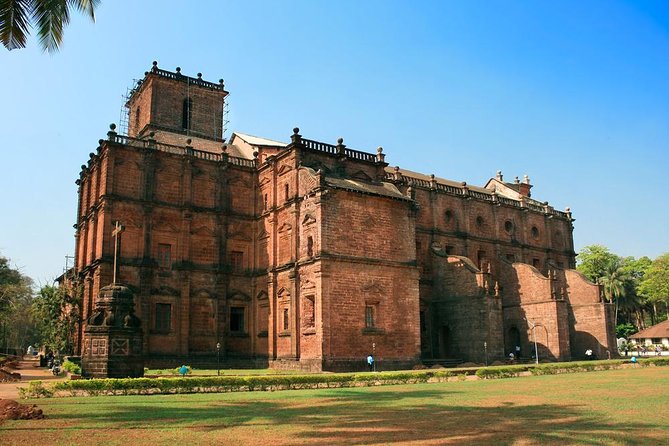
If you care about the big-ticket spiritual landmark of Old Goa, this is it: the Basilica of Bom Jesus. It’s also a UNESCO World Heritage Site and described as one of the finest examples of Baroque architecture in India.
This basilica is more than impressive walls. It holds the mortal remains of St. Francis Xavier. St. Francis Xavier, along with St. Ignatius Loyola, founded the Society of Jesus—so the site sits at the intersection of art, devotion, and major Christian history.
One detail I like because it adds a practical “how do they display sacred objects?” question: the Blessed Sacrament was earlier kept on the main altar under the statue of St. Ignatius, and now it’s preserved in a gold tabernacle.
Time here is about 30 minutes, which is enough to absorb the architecture and the meaning without turning it into a lecture-only stop.
Stop 6: St. Augustine’s Tower—what a belfry can tell you
At St. Augustine’s Tower, you get a different kind of sightline. Built in 1600, it was one of four towers of St. Augustine Church. The tower was meant to serve as a belfry, but what makes it interesting is the scale it hints at: the church it belonged to once had eight richly adorned chapels, four altars, and a convent with numerous cells.
This is one of those stops where a smaller structure becomes an information tool. You’re not looking at a full complex—you’re looking at a surviving piece that points to a larger religious machine that used to exist on the site.
The stop is about 20 minutes, which works well. It prevents the tower from becoming a detour, while still giving you enough context to appreciate why it’s still standing.
Stop 7: Church of Our Lady of the Rosary—oldest survivor and fortress-like form
The walk ends at Church of Our Lady of the Rosary, described as the oldest surviving church in Goa. It was connected to a vow: Afonso de Albuquerque took the vow while fighting the Islamic army of the Deccan Sultanate, as gratitude to Our Lady of Victory.
The standout visual detail is the church’s structure: it has high altitude windows and round towers, giving it a fortress-like look. That kind of design can surprise people who expect churches to be purely soft and ornamental. Here, the building looks like it’s built to withstand more than just weather.
The tour ends outside the church, so you’ll want to be mentally done with the “guided route” phase while you’re still at the end point. It’s a good finish because the final stop wraps the theme: faith expressed through architecture that also reflects conflict-era realities.
Price and value: is $48 worth a 3-hour Old Goa walk?
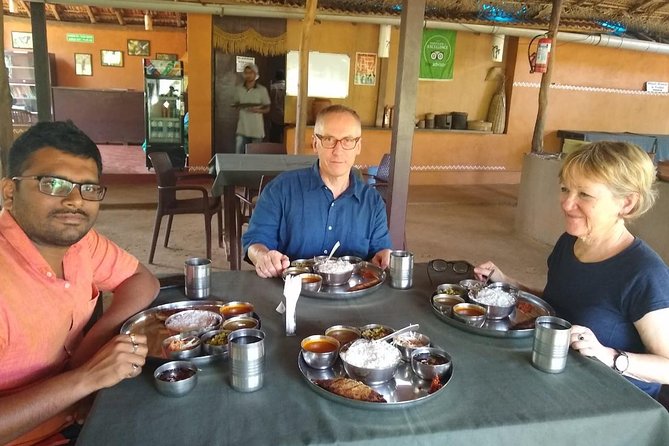
At $48 per person, you’re paying for a short guided window into a dense area of heritage. The best value comes from what’s included: a guide, entrance charges, and coffee and/or tea.
That matters because Old Goa’s church spaces aren’t just “look and leave.” You’re investing in interpretation, and interpretation is what turns a collection of buildings into a story you can repeat later. Also, because this is a small group with a maximum of 15 travelers, you’re less likely to feel like one voice in a crowd.
The tour also mentions group discounts, which can be useful if you’re traveling with friends or family. If you’re traveling solo, consider whether you’d otherwise pay for separate entry tickets and a guide to stitch everything together. In this case, the included entry charges help remove friction.
One more value check: the tour runs in about 3 hours and doesn’t include pick-up or drop. So your money goes into time at the sites and guidance—not into transportation logistics.
The guide factor: why narration can make (or break) a church tour
The most consistently praised element in the experience is the guide’s storytelling. Names that come up in past tours include Ram and Sawani, and both are described with a similar theme: they keep the group interested by explaining what you’re seeing and answering questions.
What you should look for in a guide for a route like this is the ability to connect:
- a specific date (like 1510) to a building,
- a victory (like the St. Catherine’s Day link) to design choices,
- and a named figure (like Pius XII in the Golden Rose story) to what’s actually inside.
When a guide does that well, the churches stop feeling like snapshots. They turn into a sequence you understand.
I also appreciate the “pace of attention” that guides like this tend to bring. The route has structured time windows at each site, so the narration has to be efficient. Strong guides handle that without rushing you past the details.
Tips to plan your day around this walk
- Choose good weather days. The experience notes it requires good weather, and if it’s canceled due to poor conditions you’ll be offered a different date or a full refund.
- Plan for an open-ended finish. The tour ends outside the last church, so arrange your next stop accordingly.
- Arrive at the meeting point, not just nearby. Start is at Basilica of Bom Jesus on Old Goa Road; don’t assume you can slide in from the other side streets.
- Use your mobile ticket. You won’t need a printed voucher in advance.
- Go with a question mindset. With a small group (up to 15), it’s a good chance to ask about Portuguese rule, saint-day connections, or why styles differ.
Should you book this Old Goa heritage walk?
I’d book it if you want the most meaningful way to see Old Goa in a short window. This is a solid pick when you care about why landmarks were built—not just how they look—and when you want entrance charges handled and coffee/tea included without extra legwork.
I might skip it if you prefer a fully unstructured wander with lots of downtime, because the tour is scheduled across seven stops in roughly three hours. Also, if your trip has only weather-risk days, keep Plan B in mind since the walk runs only under good conditions.
If your goal is a guided time-travel feel through Velha Goa’s Portuguese-era power and devotion, this one delivers.
FAQ
How long is the Old Goa heritage walk?
The tour lasts about 3 hours (approx.).
Where does the tour start and end?
It starts at Basilica of Bom Jesus, Old Goa Road, Goa 403402 and ends outside the Church of Our Lady of the Rosary (GW23+PX9, Old Goa).
Is pick-up or drop-off included?
No. Pick up and drop are not included.
What’s included in the ticket price?
The experience includes a guide, entrance charges, and coffee and/or tea.
Is the entrance fee covered for the stops?
Yes. Entrance charges are included.
How big is the group?
The group size is limited to a maximum of 15 travelers.
Do I need a printed ticket?
No. The tour includes a mobile ticket.
What happens if the weather is bad or I need to cancel?
The experience requires good weather. If canceled due to poor weather, you’ll be offered a different date or a full refund. You can cancel up to 24 hours in advance for a full refund.