REVIEW · ATHENS
Full Day Biblical Ancient Corinth Canal Mycenae Epidauvro Nafplio
Book on Viator →Operated by Yomadic.Tours & Transfers · Bookable on Viator
One day, three ancient worlds. You’ll move from the Corinth Canal to Bible-linked Corinth, then finish with Nafplio’s hilltop views and Venetian forts. I especially love the scriptural stop at Kenchreai (Paul’s vow-era visit) and the payoff walk up to Palamidi’s near-mythic 999 steps.
This day also has a practical edge: you’re chauffeured in comfort, with Wi‑Fi, A/C, and bottled water along the way, and drivers can tailor timing when you want a little more time at one spot. The main thing to consider is that entrance fees are not included, and you’ll want to budget extra for tickets and possible on-site waiting time at popular ruins.
In This Review
- Key highlights that make this day feel worth it
- The Corinth Canal: the “shortcut dream” that changed navigation
- Kenchreai and the Bible details you can actually place
- Ancient Corinth: where the Paul courtroom story meets the ruins
- Museum time: a useful reset before Mycenae
- Acrocorinth: the fortress view that explains the whole region
- Mycenae: Cyclopean walls, Lion Gate, and Agamemnon’s theater
- The Lion Gate: one of the most famous Mycenaean sculptures
- The Treasury of Atreus: the “how did they do that?” tomb
- The Lion Gate to Acropolis connection
- Nafplio’s Palamidi: 999 steps to a view worth the burn
- Nafplio old town: the sea-tavern lunch and the walkable streets
- Bourtzi: the fortress-islet you reach by boat fast
- Akronafplia and the Bavarian Lion: two reminders that Nafplio kept reinventing itself
- Epidauvro note: double-check what’s included for your date
- Price and logistics: what $277.09 really buys you
- So, is it worth booking for you?
Key highlights that make this day feel worth it
- Corinth Canal history you can see in minutes, including the idea of the diolkos and why ships once had to sail around the Peloponnese
- Kenchreai and Acts 18: Paul’s stop, the vow detail, and the name Phoebe tied to the local assembly
- Ancient Corinth’s Bema and Gallio: a Roman courtroom story you can picture while standing amid the ruins
- Mycenae’s Lion Gate and Treasury of Atreus: the photo spots that also explain how the Mycenaean world worked
- Nafplio from the top down: Palamidi views plus old-town wander time and a fortress-islet stop (Bourtzi)
The Corinth Canal: the “shortcut dream” that changed navigation
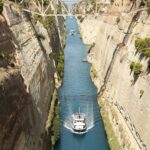
If you start your day at the Corinth Canal, you get an instant sense of why the Peloponnese matters. The canal cuts across the narrow isthmus, linking the Gulf of Corinth to the Saronic Gulf, and in a way it turns mainland Greece into something like an island.
What I like here is the story layer you get as you look at the waterway. This canal is late 19th century engineering, but the dream of connecting seas is much older—about a 2,000-year-old idea. Before the canal existed, ships often had to go the long way around the Peloponnese, adding roughly 185 nautical miles of sailing time.
You’ll also hear the name Periander, the tyrant of Corinth (602 BC), credited with conceiving the plan. Because digging was too hard back then, he’s linked to the diolkos: a stone road where ships could be transferred overland on wheeled platforms. Even if you don’t picture the whole process at first glance, it gives you a strong mental model for what the canal solved.
Practical note: this is a short stop. Use it to orient yourself—then you’ll be better able to understand why later sites like Acrocorinth and the fortresses of Nafplio were so strategically placed.
You can also read our reviews of more tours and experiences in Athens.

Kenchreai and the Bible details you can actually place
Kenchreai is one of those stops that makes your brain do a fun shift: it turns a Bible reference into a real location. This was the port town referenced in the Bible, and it’s tied to Acts 18:18, where Paul stops during his second missionary journey.
I like that the tour doesn’t treat the scripture as trivia. It gives you the context: Paul stays at Kenchreai long enough to shave his head as part of a vow, and the story also connects the place with Phoebe, mentioned in Paul’s letter to the Romans.
Even with a brief visit, you’ll likely come away with something useful: the ability to see the geography behind the text. Ports matter in early church history because they were movement hubs—people and ideas traveled through them.
If you’re traveling with someone who reads the Bible less literally, this stop still works. It’s a chance to talk about how ancient trade routes and religious travel lined up—same roads, different stories.
Ancient Corinth: where the Paul courtroom story meets the ruins
Ancient Corinth is packed, but it’s also organized enough that a driver’s explanations really help you avoid the feeling of wandering in circles. You’ll hit the big anchors connected to Paul’s time and the Roman period.
One standout is the Gallio story. During Paul’s stay in Corinth, tradition places his case before the proconsul Lucius Junius Gallio Annaeanus—often called Gallio. The heart of the story is that Gallio refused to judge what he saw as a religious dispute among Jews.
The tour ties that tradition to the Bema—a prominent elevated platform in the Roman forum area where city officials addressed the public. What makes this site interesting is how it evolved: the Bema was later transformed into a Christian church during the Byzantine period. So you’re not just looking at one layer—you’re looking at a place that repeatedly changed roles over centuries.
You’ll also see major Corinth features like:
- the Forum/Agora area, including the Bema podium concept
- the sense of scale of the civic zone, with the Agora described as a large rectangle with shops and temples
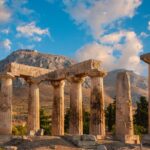
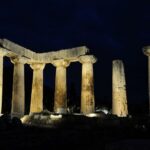
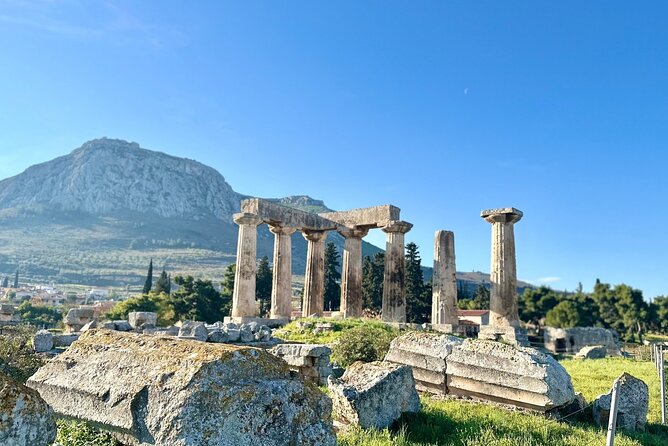
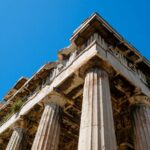
There are other stops tied to the city’s sacred side too, including the Temple of Apollo. This temple dates to around 550 BC and is described as one of the earliest Doric temples in the Peloponnese and Greek mainland, with monolithic columns noted as rare for that era. Even a quick look at the foundations and footprint helps you understand what “temple” meant here—this wasn’t a tiny shrine; it was a statement.
Time reality check: several Corinth stops are short. If you love Roman forums and early Christian transformation stories, plan to slow down at Bema-related points. If you just want the highlights for photos, you’ll still get plenty.
Museum time: a useful reset before Mycenae
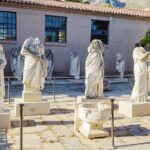
The Archaeological Museum of Ancient Corinth is a quick stop, but it can function like a translation device. It’s set up to display finds from excavations in and around the archaeological site, and it sits within the wider Ancient Corinth area.
Why that matters: when you’re jumping from ruins to another city, details can blur. A museum break helps you see objects that connect to what you’ve just been walking through. Even if your museum time is limited, you’ll usually come away with a stronger grasp of what was happening in the civic and religious zones you saw outside.
If you’re someone who hates rushing through rooms, use this as your “reset” moment. Look for the kinds of items that match the story you heard on-site—inscriptions, everyday objects, or fragments that explain how people lived with temples and public spaces around them.
Acrocorinth: the fortress view that explains the whole region
After Corinth’s urban ruins, you’ll go up toward Acrocorinth, the upper fortress area. It’s a huge rock formation overlooking ancient Corinth, and it’s the kind of place that makes sense the second you arrive—because the sightlines explain why control here meant control of routes.
Acrocorinth’s fortress was repeatedly used as a last defense line. That’s not a romantic statement; it’s a practical one. From this height, it commanded the Isthmus of Corinth, blocking entry by land into the Peloponnese peninsula.
When you look out from here, you can connect different parts of the day: why the canal mattered, why the city mattered, and why fortresses mattered even more than temples. It’s a shift from “what people built” to “what people guarded.”
If you’re sensitive to heights or steep walking, you might want to go at an easy pace. The site is dramatic, and your legs can feel the difference compared with the flatter Agora areas.


Mycenae: Cyclopean walls, Lion Gate, and Agamemnon’s theater
Mycenae is where this day starts to feel like a movie set—especially once you’re dealing with the fortified citadel and the surviving monumental pieces.
You’ll be looking at the fortified stronghold tied to the mythical and legendary King Agamemnon, but what makes the site powerful is the mix of myth and archaeology. The Mycenaean era (about 1600 BC to about 1100 BC) is the reason the name became “Mycenaean” for an entire period of Greek history.
At the peak described, the citadel and lower town could have had around 30,000 people across about 32 hectares. That scale matters. It explains why the stonework is so heavy-looking and why the walls are a big deal—they weren’t built for aesthetics.
The Lion Gate: one of the most famous Mycenaean sculptures
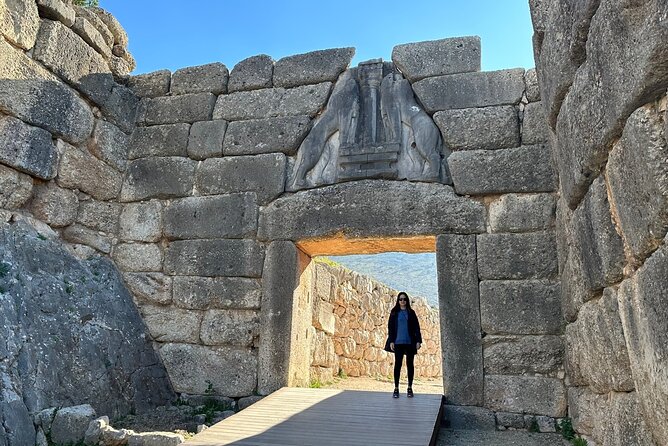
At Mycenae, the Lion Gate is the centerpiece you can’t miss. It’s described as the main entrance of the Bronze Age citadel and built around the 13th century BC, roughly 1250 BC. The relief sculpture above the entrance—two lionesses in a heraldic pose—earned the gate its name.
One very useful detail: it’s described as the sole surviving monumental piece of Mycenaean sculpture. It’s also singled out as the largest sculpture in the prehistoric Aegean. So yes, it’s a great photo—but it’s also one of the rare cases where a recognizable artwork survives in a way that matters to scholars.
The Treasury of Atreus: the “how did they do that?” tomb
Next, you’ll see the Treasury of Atreus, a beehive-shaped tholos tomb from about 1250 BC. The size of the entry area and the technical detail are what grab you: the stone lintel above the doorway is described as weighing about 120 tons, with very specific dimensions given for the doorway opening.
Even if you only pause briefly, try to do one thing: picture the engineering challenge. Then picture the intent—this wasn’t just a burial. It was power made physical.
The Lion Gate to Acropolis connection
You’ll also get the feel of the access route: Mycenae is accessed from the northwest through the Lion Gate, and the gate’s placement reinforces the idea that the approach to power was controlled.
Then you step around the acropolis area to see the surrounding Cyclopean walls—those massive, irregular stones used for fortification. They look almost too big for the people who had to build them, which is exactly why the walls are part of the “Mycenae experience.”
Nafplio’s Palamidi: 999 steps to a view worth the burn
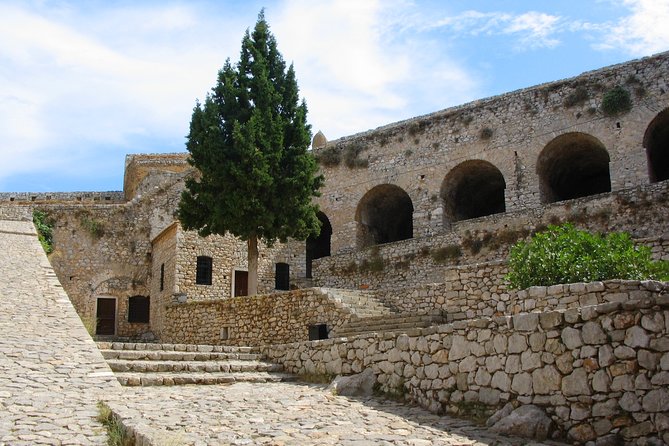
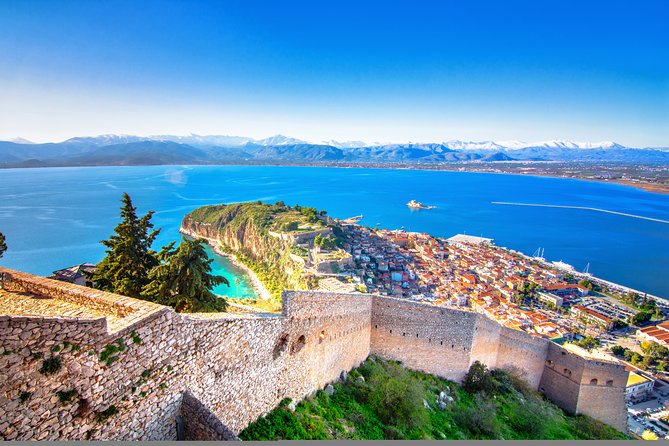
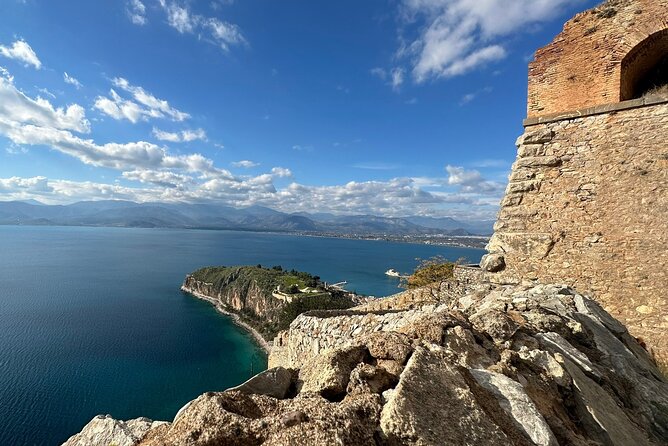
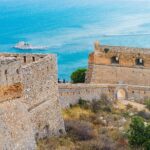
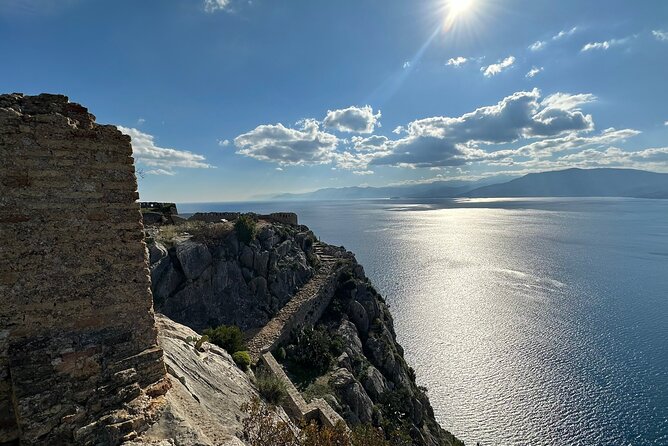
Nafplio is the kind of place where your brain wants to slow down, but Palamidi changes the game. The fortress sits on a 216-metre high hill, and it was built by the Venetians during their occupation period (1686–1715).
This is where the famous step story becomes real. You’ll hear that there are 913 steps from town to the fortress, while the local saying claims 999 steps to the top. Either number, you’ll get the same takeaway: this is a workout with a payoff.
I like Palamidi because it gives you a three-part experience at once:
- you get fortress views over the Argolic Gulf
- you see Nafplio city layout from above
- you understand why fortresses keep getting built in the same spots
If you’re going with kids or anyone who hates stairs, plan your pacing. This is not a gentle stroll. But if you enjoy viewpoints and you’re okay with a steady climb, it’s one of the best “vertical” payoff moments in the day.
Nafplio old town: the sea-tavern lunch and the walkable streets
After fortress time, Nafplio feels like a reward. The old town is described as cobbled streets with flowered balconies and a stepped layout that pulls you uphill in short segments.
You’ll also have time around Syntagma Square—described as a kind of zero point in the old town. From there, it’s easier to choose your walk and find the vibe you want, whether that’s quiet street corners or the more open square feel.
And yes, there’s lunch built into the plan: it’s at a traditional tavern by the sea. That part is smart. After hours of ruins, you want food that feels local and not like you’re grabbing something between stops.
If you’re the kind of traveler who likes to browse while walking, Nafplio is good for that. Even if you skip extra museum time elsewhere, the architecture and street angles give you something to keep your camera busy.
Bourtzi: the fortress-islet you reach by boat fast
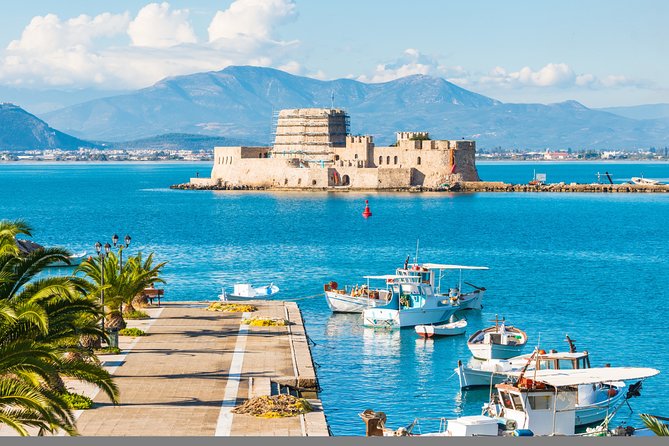
Bourtzi is a tiny-islet fortress stop that adds variety to the day. It was built by the Venetians in 1473 and later called Castello dello Soglio by the Venetians—Castle of the Throne. The name Bourtzi stuck later, linked to Ottoman usage meaning fortress.
What you’ll care about most: it’s described as a postcard setting, ideal for sunset. The timing on the ground isn’t spelled out in the details you have here, but the stop is framed as a short boat transfer—less than 10 minutes—and a straightforward payoff.
This is a good place to slow down for a few photos, then refocus on the last “rock and fort” bits of town.
Akronafplia and the Bavarian Lion: two reminders that Nafplio kept reinventing itself
Two quick stops give you a sense of Nafplio across time.
First is Acronafplia Fortress, also called Akronafplia. It’s the oldest part of the city, and until the 13th century it functioned as a town on its own. Later Venetians and Franks folded it into fortifications, and at one point it was even used as a prison. The Greek government later shifted its role again, building a hotel complex there because the views could serve tourism.
Then you’ll see the Lion of the Bavarians. It’s a huge lion carved into rock above Michael Iatrou Street. The sculptor named is Christian Ziegel, and it was commissioned by King Louis, father of Otto. The reason ties to the Bavarian soldiers who died in Nafplio in 1833 from typhoid.
Local lore adds another layer: the locals joke that something about the bitter things they ate caused it—an unofficial explanation that turns history into storytelling you can hear right where the monument sits.
Epidauvro note: double-check what’s included for your date
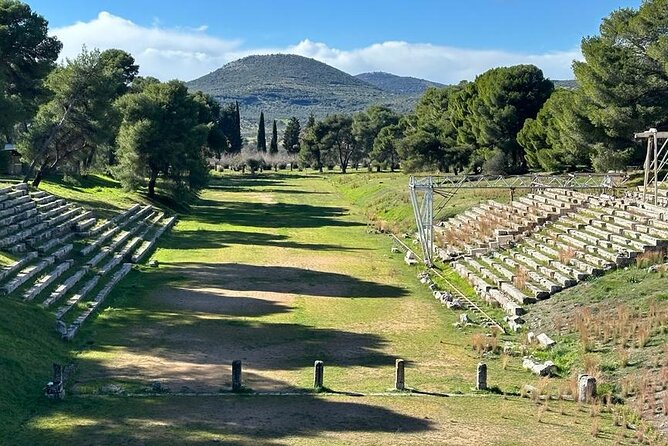
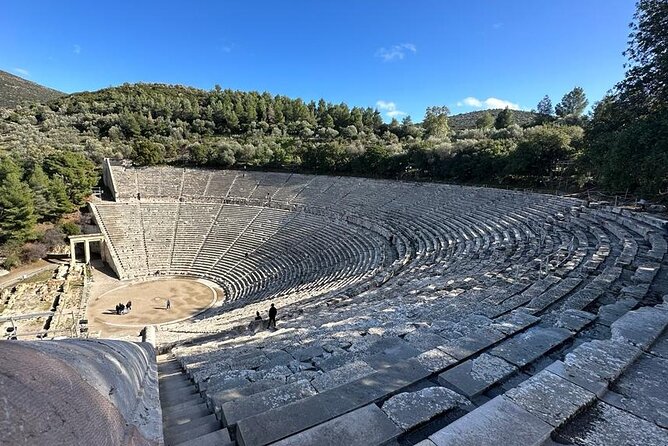
Your tour title includes Epidauvro, but the stop list you have here focuses on Corinth Canal, Corinth sites, Mycenae, and then Nafplio. Before you lock in your expectations, confirm whether Epidauvro is actually part of your specific departure for that day.
If Epidauvro is included for your booking, it would likely add another major ancient landmark. If not, you’re still getting a strong route through Corinth and Mycenae plus Nafplio, which is already a big day.
Price and logistics: what $277.09 really buys you
At $277.09 per person for about 9 to 10 hours, the value is mainly in the private transportation and the time-saving routing. You’re not wrestling public buses between distant archaeological zones. You’re also getting a vehicle with Wi‑Fi, A/C, and bottled water.
You’ll also get pickup and drop-off from your Athens hotel, Airbnb residence, or the port area. That convenience matters because this isn’t a short stroll city day; it’s a full Peloponnese push.
Group size affects the ride type: 1–3 people go in a luxurious sedan, while 4–7 ride in comfortable mini vans. Either way, the idea is the same—someone handles driving while you focus on stops.
Here’s what can change your total cost: entrance fees are not included, and lunch costs in Nafplio aren’t included either (even though the plan schedules lunch). Also, the data you have says a licensed guide to accompany you into archaeological sites isn’t included. Your driver provides extensive historical knowledge as part of the experience, but archaeological site tickets and any extra in-site guiding are separate.
One more practical point: this route hits popular ancient sites. Even with a private format, expect crowds in the big-name areas, especially at Mycenae and the best-known Corinth viewpoints. Your best defense is simple—listen for timing cues from your driver and don’t waste time deciding where to stand.
So, is it worth booking for you?
Book this if you want a single-day plan that covers the most recognizable highlights of the Corinth–Mycenae–Nafplio arc, and you like the idea of combining scripture-linked stops with fortress views and photogenic town time. It’s a strong fit for couples or small groups who value flexibility and a comfortable ride between distant sites.
Skip it (or at least confirm details) if you’re counting on entrance fees being covered, or if you strongly prefer a licensed guide inside archaeological sites. And if you want a guaranteed zero-mixing setup, it’s worth confirming in writing that your vehicle is only for your group for your departure.
If you’re the type who cares about context—why a platform mattered, why a fortress was placed there, why a gate and a tomb represent power—this is the kind of day that makes the drive feel like part of the story, not just a commute.